Graham greene, p.1
Graham Greene,
p.1



GRAHAM GREENE: THE LAST INTERVIEW AND OTHER CONVERSATIONS
Copyright © 2019 by Melville House Publishing
Introduction copyright © 2019 by John R. MacArthur
First Melville House printing: September 2019
“God, Literature, and So Forth” by Anthony Burgess, from Homage to Qwert Yuiop (Hutchinson); published in the USA as But Do Blondes Prefer Gentlemen? (McGraw-Hill), © The International Anthony Burgess Foundation.
“Graham Greene at Eighty” from Visiting Mrs. Nabokov And Other Excursions by Martin Amis, copyright © 1993 by Martin Amis. Used by permission of Harmony Books, an imprint of Random House, a division of Penguin Random House LLC. All rights reserved.
“Graham Greene at Eighty” from Visiting Mrs Nabokov And Other Excursions by Martin Amis. Published by Jonathan Cape. Reprinted by permission of The Random House Group Limited. © 1993.
“Graham Greene at Eighty” from Visiting Mrs. Nabokov And Other Excursions by Martin Amis, Copyright © 1993 Martin Amis. Reprinted by permission of Vintage Canada/Alfred A. Knopf Canada, a division of Penguin Random House Canada Limited. All rights reserved.
Interview with John Mortimer “I’m an angry old man, you see…” © The Spectator, reprinted with permission of The Spectator.
“The Last Interview” by John R. MacArthur. Copyright © 2019 by John R. MacArthur.
Melville House Publishing
46 John Street
Brooklyn, NY 11201
and
Suite 2000
16/18 Woodford Road
London E70HA
mhpbooks.com
@melvillehouse
Ebook ISBN 9781612198156
v5.4
a
CONTENTS
Cover
Title Page
Copyright
INTRODUCTION BY JOHN R. MACARTHUR
GOD, LITERATURE, AND SO FORTH
Interview with Anthony Burgess
The Observer, March 1980
GRAHAM GREENE AT EIGHTY
Interview with Martin Amis
The Observer, September 1984
“I’M AN ANGRY OLD MAN, YOU SEE”
Interview with John Mortimer
The Spectator, June 14, 1986
THE LAST INTERVIEW
Interview with John R. MacArthur,
October 1, 1990
About the Author
INTRODUCTION
JOHN R. MACARTHUR
The path to what was to be the last interview with Graham Greene began in the very opposite of a typical Greene setting: a suburban high school, during my senior year, in sheltered, temperate, and unromantic Winnetka, Illinois. Steeped as I am in the literary adulation for Graham Greene, the person as well as the celebrated writer—books by Gloria Emerson, Shirley Hazzard, Yvonne Cloetta, and Pico Iyer (plus Greene’s faithful biographer Norman Sherry), among others—I’m acutely aware that my initial experience of this virtuoso of conflicting morality and passionate attachment was stolidly, prosaically political. The first Greene novel I ever read was selected by my English teacher, Frank Wallace: The Quiet American, a story of “good intentions” gone haywire in 1950s Vietnam, and for me, then and now, the last word on America’s destructive hypocrisy in foreign policy. Therefore, I read the book as a political testament with the overlay of a plot; when I presented it to Mr. Wallace’s junior English class, I emphasized the policy critique above the literary allusions, the antiwar argument above the romantic ambiguities.
Of course The Quiet American is neither didactic nor anything resembling a political tract. The principal characters and the physical landscapes are as deeply rendered and subtle as they are in Greene’s best novels. But in 1973, my seventeen-year-old mind was fixated on the evils of the Vietnam War, which then seemed endless, so my thoughts ran, narrowly, to American foreign policy as interpreted by a famous storyteller who also happened to be quite anti-American. Vietnam was the great issue of the day—everyone in my world was affected by it, and almost everyone I knew growing up was angrily for it or against it—so Greene’s puncturing of American “innocence” abroad mattered more to me than any Catholic philosophizing, romantic tragedy, or symbolism. By the time I read The Quiet American, nearly two decades after its 1955 publication, plenty of other people had figured out that the United States of America wasn’t all it was cracked up to be—that its advertised idealism had a nasty underside, especially when it imposed itself beyond its borders. But Greene had very early on seen through American pretentions with uncanny precision and perception, even before the United States. took on the burden of “democratizing” Vietnam. His novel demolished the notion that American political or military intervention—in this case, against communism—should automatically be equated with virtue.
So if at first I may have missed the novelistic genius of Graham Greene, I was immediately struck by his brilliant political analysis. The love triangle Greene creates between Pyle (the dangerously earnest American do-gooder), Fowler (the world-weary British journalist who narrates the novel), and Phuong (the Vietnamese woman whom they both love) reveals cultural and temperamental differences that make for a wonderful story. However, in the character of Pyle, “age thirty-two, employed in the Economic Aid Mission,” we find the heart of what was wrong with the American character during the Cold War, and what is likely still present today. “An unmistakably young and unused face flung at us like a dart,” is how Fowler describes this Yankee archetype upon first meeting him. “With his gangly legs and his crew-cut and his wide campus gaze he seemed incapable of harm.” Described by Greene as “modest” and polite to a fault, Pyle is hostage to the theories of a writer named York Harding, who imagines a “Third Force” between Vietminh communism and French colonialism that might save the soul of Vietnam. Fowler disdains Pyle’s simpleminded solutions, but he nevertheless feels sympathy for the younger man.
Even today, all foreign-service officers and CIA agents should be required to read The Quiet American. Consider these two sentences from Fowler’s narrative: “Innocence always calls mutely for protection when we would be so much wiser to guard ourselves against it: innocence is like a dumb leper who has lost his bell, wandering the world, meaning no harm.” Had the best and the brightest of the 1950s and ’60s heeded Greene’s cautionary tale, we might have been spared the deaths of some fifty-eight thousand Americans, and we wouldn’t have the corpses of more than a million Vietnamese on our national conscience. By the time Pyle’s body turns up in a canal, murdered by unknown assailants, “he had been responsible for at least fifty deaths” through his undercover work promoting “democracy” for what surely is the CIA. “Grieved to report your son died a soldier’s death in cause of Democracy,” writes the US economic attaché to Pyle’s father. Grievous, indeed, that Greene’s novel was ignored at the highest policy levels in Washington.
It would take many more years for me to fully appreciate the depth and scope of Graham Greene’s talent for plumbing the darker regions of human emotion. To this day, I recommend him as a treatment for broken hearts and broken spirits, medication for the morally compromised, smelling salts for the suicidal. Of his conversion to Catholicism—he has often been called a “Catholic” novelist—I can only wonder at the cold comfort his writing may offer to the most beleaguered souls of the “true” church. Greene didn’t go in for happy endings or easy redemptions, as we know from the fates of the “whiskey priest” in The Power and the Glory and Henry Scobie in The Heart of the Matter.
To be sure, Greene’s novels are also highly entertaining and often quite humorous. He separated a category of his work into what he called “entertainments,” to distinguish them from his more “serious” books. But I never read a “serious” Graham Greene novel that didn’t grab me on some level. Suspense was one reason, but no one would call The Human Factor (an exciting espionage tale set in apartheid South Africa) a mere thriller. Greene had that rare quality found in only a few fiction writers (John Le Carré, Robert Harris, and Georges Simenon are three who come to mind) of telling such a powerful story that I would deliberately read slowly because I didn’t want it to end. Whether Graham Greene was “The Greatest English Writer of our Time,” as Penguin declared on the cover of its 1974 paperback edition of The Quiet American, isn’t something I’m interested in debating. But if forced to take a position, I think I would agree.
Once I got the hang of reading Greene, I became far more interested by the “human factor” in his stories than by the rights and wrongs of the political conflicts. Still, there is no escaping Greene’s political views, and his capacity for moral outrage against villainous politicians never seemed to flag. Nor did his capacity for disliking American foreign policy and certain Americans.
Nevertheless, one shouldn’t call Greene a conventional man of the Left. Remaining friendly with the British-spy-turned-traitor Kim Philby*, long after Philby’s flight to Moscow and the Soviet Union, didn’t make Greene a Communist dupe, or even a sympathizer. His famous quote from a 1967 letter protesting the imprisonment of two Soviet writers seems at the very least “somewhat ludicrous,” as his biographer Sherry puts it, and even a betrayal, as others felt, particularly those who could not forgive Philby for his defection: “This letter must in no way be regarded as an attack upon the Union. If I had to choose between life in the Soviet Union and life in the United States of America, I would certainly choose the Soviet Uni
on.” Certainly provocative sentences, as Sherry labors to point out, that need to be balanced with Greene’s lifelong frequent and courageous defenses of freedom of expression. Michael Shelden, another Greene biographer and a severe critic, wrote that because of The Quiet American, “the Soviets were easily misled into thinking that [Greene’s] anti-Americanism meant that he was sympathetic to communism.”
Yet Greene’s political engagement in the latter part of his life took on a remarkably personal tone that was in no way “Left” or anti-American. In 1982, he published J’Accuse, a pamphlet that denounced political and criminal corruption in Nice, France’s third largest city, near his home in Antibes. Greene was angered that the six-year-old daughter of Martine Cloetta (daughter of Greene’s French mistress, Yvonne) had been abducted by Martine’s ex-husband following an ugly divorce and despite the fact that Martine had been awarded custody of their two children. Outraged that the ex-husband had acted with impunity and the protection, Greene alleged, of Nice’s “milieu,” the celebrated English novelist appropriated the mantle of Émile Zola and went to war against the local establishment: the mafia-influenced political machine of Jacques Médecin, the mayor and longtime boss of Nice.
But before there was J’Accuse, before Greene flew to the aid of Martine Cloetta, there was Panama, another “political” cause in which personal friendship and love were paramount. Implausibly, perhaps, Greene had befriended Panama’s military dictator, Colonel Omar Torrijos, who had seized power in a bloodless coup in 1968 that overthrew President Arnulfo Arias. Having himself survived a coup attempt, Torrijos by 1976 was confident enough in his authority to invite the eminent writer to visit him in his Central American redoubt, then still a partial colony of the United States. The Canal Zone was the “sovereign” territory of Uncle Sam, and Torrijos was trying to wrest control, at long last, from the domineering and selfish Yankees.
Torrijos couldn’t have known, in the winter of 1976—the period when Greene received a mysterious invitation from an intermediary to visit Panama—that future President Jimmy Carter would be such an honest negotiating partner over the eventual transfer of the Canal Zone to Panama. But Torrijos must have had a good sense of public relations—Sherry thinks so—and even though he wasn’t a reader of Greene’s work, he figured that “Greene’s famous pen would make a mighty weapon” in negotiations with the United States. He also may have sensed that Greene was instinctively drawn to the underdog.
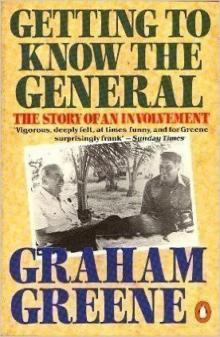
And this, I suppose, is where I came in. While I was vaguely aware that Greene had attended the signing of the Panama Canal treaty in Washington in June 1978—as a kind of temporary diplomat appointed by Torrijos for the occasion—I hadn’t thought much about Panama until I read Greene’s memoir of Torrijos, Getting to Know the General, when it was published in 1984. The book was elegiac, since Torrijos had died—some believe under suspicious circumstances—in a plane crash in 1981. By then I was a confirmed Greene partisan, having read just about everything he had ever written, including his collected movie reviews in The Spectator from the 1930s (Greene was actually sued for libel by Shirley Temple). Now, however, I was the publisher of Harper’s Magazine and emboldened to solicit famous writers I wanted to publish.
Graham Greene was a difficult proposition. I don’t recall why, but I waited until June 3, 1987 (the day before my thirty-first birthday), to make my first attempt, about four months before the great public figure turned eighty-three. I may have gotten his address in France from my friend Alexander Chancellor, formerly editor of The Spectator, and likewise a Greene admirer. Certainly I was challenged by my own assignment, and in my letter I admitted it: “Not being sure how to approach you, I’ve put off writing until I could come up with a pretext for a conversation that might extend beyond simple admiration.” Greene had already appeared in the pages of Harper’s with “The Blessing,” a short story published in the March 1966 issue. Greene’s last piece to appear in the magazine, in March 1972, was about the left-wing government of Chilean president Salvador Allende, an article that was typically prescient. Greene speculated on when the right-wing Chilean, or institutional American, reaction might begin, since the Nixon administration, then in power, was unhappy about a democratically elected Marxist leading a country with so much copper and so many American investments. “Will it take the form of an economic blockade by the United States or a disguised attack engineered by the CIA with the help of the Right extremists…?”
As it happened, Allende was overthrown the following year by “Right extremists” encouraged and condoned by Nixon’s national security adviser Henry Kissinger, if not directly aided by the CIA, which demonstrates again Greene’s talents as a journalist, as well as his left-wing and anti-American sympathies. But I couldn’t very well ask a renowned novelist in his eighties to meet to discuss a possible assignment. So I selected a pretext—I was planning a trip to the Soviet Union, then in the full bloom of Gorbachev’s glasnost, and would be heading to visit my mother in the south of France directly afterward, so I tried to intrigue him with a largely rhetorical question: “Logically [American right-wingers] should applaud Soviet liberalization, but glasnost is probably too great a threat to the sanctity of their ideological assumptions.” Why had glasnost “aroused such suspicion and hostility”? Perhaps this friend of Philby’s, this thorn in the side of the American establishment, could venture an explanation that I could use in an essay.
I vividly remember the thrill I felt when two weeks later a letter came back in an envelope postmarked Tonbridge, England. But when I read the note, I realized that I had underestimated Graham Greene in his dotage. “Many thanks for your letter,” he wrote. “I would be very interested in talking to you about your experiences in the Soviet Union, but I rather expect to be there myself in Siberia in August and it is doubtful whether I shall be here as I always try to escape from Antibes that month.” The beginning of a conversation, but I was disappointed. On the plus side, Greene still had plenty of energy. Notable was that the stationery carried Greene’s home address, La Residence des Fleurs, Avenue Pasteur, 06600 Antibes, in contradiction of the British postmark. Greene didn’t type and mail his own correspondence—he dictated letters into a tape recorder and sent the tapes to his sister, Elisabeth Dennys, who typed them and posted them. Encouraged by Greene’s announced travel plans to Siberia, I vowed to try again at a later date.
It turned out that Greene had already taken advantage of Gorbachev’s liberalization in 1986, when he visited Philby in Moscow. In 1987, he went twice (in February and again, apparently, after I wrote him), but there’s no record he went as far as Siberia. I subsequently dropped the matter, perhaps because I believed that Graham Greene was immortal.
And then came the main chance, clothed in American military aggression of the sort Greene detested. In January 1989, amid growing tension between Washington and Torrijos’s dictatorial successor, Panama’s strongman general Manuel Noriega, George H.W. Bush acceded to the White House after eight years of loyal service as vice president to the hawkish cold warrior Ronald Reagan. Though professing to want a “kinder, gentler” America, Bush in reality was every bit as blinkered as Reagan—a belligerent, intemperate, and violent man, utterly reactionary in his view that American military power was essential to enforcing moral codes and political order around the world. On December 20, 1989—allegedly to protect Americans in the Canal Zone after the killing of a US marine and other Panamanian-American military confrontations and to halt Noriega’s alleged drug trafficking and money laundering—President Bush launched a predawn invasion of Panama City by a force that would eventually number twenty-five thousand troops. During the initial assault, US rockets and tracer bullets set fire to a slum called El Chorillo, near Noriega’s headquarters, which likely caused dozens of people to die from burns and smoke inhalation. In the end, at least five hundred Panamanians, about half of them civilians (other credible organizations counted the dead at more than one thousand), perished in the wake of Operation Just Cause, which overthrew Noriega and restored American dominance over its longtime military and shipping subsidiary.
I assumed that Greene couldn’t be happy about the news, even if Noriega was a violent thug whom some suspected of engineering Torrijos’s death. So in early January 1990, about three weeks after the US invasion, I renewed my quest with a plea—for Greene to denounce Bush’s undeclared, unconstitutional, and gratuitous little war: “I imagine that you have a good deal to say about my government’s astonishingly jingoistic and retrogressive actions over the past few weeks.” No reply arrived, and after writing a follow-up letter I finally received a note signed by Elisabeth Denny’s daughter, Amanda Saunders, informing me that while Greene appreciated my interest, “his health won’t permit him to make any engagements for the time being.” I would learn later that Greene had been diagnosed with leukemia and was receiving regular blood transfusions. Elisabeth, Greene’s trusted sister and his secretary, had also become ill, felled by a stroke in February 1989. My odds of meeting her brother were lengthening.