The evening wolves, p.1
The Evening Wolves,
p.1
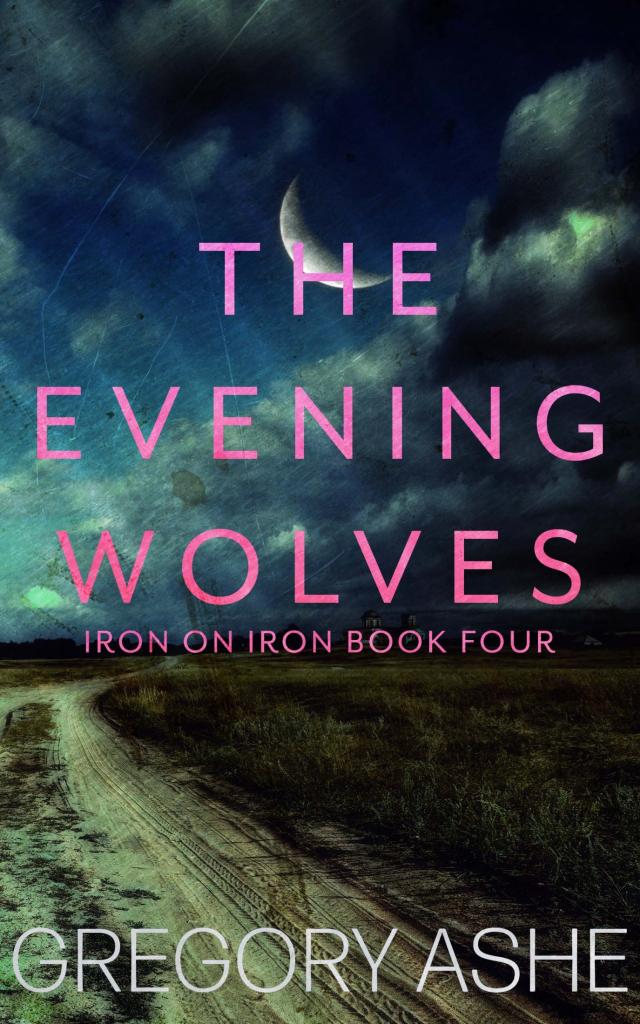


THE EVENING WOLVES
IRON ON IRON
BOOK FOUR
GREGORY ASHE
H&B
This is a work of fiction. Names, characters, places, and incidents either are the product of the author’s imagination or are used fictitiously, and any resemblance to actual persons, living or dead, business establishments, events, or locales is entirely coincidental.
The Evening Wolves
Copyright © 2024 Gregory Ashe
All rights reserved. No part of this book may be reproduced in any form, stored in any retrieval system, or transmitted in any form by any means—electronic, mechanical, photocopy, recording, or otherwise—without prior written permission of the publisher, except as provided by United States of America copyright law. For permission requests and all other inquiries, contact: contact@hodgkinandblount.com
Published by Hodgkin & Blount
https://www.hodgkinandblount.com/
contact@hodgkinandblount.com
Published 2024
Printed in the United States of America
Version 1.05
Trade Paperback ISBN: 978-1-63621-071-1
eBook ISBN: 978-1-63621-070-4
1
A broken jaw of Christmas lights sagged ahead of Emery Hazard, and he stepped gingerly over a fallen strand. Leaves, wet and slimy, made the sidewalk treacherous underfoot. A siren in the distance. A door slamming. The wind a wolf at his heels. Not a night for a private detective to be out in the cold, much less a nineteen-year-old girl.
Ahead, the dark funnel of the street ran until it dissolved. It was barely half past six, and he was in a city with millions. But it was winter, and on this block, half of the streetlights were dead. Maybe one house in three showed a scrap of yellow where curtains failed to seal a window adequately. It was late for this kind of work, which was better done in the daylight—among other reasons, because people in the camps tended to go to sleep once the sun went down. But he wanted to finish the job and go home, and so he kept walking. Not for the first time, he checked the revolver holstered under his arm.
The homeless encampment took shape gradually: a jumbled geometry of shadows at first, and then, by degrees, discrete shapes. A pallet leaning at a drunken angle. Plastic tarps rustling when a winter wind moved through them and made them billow. Armchairs lashed together with bungee cords. One improvised wall had been made from a pair of bifold doors. Cardboard, of course, the flattened boxes bending with moisture.
Encampment was a grandiose word, Emery decided, for a space that couldn’t have held more than a dozen people. The camp was on an empty lot in one of the inner Kansas City neighborhoods. On the next street, strip malls held massage parlors and tattoo artists and payday loan stores. Go a block in the other direction and you’d find tire yards and a Dollar General and a walk-in clinic with security grating over the windows and about a million signs that said WE DO NOT HAVE OPIOIDS. A hundred years ago, the Italianate brick homes here, with their mansard roofs and redbrick walls, had held the city’s well-to-do. Fifty years ago, they’d been less desirable as people with money fled to subdivisions and developments farther out. Thirty years ago, they’d been slated for urban renovation, only the money had mysteriously disappeared. Emery stepped over a used condom and thought maybe they should just clear everyone out and light a match. At least then people would be warm.
Huddled amidst the makeshift structures of the camp were a few tents, and at the curb, a Ford E-350, thirty years old minimum, with powder blue stripes and flat tires. Many of the camps Emery had visited over the day had been similar—a mixture of types of shelter. Like everyone else, people who were homeless had a pecking order. He ignored the van for now and turned toward the cluster of tents and shanties.
Pushing back his coat, he cleared the Blackhawk under his arm. The cold pressed against his chest. He called in a low voice, “Deanna?”
In some ways, Deanna Vance might have been considered lucky—or, at least, luckier than many people. She was alive, for one reason. For another, she had a family who cared for her. Parents who, until recently, sent her money. The last time, to a Western Union fifteen blocks from here. They’d known about her drug use. They hadn’t known where she was staying. When Emery had asked, her mother had said, With a friend, the way some people talked about Santa Claus.
As he moved into the encampment, he left the sidewalk behind. Instead of leaves, he now had to navigate a path trampled into the snow, which had melted and frozen again, and he went slowly to keep his balance. The stink of smoke met him—an acrid, unclean smell that suggested whatever they’d been burning had been soaked in chemicals. Pressure-treated lumber, maybe. Or some sort of synthetic. When the breeze bellied the tarps again, plastic rustling, he caught a whiff of soiled bodies, a hint of shit. Among the shanties, the darkness thickened, and he worked a flashlight out of his pocket and turned it on. “Deanna?”
“Fuck off!” a man’s voice barked back at him from a jumble of fruit crates.
Emery kept moving. The beam from his flashlight showed him the garbage littering the snow: flattened foam cups, an airplane bottle of Fireball, an empty pack of USA Gold, its cellophane unspooling to catch the light.
The wind picked up again. Emery’s ears stung. The tip of his nose. He blinked his eyes clear. How cold was it? The weather had been predicted to be in the 20s for tonight, but when the wind picked up…
“Deanna,” he called as he stepped over a lone, detached bicycle wheel.
The sound of a zipper came, and Emery shot his light in that direction. A man poked his head out of a tent. He had to be in his fifties, his face lined and puffy under graying stubble, and unless Emery missed his guess, his glasses were bifocals. He wore a Bass Pro hat, and then a hood pulled up over the hat. He stared at Emery for a long moment. Then he pointed in the direction Emery had been going and said, “She’s at the end.”
Emery nodded.
The man stared a little longer. Maybe it was a threat or a warning. Maybe it was simply curiosity. Maybe he’d been hitting his substance of choice.
When nothing more came, Emery continued in the direction he’d been walking. He glanced back once and, even in the dark, could make out the man’s head as a silhouette against the dark.
The tent at the end of the row was striped red and gray, and the beam of the flashlight penetrated the thin shell enough to suggest shadows on the other side. A two-tier shopping cart was tied to one tentpole, the top basket filled with a carry-on roller bag, the lower basket jammed with loose clothing. Plastic totes were stacked next to the cart; the topmost’s lid was broken, and inside lay what appeared to be nothing more than junk: wadded-up newspaper, a clear vinyl toiletry bag, a coaxial cable, more bungee cords.
Emery stood to one side of the tent’s flap and asked, “Deanna?”
No reply.
He shifted a little farther to the side and called again. After thirty seconds, he gripped one of the poles and jostled the tent. In a louder voice, he said, “I’m looking for Deanna Vance.”
“Shut up,” the first man called from far off, “or I’m going to shut you up!”
Emery counted to thirty again. He unzipped the tent, and the sound seemed unnaturally loud in the stillness. He braced himself for sudden movement, for outraged shouts, for drug-fueled confusion and rage. But nothing came.
She was too pale, dirty hair spilling over one cloudy eye, blueness at her lips. Then he registered the dirty water bottles piled around her, the improvised pallet of clothing, a sleeping bag twisted around her waist. The smell of loose bowels was stronger here, enough to make him rear back, draw in a lungful of the relatively cleaner air, the sharpness of it catching in his throat.
Before anything else, he drew on a pair of disposable gloves. Then he checked her pulse. Nothing. She was cold, and rigor had set in. Or perhaps, in this weather, her body was literally frozen. He would leave that to a forensic pathologist.
He found her purse, a glossy black thing that reminded him of patent leather shoes his mother had bought for him when he’d been a child. For church. It was split on one side, and the clasp had broken. No license. No ID of any kind. No cash. A tampon, a clump of dirty tissues, a stub of lipstick that she hadn’t used recently, if she had used it at all. A nearly empty bottle of hand sanitizer. He returned it all to the purse and set it next to her. Scabs marked one side of her face. No bruising that he could see. No visible wounds. No petechiae to indicate strangulation, although again, that would be a decision for the pathologist. No needles, no empty baggies. She was nineteen, and he thought she had died from the cold, alone, in the dark. He noticed distantly that the sirens had stopped.
The sound of a zipper came from behind Emery, then heavy breathing, footsteps. When he turned, it was the man in the Bass Pro hat. Over the hoodie, he wore a satin Royals jacket, and where his jeans rode up, Emery saw at least two layers of socks. He looked past Emery into the tent and shivered, his shoulders riding up.
“Did you know her?” Emery asked.
The man shrugged.
“Did you hear anything tonight? See anything?”
The man shook his head.
Emery nodded and took out his phone to call emergency services.
“You the friend?” the man asked.
As Emery raised the phone to his ear, one of the streetlights sparked and went out. “She didn’t have any friends.”
2
“It’s a simple request, Nico.” Emery pushed the pen and paper across the kitchen counter. “P
rint legibly, please.”
Nico sighed and looked at John. “Where are Noah and Rebeca? Why isn’t anyone bailing me out?”
It was the Sunday before Christmas, and in theory, everyone was still buoyed up with holiday cheer. That was probably because most of them hadn’t spent the previous day wading through clusters of human misery. Emery tried to focus on the present. The house was warm and full of light, with holiday decorations and the Christmas tree in pride of place (Colt had taken charge of decorating it), and sweet with the smell of baking cookies. Colt had been determined to frost sugar cookies, and now he stood watching the oven, turning the light on and off in thirty-second intervals, muttering to himself about the color of the Christmas tree-shaped cookies Evie and Lana had helped cut out. He’d set two timers. In between checking the cookies, he also spent a fair amount of time touching his hair, which had gotten long over the last few months, and which he was clearly dying for Nico to comment on. Biscuit waited patiently next to him, clearly under the belief that she would eventually be rewarded, either by accident or design.
“Out of town,” John said with a laugh. “You’re on your own.”
“He’s your husband.”
“Is it Chase again?” Emery asked.
Nico scowled. He was, in a turn of events that was becoming more and more common, dressed something like an adult: slim chinos, a wine-colored sweater, his shaggy hair longer than Emery remembered and spilling over his collar. “Shouldn’t you have him trained? Shouldn’t he know all his commands by now? Sit, stay, quiet.”
“We’ve been working on sit,” John-Henry said.
“Did you know you have to train a dog to speak before you can train it to be quiet?” Colt asked without looking away from the oven.
Groaning, Nico sank down onto the stool. “God, never mind.”
“You’re all hilarious,” Emery said, bumping Nico with the pen and paper. “Now write.”
“Is Nico telling you about his date?” Auggie asked as he came into the kitchen. His dark hair was dusted with snow, and he was shrugging out of a jacket that managed to look both expensive and understated at the same time. It went with the rest of the package: the soft brown of Auggie’s skin, the stunner smile, the fact that, even though he was shorter than average, he was ridiculously good-looking. A few months before, a killer had cut his face with a knife. Although the scar was still red and raised as it healed, thanks to a good plastic surgeon, it was only a fine line that ran straight down his cheek. When it healed completely, Emery guessed, it would barely be visible. Emery didn’t particularly care about that, though; he was looking forward to Auggie’s thirties, particularly to the first time Auggie saw a wrinkle.
At the words, Nico sat up, horror streaking across his face.
“It’s a date?” John asked.
“You said it was coffee,” Emery said.
This, apparently, was enough to break Colt’s attention—if only for a moment. He looked surprisingly hurt as he glanced at Nico and asked, “How old is he?”
Emery looked at his son.
Colt blushed, mumbled, “Hi, Mr. Lopez,” and turned his stare back to the oven.
“If necessary,” Emery said, “I can find his Social on my own, but I’ll need a first and last name. Date of birth would be ideal.”
“It’s not a date,” Nico said.
“I thought you were staying at his—” Admittedly a bit late, Auggie managed to stop. He put a hand to his neck as color rushed into his face, and then he said, “Um.”
Nico set his glare to murderous.
“You’re staying at his place?” Emery asked.
“Thank you, Auggie.”
“I thought they knew!”
“Just because he’s staying at his place,” Colt said, darting another big-eyed glance at Nico, “it doesn’t mean anything. Like, he could just sleep on the couch. Nico could sleep on the couch here, and it wouldn’t mean anything.”
Emery looked at his son a little longer this time. Face on fire, Colt took out his phone, apparently to set a third timer.
“I appreciate the concern—”
“It’s not concern. I simply don’t want to have to hire another administrative assistant and teach him how to file.”
“—but you’re not my boyfriend, and you’re not my brother, and you’re not my dad.”
“You don’t talk to your brother,” Emery said. “And for someone who’s not your dad, I spent a lot of time figuring out that ridiculous health insurance you have through the college.”
“Ok, yes, that was really cool of you. And I appreciate it. But Emery—and I mean this with a lot of love—it isn’t any of your business. You’re my—” He stopped, and the unfinished sentence hung in the air.
“Ex?” Emery said drily.
“Ree,” John murmured.
“Boss?”
“A little help,” Nico said to Auggie.
“Kind of like a general in an army, only you used to have sex with him. Oh, a sex general.”
Emery cut his gaze to Auggie.
A huge smirk spread across Auggie’s face. “I’ll go check on Theo and Lana.”
“Excellent idea, August.”
For whatever reason, that only made Auggie’s smile grow as he left the room. He even did a little jump at the end and slapped the top of the opening to the living room. It reminded Emery of something his son would have done. Or, for that matter, his husband.
“You’re my friend,” Nico said. “And I hope you know how much you mean to me. But I’m an adult, and when I’m ready for you to meet—”
“The word is interrogate,” John said.
“—someone I’m interested in, I’ll introduce you. Like an adult. Not because you were skulking outside his window and when he got a little aggressive, you started tapping on the window and saying, ‘Hey, you!’”
“Oh my God,” Colt muttered.
“He peed himself.”
John gaped at Emery.
“Don’t act so shocked.” Emery settled himself at the counter again. “Very well, Nico. If you refuse to tell me, I can’t force you.”
“And I don’t want you following me.”
Emery snorted.
“Promise.”
“Why would I follow you?”
“Emery Hazard.”
For a moment, Emery considered a lie. Then outrage won out. “For heaven’s sake, Nico, it’s for your own good. The one in July was running a meth lab and had three restraining orders filed against him!”
Nico shoved the pen and paper across the counter. A blush swam under his coppery skin, but his jaw was set. “Promise.”
“Fine. If you’re going to be a fool, I can’t stop you.”
“I want to hear the words.”
“I. Promise.”
The kitchen seemed hotter than it had a few minutes ago, and Emery threw the blank sheet of paper in the recycling and tossed the pen back into the junk drawer.
“I appreciate it, Em,” Nico said in a quieter voice. “Really.”
Emery made a noncommittal noise.
“What are you guys doing?” John asked, breaking the quiet that followed. “Dinner?”
The look of strain on Nico’s face almost made Emery take pity on him. When he spoke, he directed the words toward the floor. “He said it’s a surprise.”
John gave Emery a warning look, and he put his hands up in surrender.
Another silence stretched out between them. Then Nico said, with a little too much enthusiasm, “What about you, Colt? How are things with Ashley?”
Colt shrugged and turned on the light in the oven.
“Is that a good shrug or a bad shrug?”
Nico got another shrug in reply, but then Colt said, “Good, I guess.”
“It seems like they’re going really good,” John said. “They exchanged their gifts early, and Ash got Colt a necklace for Christmas.”
A smile transfigured Colt’s face, and he forgot about the oven. “It’s real gold,” he said, fishing it out from under his shirt. “And it’s exactly like the one I wanted, and he didn’t even ask me or anything.”
Nico inspected the chain, smiling. “These are really in right now. Ash did a good job.”
Colt was blushing now—and some of that, Emery had to admit, was the proximity to Nico, the undiluted attention—and he nodded. When Nico released the chain, he tucked it back under the borrowed (stolen) Blues sweatshirt that had once been John’s.