Wicked, p.49
Wicked,
p.49


Let me digress here, a little informally, and show you proof that what I was suggesting at the beginning, about how the native childhood power of appropriation and play became a nascent impulse toward building stories of my own.
One of my heroes, although I come to him warily, is Hans Christian Andersen. I own a small autographed visiting card of the great teller of tales, and he has written—in Danish of course—across the bottom of it, “Life is the most wonderful of all fairy tales.”
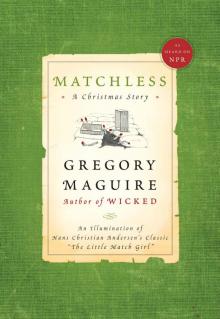
Knowing that he felt this way, I turned to Andersen when I was asked by NPR to write for them a holiday tale for airing on All Things Considered on December 25 some years ago. “Give it the Maguire treatment,” they said, by which I assumed they meant “Indulge in a little petty larceny as you are known to do, steal someone’s story and make something new out of it.” I never mind playing with other people’s material, so I came up with an idea called “Matchless.”
The thing is, one of Andersen’s best-known tales used to be “The Little Match Girl,” but in our secular age the idea of a child freezing to death and going up to heaven to be with a beloved relative seems just as likely to be the delusion of suffering as it does the transcendence of a fairy tale. And “The Little Match Girl,” interestingly, has no magic in it but for the visions the girl sees as she lights her final matches. So what could I do to honor Andersen’s original tale but return to it some of the charm of the original, as it might have seemed to certain audiences in decades and centuries past?
I mention this to show you how a thief like me works, which, when dealing with something as combustible as someone else’s famous material, can be summed up like this: very very cautiously indeed.
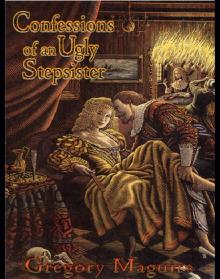
To play with the material of L. Frank Baum, which in many ways was full of useful inconsistencies and moral conundrums, was relatively child’s play. Backyard theatrics. Likewise, in tussling with Grimm and Perrault in Mirror Mirror and Confessions of an Ugly Stepsister, respectively, I could insinuate my own narrative energies into the hollows that characterize these ancient tales, hollows both accommodating and even provocative, existing because bits of original narrative have worn away or lost their meaning.
The truth is, I have written about fantasy and fairy tales so often that ambushing the topic again gives me a case of existential pyemia, known in medical circles as the collywobbles. I don’t want to repeat what I’ve said before. By now it’s a matter of filling in gaps. And isn’t that what writing is, generally? I relish this quote from E. M. Forster, an apologetic about the limits and the range of his writing life: “My defense at any Last Judgment would be, ‘I was trying to connect up and use all the fragments I was born with.’ ”
I have to share this, too, by Albert Camus, with apologies for the gendered slant of its expression. Camus wrote: “A man’s work is nothing but this slow trek to rediscover, through the detours of art, those two or three great and simple images in whose presence his heart first opened.” (The New Yorker, September 24, 2018, page 65.)
I bet most of our hearts opened wide with the hope for an experience of life that was larger than our own private prison of here and now. That’s how we became readers, after all. Think of a map in whose corners you may still be able to make out the phrase HIC SUNT DRACONES. I’ve given you this map, now, to hold in your mind during the rest of this commentary. I’ve called it “The World at Hand, the World Next Door,” and it might have been subtitled, “Methods and Motivations of a Fantasy Writer.” But you don’t need a subtitle or an outline. You just need to imagine this map in your hands.
Not long ago someone posed this question: Have you ever gotten stuck in your work, and what has unstuck you—or are you still stuck?
This is equivalent to saying, Do you always know where you’re going? And how to get back? Do you have a map? What is your method?
I suffered writer’s block once. Almost two decades ago I had a couple of adopted children under the age of three at home, and another on the way. Now, at the point I’m talking about, eighteen years ago, I’d finally had a little luck in my career. After years of shantytown insolvency, I found that my first two adult novels were selling well enough to make my agent wish he’d taken a healthier percentage. But risking the adoption of three infants from overseas on the incomes of a freelance writer and artist—my then boyfriend, now husband, is a painter—still kept me up at night. I don’t know what the medical profession would call this condition. The British sometimes call it financial embarrassment.
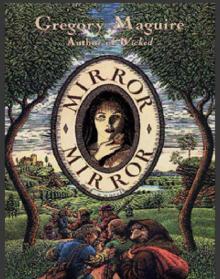
I was about to launch into my fourth adult novel, called Mirror Mirror. I hadn’t wanted to become known as the adult writer who rewrites fairy tales for grown-ups, but my publisher insisted. It’s all about “branding,” she said. So throughout that summer, eighteen years ago, I’d been mulling over the story of Snow White. Was this famous fairy tale only about that truth that all glamorous parents must give way in time to even more glamorous youth? What is it that the young must relinquish in order to grow up? What are the costs of maturity?
I had decided to set my Snow White–ish tale of the education of innocence at a time in which the culture at large was doing something analogous to what a teenager does—to wit, enjoying the convulsions of sudden-onset pubescence. I would set my tale at the end of the quattrocento, in the hills of Tuscany, circa 1500, when the peasant culture and old beliefs were being driven underground by the sexy thrill of the latest thing, called the Renaissance.
Cesare Borgia, thought to be the inspiration for Machiavelli’s The Prince, could figure. So could his sister, the notorious Lucrezia Borgia. She could feature as the wicked stepmother. After all, she had a reputation for poisoning her enemies, so making a deadly apple for her ravishing new stepdaughter would be right in her wheelhouse. The dwarves in their humble outpost, the queen in her lofty tower—from their separate vantages, they would represent the pagan past and the brittle, intelligent future. I hadn’t wanted to write this book, really, but once I got an organizing concept up and running, I was ready to go. It might be fun. I could do it.
Then, in the week I was to begin chapter one, the day broke that we have come to know as 9/11. I rushed to the day care to collect our boys, and like everyone else, I filled up the car with gas, bought bottled water. I kept my voice level and scraped away tears with the side of my hand before the boys could notice. Aware again of the separate outposts of brutal reality and of innocence.
And, like most writers I knew, I found I couldn’t work. My only instance of writer’s block was imposed not from creative drought but from the world’s clamor. I needed to work—for cash, for steadiness, as if my ability to write a novel about Snow White in Tuscany would somehow prove that the terrorists hadn’t won—but I couldn’t. I could only listen to NPR and read the Times. And it wasn’t only my own work that seemed self-indulgent. I couldn’t read any fiction. Fiction couldn’t hold a metaphoric candle to the literal firestorm of reality.
So I put my work aside. I had to go on a book tour anyway, for an adult novel just out—a novel called Lost. No one in October 2001 wanted to read a novel called Lost. I didn’t want to promote it, either. But my commitments required me to leave my family and get on an airplane. I was clutching my first prescription of Xanax, for that month who could bear to take to the air unfortified with chemicals or booze or a rosary? As we advanced down the runway for takeoff of the flight to Denver, I was sure I’d never see my boys again. I would die of terror at the first moment of gentle turbulence.
I emerged from my Xanax haze somewhere over the Mississippi and the plane landed without incident. At the Tattered Cover, Denver’s great independent bookstore, my host told me that visiting authors were invited to select any book off the shelves as a present. On the bestseller list that season, alongside Islam by Karen Armstrong and Twin Towers by Angus Kress Gillespie and The New Jackals by Simon Reeve, were The Corrections by Jonathan Franzen and The Best Loved Poems of Jacqueline Kennedy Onassis. Somehow, nothing appealed. My doctor had told me I was suffering from anhedonia, an inability to experience pleasure.
Then I happened upon the Fantasy and Science Fiction corridor. I picked up Tolkien’s The Fellowship of the Ring. I know it’s downright heretical for any modern fantasy writer to confess that Tolkien, meh—I can take it or leave it. While I had read the Lord of the Rings cycle in high school, I’d preferred the books of my younger childhood—the Alice books, the Narnia books, Peter Pan and The Wizard of Oz, the fairy tales of Grimm and Andersen.
Yet perhaps because I had read it once with only passing interest, the first volume of the Lord of the Rings found its way into my carry-on the next morning when I left Denver, heading for San Francisco. I can’t pretend I read on the plane—I was on Day 2 of my Xanax addiction—but sometime in the next few days I opened the volume and tiptoed back into Middle-earth.
Here is a quote from my journal at the time—October 25, 2001, in a hotel in Seattle:
Tolkien never a great favorite, but in these days post 11 Sept., the clear sentimental language, the palpable but distant danger, the broad otherness of it—it is the first thing I’ve been able to read, and Lord, how I’ve lost myself in it.
What I found in Tolkien was just exactly what I needed. In Middle-earth I could experience my sense of dread without being paralyzed by it. In approaching Middle-earth, the World Next Door, I could afford to feel shattered. And I had to feel shattered—in order not to be shattered. Is this part of what the Greeks meant by catharsis? I think so.
[Haldir said:] The world is indeed full of peril, and in it there are many dark places; but still there is much that is fair, and though in all lands love is now mixed with grief, it grows perhaps the greater. (“Lothlórien” chapter)
One of my articles of faith is a phrase from the British moral philosopher Roger Scruton. He said: “The consolation of the imaginary is not imaginary consolation.” He might as well have been talking about reading Tolkien during the time of Al Qaeda.
I finished that book tour and went home to my family. I was refreshed by my revived trust in the consolations of fiction and fantasy. So I tried again to find a way into the world of fairy tale, which when metastasized into novel-length can turn into a fantasy.
Snow White, best known for the Grimm version as coarsened and jollied up by Disney, has an ancestor in an Italian version, I recalled—is it in Il Pentamerone, perhaps—in which the seven dwarves are seven thieves who live under a hill. Like the seven dwarves, I became a hunter-gatherer. Theft. Appropriation. I went about collecting fragments.
I heard a story on NPR about how mercury poisoning can cause paranoia. I found out that some Renaissance guild or other actually made bathtubs out of hammered mercury. Then I remembered that some early mirrors were panes of glass laid over backing boards painted with mercury, the better to amplify mercury’s silvery reflective power. Could Lucrezia Borgia’s belief that the mirror was talking to her derive in part from paranoia brought on by mercury poisoning?
I read about the redoubtable Ms. Borgia and her father, Pope Alexander VI, and the supposed pornographic parties and orgies held in the halls of the Vatican. What a contrast to Snow White and her purity! The biographies of the Borgias all suggested that most of what is bruited about Lucrezia is what we would today call “fake news,” circulated by the enemies of the powerful clan. Still, the gossip is saucy enough that I’m not about to repeat it here.
I considered the name Snow White in the Italian language—I forget how it translates—not usefully. But with a little torsion, Snow White in Spanish becomes Bianca de Nevada. So her family was Spanish—how and why had they come to Italy by the end of the fifteenth century? Oh, yes—Torquemada and the expulsion of Sephardic Jews from Spain. Her family had gone underground in Italy—hiding in plain sight.
Going underground—what else was underground in Tuscany besides robber dwarves? The graves of the pre-Romans, the Etruscans. I read up on the myth of Proserpina, a sort of Persephone with a makeover, and remembered that her crime is also eating a forbidden fruit, and being hauled underground was her punishment. Being exiled, being underground—Bilbo Baggins in Gollum’s cave, Persephone, the Lost Boys, Alice herself . . .
Are you getting dizzy? My market basket was near to overflowing. But did the fragments connect? They could be made to connect, by bashing them, the way kids can force the wrong puzzle piece into place. But cramming doesn’t solve the problem of shapeliness, and shapeliness in a story, even a fantasy or a fairy tale, I think, depends first and last on following a map.
Meanwhile, my journal from that year tells me that one day at home my toddler son Luke asked me why I was crying. Some buildings fell down in New York City, I said, and some people were hurt. His response was, “Do you still love me?”
I was still blocked. I couldn’t write a word of narrative. So, having to do something, I decided to draft a series of poetic monologues. They were intended as a prewriting exercise, but almost immediately I found I could channel my post-9/11 trauma into language about characters dealing with their own traumas. Here are a few of the profiles that helped me break my one and only experience of writer’s block.
The first one, of Bianca de Nevada, was written with the thought of those who threw themselves off the burning towers of the World Trade Center, perhaps some of them trying to pray, hoping for miracles. These are the first words of fiction, if you will, I could write after 9/11.
I am a girl who did no wrong.
I walked this side of Gesù when I could.
I kept an angel in my apron pocket.
I do not think it did me any good.
As soon as I had something in the voice of the innocent, Lucrezia Borgia brashed forward, as if it were open mike night at a poetry slam, declaring this:
I am a woman who slept with my father the Pope.
They say I did, at least, and so does he.
And who am I to make of the Pope a liar?
And who is he to make a liar of me?
A character wandering in from any one of half a dozen fairy tales, a gooseboy who is also a simpleton, speaks a couplet bereft of punctuation:
I am a gooseboy or am I a goose
The margin that separates us is loose
And the dwarves, who in their poem almost have a common voice like a Greek chorus, are true denizens of the underground: they are some outmoded race of creatures who will not survive the bright gimlet focus of the Enlightenment—but perhaps only go deeper underground:
I am a rock and my brothers are rocks
And our family name is patience.
Grinding our lunch can take most of a decade.
Step soft, we’re a beach; step firmly, a landslide.
. . . .
We are the bed on which the world rests,
Its criminal patience, its bleak stupid patience.
By serving up smaller blocks of text that could represent my characters as well as my distress about that moment in history, autumn 2001, I could do two things at once: I could trick myself back into writing, and I could approach horror, loss, grief, and the mystery of cruelty.
In talking about method, perhaps I’ve gone on too long about a single book. I promised to talk about fairy tales and fantasy. How about this: Why is “Snow White” a fairy tale and Mirror Mirror a fantasy?
There are several possibilities that only tangentially have to do with length. One difference between fairy tales and fantasy might be in the inevitability of the narrative. If you remember your high school chemistry, you may recall the single-displacement reaction versus the class clown’s shenanigans with vials of chemicals and a Bunsen burner. A fairy tale is the former—once the story is started, only one set of things can happen. It is a parable of sorts. There is only one outcome. The seed dropped on stony ground can only die. The seed dropped on fertile ground can only prosper. The seed sold to Jack can only become a mighty beanstalk. In a fantasy, however, anything can happen to a seed “dropped by a skybird halfway through the wood.” A fairy tale is Aesop, and a fantasy is Emily Dickinson’s “fairer house” of possibility. (And incidentally I love to remember that fairer has two meanings: more lovely—and also more just.)
Another difference between fairy tales and fantasy is the question of audience. People commonly give newborn babies board books of Mother Goose. Only at a christening to which he wasn’t invited would Dr. Frankenstein bring a board book called Baby’s First Kafka. The very young need fairy tales; while if a fantasy is built on possibility, some of those possibilities will be unsightly. Fantasy is unsettling, anarchic—anyway, it might be.
Thirdly, a fairy tale happens to a generic character. The nameless stereotyped character is usually straight out of central casting, the generic Beauty, or Belle, or Jack, which is as good as calling someone Boy, or Kid, or Buddy, or Miss. Such a stock character exchanges one thing for another—usually his or her charitable gesture for the chance to prosper through the help of magic. Likewise, the stereotyped villain is nameless in a fairy tale. The wolf, the king, the stepmother. But once the witch becomes Elphaba Thropp, she is in a fantasy. Once the wise woman in the woods becomes Mary Poppins, we have left the realm of cautionary tale and entered the more subtle, ambiguous arena of fantasy. There is no longer an inevitable through line to the narrative, but constellations of possibilities.
Another journal entry: June 11, 2003, about the formal out-of-town opening of the musical Wicked at the Curran Theater in San Francisco. I wrote:
Last night—maybe not yet the triumph it could be, but very solid, very funny, very moving in parts. . . . The audience is so with that witch. Oh, let it rip: it was a huge high. I had tears leaking from my eyes through the bottom of the first act and a good deal through the second. As I said to an interviewer recently . . . the idea of personal fame or recognition as an artist means only so much to me, though I’m glad I can pay my bills—what is really satisfying, or will be if it happens, is to name an anonymous person, and make her human.