The manor, p.1
The Manor,
p.1
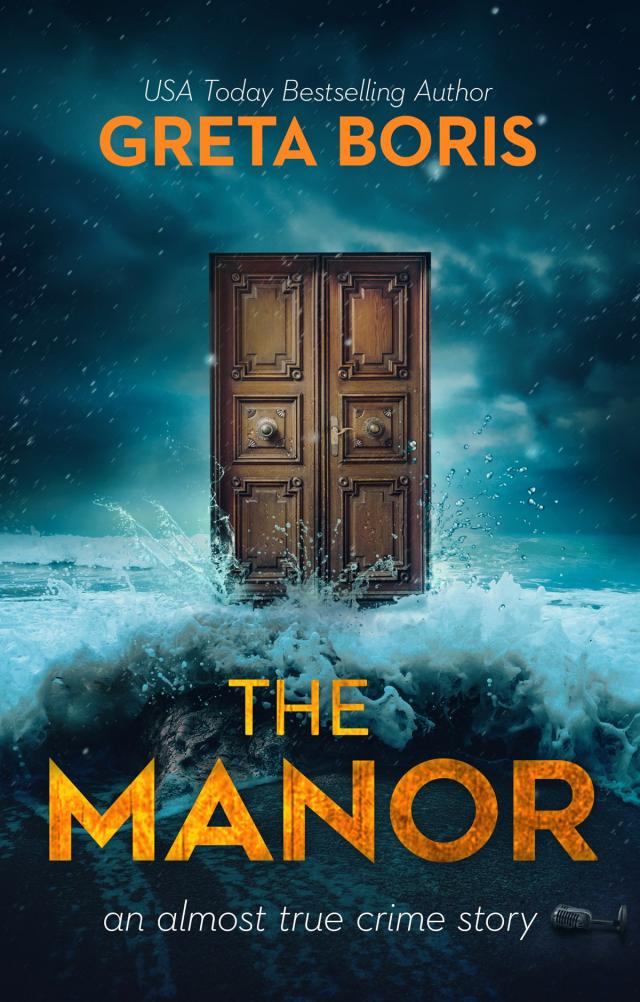


The Manor
An Almost True Crime Story
Greta Boris
Copyright © 2025 by Greta Boris
All rights reserved.
No part of this book may be reproduced in any form or by any electronic or mechanical means, including information storage and retrieval systems, without written permission from the author, except for the use of brief quotations in a book review.
Parts of this book were previously published as The Key of Greed.
Cover Design by ambient studios
Print ISBN 978-1-957529-33-2
Ebook ISBN 978-1-957529-34-9
Library of Congress Control Number 2024942773
This book is a work of fiction. Names, characters, businesses, places, events, locations, and incidents are either the product of the author’s imagination or used in a fictitious manner. Any resemblance to actual persons, living or dead, or actual events, is purely coincidental. Brand names are the property of respective companies; author and publisher hold no claim.
Contents
Part I
season five; intro
Part II
season five; episode one
June 3 journal entry
6.1.2
6.1.3
6.1.4
6.1.5
6.1.6
June 4 journal entry
Part III
season six; episode two
6.2.2
6.2.3
6.2.4
June 5 journal entry
6.2.5
6.2.6
Part IV
season six; episode three
6.3.2
6.3.3
6.3.4
6.3.5
June 6 journal entry
Part V
season six; episode four
6.4.2
June 7 journal entry
6.4.3
6.4.4
6.4.5
6.4.6
Part VI
season six; episode five
6.5.2
6.5.3
June 9 journal entry
6.5.4
6.5.5
6.5.6
Part VII
season six; episode six
6.6.2
June 13 journal entry
6.6.3
6.6.4
6.6.5
season six; episode seven
6.7.2
6.7.3
6.7.4
6.7.5
seven months later
If you enjoyed this book…
Also by Greta Boris
Part One
MURDERS UNDER THE SUN
SEASON SIX; INTRO
* * *
MOLLY: Welcome to Murders Under the Sun, a podcast that explores a series of unusual crimes that have occurred in sunny Southern California.
I’m Molly Shure, your host. For the past five years I’ve worked as a journalist at a local news outlet. Stories of murder and mayhem come across my desk weekly, if not daily. However, one day last March, I noticed something startling.
There seemed to be a connection between several crimes that transpired over a five-year period—seven crimes to be precise. What connected them? Location for one. They all took place within a twenty-mile radius of each other, but that alone wasn’t significant.
The thing that pinged in my brain was that many of the people at the center of these crimes knew each other. Not the criminals, which would be an obvious thread, but the victims. I know, I know, six degrees of separation. Didn’t I already say the crimes took place in a twenty-mile radius? But we’re not talking six degrees here. It’s more like one degree.
You’ll see if you stick with me for all seven seasons of the show, the crimes circle back around. The people you meet in the first season play a role in Season Seven’s story.
Am I imagining things? Is the connection real? Is there one mastermind behind the crimes? Or are they linked by some kind of social, psychological or even spiritual force? I’m afraid that’s something you’ll have to decide for yourself.
Each season, I’ll do a deep dive into just one of these stories. You’ll hear from the people who were victimized, and listen to transcripts of journal entries, memoirs, and letters from others who were involved—sometimes the criminals themselves—and behind the scenes information you can’t get anywhere else.
So, get out your sunglasses. We’re pulling back the curtains and letting the light shine on some of Orange County’s darkest mysteries.
Part Two
MURDERS UNDER THE SUN
SEASON SIX; EPISODE ONE
* * *
MOLLY: Welcome to Season Six of Murders Under the Sun. This is Molly Shure, your host.
I have to say this season, which I’ve entitled The Manor, may be the most compelling or unsettling or fascinating yet. I’m not sure which adjective fits best. Maybe all of them. I was absolutely riveted by Willow’s story.
When we wrapped up last season, we learned that she was dating a man named Jonathan. He seemed perfect. He was handsome, fun, had a good career, came from a wealthy family, and liked to cook. Even Booker, Willow’s dad, liked him.
As this season opens, we discover that Willow is pregnant with Jonathan’s child. Their relationship went from casual to serious in a matter of months. We also discover that his father has died, which may require Jonathan to get more involved in his family’s affairs.
As long time listeners know, in every season I interview the person impacted most by the crimes. In this case, it’s Willow. I then take my notes and create a third person narrative in which I attempt to put you, the listener, into their mind, so you see what they see and feel what they feel. This script goes through several edits. It bounces back and forth between me and the individual until we’re both happy with it. So, I can safely say you will experience the story as close to the way they experienced it as is possible.
Each season, I also include missives from another character that reveal things that have happened behind the scenes. Listeners often don’t know who that individual is until our hero knows.
In The Manor, I’ve included entries from a journal Willow finds in Episode Four. She won’t know who the writer of the journal is until the very end, however, so neither will we. The diary is hard to hear in spots, but it becomes very important as the story unfolds. It provides clues that help Willow—and us—uncover the who and why behind the crimes.
I decided to start off today with a short journal entry. The style it’s written in is very different to Willow’s matter-of-fact communication. It’s a little poetic, and definitely imaginative and evocative. I feel like this first entry sets the tone for the entire season.
JUNE 3
My cage is gilded. Like the proverbial songbird, I have everything I could ever want except freedom. The meals I’m served are delicious. The pictures on my walls, expensive. Even my bedding is the highest thread count money can buy. I don’t care. All I want is out.
If that’s going to happen, I’m going to have to engineer it, cleverly, creatively, because they don’t want me to leave. They believe, wrongly, that I’m too valuable.
I’ve always thought being a commodity was something to be aspired to. Who doesn’t wish to be treasured? I now know that coin has two sides, heads and tails. Heads is the winning side of the equation, the only side most of us have ever imagined. It’s the only side I’d ever considered.
Coins can be spent, or they can be hoarded. When they’re spent, they circulate, moving from admiring hand to admiring hand. When they’re hoarded, they’re locked in a secret place, held for some future event—real or imagined. Heads, I win. Tails, I lose. Tails has become my life.
MOLLY: The writer’s words make me feel so claustrophobic. Did I mention in past seasons that I don’t like close spaces? Maybe that’s why this season impacted me so personally, but enough about me. Let’s get into Willow’s narrative.
6.1.2
Everyone wore black but Willow. How stupid could she be? Even the universe seemed to understand the need for adherence to tradition. The day wore gloom like a shroud, the priest’s white collar neon against its leaden sky. She tugged her green blazer tighter around herself, hoping to cover more of her cream silk blouse.
Willow cast a glance at Jonathan, who stood granite still next to her. His blue eyes, almost iridescent in the colorless surroundings, were dry, his square jaw tense. Only the pallor of his face gave any indication of his emotion.
Her gaze roamed the rest of the group gathered at the grave. They were as somber as their clothing, each appearing deep in their own dark thoughts, expressions unreadable. Not even Hamish’s widow or daughter shed a tear. Note to self—the wealthy do their crying in private.
She’d expected this event to be well attended. Hamish Lauder was rich if not loved, and well-known with Orange County’s elite, but his funeral was as tight-fisted as the man had been. She squeezed Jonathan’s arm in sympathy.
The priest nodded his head toward Gerry, Hamish’s widow. Jonathan tugged Willow’s hand, dropped it, then hurried to his mother’s side. Gerry and Jonathan walked together toward the yawning hole in the otherwise perfectly groomed lawn. Was Willow supposed to follow?
She stood still, wishing she’d worn something more appropriate, wishing she knew what to do. Gerry plucked a white rose from a vase balanced in the grass and let it fall into the abyss. Jonathan glanced at Willow over his shoulder and widened his eyes meaningfully before doing the same, and after a quiet moment the two resumed their places.
He leaned toward Willow when he reached her side and lowered his voice. “Why didn’t you come with me?”
Her answer was a small shake of her head. She didn’t go because she’d have felt like a Protestant taking communion at a Catholic mass. This wasn’t her clan, her people. They’d had this discussion before, and he hadn’t understood her feelings then. Now wasn’t the time to tackle the topic again.
A rustle of fabric drew Willow’s attention. Chloe, Jonathan’s beautiful twin, and her fiancé walked up the grassy aisle to the grave. Mat and Chloe had only been engaged a month and a half longer than Willow and Jonathan, but he seemed perfectly at ease with the Lauders.
Of course, he came from money. Mateo Avila was a pediatrician. He was also descended from one of the first Spanish families of Southern California. Willow was descended from a Kentucky firefighter and a chef who specialized in Southern-French fusion food.
Mat’s suit probably cost more than she paid for three months’ rent, and Chloe’s outfit—a flowing, black dress with an edge of lace peeking from the hem—more than Willow’s annual grocery budget. They looked cool, sophisticated, and elegant. Willow shifted her weight until her pilling gray wool slacks were halfway hidden behind Jonathan.
After Chloe and Mat paid their respects, Hamish’s brother, his rabbit-faced wife, and his pale daughter each threw a rose into the dark hole. Willow had met them briefly at Sunset House the month before. The daughter’s name was Ophelia. Willow remembered it because the Shakespearean association was so apt. According to Jonathan, Ophelia was the crazy cousin every family had and tried to hide.
The final flower was tossed into the grave by an olive-skinned, hollow-eyed woman of about Willow’s age. The priest stood, gave a short homily, prayed, then announced the reception following at Sunset House. Nobody gave a eulogy.
Months ago, when Willow’s father, Booker, was in the hospital, fear had painted visions of his death and burial in her mind. If her father had died—thank God he hadn’t—she was sure the entire fire department would have turned out for the funeral, along with the neighborhood and the entire large, unruly, extended Wells family. Eulogies would go on for hours amid tears and laughter and toasts to his memory.
Hamish’s family turned away from the gravesite without a backwards glance. Everyone made their way toward the cars parked along the cemetery’s narrow streets. The clicking of their hard-soled shoes echoed in the holy hush. Willow gripped Jonathan’s arm. She’d been a bit off-balance lately, and her kitten heels weren’t helping. “How are you doing?” she asked under her breath.
Jonathan inhaled deeply as if he were going to speak then tightened his lips. He’d been opaque since his father’s death. A neutral veil had slid over his face, masking his emotions. The death had been a surprise, but not a shock. After Hamish’s first stroke, the doctor had warned the family another could come at any time. Willow had assumed Jonathan was ready for this eventuality, but now she wasn’t sure. Grief, anger, denial, whatever he was feeling was a mystery to her. He wasn’t sharing.
“I think I should call an Uber,” Willow said.
Jonathan stopped walking and stared at her. “Why on earth would you do that?”
“I don’t belong in the limo.”
“Of course you do. You’re my fiancée.”
“I’m not family yet.”
He placed his free hand on the small bump hidden beneath her blazer. “You’re carrying family. That’s more than Mat can say.” He removed his hand quickly, tugged her arm, and began walking again. Willow tumbled forward, righted herself, and hurried along beside him.
She might be carrying Hamish’s grandchild, but nobody knew it. They’d planned to break the news to Jonathan’s parents when Hamish recovered from his first stroke. He’d died before they’d had the chance, and it didn’t seem appropriate to bring it up now.
They reached the limo after Gerry, Chloe, and Mat had been seated. As Willow slid inside, she noticed the woman who’d thrown the last rose unlocking a car across the narrow road. Tears streaked her face. Someone had loved Hamish, then. Who was she?
The fifteen-minute ride from San Juan Capistrano to San Clemente was silent and awkward. It was a relief when the wrought iron gates of Sunset House opened and the parade of vehicles processed through. A staff of four, all dressed in somber black uniforms, met them at the top of the circular drive. It looked like a scene from Downton Abbey.
The first time Willow had visited Sunset House, she’d been in awe. She hadn’t been raised in poverty, far from it. Her upbringing was very middle class. She hadn’t had everything she’d wanted, but she’d had everything she’d needed. Sunset House was a fairy tale. It was full of things you never knew you should want until you saw them.
House was a misnomer, though. It was an estate, a manor. Behind its high walls and locked gates were several buildings. The main house, or hacienda, was horseshoe shaped—a two story building encircling a courtyard of fountains and flowers. There was also a botanical conservatory, two unattached garages that housed six to ten cars each, a pool house, a garden shed that could sleep a family of five, and a library. The property bordered the Pacific Ocean, hence its name. The sunset view was breathtaking.
“What can I do to help?” she asked Jonathan after they dropped their coats into the arms of a dark-haired maid.
He tipped his head to one side, a quizzical expression on his perfectly proportioned face. “We have plenty of help.”
She thought she heard condescension in his tone and felt her own face redden. This new Jonathan, the man he became when he was with his family, was foreign to her. Where was the fun foodie she’d sampled beer with in San Diego? Where was the man who’d been nervous about barbecuing ribs for her parents? “I, I know, but—”
He squeezed her shoulders. “You’re very thoughtful, babe, but mother has it covered. It’s what she does. Just be your beautiful self.”
Willow decided not to interpret that comment to mean she wasn’t good for anything but being attractive. She gave Jonathan an anemic smile and followed him from the front hall into the great room.
If the group of mourners seemed small at the gravesite, it appeared minuscule in the cavernous space. The ceiling was low, but the room went on for miles. A fire crackled at its far end. Long tables festooned with overflowing vases of flowers were filled with enough food for fifteen times the number of guests. Heavy, antique Spanish furniture beckoned the weary into their deeply cushioned embrace. Gerry Lauder had handled things beautifully, Jonathan was correct.
“Jonathan. Willow.” Ophelia floated toward them under a cloud of platinum hair. “How are you holding up? It was a lovely ceremony, don’t you think? Uncle Ham would have approved.” She gave Jonathan a tight smile, then kissed Willow’s cheeks with featherlight kisses.
Lovely wasn’t how Willow would have described the funeral. Distinguished, staid, stoic, all seemed more appropriate. She didn’t argue, however. Ophelia had already moved on to other topics.
“I’m sure Gerry appreciates you staying at the house. Chloe means well, but she’s—”
Willow watched as Jonathan’s sister glided up behind Ophelia and wondered if she should somehow warn his cousin.