

Gunning for ho 25th anni.., p.4
Gunning For Ho, 25th Anniversary Edition,
p.4
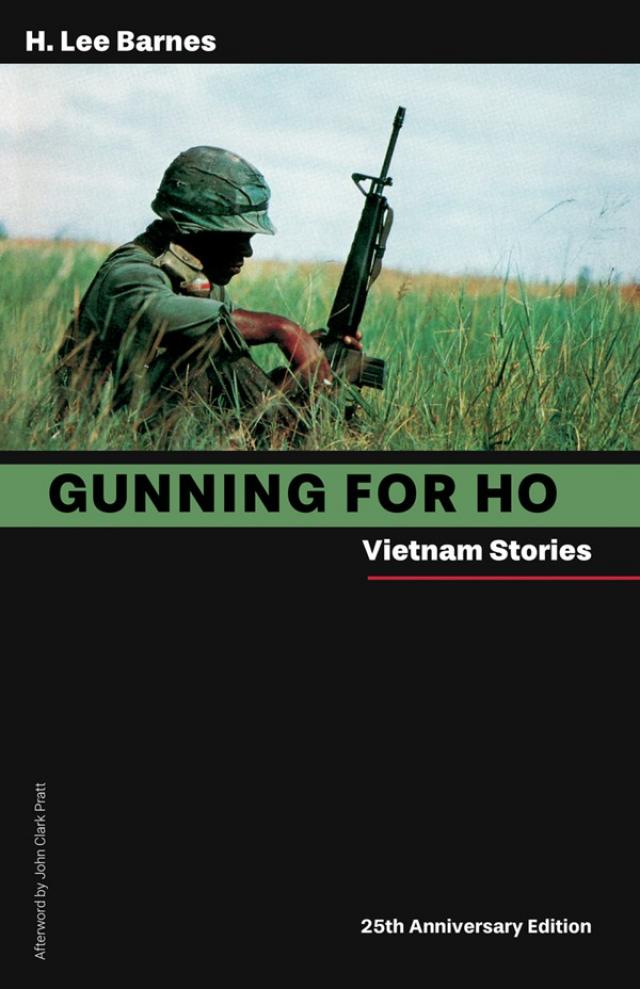


The fog was hypnotic. His eyelids drooped from staring into the dark. To keep alert, he tried to recall every movie he’d ever seen. That proved tiring. In the distance five-hundred-pounders fell to the west somewhere over Laos—Operation Arc Light. He counted explosions, seven in all, dropped from B-52s so high up their engines were silent.
“Think strong,” Stonehands muttered as he cranked the field phone to make a commo check. The voice on the other end seemed uninterested. Anything out there? No, nothing, except fog and . . . noise. “Nothin,” Stonehands reported. That was the last human sound for another hour.
He remembered on the march to Hai Drong—the ARVN soldiers taking over the prisoner, slapping him and shouting. The vc, helpless to protect himself, had balled up on the road. His enemies had merely seen that as an excuse to use their feet. They kicked the side of his head as if practicing soccer, straight on or sideways with an instep or backward with a heel. His squad mates, ashamed that they’d handed over the prisoner, talked about shooting the ARVN soldiers and turning the prisoner loose, but that was crazy talk. Still, they were ashamed and angry. You could see it in their eyes. Perhaps that’s why they’d taken to the boy so quickly—to make up for their shame.
But the boy had only brought them more shame.
Stonehands turned his attention to what he thought was movement in the fog, a swirling current. A wind. A sound. No, just imagination. Think strong. Stay awake. As a boy he’d memorized facts about presidents. His mother had bragged on him to her friends, called him into the kitchen to show the skeptics, especially Naomi Slaughter, the county Mrs. Know-Everybody’s-Business. Learning facts was a trick, but they’d stayed with him. Now he drew them up—Andrew Jackson, birth date March 15, wife’s name, wife’s name?—Martha, no, Mary. Rachel—yes. He wasn’t sure. Jackson followed by Van Buren. No one knows about him. Next was Polk. No, Tyler.
Again he heard something moving out there and had a passing desire to call out. He choked the rifle stock and listened but heard only his breathing and an annoying sound in his ears. At first he couldn’t figure out where the sound came from, then realized it was in his head. It was an alarm.
As the animal circled, Stonehands, keeping his M-16 ready, wheeled in time with it. They moved cautiously like strangers testing a dance step. It coughed, not a cough exactly, but something low and guttural that seemed to vibrate out of its belly. Each of its circles became more attenuated. Though it was mostly shadow, Stonehands could identify its shoulders and head with small half-moon ears.
He checked the safety, squeezed the rifle, thinking to use it—just shoot—but that presented a different set of problems. The enemy was somewhere, a regiment perhaps, hiding in shadows, or maybe they were ghosts. Maybe all of this is shadows or, as Howkert had said, shadows without essence. If so, what is the tiger? Doesn’t matter. He’d see if a ghost bleeds.
Stonehands listened to its breathing, fast and heavy, double his, perhaps. He appealed to God that it didn’t make sense, his dying this way, that he’d come to fight Charley, and if he was to die, Charley should do it. Strong mind, he thought, and over and over repeated in his mind the names—Tyler, Polk, Taylor; Tyler, Polk, Taylor—like a novena.
On tottering knees, he stood up to look around. He considered calling the command bunker. And say what? There’s a tiger here. What could anyone do? They’d just think he was scared. Hell, he was.
It seemed gone—a hallucination, perhaps, as the boy might have been, and the prisoner and Howkert. What did Smitty say? Felt he wasn’t alone. Alone gets to you. Causes delusions. A man could imagine anything, seeing what he’d seen in ’Nam. That boy might show up in the Smokies looking for a home, another shadow looking for its essence.
The animal materialized again, a vague shadow. Some initial fear gone, Stonehands waited, rifle at the ready. Twice it stepped from and retreated back into the fog. The third time it appeared, Stonehands felt an odd sensation, a knowing of sorts. He knew for certain it was a she as she circled.
He recalled an encounter on a trail near his home when a similar sensation had guided him to a deer trapped between a tree and a boulder. He’d talked to the deer gently to slow its struggle until he’d freed it. It’d stood, dazed, its bulblike eyes staring at Stonehands until he flapped his arms and sent it scurrying into the brush. But this was no whitetail deer, or even an ordinary tiger.
The beast stopped. Stonehands tried to swallow, but his mouth and throat had gone dry on him. She inched so close that the feel of her was on his flesh. His skin prickled as if she’d brushed him. Be quick, be strong. Taylor, Fillmore . . . Pierce. Her flicking tail grazed his cheek. It was like the touch of an icicle. In the next instant, before he could recover, she retreated into the fog.
He took a deep breath and blinked. He recalled the tale of the princess, the restless spirit of the tiger that must leave one behind to assure a way into heaven. No legend. Just an animal, a big one. He wondered why he hadn’t shot her and if she would return. He didn’t have to speculate on that question long. All he had to do was look over his shoulder.
She faced him, opened her broad mouth and bared her teeth without uttering a sound. How she’d gotten behind him he had no idea, but she was there, and he could taste the animal smell, see the vapor of her breath swirl in the fog. He pointed the M-16 at the triangle-shaped nose, which was so close now he could see it move as she breathed. What amazed him most was her enormous head, like a moon with tufted ears. Time orbited around such a creature.
Neither he nor the animal moved. A thought occurred to him, something said about Armstrong and the moon, how a man could effortlessly break any earthly jumping record, but the results of a leap were unpredictable because he couldn’t control his own body away from Earth’s gravity. That was how Stonehands felt. He couldn’t miss, but he couldn’t pull the trigger either.
Then, as if unburdening herself of a great heaviness, she dropped to the ground no more than a foot from the foxhole, yawned once, and stared away from him into the fog. Her breathing was slower now, and from inside her rose a deep rumbling purr that prickled the hair on his arms.
He forgot everything but her. There was no sense of the world, no sense of the past or the future. Just his breathing and her rumbling. Occasionally she’d flick her tail. She was so near he could reach out and stroke her. How would she react?
She lay calmly beside him. Relaxed now, he recited presidents’ names all the way up to Grant and explained how Mark Twain had found Grant living in poverty. He described the boy with no left arm and half a leg, the vc they’d captured, and explained how Howkert had gone over the wall to be with a boom-boom girl in Quang Ngai, a girl he’d planned on running away with—though there was no place to run when you were a six-foot-two-inch American, a deserter.
Sometime later she rose into a crouch, her powerful legs locked, ready. He held the rifle but had no intention of shooting. Her body twitched. She flicked her tail once again and an instant later bolted into the fog.
What would he tell his squad? Who would believe it?
A roar broke the stillness. Then a man dashed by, chattering like a lunatic in Vietnamese, followed quickly by another. A third North Vietnamese tripped on the parapet and toppled into the foxhole, his AK-47 striking the side of Stonehands’s helmet. Stonehands gripped the soldier by his neck, said he was sorry, then with a powerful twist of the hands, snapped the cervical cord. He heard more soldiers emerge from the fog and laid the dead soldier aside to ring up base camp.
He whispered into the mouthpiece, “Jus’ put ever’thing right on top’a me.”
He cloaked his shoulders with the dead man and sank down into the pit. He heard the distinct pop, a mortar round leaving the tube. A moment later the ground became a flash pot; the sound traveled through his bones; he felt a stabbing pain in his right eardrum. He clasped the dead man, closed his eyes, and prayed.
It was still dark, but not pitch-black as before. The air smelled of nitrate. The ground remained immersed in fog, and smoke hung just above the fog, trapped by the dense net of limbs and leaves. He’d lost sense of time and fact. The barrage could have been ten minutes or two hours. He couldn’t say. He listened for evidence that the enemy was gone or still there—something, a sound, but there was nothing.
He slowly rose up. The dead man on his shoulders was a painful weight, but one he was grateful for. As he readied to toss the body off his back, he felt it lift away. He hoped for a bullet to the head, a quick death, but when he opened his eyes and peered out, he caught a fleeting glimpse of the tigress dragging the dead man into the fogbank.
The phone line was severed, so he waited until dawn to crawl out of the foxhole. When at last sunlight infiltrated the forest, he saw through the fog men lying in grotesque poses. Thin vapors of smoke curled out of the ground like spun silk. Flies appeared to do their mischief. At the edge of the trees the tigress sat staring at him, her expression bland. She lay down, rolled onto her side, and began licking her paws. He thought of the legends mentioned in the tent and grasped at last what Howkert knew the night he’d gone over the wire, what it was like to be summoned.
Stonehands walked, paying no mind to the bodies he side-stepped or the ground rent by craters or the blood that trickled from his ear. These obstacles, inconsequential parts of an aberrant world, matters of limited possibility, were measurements of a past he saw evaporating with the fog. At the perimeter, he shouted the password several times, gave his name, said he was coming in and told them not to shoot. The platoon swarmed about him, patted his back, and asked what had happened. Drammel told him his ear was bleeding, said it without stammering.
The lieutenant pushed his way to the front. “How many?” he asked.
“Sir?” Stonehands looked uncomprehendingly at him, shook his head and grabbed Donatello by the arm.
“Easy, pal,” Donatello said. “We thought you’d bought it—chet roi.“
“Where’s the cub?” Stonehands asked.
“Hey, Bro . . .”
He lifted Donatello off his feet and stared into his eyes. Donatello pointed to a nearby bunker.
Stonehands swooped the cub up and walked toward the woods, his long strides devouring earth. The lieutenant ordered him to stop, but Stonehands paid no attention, and when Halverson caught up and told him to go back, Stonehands merely shook his head. Donatello hurried behind, telling him to put the cat down, that it wasn’t his. Stonehands fired a single glance that sent Donatello reeling backward. No one made any further attempt to stop him. At the wire he threw his rifle aside and a few steps farther disappeared into a fogbank at the edge of the forest.
At the inquiry Donatello claimed Stonehands had returned a week later and caught him by surprise in the latrine, just appeared out of nowhere with the cub in his arms.
“What did he want?”
“To have me tell his mother he wouldn’t be coming home.”
“That’s all?”
“That’s all, sir.”
“Anything else you’d like to add, soldier?”
“No, sir.” Donatello looked at his squad mates. He swallowed. “Yes, sir. His eye was on the woods. He kept watching like someone who might miss a bus, worried like. Something kept moving back and forth in the shadows. I can’t be sure, but I think it was a tiger.”
“But you aren’t sure?”
“No, sir.”
The board—a colonel, a major, and two captains—looked at one another. Saying soldiers love to make up stories, the colonel dismissed the inquiry. Officially Stonehands went mad in the A Shau Valley, was missing in action and likely dead. That’s what Donatello later told Stonehands’s mother.
Brief facts: In the thick forests of Southeast Asia, the black and gold striping of the Bengal tiger serves to make the great cat virtually invisible to the human eye. Occasionally a hunter stalking one ends up being the prey. Several official reports from Vietnam spoke of encounters with tigers, especially among grunts who humped the mountainous rain forests. A Marine was once dragged from his foxhole near the DMZ in 1966 but fought the animal off with a K-bar knife. In 1969 Army PFC Michael Mize was dragged away by a Bengal while standing watch at a listening post west of Pleiku. His remains—a skeleton, some shredded flesh, and his dog tags, upon which dangled a tiger’s claw—were found the next day. Walter “Stonehands” Harvey is one of 1,568 missing in action still unaccounted for. A neutral investigator sent to account for MIAS heard rumors of a giant running in the forests with a tigress. Laotians had seen them playing in the streams, splashing one another like children at play. They couldn’t say if the man was black or not. He was a giant. Wasn’t that enough?
The Cat in the Cage
Inside the earthen walls and thatch roof the air was pleasant, if not cool. The drive up in Vietnam’s tropical heat had been arduous, and Calvin Widerly was glad to be out of the sun at last. He smiled as he slowly seated himself on the woven mat. A tall, stoop-shouldered man of seventy-two, he found it uncomfortable no matter how he positioned himself. He was unused to sitting cross-legged on a floor, but he thought it best to try and minimize his size. His son, he thought, would probably have felt the same way.
He watched Mai place a ceramic teapot and cups on the table. Bowing politely, she sat opposite Calvin and poured tea in his cup, then did the same for the interpreter, Tran Van Dao, and herself. Like the others Calvin had interviewed, she seemed shy yet curious, not at all hostile or resentful. He liked her already, although other than offering an initial greeting, she’d not spoken.
The dirt floor was swept and the room was clean. The air smelled faintly of cinnamon and nectar. On the table Mai had placed flowers. Hibiscus, Calvin figured, from what little he knew. He wondered if this was out of habit or in honor of him.
He said to Dao, “Tell her that her home is very nice.”
As Dao spoke, Mai listened and smiled but didn’t respond.
Calvin thought she was too petite, too delicate to be the mother of three teenage boys. But she was indeed their mother. He’d met the boys before being invited into the hut, youngsters with broad smiles and inquisitive eyes who had run off to play whatever games boys played here. And she’d scolded them as mothers scold sons, as his wife had scolded their own son.
“Will she talk now, Mr. Dao?” Calvin asked.
“Oh, yes, sir. She talk now.”
The interpreter motioned with his hands for her to begin. At first she spoke tentatively, but gradually more swiftly in tonal syllables. The language, utterly lost on Calvin, sounded lovely in a singsong way. As she spoke she looked at the interpreter, but Calvin, looking for signs of truth, watched only her.
She paused and looked now at Calvin as Dao told him she’d been working for three years in Ho Chi Minh City, in a factory making glass roses for export. She’d cut her fingers often. The flowers were beautiful, but glass breaks. She and her husband had returned to the village, where she now worked the rice fields and he caught rare birds in the forest.
“They are happier here,” Dao said.
“Tell her I’d like to do something for her if she can help. Tell her I’m an old man and my wife has died. All I have left is my daughter and two granddaughters.” He thought of his daughter’s comfortable brick and stucco home in Reno, warm in winter, cool in summer. “I’d like to know if she remembers a man in a cage.”
The cage he spoke of, according to a one-legged Viet Cong veteran he had talked to, had been abandoned during an air strike because it wouldn’t fit into the tunnels, and there had been no time to open the barred door and lead the prisoner underground. For twenty minutes bombs had ripped the earth, uprooted trees, and left craters the size of ponds. At dawn when the vc crawled out of the tunnel, they’d found nothing but barren hillsides and blackened earth where a lush jungle had been. Untouched in the center of the devastation were the cage and the rangy American, who pressed his hands to his ears and shouted like a madman.
“She know a’retty what you say. Someone talk her.”
“Please, tell her anyhow, the part about my wife.”
The interpreter nodded and sipped from his tea. He set the cup down and repeated Calvin’s request. Mai listened. This time she looked at Calvin. Before Dao could finish, she spoke.
“She want come America,” Dao said.
She looked at Calvin expectantly.
He thought of Ho Chi Minh City, teeming with people on foot or bicycle, and a few lucky ones on Vespas. It was to him a city of few official details and many official denials, and the air smelled of decaying vegetables and urine. He pictured the country he’d flown over, stretches of mud highway still effaced by bombs dropped thirty years earlier. Who wouldn’t wish to leave?
He said, “The officials warned me not to make promises of that kind.”
Hearing this, she blinked and looked away. Though she seemed disappointed, she told Dao she understood, that it was a hope she had, she and her husband. Calvin was limited in amounts he could offer and had been warned that the government sanctioned his mission so long as he obeyed the rules, and that if someone chose not to talk, he was not to press the matter. These instructions he’d received along with smatterings of information about a man captured whom he believed to be his son, Robert, a man who’d been captured by the side of a trail in the Highlands in 1968 and held captive by the Viet Cong. That soldier, like Calvin, had been a tall man.
Four former vc who’d served with the 437th vc Battalion had told him of an American toted about for three years in a bamboo cage over spiraling jungle paths, up and down mountains from Quang Ngai to Quang Tri to Kon Tum Province. According to the vc, who’d collectively agreed to an interview in Nha Trang, that first year the prisoner had attempted escape but had been recaptured and beaten on the soles of his feet, as “bloodied feet,” one had said with a grin, “hinder the most determined of men.”


