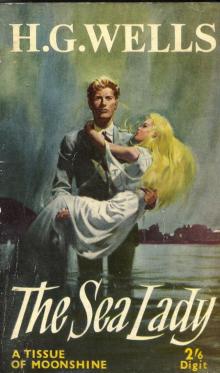
H g wells omnibus, p.321
H G Wells Omnibus,
p.321


Then I stopped the machine, and saw about me again the old familiar laboratory, my tools, my appliances just as I had left them. I got off the thing very shakily, and sat down upon my bench. For several minutes I trembled violently. Then I became calmer. Around me was my old workshop again, exactly as it had been. I might have slept there, and the whole thing have been a dream.
And yet, not exactly! The thing had started from the south-east corner of the laboratory. It had come to rest again in the north-west, against the wall where you saw it. That gives you the exact distance from my little lawn to the pedestal of the White Sphinx, into which the Morlocks had carried my machine.
For a time my brain went stagnant. Presently I got up and came through the passage here, limping, because my heel was still painful, and feeling sorely begrimed. I saw the Pall Mall Gazette on the table by the door. I found the date was indeed to-day, and looking at the timepiece, saw the hour was almost eight o’clock. I heard your voices and the clatter of plates. I hesitated—I felt so sick and weak. Then I sniffed good wholesome meat, and opened the door on you. You know the rest. I washed, and dined, and now I am telling you the story.
“I know,” he said, after a pause, “that all this will be absolutely incredible to you. To me the one incredible thing is that I am here in this familiar room looking into your friendly faces and telling you these strange adventures.”
He looked at the Medical Man. “No. I cannot expect you to believe it. Take it as a lie—or a prophecy. Say I dreamed it in the workshop. Consider I have been speculating upon the destinies of our race until I have hatched this fiction. Treat my assertion of its truth as a mere stroke of art to enhance its interest. And taking it as a story, what do you think of it?”
He took up his pipe, and began, in his old accustomed manner, to tap with it nervously upon the bars of the grate. There was a momentary stillness. Then chairs began to creak and shoes to scrape upon the carpet. I took my eyes off the Time Traveller’s face, and looked round at his audience. They were in the dark, and little spots of colour swam before them. The Medical Man seemed absorbed in the contemplation of our host. The Editor was looking hard at the end of his cigar—the sixth. The Journalist fumbled for his watch. The others, as far as I remember, were motionless.
The Editor stood up with a sigh. “What a pity it is you’re not a writer of stories!” he said, putting his hand on the Time Traveller’s shoulder.
“You don’t believe it?”
“Well—”
“I thought not.”
The Time Traveller turned to us. “Where are the matches?” he said. He lit one and spoke over his pipe, puffing. “To tell you the truth … I hardly believe it myself.… And yet …”
His eye fell with a mute inquiry upon the withered white flowers upon the little table. Then he turned over the hand holding his pipe, and I saw he was looking at some half-healed scars on his knuckles.
The Medical Man rose, came to the lamp, and examined the flowers. “The gynæceum’s odd,” he said. The Psychologist leant forward to see, holding out his hand for a specimen.
“I’m hanged if it isn’t a quarter to one,” said the Journalist. “How shall we get home?”
“Plenty of cabs at the station,” said the Psychologist.
“It’s a curious thing,” said the Medical Man; “but I certainly don’t know the natural order of these flowers. May I have them?”
The Time Traveller hesitated. Then suddenly: “Certainly not.”
“Where did you really get them?” said the Medical Man.
The Time Traveller put his hand to his head. He spoke like one who was trying to keep hold of an idea that eluded him. “They were put into my pocket by Weena, when I travelled into Time.” He stared round the room. “I’m damned if it isn’t all going. This room and you and the atmosphere of every day are too much for my memory. Did I ever make a Time Machine, or a model of a Time Machine? Or is it all only a dream? They say life is a dream, a precious poor dream at times—but I can’t stand another that won’t fit. It’s madness. And where did the dream come from?… I must look at that machine. If there is one!”
He caught up the lamp swiftly, and carried it, flaring red, through the door into the corridor. We followed him. There in the flickering light of the lamp was the machine sure enough, squat, ugly, and askew; a thing of brass, ebony, ivory, and translucent glimmering quartz. Solid to the touch—for I put out my hand and felt the rail of it—and with brown spots and smears upon the ivory, and bits of grass and moss upon the lower parts, and one rail bent awry.
The Time Traveller put the lamp down on the bench, and ran his hand along the damaged rail. “It’s all right now,” he said. “The story I told you was true. I’m sorry to have brought you out here in the cold.” He took up the lamp, and, in an absolute silence, we returned to the smoking-room.
He came into the hall with us and helped the Editor on with his coat. The Medical Man looked into his face and, with a certain hesitation, told him he was suffering from overwork, at which he laughed hugely. I remember him standing in the open doorway, bawling good-night.
I shared a cab with the Editor. He thought the tale a “gaudy lie.” For my own part I was unable to come to a conclusion. The story was so fantastic and incredible, the telling so credible and sober. I lay awake most of the night thinking about it. I determined to go next day and see the Time Traveller again. I was told he was in the laboratory, and being on easy terms in the house, I went up to him. The laboratory, however, was empty. I stared for a minute at the Time Machine and put out my hand and touched the lever. At that the squat, substantial-looking mass swayed like a bough shaken by the wind. Its instability startled me extremely, and I had a queer reminiscence of the childish days when I used to be forbidden to meddle. I came back through the corridor. The Time Traveller met me in the smoking-room. He was coming from the house. He had a small camera under one arm and a knapsack under the other. He laughed when he saw me, and gave me an elbow to shake. “I’m frightfully busy,” said he, “with that thing in there.”
“But is it not some hoax?” I said. “Do you really travel through time?”
“Really and truly I do.” And he looked frankly into my eyes. He hesitated. His eye wandered about the room. “I only want half an hour,” he said. “I know why you came, and it’s awfully good of you. There’s some magazines here. If you’ll stop to lunch I’ll prove you this time travelling up to the hilt, specimens and all. If you’ll forgive my leaving you now?”
I consented, hardly comprehending then the full import of his words, and he nodded and went on down the corridor. I heard the door of the laboratory slam, seated myself in a chair, and took up a daily paper. What was he going to do before lunch-time? Then suddenly I was reminded by an advertisement that I had promised to meet Richardson, the publisher, at two. I looked at my watch, and saw that I could barely save that engagement. I got up and went down the passage to tell the Time Traveller.
As I took hold of the handle of the door I heard an exclamation, oddly truncated at the end, and a click and a thud. A gust of air whirled round me as I opened the door, and from within came the sound of broken glass falling on the floor. The Time Traveller was not there. I seemed to see a ghostly, indistinct figure sitting in a whirling mass of black and brass for a moment—a figure so transparent that the bench behind with its sheets of drawings was absolutely distinct; but this phantasm vanished as I rubbed my eyes. The Time Machine had gone. Save for a subsiding stir of dust, the further end of the laboratory was empty. A pane of the skylight had, apparently, just been blown in.
I felt an unreasonable amazement. I knew that something strange had happened, and for the moment could not distinguish what the strange thing might be. As I stood Staring, the door opened, and the man-servant appeared.
We looked at each other. Then ideas began to come. “Has Mr. —— gone out that way?” said I.
“No, sir. No one has come out this way. I was expecting to find him here.”
At that I understood. At the risk of disappointing Richardson I stayed on, waiting for the Time Traveller; waiting for the second, perhaps still stranger story, and the specimens and photographs he would bring with him. But I am beginning now to fear that I must wait a lifetime. The Time Traveller vanished three years ago. And, as everybody knows now, he has never returned.
ONE cannot choose but wonder. Will he ever return? It may be that he swept back into the past, and fell among the blood-drinking, hairy savages of the Age of Unpolished Stone; into the abysses of the Cretaceous Sea; or among the grotesque saurians, the huge reptilian brutes of the Jurassic times. He may even now—if I may use the phrase—be wandering on some plesiosaurus-haunted Oolitic coral reef, or beside the lonely saline lakes of the Triassic Age. Or did he go forward, into one of the nearer ages, in which men are still men, but with the riddles of our own time answered and its wearisome problems solved? Into the manhood of the race: for I, for my own part, cannot think that these latter days of weak experiment, fragmentary theory, and mutual discord are indeed man’s culminating time! I say, for my own part. He, I know—for the question had been discussed among us long before the Time Machine was made—thought but cheerlessly of the Advancement of Mankind, and saw in the growing pile of civilisation only a foolish heaping that must inevitably fall back upon and destroy its makers in the end. If that is so, it remains for us to live as though it were not so. But to me the future is still black and blank—is a vast ignorance, lit at a few casual places by the memory of his story. And I have by me, for my comfort, two strange white flowers—shrivelled now, and brown and flat and brittle—to witness that even when mind and strength had gone, gratitude and a mutual tenderness still lived on in the heart of man.
READING GROUP GUIDE
As Ursula Le Guin mentions in her Introduction, The Time Machine was once published in a collection titled Seven Scientific Romances, and indeed H. G. Wells was known to refer often to the novella as a “romance.” This may seem an unusual way of classifying The Time Machine. Why might Wells have deemed his work a “scientific romance”? What elements of the story, and of Wells’s own motivations for writing it, would justify that categorization?
In Wells’s Preface to this edition of The Time Machine, he refers to himself in the third person, as “the writer,” until he startles the reader by referring to “my story” at the midpoint of the essay. Why might Wells have made the choice to refer to himself in the third person, and what effect did this have on your response to the rest of the book? Did his apparent objectivity provide an additional sense of credibility to the text? Why might he have abruptly switched voices, making the piece more personal, after establishing himself as an objective observer?
The story of The Time Machine is framed by a dinner party. The banquet, or dinner party, is prevalent in literature as both a trope and a literary device. The use of a dinner party in science fiction may, however, seem somewhat untraditional. Why might Wells have chosen a dinner party as a framing device for his story? What purposes does it serve? In a story about time and time travel, did it help to ground you, the reader, in the present?
The Time Machine, written in 1895, is often viewed as a radical and insightful discourse in the science of time/space relations. As a piece of fiction, it is entertaining and provocative, but Wells also delves into a profound discussion of time as a fourth dimension. The Time Traveller’s explanation of these scientific ideas is rather detailed and quite scholarly. Where in the story does he first explain these ideas, and how does he do so? While this may be exposition for the rest of the story, what other purposes might Wells have had in engaging this discussion in such detail? What might Victorian readers have thought about these ideas? What might the character of the Time Traveller reveal about Wells’s attitudes toward science and the scientific pursuit?
The issue of credibility comes up at the outset of The Time Machine. How does the Time Traveller attempt to give credibility to his ideas at the beginning, and what devices throughout does the character use to make the time-travel premise believable for his audience? What techniques or ideas does Wells use to make the premise credible for his readers?
Throughout the novel, the only character named is Weena. Each of the Time Traveller’s companions is referred to by either first initial or occupation, and the narrator’s identity is not even disclosed until the book’s conclusion. Why might Wells have used this technique? Is the fact that Weena is the only character acknowledged by name meaningful to the book?
Written at a time of rapid economic growth and industrialization in England, The Time Machine is renowned as a work of social criticism. It is known that Wells’s own political beliefs were leftist. Describe the relationship between the species of the future, the Eloi and the. Morlocks. How might The Time Machine, in its depiction of the future and the struggle between these species, be a metaphor and prophecy for the age in which Wells was living?
It is noteworthy that the Time Traveller comments so often on the year in the future to which he traveled, 802,701. Why was it necessary for Wells’s to set his story so far in the future? Does the extremity of the setting make the novel more or less relevant as a work of social criticism?
The idea of evolution arises often in this book; the discussion of it falls into the categories of both scientific commentary and social criticism. How does Wells depict the evolution of the human race? What factors contribute to the final results? How do the Eloi evolve into androgynous automatons, while the Morlocks devolve into brutish troglodytes?
The processes of evolution and devolution as depicted in The Time Machine provide interesting insight into the concept of gender roles in modern society. How does Wells construct his criticism of gender and society through the depiction of these two species? How do you think his Victorian audience would have responded to this type of commentary?
The Time Machine is a work laden with symbolism. The Palace of Green Porcelain stands out as having significant meaning in terms of both the plot and the social commentary it affords. What is the relevance of the palace in the year 802,701, what is it in the Time Traveller’s age, and how does the palace figure into the plot? While in the Palace of Green Porcelain, the Time Traveller chooses a few “weapons.” What are they and how does he use them? It is interesting that the matches he selects figure the most prominently into the story. Is the importance of fire in the far distant future ironic? Find, describe, and discuss other symbols that appear over the course of the novel.
While the story takes place far in the future, the hero of the story, a civilized British scientist, experiences profoundly primitive emotions over the course of the story. At what points in the book is it evident that the Time Traveller is regressing to a primitive state? What does this character development say about “time travel,” in scientific, evolutionary, and emotional terms?
What purpose does the Time Traveller’s foray to “the end of the world” serve in the story and in Wells’s social commentary? This episode appears desperate and hopeless. Do you think Wells was truly pessimistic about the future of mankind? How does Wells remind the reader that optimism is not only present in his story, but essential? How do Weena’s flowers figure into the optimism/pessimism discourse?
The Time Machine is a major work of utopian/dystopian fiction. What is a Utopia? A dystopia? Describe the physical landscape of the future as Wells envisions it. What elements of both Utopia and dystopia are immediately noticeable? How is the social landscape simultaneously Utopian and dystopian? How does this theme figure into the idea of appearance versus reality, a debate that also figures prominently in the novel?
Wells certainly opens the doors for discussion with this novel, and it is clear that he felt extremely connected to the ideas conveyed in the book. To what extent do you think the character of the Time Traveller was a literary mask or mouthpiece of the author? Are there any aspects of the book that lead you to believe Wells was more or less hopeful about the future of mankind than his protagonist?
SUGGESTIONS FOR FURTHER READING
The Time Machine is a masterpiece of science fiction, but it is also a unique and remarkable piece of nineteenth-century British literature. For a fuller understanding of the ideas on which Wells’s social commentary is based, there are several pieces of reading that may be useful. H. G. Wells, a socialist sympathizer, was ultimately moved by a set of ideas put forth by the Fabian reform movement. In 1889, the Fabian group published a collection of essays that provided readers with a comprehensive account of the organization’s belief system. Titled Fabian Essays in Socialism, and edited by George Bernard Shaw, this volume sheds light on Wells’s political views and how he made them literary and palatable to his Victorian audience.
Another important book that might be of interest is Charles Darwin’s seminal work The Origin of Species. As a document of both scientific and social value, Darwin’s treatise on evolution and the process of natural selection is essential to gaining a full understanding of, and appreciation for, Wells’s “scientific romance.”
The Modern Library is committed to providing readers with a full selection of titles by H. G. Wells. Other available titles include The War of the Worlds, The Island of Dr. Moreau, and The Invisible Man.
THE MODERN LIBRARY EDITORIAL BOARD
Maya Angelou
•
Daniel J. Boorstin
•
A. S. Byatt
•
Caleb Carr
•
Christopher Cerf
•
Ron Chernow
•
Shelby Foote
•
Charles Frazier
•
Vartan Gregorian