

Bloodlust and secret whi.., p.5
Bloodlust and Secret Whispers,
p.5
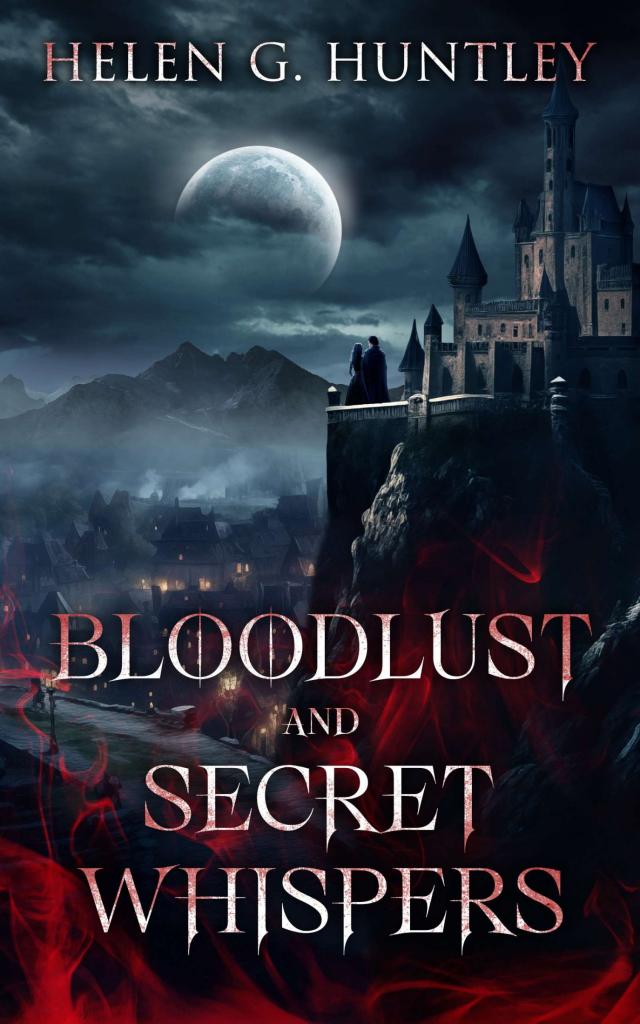


Divan slowed his horse as the gates groaned open, the iron bars shrieking against rusted hinges, a sound that cut through the stillness like a dying wail. The air thickened around him, colder than it should have been, clinging to his skin with a weight that had nothing to do with the night’s breeze.
Castl Bran stood in silence, its once-proud towers black against the sky, its windows dark and hollow like empty, watching eyes. Rain and creeping ivy weathered and worn the great walls, streaking them with years of age and claiming the stones. The fortress was still standing, but it was a ruin more than a home, a place where time had slowed but never stopped its relentless decay.
Beyond the gates, the courtyard stretched wide, its cobblestones cracked and uneven, with wild grasses pushing through the gaps. The fountain at its center, once a masterpiece of carved marble, was now dry and crumbling, its basin choked with dead leaves and moss. Somewhere in the distance, an owl called, its lonely voice swallowed by the vast emptiness of the grounds.
To the east, where his mother’s orchard once flourished, the trees stood in silent rows, their twisted branches bare. The scent of apples no longer lingered here, only the damp rot of fallen leaves and forgotten harvests. In the spring, this place had been alive with color, the blossoms spilling like snow across the grass. Now, it was a graveyard of memories, the wind whispering through skeletal limbs like a mournful sigh.
To the west, near the castle’s outer wall, his mother’s flower beds lay in ruin. Where once roses, lilacs, and lavender had flourished, there were now only tangled weeds and brambles, clawing at the earth like gnarled fingers. He remembered how she would walk among them, humming softly as she clipped fresh blooms, the scent of jasmine and thyme trailing in her wake. Now, the air held only the bitter, wild scent of decay.
Divan exhaled, his breath clouding before him. Nothing had changed, and yet everything had. The fortress of his childhood was still here, but it bore the weight of twenty-five years of silence, of secrets buried beneath its cold stones. His brother was somewhere inside, waiting.
He pressed his heels to his horse’s flanks and crossed the threshold, the past rising around him like a ghost. He dismounted and tied his horse, inhaling deeply before pushing open the heavy wooden doors.
Inside, the great hall was dimly lit, the only source of warmth a roaring fire at its center. The scent of old stone, burnt wood, and something damp filled the air. Then he saw him. Caliban Drakovar. Slouched in a worn chair by the fire, one boot propped against the stone hearth, a glass of vodka dangling from his fingers. The flickering light cast deep shadows over his face, making his strong features even harsher.
Divan’s eyes flicked to the floor beside him. Several bottles, empty. This must be what twenty-five years of isolation does to a man. But then, to his surprise, Caliban stood, and he was completely sober. His movements were steady, his gaze sharp as it settled on Divan. For a moment, neither of them spoke. Then Caliban’s brows furrowed. “Who are you?”
Divan let out a slow breath, stepping forward. “I am Divan Drakovar.” He met his brother’s gaze. “I received your message.”
Caliban stared at him, his expression unreadable. He shook his head with a dry chuckle. “You can’t be Divan. Divan is six years old and runs around the castle like a curious little raccoon.”
Divan smirked slightly. “Quite some time has passed, hasn’t it?”
Caliban stepped closer, studying him with calculating eyes. His little brother was no longer little. Divan was taller than Caliban, stronger, his frame lean but powerful. He didn’t look like Caliban, whose face reminded him of the little he remembered of his father. Broad, strong, square, with inset eyes under a strong brow, while Divan’s face was longer with sharp features and large eyes.
“You’re far more handsome than I ever was,” Caliban said with a dry smile. “You take after our mother’s side of the family.”
Divan’s jaw tightened slightly, but he nodded.
Caliban exhaled. “I’m glad you came.” His voice dropped just slightly. “I do have a room ready for you. Your old room, if you don’t mind.”
Divan had expected that. A simple solution, chosen more out of ease than thought. “That’s fine.”
Caliban waved a hand. “It isn’t much, but it’s better than any other room in this cave.”
Divan glanced around. “You should have torn this place down and left years ago.”
Caliban let out a low, humorless laugh. “Perhaps.”
Silence settled between them, stretching uncomfortably.
Finally, Divan cleared his throat. “I came to check on you. But I can’t stay long, a fortnight, but no more.”
Caliban smirked faintly. “Yes, yes, I’m sure you have a life to get back to.” His tone was teasing, but there was something beneath it, something almost bitter. Then, with a shrug, he said, “But I’m happy you came.”
Divan only nodded, his eyes flicking once more to the empty bottles on the floor. He was curious how a man could drink so much and remain so dry and sober.
Before he could comment, Caliban continued, “Otilla is bringing supper, then we can talk.”
Divan arched a brow. “Otilla?”
Caliban smiled, something almost wistful passing over his features. “She is my friend, my lover, my woman. Whatever you want to call her.”
A strange name from the past surfaced in Divan’s memory. “Otilla, Vladimir Hahn’s wife?”
Caliban chuckled, shaking his head. “Yes. I’m surprised you remember.”
“Vladimir was a kind man.”
Caliban’s expression darkened. “He died several years ago.”
“And so, you. . .” Divan gestured vaguely.
“We.” Caliban exhaled, rolling his shoulders. “Well. You’re a man now. I’m sure you understand.”
Divan said nothing. Silence settled again, thick with words left unsaid. Finally, he straightened. “Show me to my room. We’ll speak in the morning.”
Caliban held his gaze for a moment before nodding. “Very well.”
He turned, leading Divan down the dim corridors. As they walked deeper into the castle, the shadows followed them, watching and waiting.
Chapter 6
I did not intend to know her. She was kind to me when kindness was rare. A widow, but still laughing, still alive, as though the world had not broken her yet. I knew it was wrong before I ever touched her hand. There are nights I tell myself I did not know what I had done, not truly. She forgave what she did not understand. I loved her for that. - from The Journal of Caliban Drakovar
Divan’s old room in Castle Bran haunted his childhood, preserved yet abandoned, remaining untouched since they took him to Brașov as a boy. As Divan stepped into his childhood room, the air was thick with dust and memories. The sight of it sent an unexpected chill through him. He had imagined it would be different, that time would have swallowed it whole, or that his brother would have cleared it away. Instead, it is as if a part of him has been entombed here, waiting.
He swallowed hard as he walked further in, his boots stirring up dust from the wooden floor.
The room was insignificant compared to the grand halls of the castle, but it was once warm and comforting, with its dark wooden furniture and deep blue draperies. Although its velvet was dulled with dust, someone had neatly made the heavy canopy bed as if expecting his return. The embroidered coverlet, stitched by his mother’s hands, remained in place, faded but intact. Time had yellowed the delicate fabric of his small childhood clothes, still folded in a trunk at the foot of the bed.
His eyes landed on the wooden soldiers, their paint chipped and faded, still standing in perfect formation on the shelf. He remembered playing with them late into the night, whispering battle strategies under the covers, pretending the castle was his fortress to defend. Now, they seem like relics of another life, a life that ended the night his parents were massacred.
The spinning top on the floor caught his attention next. He crouched, tracing the grooves with his fingertips. He can almost hear the echoes of his laughter, the way he used to spin it endlessly while his brother told him stories of warriors and kings. His fingers curled into a fist, a dull ache settling in his chest.
Then his gaze shifted to the dresser. The dust was thick, but something familiar peeked through. He wiped it away, revealing the delicate sketch, his mother’s work, unmistakable. The drawing was of him and his brother, side by side, before everything fell apart. Divan was three, Caliban seventeen.
His throat tightened as he picked it up, his thumb brushing the faded lines. Under it rested a dried sprig of lavender, his mother’s favorite. A symbol of love and protection. The scent was nearly gone, but when he brought the lavender closer, the ghost of a scent lingered beside the smell of dust.
A strange mix of emotions churned inside him, grief, longing, anger. A part of him felt like the child who once lived here, safe under his mother’s watchful eye, while another part of him was the man wondering what really happened that fateful day when all this was taken from him.
Divan placed the sketch back down carefully, his fingers lingering for a moment before pulling away. His heart was heavy. The room was both a sanctuary and a grave, filled with pieces of a past that would never be whole again. With that last thought, Divan shook the dust off his bedding and fell onto the bed.
***
The scent of food stirred Divan from a light, restless sleep. He blinked against the dim morning light filtering through the heavy curtains, his mind slow to shake the weight of uneasy dreams. Shadows stretched along the cold stone walls of his childhood chamber, as remnants of the past pressed in around him.
Then a sharp knock came at his door. He pushed himself upright. It could only be Caliban. “Come in.”
The door creaked open, and the scent of warm bread and roasted meat grew stronger. A woman entered, carrying a tray laden with food. There were eggs, sausages, dark bread, and a steaming cup of coffee.
Divan’s brows rose slightly as he recognized her. Otilla. She was striking in a way that was only enhanced by age, a woman in her early forties, still beautiful, with chestnut, curling hair pulled back loosely and high cheekbones that spoke of Romani blood. Her sharp brown eyes studied him with open curiosity as she set the tray on a small table by the window.
“Well,” she said, dusting her hands on her skirts. “The last time I saw you, you were no taller than my knee.”
Divan swung his legs over the side of the bed, rubbing his jaw. “Then you must have known me well.”
Otilla smirked. “I did. You ran wild through this castle, always underfoot, always asking questions.”
He huffed a soft laugh. “That sounds like me.”
She gestured to the tray. “Eat while it’s hot. I had to insist that Caliban let me bring it to you. He thinks you’re a grown man who needs no fussing over.”
Divan glanced at the food but didn’t immediately move to eat. Instead, he studied her. “And you? Are you living here now?”
Otilla arched a brow. “No, I am not. I wouldn’t live in this horrid castle. I just take care of your miserable brother now and then when he needs me, which isn’t often, but I love him.”
“He told me about Vladamir, just that he had died and you and he–”
“Yes, Vladimir died, taken by the beast. A horrible time, but Caliban came to comfort me, and after a while we fell in love, although I miss Vlad every day.”
“I’m so sorry that happened to you. I remember Vladimir was an exceedingly kind man.”
“The kindest, and he genuinely loved me. His death was a tragedy.”
“But this beast? You believe it was real?”
“I know it was real. I saw what the creature left behind.” She hesitated, glancing toward the heavy window shutters. “We all know. We just don’t speak of it loudly.”
Her tone expressed resignation at the sadness she lived in. Divan wondered how much of a choice she truly had in the matter of this relationship with his brother.
Before he could ask further, she turned toward the door. “Your brother is waiting in the hall. I suggest you don’t let him sit too long with his thoughts before joining him.”
She left before he could respond, her skirts swishing softly as she disappeared down the corridor.
As the door closed behind her, Divan remained standing for a moment, staring at nothing. Her words echoed in the silence. “The beast killed him.” She had said it with such certainty, not fear, not drama, just a quiet acceptance, like speaking of rain or hunger. This unsettled him more than he cared to admit.
Divan scrubbed a hand across the back of his neck, pacing once across the room. He had expected grief. He had even expected bitterness. But he had not expected certainty, not from an intelligent woman like Otilla.
A wolf, or some predator too cunning for the villagers to track. But something in her eyes, something hollow and knowing, whispered that it was not a simple animal she spoke of.
Divan set his jaw, forcing the unease down. He was a man of science. He had seen plague, fever, and madness. There was always an explanation. Always.
***
By the time Divan reached the great hall, Caliban was already sitting at the long wooden table, a half-empty bottle of vodka at his elbow. He wasn’t drinking yet, though, just turning the glass in his fingers absently, staring into the fire.
As Divan sat down across from him, his brother finally looked up.
“You slept?”
“Well enough.”
Caliban smirked. “Then you’re one of the lucky ones. How was your breakfast?”
“Delicious. Where is Otilla?”
“She went home.”
“Does she still live in the house that Vladimir owned?”
“Yes, she does.”
Divan sat for a moment, waiting for more, but there was no more, so he took a bite of the dark bread on the plate in the center of the table, chewing slowly before speaking. “When I arrived in town, I ran into Maria Unger. She invited me to dinner.”
Caliban grinned. “Did you meet that gorgeous granddaughter of hers?”
Divan frowned slightly, but nodded. “Lila.”
Caliban chuckled. “Lila.” He leaned back in his chair, taking a slow sip of his drink before shaking his head. “That girl’s going to cause trouble in Bran. Mark my words.”
Divan’s grip on his fork tightened slightly. “She seems sweet and kind.”
“Oh, she is,” Caliban said, smirking again. “But more than that, she’s impressive. She’s a genuine beauty.”
Divan swallowed his irritation.
Caliban sat back, stretching. “As much as I admire her, she’s young enough to be my daughter. I like my women with some experience, if you know what I mean.” He stared into the fire, a smile creeping onto his face. “Yet, it would be fascinating to see how she squirmed with pleasure underneath me while I. . .” He took a sip of his drink. “Well, never mind. That’s not quite appropriate, is it?”
There it was again. That grin. That knowing look, as if Lila were nothing more than a fine meal or a well-aged wine. Even at six years old, he hadn’t fully understood, but he had heard the whispers. Caliban had always been too free with women, and he hadn’t changed.
Twenty-five years. Twenty-five years of silence, of abandonment, not a letter, not a single word, and now, after finally meeting his brother again, he was certain of one thing. He did not like the man. A fortnight was too long.
Divan fought to keep his expression neutral. “No, it isn’t.”
Caliban didn’t respond.
There was something wrong in Castle Bran. Divan had felt it the moment he crossed the threshold, but last night, as he lay awake in his childhood chamber, the sensation had only grown stronger.
That sense wasn’t just the cold dampness that seeped into the walls, nor the eerie silence that filled the corridors. There was something else. Something unseen, yet undeniable. A presence pressed against his senses, whispering along the edges of his mind like a presence just out of reach.
Something evil.
For the first time in years, he had felt unsafe in his bed, which was why he had kept the dagger beneath his pillow. When he rose that morning, he had carefully slipped it into the hidden sheath at his belt. The cool weight of the blade was oddly reassuring. He didn’t know why he needed it, only that he did.
Divan barely stood to excuse himself before his brother spoke. “Sit.” That wasn’t a request.
Divan hesitated, but then lowered himself back into the chair. He had learned early in life that refusing a man like Caliban only made things worse.
Caliban leaned back, rolling a half-empty glass of vodka between his fingers. “Tell me about yourself.”
Divan exhaled slowly, keeping his voice calm. “I’m a doctor.”
Caliban gave a humorless chuckle. “A doctor.” He nodded to himself. “Of course you are.”
Divan ignored the strange remark. “I run a clinic and an apothecary in Brașov.”
His brother swirled the vodka in his glass. “Good for you.”
Silence stretched between them for a moment before Caliban’s gaze sharpened. “How’s the family?”
“They’re well.” Then, without thinking, Divan added, “Do you remember Cel Tradat? He lived here in Bran for many years.”
The change in Caliban was immediate. His shoulders tensed. The easy, almost lazy demeanor disappeared, replaced by something rigid and dangerous. His jaw clenched, and when he spoke, his voice was low, a growl. Divan blinked, cautiously, very aware of the shift in his brother’s mood.
“Why do you bring him up?”
“No reason,” Divan said slowly, cautious now. “Just a question. He lived in Bran, and I thought you knew him.”


