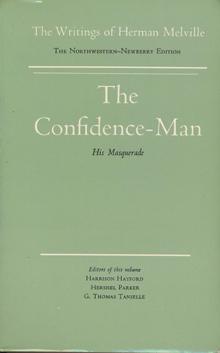
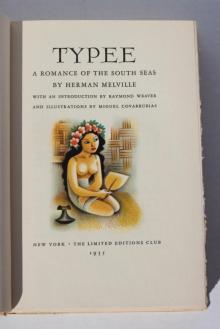
The confidence man his m.., p.18
The Confidence-Man: His Masquerade.,
p.18


"Ah, now," deprecating with his pipe, "irony is so unjust: never could abide irony: something Satanic about irony. God defend me from Irony, and Satire, his bosom friend."
"A right knave's prayer, and a right fool's, too," snapping his rifle-lock.
"Now be frank. Own that was a little gratuitous. But, no, no, you didn't mean it; any way, I can make allowances. Ah, did you but know it, how much pleasanter to puff at this philanthropic pipe, than still to keep fumbling at that misanthropic rifle. As for your worldling, glutton," [214] and coquette, though, doubtless, being such, they may have their little foibles—as who has not?—yet not one of the three can be reproached with that awful sin of shunning society; awful I call it, for not seldom it presupposes a still darker thing than itself—remorse."
"Remorse drives man away from man? How came your fellow-creature, Cain, after the first murder, to go and build the first city? And why is it that the modern Cain dreads nothing so much as solitary confinement?
"My dear fellow, you get excited. Say what you will, I for one must have my fellow-creatures round me. Thick, too—I must have them thick."
"The pick-pocket, too, loves to have his fellow-creatures round him. Tut, man! no one goes into the crowd but for his end; and the end of too many is the same as the pick-pocket's—a purse."
"Now, my dear fellow, how can you have the conscience to say that, when it is as much according to natural law that men are social as sheep gregarious. But grant that, in being social, each man has his end, do you, upon the strength of that, do you yourself, I say, mix with man, now, immediately, and be your end a more genial philosophy. Come, let's take a turn."
Again he offered his fraternal arm; but the bachelor once more flung it off, and, raising his rifle in energetic invocation, cried: "Now the high-constable catch and confound all knaves in towns and rats in grain-bins, and [215] if in this boat, which is a human grain-bin for the time, any sly, smooth, philandering rat be dodging now, pin him, thou high rat-catcher, against this rail."
"A noble burst! shows you at heart a trump. And when a card's that, little matters it whether it be spade or diamond. You are good wine that, to be still better, only needs a shaking up. Come, let's agree that we'll to New Orleans, and there embark for London—I staying with my friends nigh Primrose-hill, and you putting up at the Piazza, Covent Garden—Piazza, Covent Garden; for tell me—since you will not be a disciple to the full—tell me, was not that humor, of Diogenes, which led him to live, a merry-andrew, in the flower-market, better than that of the less wise Athenian, which made him a skulking scare-crow in pine-barrens? An injudicious gentleman, Lord Timon."
"Your hand!" seizing it.
"Bless me, how cordial a squeeze. It is agreed we shall be brothers, then?"
"As much so as a brace of misanthropes can be," with another and terrific squeeze. "I had thought that the moderns had degenerated beneath the capacity of misanthropy. Rejoiced, though but in one instance, and that disguised, to be undeceived."
The other stared in blank amaze.
"Won't do. You are Diogenes, Diogenes in disguise. I say—Diogenes masquerading as a cosmopolitan."
With ruefully altered mien, the stranger still stood mute awhile. At length, in a pained tone, spoke: "How hard the lot of that pleader who, in his zeal conceding too [216] much, is taken to belong to a side which he but labors, however ineffectually, to convert!" Then with another change of air: "To you, an Ishmael, disguising in sportiveness my intent, I came ambassador from the human race, charged with the assurance that for your mislike they bore no answering grudge, but sought to conciliate accord between you and them. Yet you take me not for the honest envoy, but I know not what sort of unheard-of spy. Sir," he less lowly added, "this mistaking of your man should teach you how you may mistake all men. For God's sake," laying both hands upon him, "get you confidence. See how distrust has duped you. I, Diogenes? I he who, going a step beyond misanthropy, was less a man-hater than a man-hooter? Better were I stark and stiff!"
With which the philanthropist moved away less lightsome than he had come, leaving the discomfited misanthrope to the solitude he held so sapient.
* * *
CHAPTER XXV. THE COSMOPOLITAN MAKES AN ACQUAINTANCE.
In the act of retiring, the cosmopolitan was met by a passenger, who with the bluff abord of the West, thus addressed him, though a stranger.
"Queer 'coon, your friend. Had a little skrimmage with him myself. Rather entertaining old 'coon, if he wasn't so deuced analytical. Reminded me somehow of what I've heard about Colonel John Moredock, of Illinois, only your friend ain't quite so good a fellow at bottom, I should think."
It was in the semicircular porch of a cabin, opening a recess from the deck, lit by a zoned lamp swung overhead, and sending its light vertically down, like the sun at noon. Beneath the lamp stood the speaker, affording to any one disposed to it no unfavorable chance for scrutiny; but the glance now resting on him betrayed no such rudeness.
A man neither tall nor stout, neither short nor gaunt; but with a body fitted, as by measure, to the service of his mind. For the rest, one less favored perhaps in his features than his clothes; and of these the beauty may have been less in the fit than the cut; to say nothing of [218] the fineness of the nap, seeming out of keeping with something the reverse of fine in the skin; and the unsuitableness of a violet vest, sending up sunset hues to a countenance betokening a kind of bilious habit.
But, upon the whole, it could not be fairly said that his appearance was unprepossessing; indeed, to the congenial, it would have been doubtless not uncongenial; while to others, it could not fail to be at least curiously interesting, from the warm air of florid cordiality, contrasting itself with one knows not what kind of aguish sallowness of saving discretion lurking behind it. Ungracious critics might have thought that the manner flushed the man, something in the same fictitious way that the vest flushed the cheek. And though his teeth were singularly good, those same ungracious ones might have hinted that they were too good to be true; or rather, were not so good as they might be; since the best false teeth are those made with at least two or three blemishes, the more to look like life. But fortunately for better constructions, no such critics had the stranger now in eye; only the cosmopolitan, who, after, in the first place, acknowledging his advances with a mute salute—in which acknowledgment, if there seemed less of spirit than in his way of accosting the Missourian, it was probably because of the saddening sequel of that late interview—thus now replied: "Colonel John Moredock," repeating the words abstractedly; "that surname recalls reminiscences. Pray," with enlivened air, "was he anyway connected with the Moredocks of Moredock Hall, Northamptonshire, England?" [219]
"I know no more of the Moredocks of Moredock Hall than of the Burdocks of Burdock Hut," returned the other, with the air somehow of one whose fortunes had been of his own making; "all I know is, that the late Colonel John Moredock was a famous one in his time; eye like Lochiel's; finger like a trigger; nerve like a catamount's; and with but two little oddities—seldom stirred without his rifle, and hated Indians like snakes."
"Your Moredock, then, would seem a Moredock of Misanthrope Hall—the Woods. No very sleek creature, the colonel, I fancy."
"Sleek or not, he was no uncombed one, but silky bearded and curly headed, and to all but Indians juicy as a peach. But Indians—how the late Colonel John Moredock, Indian-hater of Illinois, did hate Indians, to be sure!"
"Never heard of such a thing. Hate Indians? Why should he or anybody else hate Indians? I admire Indians. Indians I have always heard to be one of the finest of the primitive races, possessed of many heroic virtues. Some noble women, too. When I think of Pocahontas, I am ready to love Indians. Then there's Massasoit, and Philip of Mount Hope, and Tecumseh, and Red-Jacket, and Logan—all heroes; and there's the Five Nations, and Araucanians—federations and communities of heroes. God bless me; hate Indians? Surely the late Colonel John Moredock must have wandered in his mind."
"Wandered in the woods considerably, but never wandered elsewhere, that I ever heard." [220]
"Are you in earnest? Was there ever one who so made it his particular mission to hate Indians that, to designate him, a special word has been coined—Indian-hater?"
"Even so."
"Dear me, you take it very calmly.—But really, I would like to know something about this Indian-hating, I can hardly believe such a thing to be. Could you favor me with a little history of the extraordinary man you mentioned?"
"With all my heart," and immediately stepping from the porch, gestured the cosmopolitan to a settee near by, on deck. "There, sir, sit you there, and I will sit here beside you—you desire to hear of Colonel John Moredock. Well, a day in my boyhood is marked with a white stone—the day I saw the colonel's rifle, powder-horn attached, hanging in a cabin on the West bank of the Wabash river. I was going westward a long journey through the wilderness with my father. It was nigh noon, and we had stopped at the cabin to unsaddle and bait. The man at the cabin pointed out the rifle, and told whose it was, adding that the colonel was that moment sleeping on wolf-skins in the corn-loft above, so we must not talk very loud, for the colonel had been out all night hunting (Indians, mind), and it would be cruel to disturb his sleep. Curious to see one so famous, we waited two hours over, in hopes he would come forth; but he did not. So, it being necessary to get to the next cabin before nightfall, we had at last to ride off without the wished-for satisfaction. Though, to tell the [221] truth, I, for one, did not go away entirely ungratified, for, while my father was watering the horses, I slipped back into the cabin, and stepping a round or two up the ladder, pushed my head through the trap, and peered about. Not much light in the loft; but off, in the further corner, I saw what I took to be the wolf-skins, and on them a bundle of something, like a drift of leaves; and at one end, what seemed a moss-ball; and over it, deer-antlers branched; and close by, a small squirrel sprang out from a maple-bowl of nuts, brushed the moss-ball with his tail, through a hole, and vanished, squeaking. That bit of woodland scene was all I saw. No Colonel Moredock there, unless that moss-ball was his curly head, seen in the back view. I would have gone clear up, but the man below had warned me, that though, from his camping habits, the colonel could sleep through thunder, he was for the same cause amazing quick to waken at the sound of footsteps, however soft, and especially if human."
"Excuse me," said the other, softly laying his hand on the narrator's wrist, "but I fear the colonel was of a distrustful nature—little or no confidence. He was a little suspicious-minded, wasn't he?"
"Not a bit. Knew too much. Suspected nobody, but was not ignorant of Indians. Well: though, as you may gather, I never fully saw the man, yet, have I, one way and another, heard about as much of him as any other; in particular, have I heard his history again and again from my father's friend, James Hall, the judge, you know. In every company being called upon to [222] give this history, which none could better do, the judge at last fell into a style so methodic, you would have thought he spoke less to mere auditors than to an invisible amanuensis; seemed talking for the press; very impressive way with him indeed. And I, having an equally impressible memory, think that, upon a pinch, I can render you the judge upon the colonel almost word for word."
"Do so, by all means," said the cosmopolitan, well pleased.
"Shall I give you the judge's philosophy, and all?"
"As to that," rejoined the other gravely, pausing over the pipe-bowl he was filling, "the desirableness, to a man of a certain mind, of having another man's philosophy given, depends considerably upon what school of philosophy that other man belongs to. Of what school or system was the judge, pray?"
"Why, though he knew how to read and write, the judge never had much schooling. But, I should say he belonged, if anything, to the free-school system. Yes, a true patriot, the judge went in strong for free-schools."
"In philosophy? The man of a certain mind, then, while respecting the judge's patriotism, and not blind to the judge's capacity for narrative, such as he may prove to have, might, perhaps, with prudence, waive an opinion of the judge's probable philosophy. But I am no rigorist; proceed, I beg; his philosophy or not, as you please."
"Well, I would mostly skip that part, only, to begin, some reconnoitering of the ground in a philosophical [223] way the judge always deemed indispensable with strangers. For you must know that Indian-hating was no monopoly of Colonel Moredock's; but a passion, in one form or other, and to a degree, greater or less, largely shared among the class to which he belonged. And Indian-hating still exists; and, no doubt, will continue to exist, so long as Indians do. Indian-hating, then, shall be my first theme, and Colonel Moredock, the Indian-hater, my next and last."
With which the stranger, settling himself in his seat, commenced—the hearer paying marked regard, slowly smoking, his glance, meanwhile, steadfastly abstracted towards the deck, but his right ear so disposed towards the speaker that each word came through as little atmospheric intervention as possible. To intensify the sense of hearing, he seemed to sink the sense of sight. No complaisance of mere speech could have been so flattering, or expressed such striking politeness as this mute eloquence of thoroughly digesting attention.
* * *
CHAPTER XXVI. CONTAINING THE METAPHYSICS OF INDIAN-HATING, ACCORDING TO THE VIEWS OF ONE EVIDENTLY NOT SO PREPOSSESSED AS ROUSSEAU IN FAVOR OF SAVAGES.
"The judge always began in these words: 'The backwoodsman's hatred of the Indian has been a topic for some remark. In the earlier times of the frontier the passion was thought to be readily accounted for. But Indian rapine having mostly ceased through regions where it once prevailed, the philanthropist is surprised that Indian-hating has not in like degree ceased with it. He wonders why the backwoodsman still regards the red man in much the same spirit that a jury does a murderer, or a trapper a wild cat—a creature, in whose behalf mercy were not wisdom; truce is vain; he must be executed.
"'A curious point,' the judge would continue, 'which perhaps not everybody, even upon explanation, may fully understand; while, in order for any one to approach to an understanding, it is necessary for him to learn, or if he already know, to bear in mind, what manner of man the backwoodsman is; as for what manner of man the Indian is, many know, either from history or experience. [225]
"'The backwoodsman is a lonely man. He is a thoughtful man. He is a man strong and unsophisticated. Impulsive, he is what some might call unprincipled. At any rate, he is self-willed; being one who less hearkens to what others may say about things, than looks for himself, to see what are things themselves. If in straits, there are few to help; he must depend upon himself; he must continually look to himself. Hence self-reliance, to the degree of standing by his own judgment, though it stand alone. Not that he deems himself infallible; too many mistakes in following trails prove the contrary; but he thinks that nature destines such sagacity as she has given him, as she destines it to the 'possum. To these fellow-beings of the wilds their untutored sagacity is their best dependence. If with either it prove faulty, if the 'possum's betray it to the trap, or the backwoodsman's mislead him into ambuscade, there are consequences to be undergone, but no self-blame. As with the 'possum, instincts prevail with the backwoodsman over precepts. Like the 'possum, the backwoodsman presents the spectacle of a creature dwelling exclusively among the works of God, yet these, truth must confess, breed little in him of a godly mind. Small bowing and scraping is his, further than when with bent knee he points his rifle, or picks its flint. With few companions, solitude by necessity his lengthened lot, he stands the trial—no slight one, since, next to dying, solitude, rightly borne, is perhaps of fortitude the most rigorous test. But not merely is the backwoodsman content to be alone, but in no few cases [226] is anxious to be so. The sight of smoke ten miles off is provocation to one more remove from man, one step deeper into nature. Is it that he feels that whatever man may be, man is not the universe? that glory, beauty, kindness, are not all engrossed by him? that as the presence of man frights birds away, so, many bird-like thoughts? Be that how it will, the backwoodsman is not without some fineness to his nature. Hairy Orson as he looks, it may be with him as with the Shetland seal—beneath the bristles lurks the fur.
"'Though held in a sort a barbarian, the backwoodsman would seem to America what Alexander was to Asia—captain in the vanguard of conquering civilization. Whatever the nation's growing opulence or power, does it not lackey his heels? Pathfinder, provider of security to those who come after him, for himself he asks nothing but hardship. Worthy to be compared with Moses in the Exodus, or the Emperor Julian in Gaul, who on foot, and bare-browed, at the head of covered or mounted legions, marched so through the elements, day after day. The tide of emigration, let it roll as it will, never overwhelms the backwoodsman into itself; he rides upon advance, as the Polynesian upon the comb of the surf.