The steppenwolf, p.1
The Steppenwolf,
p.1
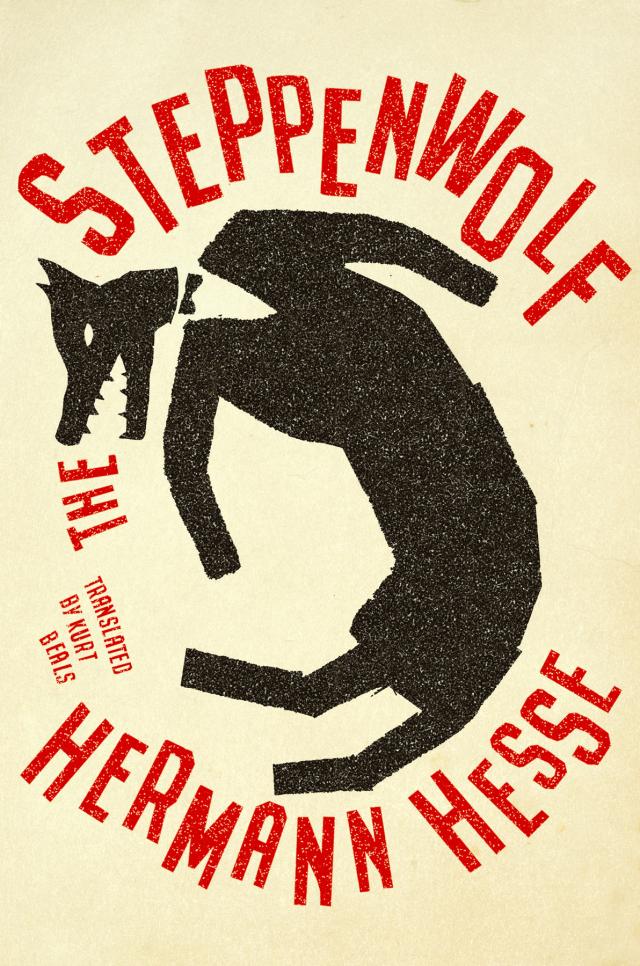


The
Steppenwolf
Hermann Hesse
TRANSLATED BY Kurt Beals
CONTENTS
Introduction
Editor’s Foreword
Harry Haller’s Notebooks
Treatise on the Steppenwolf
INTRODUCTION
BY THE TIME THE CANADIAN AMERICAN ROCK BAND Steppenwolf released their single “Born to Be Wild” in 1968, the German Swiss author Hermann Hesse had been dead for more than five years. There is no way to be sure, then, just what the Nobel Prize–winning novelist would have thought of the seminal heavy metal hit, or of the biker movie Easy Rider, which appeared the following year and helped boost the song to even greater popularity. Nevertheless, Hesse’s 1927 novel Der Steppenwolf (translated as The Steppenwolf or just Steppenwolf), from which the band took its name, provides some clues. The novel’s titular protagonist, Harry Haller, shares more than a few features with Hesse himself: both the novelist and his character have the initials H.H.; both were born in Germany but moved to Switzerland; both were pacifists; both were nearing fifty in the period when the novel unfolds.1 In the novel, the reclusive intellectual Harry Haller worships Mozart, while initially despising jazz, gramophones, the radio, and movies made to entertain the masses. Such a curmudgeon could hardly be expected to enjoy a rock-anthem-turned-film-soundtrack that became a staple of biker culture. Thus, if this resemblance between author and protagonist is any guide, Hesse would likely have struggled to find any pleasure in “Born to Be Wild.”
Yet Haller’s misanthropy is only half the story, as readers of the novel will discover—and as the members of the band Steppenwolf apparently discovered only later, having adopted the name at the suggestion of their producer before they took the time to read the novel.2 While Harry Haller appears at the beginning as a man of uncompromising tastes and judgments—repeatedly expressing his admiration for Mozart and Goethe and his disdain for the intellectual posturing and pretensions of his own contemporaries—he learns over the course of the novel to appreciate the charms and thrills of more worldly amusements. Haller purchases a gramophone, learns the latest jazz dances, and eventually overcomes his strongest inhibitions to test out his newly acquired dance steps in public. But this metamorphosis from a lone wolf into a social butterfly is only an early stage in the transformation that Haller undergoes; in lieu of spoilers, suffice it to say that things get much, much wilder. An indication of just how wild things get for Harry Haller can be seen in the endorsement that The Steppenwolf and Hesse’s other greatest hit, Siddhartha, garnered from Timothy Leary, the prophet of psychedelics: “Before your LSD session, read Siddhartha and Steppenwolf.” Indeed, for all its historical grounding in the Switzerland of the 1920s, there is something very 1960s about some sections of The Steppenwolf. Had Harry Haller lived forty years later, he might well have been won over not by 1920s jazz hits like “Yearning” or “Valencia,” but by 1960s rock anthems like “Born to Be Wild.”
WHILE THE WILDNESS OF The Steppenwolf clearly scratched an itch for certain sixties icons, in other respects this novel seems like the unlikeliest candidate among Hesse’s works for rediscovery by a generation so strongly associated with youthful rebellion—because what sets Harry Haller apart from Hesse’s other notable protagonists is, above all, his age. In general, Hesse’s major works (not just Siddhartha, but also Demian, Narcissus and Goldmund, and The Glass Bead Game, to name only the most prominent) tend to focus on young men who embark on journeys of self-discovery. They follow, to a greater or lesser degree, the model of the German bildungsroman, the novel of education or coming-of-age.3 While the temporal scope of some of these books (such as Siddhartha) extends beyond the protagonist’s youth, even encompassing old age and death, the youthful drive to self-discovery and self-realization is an essential ingredient in each of these works. As Adam Kirsch wrote in The New Yorker in 2018, “The stories [Hesse] tells appeal to young people because they keep faith with the powerful emotions of adolescence, which most adults forget or outgrow—the woundedness, the exaltation, the enormous demands on life.”4
With all of these tales of youth to choose from, why did young readers in the sixties turn to Hesse’s tale of Harry Haller—the Steppenwolf, rapidly approaching fifty, his best days seemingly behind him, whose gout-ridden limbs make it difficult for him to climb the stairs to his garret? (Perhaps I should say “youngish readers”—Leary himself was pushing fifty by the end of the decade.) One possible answer would be that this attraction was the product of a misunderstanding, as Hesse himself suggested in a brief afterword to the book written in 1941 and first published in 1942 in Switzerland, while Germany was under Nazi rule. There Hesse attributed the frequent “misunderstanding” of the book “in part, but only in part, to the fact that this book, written by a fifty-year-old and dealing with problems pertaining to that same age, very frequently fell into the hands of quite young readers.” But there are other possibilities as well. Rather than accuse these young readers of misunderstanding the problems of late middle age, perhaps we can read Harry Haller himself, the Steppenwolf, as a figure who “keep[s] faith with the powerful emotions of adolescence.”
Or to put it in slightly different terms, perhaps we can see The Steppenwolf as a sort of epilogue or sequel to the unwritten bildungsroman of Harry Haller. Although we learn very little about the Steppenwolf’s childhood and youth, the hints that the novel provides suggest that he, like many of Hesse’s protagonists, set out as a young man to discover himself, to become the person he was destined to be; and he has remained true to that goal, despite the suffering it has caused him. Indeed, his journey seems to have brought him far more pain than glory. The lonely, gouty Harry Haller, particularly as the novel begins, is hardly a figure to be emulated or envied; it would be easier to pity him, if his own stubborn pride did not prohibit us from doing so. But even in his misery, Haller embodies a sort of integrity, refusing to compromise with a world that fails to live up to his standards. Thus for readers coming of age in the sixties—a generation that famously didn’t trust anyone over thirty—Haller (and Hesse) might have embodied a perverse sort of hope: the possibility that youthful ideals need not inevitably yield to cynical pragmatism, that the self need not always be corrupted by the obligation to adhere to social norms, to conform, to cut one’s hair, join the army, get a job.
But if this is indeed the message that readers in the sixties took from The Steppenwolf, they were only getting half the story, and Hesse’s earlier accusations of “misunderstanding” did not entirely miss the mark—because Haller’s persistent postadolescent alienation is only the starting point, not the end point of the novel. As I have already noted, despite his advancing years, the Harry Haller we meet at the outset has not yet overcome his youthful restlessness and settled into a suitable social niche in which he can spend his adult years; unlike the prototypical protagonist of a bildungsroman, he has not been reconciled and reincorporated into society, though he flirts with such assimilation by leading his nonconformist life in rented rooms of bourgeois apartment buildings, living in the “normie” world without being of it. And yet, even as he persists in living on his own terms, the Steppenwolf begins to feel what kids today (or yesterday) might call FOMO—or perhaps not so much the fear of missing out as the fear that he has already missed out, that he has let too many chances in life pass him by and has missed the opportunity to become the person he once had the potential to be. And, strikingly, he has missed this opportunity precisely by following the path taken by other Hesse heroes—by setting himself apart from society, from his peers, from the life of the world, and dedicating himself to his own peculiar predilections. In his stubborn insistence on living life on his own terms, Haller has missed out on a great deal of what the world has to offer to less ascetic, less hermetic natures—and this is precisely what the Steppenwolf on the verge of fifty sets out to discover.
HESSE, AS MENTIONED ABOVE, was also nearing fifty as he wrote The Steppenwolf, and the author’s similarities to his character do not end there—though, to be sure, there are also striking differences. Hermann Hesse was born in 1877 in Calw, Germany, a small town located in the northern Black Forest, roughly halfway between Stuttgart and the Rhine. His mother had been born in India to German Protestant missionaries, though raised in Germany; his father grew up among the German-speaking minority of Estonia, part of the Russian Empire at the time. While this distinctive family background, together with his Pietist religious upbringing, may have helped to make Hermann Hesse a bit of a misfit in his provincial southwestern German surroundings, his family’s connections to the outside world also instilled in him an international sensibility, and particularly a curiosity about Eastern religions, which would later play an important role in his literary works. (His maternal grandfather was not only a missionary but also a scholar and linguist who compiled a grammar of Malayalam, a Dravidian language spoken in parts of southern India.) After a youth that included both boarding school and a mental institution, as well as threats of suicide, at the age of eighteen Hesse found work at a bookshop in Tübingen, Germany. Four years later, he took a similar position in Basel, Switzerland, while devoting much of his free time to his own literary work. His first novel, Peter Camenzind, published in 1904, became a bestseller, and Hesse resolved henceforth to earn his livelihood as a writer.
That same year, he married Maria Bernoulli, with whom he would have three sons. The family initially lived in southern Germany, but in 1912, following Hesse’s return from a long trip to Sri Lanka, Indones
ia, and other Far Eastern destinations, they moved to Bern, Switzerland. During the First World War, Hesse spoke out publicly for peace from this neutral ground, drawing criticism from the nationalist German press. Meanwhile, his wife began to suffer from mental illness, which contributed to the dissolution of their marriage—an episode that has echoes in Harry Haller’s backstory. After their divorce in 1923, Hesse would marry two more times. The next year, he entered into what would be a three-year marriage to the Swiss singer and painter Ruth Wenger. In 1931 he married the art historian Ninon Dolbin (born Ninon Ausländer in Czernowitz, now Chernivtsi, Ukraine), a union that would endure until the end of his life.
It was in the midst of all this domestic turmoil and transition that Hesse produced his most memorable works of fiction. His novella Siddhartha, published in 1922, is set in the world of Gautama Buddha. While drawing on Hesse’s explorations of Eastern religions and philosophy and his own travels to South Asia, Siddhartha explores many of the same themes of self-discovery and the search for fulfillment that run through the author’s works set in European contexts; indeed, his biographer Gunnar Decker has argued that the novella’s emphasis on self-discovery and its rejection of discipleship “undoubtedly had more of Nietzsche’s Zarathustra about it than of Buddha. ‘Don’t follow me, follow yourself.’ For it was not a question of renouncing the Self but precisely about finding it. This was a very Western line of thought.”5
A similarly syncretistic, though ultimately Western, impulse can be found in The Steppenwolf, which first appeared in print five years after Siddhartha. While this novel can be read, from one perspective, as the narrative of Harry Haller’s search for fulfillment, from another perspective it is, like most of Hesse’s fiction, a meditation on human nature, and as such it draws on an eclectic range of sources. One source for The Steppenwolf, as for Siddhartha, is the philosophy of Friedrich Nietzsche. Just a few pages into the novel, in the fictional “Editor’s Foreword” (ostensibly written by the nephew of the woman from whom Haller rents his room), we read: “I recognized that Haller was a genius of suffering, that he, in the spirit of some of Nietzsche’s sayings, had cultivated within himself an ingenious, limitless, terrible capacity for suffering.” But Nietzsche is not the only author who influences Haller’s view of human nature. Unattributed traces of the Swiss psychiatrist Carl Jung’s psychoanalytic theories can be identified throughout the novel, while Haller’s self-conception as a creature composed of both wolf and human natures is derived in part from Goethe’s Faust, with its famous line “Two souls, alas, are housed within my breast!” Yet this notion of a bifurcated human identity is not allowed to stand unchallenged in the novel. In fact, the Faustian view of the self is first made explicit, but then criticized, in an odd pamphlet entitled Treatise on the Steppenwolf that Haller receives from a man on the street, in which he finds his own life both described and scrutinized. This treatise invokes Buddhist thought in elaborating a vision of not two, but “countless” souls housed within the human breast.
It is hardly surprising, then, that when Hesse received the Nobel Prize for Literature in 1946, The Steppenwolf was praised in the presentation speech as “an inspired account of the split in human nature, the tension between desire and reason in an individual who is outside the social and moral notions of everyday life.” However, what exactly it means to live “outside” these “social and moral notions” can surely be a matter of debate. At times, Hesse garnered criticism for his failure to speak out as clearly as many of his contemporaries did against the political developments of his age. There is no question that Hesse was appalled by the Nazis’ rise to power, and he had made no secret of his pacifism and his opposition to nationalism and anti-Semitism. His third wife, Ninon Dolbin, was Jewish, and he continued to write reviews of books by Jewish authors after the Nazis came to power, an implicit protest that drew attacks from supporters of the regime. Hesse also opened his home in Switzerland to a number of refugees from Nazi Germany, and lent support of various kinds to fellow writers, including Thomas Mann and Bertolt Brecht, when they went into exile.6 Nevertheless, he did not adopt as vocal a stance against the Nazis as either of these authors, opting instead for a “politics of detachment” for which he was sometimes condemned.7 Still, Hesse’s literary works—which were ultimately banned by the Nazis in 1943—clearly offer a philosophical and ethical, if not an overtly political, basis for opposition to fascism and other violent, nationalist ideologies. Hesse’s failure to more vocally oppose the Nazis was in no way an expression of indifference or neutrality; rather, it was symptomatic of his lifelong tendency to keep his distance from the world. When he was awarded the Nobel Prize, he complained “that the world had decided to ‘stone him to death’ with letters and messages of congratulation” and responded by retreating to a sanatorium.8 After receiving the prize, he never wrote another novel.
CERTAINLY HESSE’S OWN UNWORLDLINESS is reflected in the character of the Steppenwolf Harry Haller. That the author should manifest himself in his protagonist is no surprise: Hesse once called art (in his case, writing) “a long, varied, and tortuous route, whose aim is to express the personality of the artist’s Self so comprehensively . . . that this Self is ultimately unwrapped and laid bare.”9 Still, as I have suggested above, it would be a mistake to too closely identify the creator with his creation. To begin with, while the two suffer from a number of the same problems—suicidal tendencies, a marriage destroyed by mental illness, the general maladies of advancing age—there are also notable differences. For instance, Hesse, by 1927, had become a much more successful author than Haller seems to be (though Haller is said to have published multiple books, and also writes for newspapers). There is also no indication that Haller has children. Of course, such differences might be dismissed as minor concessions made for the sake of plausible deniability, window dressing to allow the author to make confessions in the guise of fiction that he would not make in a memoir. But there is a more striking reason to avoid assuming such a one-to-one correspondence: namely, the fact that Harry Haller is not the novel’s only stand-in for Hermann Hesse.
Particularly notable in this regard is the young woman named Hermine whose acquaintance Harry first makes at a tavern called the Black Eagle. At least, she seems to be named Hermine, and she is called by this name throughout the book; but more skeptical readers might have their doubts. After all, rather than simply tell Harry what her name is, this young woman makes him guess, and in the process draws his attention to the fact that she sometimes has “a boy’s face.” This prompts Harry to observe: “her face began to speak to me, it reminded me of my own boyhood, and of a friend I had back then whose name was Hermann.” He tells her, “If you were a boy . . . your name would have to be Hermann,” then tries his luck with the feminine form of the same name, asking, “Is your name Hermine?”—and the putative Hermine nods in affirmation. But is this really her name, or does Hermine simply allow Harry to believe that it is, to turn her into anyone he wants her to be? To what extent is Hermine simply a projection of Harry’s own psyche, an alter ego? Surely the fact that she resembles Harry’s childhood friend, who in turn shares Hermann Hesse’s first name, is hardly a coincidence. If the Steppenwolf Harry Haller’s breast contains not one, not two, but “countless” souls, as the odd treatise tells him, perhaps The Steppenwolf, Hermann Hesse’s novel, contains not one, but two, or even countless incarnations of its author.
Such ambiguity and multiplicity is not confined to the blending identities of the novel’s characters; rather, throughout the novel, the lines between reality and fantasy are also frequently blurred, transgressed, or simply rendered irrelevant. When Harry Haller sees letters of light dancing on the gray stone wall that surrounds the yard of an old cloister—letters that then leap off the wall and tumble down onto the ground at his feet—we surely aren’t expected to take this literally, are we? And yet, if those letters are not really there, how can we explain the fact that this apparition accurately foretells Harry’s later adventures? If those letters are all in his mind, does that go for his later adventures as well? Likewise, the episode in which a stranger presents Harry with the mysterious Treatise on the Steppenwolf—in which Harry himself is described—is so improbable as to defy belief, and yet so integral to subsequent developments in the novel that it simply must be true. But true in what sense? Do these fantastical events actually unfold in the reality of the objective world that Harry inhabits, alongside his fellow lodgers and the upright citizens of Switzerland? Or do they represent a parallel reality that exists primarily in Harry’s own mind, though at times intersecting with events in the outside world?