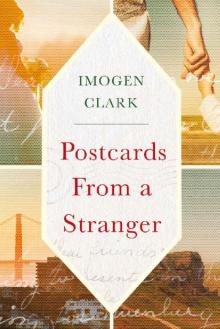
Postcards from a strange.., p.22
Postcards From a Stranger,
p.22


I’m just wondering how well my make-up is standing up to the storm when a van drives past too close and a newly fallen puddle splashes up from the curb and covers me in icy water. At first, I’m too shocked to speak and stand open-mouthed like a fish, but when I look down and see the state I’m now in, outrage takes over and I scream after the van driver, who zooms off, oblivious to the devastation that he leaves in his wake. I look around me, expecting sympathy from my fellow pedestrians, but nobody cares. They’re just glad the tsunami missed them. I try to undo the damage. The worst of the water brushes away. At least it is all over my coat and not my blouse, but there are telltale black splatters covering my trousers. There is nothing I can do. It’s too late to go back to the hotel and change. I can’t run the risk of Ursula getting impatient and leaving before I get back. I’ll just have to brazen it out. I can go straight to the ladies’ when I arrive, do my best with my hair under the hand dryer, rescue my make-up. It’s not the start I was hoping for but it’s not the end of the world.
The restaurant is just around the next corner. The frontage is bathed in light from its red neon sign and the place looks warm and inviting. I try to peer inside but the lighting is too dim. There’s nothing for it but to go in. My heart is racing so fast that I’m struggling to catch my breath. I make one last, futile rub at my smudged mascara and cross the threshold.
As soon as I walk in a man is there to greet me. So much for tidying myself up.
‘Hi. Can I help you?’ he asks.
‘I’m meeting someone. Ursula Kemp?’
I don’t know if she’s well known or whether her name will ring a bell. It clearly does.
‘Ah, Signora Kemp,’ he says and raises an eyebrow. ‘She’s already here. Please. Follow me.’
With no time to check how I look, I trail after him, trying to revitalise my limp hair as I walk. The restaurant feels relaxed and welcoming. The walls are exposed brick, the ceiling dotted with fairy lights. Even though it’s early, most of the tables are already full with couples and groups chatting and laughing. Enormous pizzas balance precariously on terracotta stands. It’s clearly the kind of place where people share the food, which surprises me. I didn’t have Ursula pegged as the food-sharing type.
Beyond the bar there are one or two booths, upholstered in buttoned red leather, and it’s to one of these that I’m shown.
‘Here you are, signorina,’ he says.
In normal circumstances I’d scoff at this feeble flattery, but right now I have other things on my mind. Pushed to the back of the booth with her arm resting languidly across the table is my aunt. Before her stands a wine bottle and a half-empty glass.
She looks older than I imagined. Her hair is white and cropped in a pixie cut. I couldn’t wear my hair as short as that but it really suits her. Her face is gaunt and criss-crossed with deep wrinkles. One runs straight down her forehead like a battle scar and she has the puckered lips and wrinkled eyes of a perpetual smoker. She looks me up and down and, without thinking, I find myself folding my arms across my chest.
‘It’s raining,’ I say, thrown by her stare and feeling the need to explain my appearance.
‘So I see.’ Her accent is pure East London, with barely a trace to show that she has lived here for thirty years.
‘Bring us another, Enzo,’ she says, nodding at the bottle, and I wonder quite how long she has been here. The waiter nods and bustles off. I just stand there, dishevelled, and stare at my new aunt. ‘Don’t gawk at me like that,’ she says, her voice bordering on aggressive. ‘And sit down, for God’s sake. You’re drawing attention to me.’
I snap out of whatever has been holding me and slide into the bench seat opposite her. Her aggressive tone is gone when she speaks again but there’s no warmth in her voice.
‘Well, just look at you,’ she says, taking a drag of her drink. ‘Annie’s little baby, all grown up.’
My jaw feels like it is wired shut. Even if I could open my mouth, I can’t think of a single sensible thing to say and so I don’t speak. I wish the waiter would hurry up with a drink for me so that I’d at least have something to do with my hands.
‘Why are you here, Cara? What do you want from me?’ Her bluntness does nothing to help my frozen state but I know that if I don’t speak soon she will think I’m a half-wit.
‘Hello, Aunt Ursula,’ I manage.
‘We’ll have less of that,’ she says. ‘I may be your aunt by birth but I lay no claim to the title. Just plain Ursula will do fine.’
Enzo arrives with the bottle, which he opens in front of us and then pours without waiting for us to taste it. That is fine by me. I do not care what I drink. I just need one. I lift the glass and put it to my lips.
‘What? No toast?’ asks Ursula. ‘How about, To absent friends?’ She waves her glass in the air at me but I do not respond. I don’t think I’m going to like Ursula Kemp.
‘So,’ I begin. ‘As I said in my letter, I wanted to ask you some questions about my mother, Anne.’
‘Darling little Annie,’ she says, her words dripping with something cold that I can’t quite identify. It is not exactly malice but there’s no tenderness there.
This is not going at all to plan. I had hoped she might be pleased to see me, her long-lost niece, but there’s none of that kind of warmth here. Her animosity sits between us like the bars in a prison. There is nothing else for it. If I want to get what I have come for, I will have to be as blunt and direct as she is being. I start to feel bolder. I can do this. If she wants cold and aloof then she’s got it.
I’m about to speak when Enzo arrives with menus. Ursula bats him away like an irritating fly. She’s clearly intent on just drinking but I’m hungry and accept the proffered menu with thanks. I order a jug of water and the smallest margherita they offer, which it says will feed two to three people. I think Ursula is watching me but her eyes are so narrowed that it is hard to tell whether they are even open.
‘So,’ she says when Enzo has retreated again. Her voice is dripping with indifference. ‘I ask yet again. What, exactly, is it that you want to know?’ She lingers over the word ‘exactly’, giving it prominence by enunciating each syllable individually. I pick up my glass, more to give myself breathing space than anything. My shaking hand disturbs the surface of the wine, making little red ripples, but if Ursula notices then she chooses not to comment.
‘Until very recently,’ I say, ‘I thought my mother had died when I was two but now I think she might still be alive. I was wondering if you could shed any light on this.’ I speak in a calm, matter-of-fact tone as if I have nothing invested in whatever she might tell me.
‘His conscience finally pricking him then?’ she says.
‘Whose conscience?’
‘That arrogant, cocksure idiot that calls himself your father.’
This knocks me sideways. I want to leap in and defend Dad but I can tell that if I do, Ursula will build even higher barriers between us.
‘You mean, did Dad tell me?’ I reply, keeping my voice as flat as I can manage. ‘No. He didn’t. I found something that made me ask questions.’
‘And he wouldn’t answer them so you fly all the way here and pester me like a spoiled child?’
‘No,’ I say, stung by her accusation. ‘I haven’t talked to Dad about it at all.’
‘You should have saved yourself the airfare and me the effort. Or is he still playing the self-righteous prat and telling his little lies?’
‘I can’t ask him. He isn’t well. He has Alzheimer’s. He barely knows who he is, let alone is able to answer questions about something that happened thirty years ago.’
Ursula takes up her glass and swirls the wine around in the bowl before downing the lot in one mouthful.
‘Oh, I am sorry to hear that,’ she says, although she sounds anything but. ‘Couldn’t have happened to a nicer bloke. So he’s completely gaga then?’
This pushes buttons that I can’t ignore.
‘Don’t talk about him like that,’ I snap. ‘He’s really not well.’
‘Ooh,’ she says. ‘Quick to defend him, aren’t you. I find that surprising. I really do. In the circumstances.’ She’s clearly enjoying this game of cat and mouse but it’s making me increasingly angry.
‘Look,’ I say through gritted teeth to keep my voice low. ‘I’ve come a long way to see you. You agreed to meet me. No one made you come. If you have nothing constructive to tell me then I can just leave now and forget all about it. But I’m not prepared to sit here and be the subject of your sad little mind games.’
Even before the words have left my lips, I know that I’ve blown it. Ursula is gathering her things and pushes herself, slightly unsteadily, to her feet.
‘Then we have nothing else to say to each other,’ she says. She opens her bag and tosses a $50 note on the table and then storms towards the door, oblivious to the heads that are turning to watch her.
I just sit there, not quite able to take in what has just happened, and then the pizza made for sharing arrives. Enzo looks at her empty seat.
‘She had to leave,’ I say.
He shrugs as though customers flouncing out before their food has even arrived is only to be expected.
‘Enjoy,’ he says and leaves me to it.
My hunger has completely gone. The mere smell of the pizza is making me feel nauseous. I push it away and reach for my glass instead.
CHAPTER THIRTY-EIGHT
I’m back at the hotel by 8 p.m. Nothing has changed. The lobby still hums with guests coming and going. Suitcase wheels trundle over the tiled floor. The concierge shouts out at passing cabs. Guests huddle in corners taking advantage of the Wi-Fi, their faces up-lit by the eerie blue light of their screens. For them, it’s just another night on their travels. For me, the world has just imploded.
I think about heading straight for the bar, downing a couple of swift gin and tonics to numb whatever it is that I’m feeling, but I don’t want to be among people and run the risk of someone trying to strike up a conversation with me.
Instead, I turn left and make for the lifts. One arrives almost at once and I leap in and push the ‘Close Door’ button as quickly as I can to prevent anyone sharing it with me. As the lift rises, so does the lump in my throat. Tears prick at my eyes. I bite the inside of my mouth until it hurts to take my mind off the hurt in my heart. As the lift stops at my floor, I can taste the sharp, metallic tang of my own blood.
I fumble for my key card as I walk along the corridor to save precious seconds when I reach my door. I let myself in and push the door closed behind me as if someone has been chasing me. Then my legs give way and I sink to the corporately carpeted floor. I don’t even try to hold the tears back. I cry until snot and tears mingle like snail-trail over my chin.
After a while, the tears stop flowing and dry tightly on my cheeks. I sit there with my back against the door, clutching my bag like a teddy bear for a while longer. There seems no point in getting up and moving myself over towards the bed. I am spent.
Over the next hour or two, my confused emotions fling me back and forth. First, I’m embarrassed, mortified that I have managed to provoke a row with almost my only living relative and in such a devastating fashion. Did I have to be so rude to her? I replay the conversation, such as it was, in my head to see if there were other ways in which I could have handled her antagonism. I’m usually so calm, not easily riled, my emotional response to situations safely buried deep where no one can hurt it. What provoked me were the cruel things she said about Dad. Even after everything he’s done, my gut reaction is still to take his side when the chips are down. Clearly Ursula knows something of what happened. Not that that matters anymore. She’s not about to share it with me now.
Then I start to feel angry with her. Who the hell does she think she is, arranging to meet her long-lost niece and then turning up half-drunk, shouting the odds and being unforgivably rude? It doesn’t matter how insular your life: there’s no excuse for rudeness, especially to strangers, which is in effect what I am.
This anger is enough to get me up from my slump. I pace the room, looking out at the lights in the streets below. In this phase of my emotional journey I almost raid the mini-bar, but then I decide that another drink or two won’t help me with my thinking process – and this does need thinking about carefully.
When the anger burns itself out, I’m left just feeling sad. Incredibly, deeply sad. I mourn an opportunity lost. Gone is my chance to find out about my mother but also to get to know my aunt, who, for all her charged personality, might have been someone I could have got along with. One ill-judged spat and it is all lost – and this thought makes me cry again.
I curl up in a ball on the bed. I don’t even bother pulling the curtains against the neon glow of the sky outside. I should get undressed, try to sleep, but there I lie, nipping at the skin on my damaged arm with my finger nails, making little red ridges among the silvery white ones.
Then my phone buzzes. With no real interest, I give it a cursory glance. It is the wee small hours in England and who would be contacting me anyway? If there was a problem with Dad then Mrs P would ring, not text. It will no doubt be some irritating marketing message.
It is from Simeon.
I flip myself over as if the bed were hot and read the message. It is short and sweet.
How did it go?
Bless him. What is he doing up at this time? It must be about 5 a.m. at home. Suddenly I wish with all my heart that he were here with me to tell me that everything is okay, that it doesn’t matter that my aunt is a mean-spirited, bitter and twisted, drunken old witch, and to hold me while I cry it all out all over again. Then he could take me out to the Golden Gate Bridge to watch the sunrise and off to breakfast in a lovely little café. If he were here, he could shield me in his arms and protect me against all evils and I would no longer feel isolated and scared in a country where I know no one. He could listen to me cry and rage at the injustice of it all and then we could make lingering, tender love until we both fall asleep, safe and secure in each other’s arms.
But that kind of thing does not happen in my life. I hit reply and type an equally short message back to him.
Fine thanks.
CHAPTER THIRTY-NINE
Annie, 1986
‘Have you collected the Child Benefit yet this week?’ Joe asks her, and Annie feels her heart sink.
She had meant to do it yesterday on her way back from the supermarket but it had been raining cats and dogs and she couldn’t get the rain cover for the pushchair to sit right. Soaked to the skin in minutes, she’d run home with Cara, intending to go and get the money when the weather cleared up.
‘No, sorry,’ she says. ‘I forgot. I’ll get it on Monday.’
Joe looks up from his paper.
‘Well, that’s no good,’ he says, smiling at her.
It is the smile that he saves for when she’s been particularly hopeless, the one that makes her feel like a stupid child.
‘I need that money today,’ he adds. ‘Can’t you nip and get it?’
Annie looks at her watch. It’s eleven forty-five. The post office closes at twelve. By the time she has got coats and shoes on the children, cajoled Cara into the pushchair and got there it’ll be shut.
‘Well,’ she says, chewing on her thumb as she speaks. ‘If you could mind the children for a few minutes, I could run down. I should just get there before they close.’
The children are happy. Michael is watching cartoons on the telly and Cara is in her playpen posting shapes into a wooden post box.
‘Fine,’ says Joe. ‘You go and get it and then you can get on with the lunch when you get back.’
Annie finds her bag, slips her coat on, plants a kiss on the crown of each child’s head and leaves the house.
It’s a glorious day outside, the sun high in the sky, the light golden and full of promise. Kids play on bikes or kick balls up and down the street. A group of teenagers is hanging about on the corner listening to Grace Jones playing on a huge tape player. Annie drops her head as she squeezes past and hurries along to the post office. Her watch says eleven fifty-five when she gets there and, feeling relieved, she goes inside and joins the small queue.
Moments behind her, someone else comes in. Annie smells them before she sees them, the heady, floral notes of Giorgio Beverly Hills. Annie recognises it because Babs had some for Christmas and wore it every day until it ran out. The queue moves forward one place.
‘Annie, isn’t it?’ says the person wearing the perfume.
Annie turns round.
‘I thought so. Annie Kemp. How the devil are you? You look well. What have you been up to for all this time?’
The woman snatches up Annie’s left hand, admires the ring and then drops it back down.
‘Got yourself hitched, I see. Shame. All the best ones get snaffled up too soon.’
Annie would know this woman anywhere, although she was little more than a girl last time they met. She was a friend of Katrina’s, Annie’s erstwhile workmate from her days at Selfridges, and they went on many a night out back in the day, before Annie married Joe. Even then she was intriguing, set aside from the crowd. Annie remembers platform boots higher, bell bottoms wider, make-up bolder than anyone else’s around her.
‘Tilly!’ says Annie, smiling widely at the woman, who returns her smile.
‘Sure is!’
‘Hi. It’s been so long. You look just the same.’