

Beatrice the sixteenth, p.1
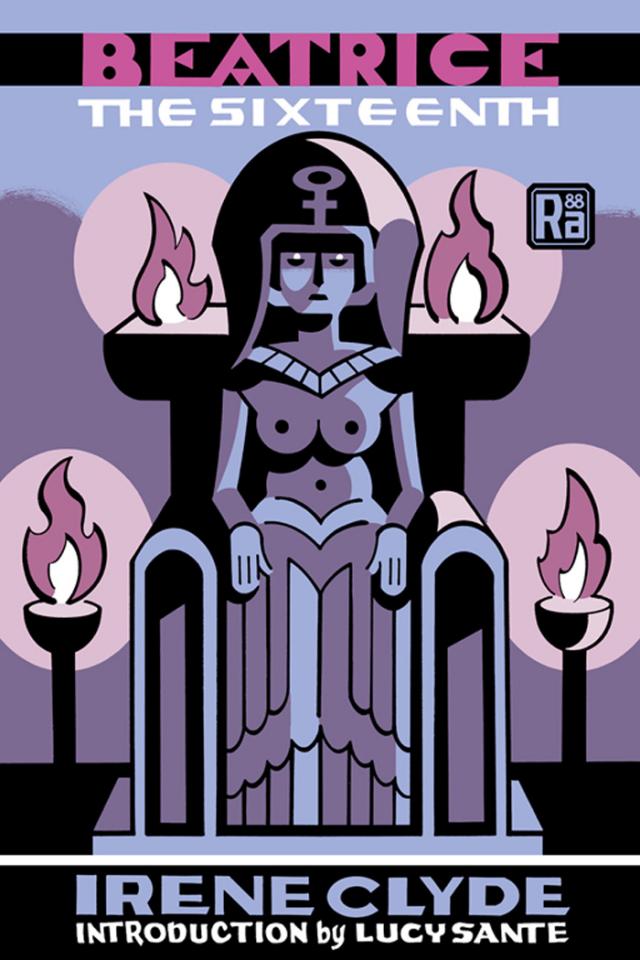
Beatrice the Sixteenth,
p.1


PRAISE FOR THE RADIUM AGE SERIES
“New editions of a host of under-discussed classics of the genre.”
—Reactor Magazine
“Neglected classics of early 20th-century sci-fi in spiffily designed paperback editions.”
—Financial Times
“An entertaining, engrossing glimpse into the profound and innovative literature of the early twentieth century.”
—Foreword
“Shows that ‘proto-sf’ was being published much more widely, alongside other kinds of fiction, before it emerged as a genre.”
—BSFA Review
“An excellent start at showcasing the strange wonders offered by the Radium Age.”
—Shelf Awareness
“Lovingly curated . . . The series’ freedom from genre purism lets us see how a specific set of anxieties—channeled through dystopias, Lovecraftian horror, arch social satire, and adventure tales—spurred literary experimentation and the bending of conventions.”
—Los Angeles Review of Books
“A huge effort to help define a new era of science fiction.”
—Transfer Orbit
“Admirable . . . and highly recommended.”
—Washington Post
“Long live the Radium Age.”
—Los Angeles Times
Beatrice the Sixteenth
The Radium Age Book Series
Joshua Glenn
Voices from the Radium Age, edited by Joshua Glenn, 2022
A World of Women, J. D. Beresford, 2022
The World Set Free, H. G. Wells, 2022
The Clockwork Man, E. V. Odle, 2022
Nordenholt’s Million, J. J. Connington, 2022
Of One Blood, Pauline Hopkins, 2022
What Not, Rose Macaulay, 2022
The Lost World and The Poison Belt, Arthur Conan Doyle, 2023
Theodore Savage, Cicely Hamilton, 2023
The Napoleon of Notting Hill, G. K. Chesterton, 2023
The Night Land, William Hope Hodgson, 2023
More Voices from the Radium Age, edited by Joshua Glenn, 2023
Man’s World, Charlotte Haldane, 2024
The Inhumans and Other Stories: A Selection of Bengali Science Fiction, edited and translated by Bodhisattva Chattopadhyay, 2024
The People of the Ruins, Edward Shanks, 2024
The Heads of Cerberus and Other Stories, Francis Stevens, edited and introduced by Lisa Yaszek, 2024
The Greatest Adventure, John Taine, 2025
The Hampdenshire Wonder, J. D. Beresford, 2025
Superhumans: A Radium Age Proto-Science Fiction Collection, edited by Joshua Glenn, 2025
Yankees in Petrograd, Marietta Shaginyan, edited and introduced by Jill Roese, 2025
Flaxman Low: Occult Detective, E. and H. Heron, edited and introduced by Alexander B. Joy, 2026
Beatrice the Sixteenth, Irene Clyde, 2026
Beatrice the Sixteenth
Irene Clyde
introduction by Lucy Sante
The MIT Press
Cambridge, Massachusetts
London, England
The MIT Press
Massachusetts Institute of Technology
77 Massachusetts Avenue
Cambridge, MA 02139
mitpress.mit.edu
© 2026 Massachusetts Institute of Technology
This edition of Beatrice the Sixteenth follows the text of the 1909 edition published by George Bell & Sons, which is in the public domain.
All rights reserved. No part of this book may be used to train artificial intelligence systems or reproduced in any form by any electronic or mechanical means (including photocopying, recording, or information storage and retrieval) without permission in writing from the publisher.
This book was set in Arnhem Pro and PF DIN Text Pro by New Best-set Typesetters Ltd.
Library of Congress Cataloging-in-Publication Data
Names: Clyde, Irene author | Sante, Lucy writer of introduction
Title: Beatrice the Sixteenth / Irene Clyde ; introduction by Lucy Sante.
Description: Cambridge, Massachusetts : The MIT Press, 2026. | Series: Radium age
Identifiers: LCCN 2025030688 (print) | LCCN 2025030689 (ebook) | ISBN 9780262051620 paperback | ISBN 9780262051637 epub | ISBN 9780262051644 pdf
Subjects: LCSH: Feminist fiction, English | LCGFT: Science fiction | Transgender fiction | Utopian fiction | Novels
Classification: LCC PR6003.A978 B43 2026 (print) | LCC PR6003.A978 (ebook) | DDC 823/.912—dc23/eng/20250915
LC record available at https://lccn.loc.gov/2025030688
LC ebook record available at https://lccn.loc.gov/2025030689
10 9 8 7 6 5 4 3 2 1
EU Authorised Representative: Easy Access System Europe, Mustamäe tee 50, 10621 Tallinn, Estonia | Email: gpsr.requests@easproject.com
d_r0
Contents
Series Foreword
Introduction: An Edwardian Proto-Transwoman
Lucy Sante
1 The Desert
2 The City
3 The Palace
4 The House
5 The Queen
6 The Latticed Door
7 The Frontier
8 The Lattice
9 The War
10 The Camp
11 The Ramparts
12 The Caves
13 The Triumph
Series Foreword
Joshua Glenn
Do we really know science fiction? There were the scientific romance years that stretched from the mid-nineteenth century to circa 1900. And there was the genre’s so-called golden age, from circa 1935 through the early 1960s. But between those periods, and overshadowed by them, was an era that has bequeathed us such tropes as the robot (berserk or benevolent), the tyrannical superman, the dystopia, the unfathomable extraterrestrial, the sinister telepath, and the eco-catastrophe. In 2009, writing for the sf blog io9.com at the invitation of Annalee Newitz and Charlie Jane Anders, I became fascinated with the period during which the sf genre as we know it emerged. Inspired by the exactly contemporaneous career of Marie Curie, who shared a Nobel Prize for her discovery of radium in 1903, only to die of radiation-induced leukemia in 1934, I eventually dubbed this three-decade interregnum the “Radium Age.”
Curie’s development of the theory of radioactivity, which led to the extraordinary, terrifying, awe-inspiring insight that the atom is, at least in part, a state of energy constantly in movement, is an apt metaphor for the twentieth century’s first three decades. These years were marked by rising sociocultural strife across various fronts: the founding of the women’s suffrage movement, the National Association for the Advancement of Colored People, socialist currents within the labor movement, anticolonial and revolutionary upheaval around the world . . . as well as the associated strengthening of reactionary movements that supported, for example, racial segregation, immigration restriction, eugenics, and sexist policies.
Science—as a system of knowledge, a mode of experimenting, and a method of reasoning—accelerated the pace of change during these years in ways simultaneously liberating and terrifying. As sf author and historian Brian Stableford points out in his 1989 essay “The Plausibility of the Impossible,” the universe we discovered by means of the scientific method in the early twentieth century defies common sense: “We are haunted by a sense of the impossibility of ultimately making sense of things.” By playing host to certain far-out notions—time travel, faster-than-light travel, and ESP, for example—that we have every reason to judge impossible, science fiction serves as an “instrument of negotiation,” Stableford suggests, with which we strive to accomplish “the difficult diplomacy of existence in a scientifically knowable but essentially unimaginable world.” This is no less true today than during the Radium Age.
The social, cultural, political, and technological upheavals of the 1900–1935 period are reflected in the proto-sf writings of authors such as Olaf Stapledon, William Hope Hodgson, Muriel Jaeger, Karel Čapek, G. K. Chesterton, Cicely Hamilton, W. E. B. Du Bois, Yevgeny Zamyatin, E. V. Odle, Arthur Conan Doyle, Mikhail Bulgakov, Pauline Hopkins, Stanisław Ignacy Witkiewicz, Aldous Huxley, Gustave Le Rouge, A. Merritt, Rudyard Kipling, Rose Macaulay, J. D. Beresford, J. J. Connington, S. Fowler Wright, Jack London, Thea von Harbou, and Edgar Rice Burroughs, not to mention the late-period but still incredibly prolific H. G. Wells himself. More cynical than its Victorian precursor yet less hard-boiled than the sf that followed, in the writings of these visionaries we find acerbic social commentary, shock tactics, and also a sense of frustrated idealism—and reactionary cynicism, too—regarding humankind’s trajectory.
The MIT Press’s Radium Age series represents a much-needed evolution of my own efforts to champion the best proto-sf novels and stories from 1900 to 1935 among scholars already engaged in the fields of utopian and speculative fiction studies, as well as general readers interested in science, technology, history, and thrills and chills. By reissuing literary productions from a time period that hasn’t received sufficient attention for its contribution to the emergence of science fiction as a recognizable form—one that exists and has meaning in relation to its own traditions and innovations, as well as within a broader ecosystem of literary genres, each of which, as John Rieder notes in Science Fiction and the Mass Cultural Genre System (2017), is itself a product of overlapping “communities of practice”—we hope not only to draw attention to key overlooked works but pe
rhaps also to influence the way scholars and sf fans alike think about this crucial yet neglected and misunderstood moment in the emergence of the sf genre.
John W. Campbell and other Cold War–era sf editors and propagandists dubbed a select group of writers and story types from the pulp era to be the golden age of science fiction. In doing so, they helped fix in the popular imagination a too-narrow understanding of what the sf genre can offer. (In his introduction to the 1974 collection Before the Golden Age, for example, Isaac Asimov notes that although it may have possessed a certain exuberance, in general sf from before the mid-1930s moment when Campbell assumed editorship of Astounding Stories “seems, to anyone who has experienced the Campbell Revolution, to be clumsy, primitive, naive.”) By returning to an international tradition of scientific speculation via fiction from after the Poe–Verne–Wells era and before sf’s Golden Age, the Radium Age series will demonstrate—contra Asimov et al.—the breadth, richness, and diversity of the literary works that were responding to a vertiginous historical period, and how they helped innovate a nascent genre (which wouldn’t be named until the mid-1920s, by Hugo Gernsback, founder of Amazing Stories and namesake of the Hugo Awards) as a mode of speculative imagining.
The MIT Press’s Noah J. Springer and I are grateful to the sf writers and scholars who have agreed to serve as this series’ advisory board. Aided by their guidance, we’ll endeavor to surface a rich variety of texts, along with introductions by a diverse group of sf scholars, sf writers, and others that will situate these remarkable, entertaining, forgotten works within their own social, political, and scientific contexts, while drawing out contemporary parallels.
We hope that reading Radium Age writings, published in times as volatile as our own, will serve to remind us that our own era’s seemingly natural, eternal, and inevitable social, economic, and cultural forms and norms are—like Madame Curie’s atom—forever in flux.
Introduction: An Edwardian Proto-Transwoman
Lucy Sante
First published in 1909, Beatrice the Sixteenth is the story of Mary Hatherley, explorer, geographer, and medical doctor, who at the start has just regained consciousness after being kicked in the head by the camel she was riding through the Arabian desert. She is brought to Armeria, a city that appears utopian in its spacious layout and ease of manners. Domestic chores are done by slaves. Armeria is reliant on slavery and no one thinks twice about it; the slaves are “well-treated.” She is shocked to learn that Armerians foreswore eating flesh centuries before. (They appear to eat mostly fruit, oatcakes, and sweets.) They have no organized religious rites, but their mythology seems to be the same as the Greek one, minus its male gods, who have been either eliminated or demoted to demiurge status.
The Armerians are in turn baffled by the concept of gender. Their language is genderless, and when Mary inquires as to how they refer to people who “fight and wear whiskers and moustaches,” she realizes that there is no one around fitting that description. Their version of marriage is conjux, which means “a joined person . . . the community between two persons of all circumstances.” This is all explained to Mary by Ilex, who becomes her daily guide, and increasingly appears to be her love interest (the feeling is mutual).
Beatrice the Sixteenth appeared under the byline of Irene Clyde. In public life Clyde was known as Thomas Baty (1869–1954), an international lawyer and legal scholar. Baty obtained degrees from both Oxford and Cambridge, was admitted to the bar in 1901, and wrote or co-wrote eight books on international law. His contacts in that field led him to apply successfully to be foreign legal adviser to the Japanese government. He moved there in 1916 and remained until his death 38 years later. He argued Japan’s position at the League of Nations, writing legal opinions justifying Japan’s invasion of China in 1932 and its establishment of the puppet state of Manchukuo. During the war he justified the nation’s expansionist policy and unlike nearly all foreigners did not have his assets frozen by the state. After the war the British government decided he was too insignificant to be charged with treason, but revoked his citizenship.
In private Baty was Irene Clyde, who, one reads in Jana Funke’s 2023 essay “Lesbian-trans-feminist modernism and sexual science,” called for “the elimination of male supremacy, abolition of gender binaries, acknowledgement of the mutability of biological sex, critique of heterosexual marriage and biological reproduction, and celebration of female–female intimacy.” In 1911 she founded the Aëthnic Union, which stood for pacifism, vegetarianism, and above all the elimination of the traditional gender binary; the membership was comprised largely of women from the suffrage movement, as well as from progressive education and animal welfare. When Clyde moved to Japan in 1916, the Union began devoting its energies to the journal Urania, which advocated for the eradication of gender roles and had a small but fervent readership until it stopped publication at the outbreak of World War II. Clyde came out to a select group of friends in a 1926 letter, published posthumously, in which she admitted that she had always wanted to be a girl, and “could not bear to be relegated to the ranks of rough and stern men.” Acquaintances noted her reserve and gentleness, her habitual use of the women’s form of Japanese and, as the years wore on, her increasing adoption of women’s clothing and accessories.
Considering Beatrice the Sixteenth as well as her other activities and advocacies, Irene Clyde is rightly regarded as a transgender pioneer. She wrote at a time when transgender people and activities were just beginning to be documented in Berlin by Magnus Hirschfeld, while in most places they remained deep underground. Was Clyde aware of Hirschfeld? She was, of course, a creature of her time and not ours—she was a Theosophist until she became an adherent of Shinto, and her memberships in the Vegetarian Society and the Anti-Vivisection League were held in common with a great many prewar British intellectuals. Her boldness in publishing the book is striking, but contemporary reviews seem to have largely sidestepped the question of gender. The Herald of the Cross saw it as an occult fable; other sectors applauded the vegetarianism. Nevertheless, the book bombed. Remainder copies were available for forty years. And yet it is amazing that it exists at all. Beatrice the Sixteenth is no crossdressing fantasy, but a vision of an ideal society, one in which humans evolve naturally, perhaps as a reward for their upstanding qualities, into their final female form. In that regard Clyde could be our contemporary. The time when she wrote was a hopeful interval just before the war, a time of utopian visions on subjects such as gender equality and communes and mutual aid and Esperanto and spiritualism and veganism. So Clyde was given a certain cushioning by the ethos of her era, and class also had something to do with it; her work certainly wasn’t going to frighten the horses.
But Clyde gave voice to a shared dream that has lived in individual minds for millennia, since there have always been trans people and they have almost always had to live in deep cover. It required a jurist to expand this alluring but vague fantasy into the lineaments of an entire social world. And that is something to look to, at a time when the president of the United States has employed his executive power to erase transgender people from the public record. Which makes as much sense as deleting any mention of red-headedness or left-handedness, since the transgender situation is simply a biological fact, devoid of moral overtones. The awakening of transgender consciousness, which has been cresting, especially among the young, for the last twenty years approximately, is not something that can be reversed. It keeps happening, even now when transgender people are in real danger, that people young and old find the strength to throw off the shackles of denial. There are many more of us than anyone suspects. And Irene Clyde in 1909 had a premonitory vision of it all.
As a creature of her time, of course, she wanted not merely to be a woman but to be a lady, with the full connotations of that time: well-born, gently reared, soft-spoken, demure creatures in gowns by Worth or Paul Poiret who glided through rooms, laughed behind their fans, and never broke a sweat. Certainly Armeria is a land for such persons, in which a leisured class inhales art and culture and wisdom while others toil for them. They don’t bear children, either, so like the Shakers they have to import them. Unlike the Shakers, they accomplish this by barter. On a trip to neighboring countries with Ilex, Mary observes “a procession of dirty, unkempt denizens of the prairie,” each bearing one or two infants, who are then stacked “like so much merchandise” on the ground. The Armerians advance “an equally imposing pile of carpets and woven tissues of the commonest sort,” and the trade is concluded.


