A matter of death and li.., p.1
A Matter of Death and Life,
p.1
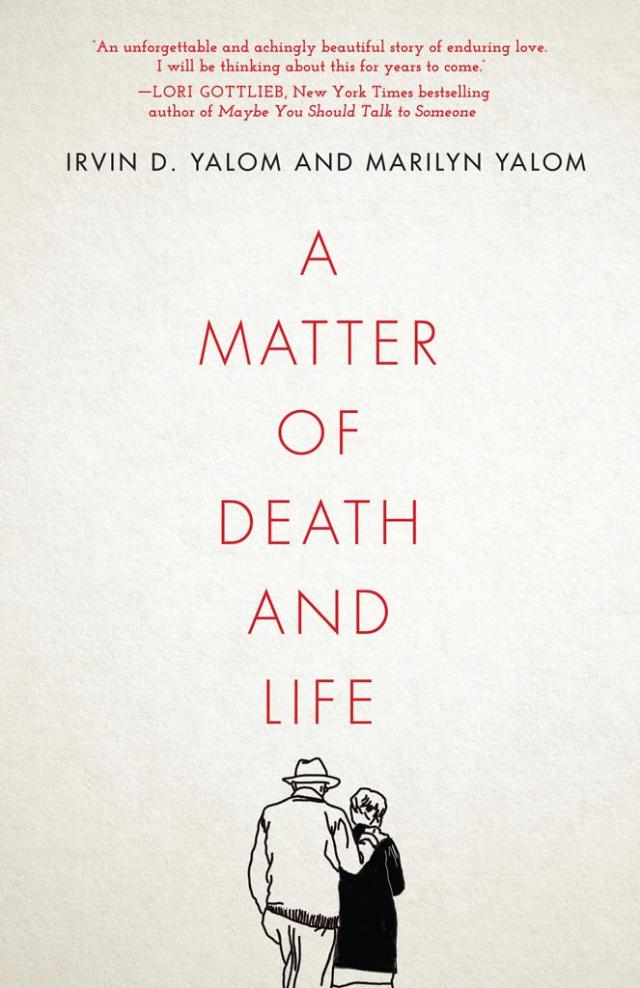


A MATTER OF Death and Life
Irvin D. Yalom & Marilyn Yalom
REDWOOD PRESS
Stanford, California
STANFORD UNIVERSITY PRESS
Stanford, California
© 2021 by Irvin D. Yalom and Marilyn Yalom. All rights reserved. Epigraph by Rabbi Sanford Ragins, originally published in L’chol Z’man v’Ei: For Sacred Moments –New Rabbi’s Manual, CCAR Press, © 2015 by Sanford Ragins. Reprinted with permission.
Excerpt from “Let Evening Come” by Jane Kenyon from Collected Poems. Copyright © 2005 by The Estate of Jane Kenyon. Reprinted with the permission of The Permissions Company LLC on behalf of Graywolf Press, graywolfpress.org.
No part of this book may be reproduced or transmitted in any form or by any means, electronic or mechanical, including photocopying and recording, or in any information storage or retrieval system without the prior written permission of Stanford University Press.
Printed in the United States of America on acid-free, archival-quality paper
Library of Congress Cataloging-in-Publication Data
Names: Yalom, Irvin D., 1931-author. | Yalom, Marilyn, author.
Title: A matter of death and life / Irvin D. Yalom and Marilyn Yalom.
Description: Stanford, California : Redwood Press, 2021.
Identifiers: LCCN 2020035303 (print) | LCCN 2020035304 (ebook) | ISBN 9781503613768 (cloth) | ISBN 9781503627772 (epub)
Subjects: LCSH: Yalom, Irvin D., 1931-| Yalom, Marilyn—Health. | Yalom, Marilyn—Death and burial. | Psychiatrists—United States—Biography. | Spouses of cancer patients—United States—Biography. | Multiple myeloma—Patients—United States—Biography. | Terminally ill—United States—Biography. | Women historians—United States—Biography. | LCGFT: Autobiographies.
Classification: LCC RC339.52.Y35 A3 2021 (print) | LCC RC339.52.Y35 (ebook) | DDC 616.890092 [B]—dc23
LC record available at https://lccn.loc.gov/2020035303
LC ebook record available at https://lccn.loc.gov/2020035304
Cover design: Rob Ehle
Text design: Kevin Barrett Kane
Typeset at Stanford University Press in 11/15 Galliard Pro
Praise for A Matter of Death and Life
“For over half a century, the eminent psychiatrist Irvin Yalom has dazzled the world with his stories of the human psyche packed with wisdom, insight, and humor. Now, with stunning candor and courage, he shares with us the most difficult experience of his life: the loss of his wife and steadfast companion since adolescence. Partners to the end, including in the co-writing of this book, they share an indelible portrait of bereavement—the terror, pain, denial, and reluctant acceptance. But what we are left with is much more than a profound story of enduring loss—it’s an unforgettable and achingly beautiful story of enduring love. I will be thinking about this for years to come.”
—Lori Gottlieb, New York Times bestselling author of Maybe You Should Talk to Someone: A Therapist, Her Therapist, and Our Lives Revealed
“This beautiful, poignant, and uplifting memoir is a love story, a tale of two incredibly accomplished lives that were lived almost as one, the sum turning out to be so much greater than its parts. It will inspire you and perhaps move you to look differently at your life—it did that for me.”
—Abraham Verghese, author of Cutting for Stone
“The Yaloms are not just honest, but astonishingly generous with their readers. This book takes its immediate place in the canon of great end-of-life memoirs.”
—Caitlin Doughty, founder of The Order of the Good Death
“A Matter of Death and Life is both a sweet reminiscence and a path to discovery. Two eminent professors, authors, and lifelong partners grapple with aging, fragility, and death. In the process of honestly meeting the precariousness of life, they come to a deeper appreciation of its preciousness.”
—Frank Ostaseski, author of The Five Invitations: Discovering What Death Can Teach Us About Living Fully
“A Matter of Death and Life is so much more than a book. It is an indefatigable love story. It is a text that traverses past and present. It is exquisite, candid, and vulnerable—absent the too-common defenses of artifice and pomposity—as it approaches the untenable pain of separation and unyielding yearning of loss. Every person would benefit from multiple readings of this intelligently relatable book, both to confront dying as we inch toward our own mortality and, perhaps more importantly, the grief when one so beloved precedes us in death. I am deeply enriched for having absorbed this intimate narrative, as I wipe the tears from my eyes. Irv and Marilyn’s love story, ending in the tragedy of endings, is yours, mine, and all of ours.”
—Dr. Joanne Cacciatore, author of Bearing the Unbearable: Love, Loss, and the Heartbreaking Path of Grief
“This is a remarkable book—as remarkable as its authors, Irv Yalom, the master existential therapist and widely read author, and Marilyn Yalom, an accomplished scholar and writer. Summoning immense courage, the Yaloms co-write the story of their emotional and moral caregiving for each other. A Matter of Death and Life is the culmination of the Yaloms’ career-long quests for wisdom in the art of living and dying. It is a book that transforms the reader—I couldn’t put it down.”
—Arthur Kleinman, author of The Soul of Care: The Moral Education of a Husband and Doctor
Mourning is the price we pay for having the courage to love others.
CONTENTS
Preface
1. The Vital Box
2. Becoming an Invalid
3. Awareness of Evanescence
4. Why Don’t We Move to Assisted Living?
5. Retirement: The Precise Moment of Decision
6. Setbacks and Renewed Hopes
7. Staring at the Sun, Once Again
8. Whose Death Is This Anyway?
9. Facing Endings
10. Considering Physician-Assisted Suicide
11. A Tense Countdown to Thursday
12. A Complete Surprise
13. So Now You Know
14. Death Sentence
15. Farewell to Chemotherapy—and to Hope
16. From Palliative Care to Hospice
17. Hospice Care
18. A Soothing Illusion
19. French Books
20. The End Approaches
21. Death Arrives
22. The After-Death Experience
We Will Remember
23. Life as an Independent, Separate Adult
24. Home Alone
25. Sex and Grief
26. Unreality
27. Numbness
28. Help from Schopenhauer
29. Denial Revealed
30. Stepping Out
31. Indecisiveness
32. On Reading My Own Work
33. Seven Advanced Lessons in the Therapy of Grief
34. My Education Continues
35. Dear Marilyn
PREFACE
We both embarked on academic careers after postgraduate training at Johns Hopkins, where I had completed a residency in psychiatry and Marilyn obtained a PhD in comparative (French and German) literature. We were always each other’s first reader and editor. After I wrote my first book, a textbook on group therapy, I was awarded a writing fellowship from the Rockefeller Foundation at the Bellagio Writing Center in Italy to work on my next book, Love’s Executioner. Shortly after we arrived, Marilyn spoke to me about her growing interest in writing about women’s recollections of the French Revolution, and I agreed that she had ample excellent material for a book. All of the Rockefeller scholars had been given an apartment and a separate writing studio, and I urged her to ask the director whether there might also be a writing studio for her. The director responded that a writing studio for a scholar’s spouse was an unusual request and, furthermore, all the studios in the main structure had already been assigned. But, after a few minutes of reflection, he offered Marilyn an unused tree house studio only a five-minute walk away in the adjoining forest. Delighted with it, Marilyn began work, with gusto, on her first book, Compelled to Witness: Women’s Memoirs of the French Revolution. She was never happier. From that point on, we were fellow writers, and for the rest of her life, despite four children and full-time teaching and administrative positions, she matched me book for book.
In 2019, Marilyn was diagnosed with multiple myeloma, a cancer of the plasma cells (antibody-producing white blood cells found in the bone marrow). She was placed on a chemotherapy drug, Revlimid, that precipitated a stroke, leading to an emergency room visit and four days in the hospital. Two weeks after she returned home, we took a brief walk in the park just a block from our home, and Marilyn announced, “I have a book in mind that we should write together. I want to document the difficult days and months before us. Perhaps our trials will be of some use to other couples with one member facing a fatal illness.”
Marilyn often suggested topics for books that she or I should undertake, and I replied, “It’s a good idea, darling, something you should plunge into. The idea of a joint project is enticing but, as you know, I’ve already started on a book of stories.”
“Oh, no, no—you’re not writing that book. You’re writing this one with me! You'll write your chapters and I'll write mine, and they will alternate. It will be our book, a book unlike any other book because it entails two minds rather than one, the reflections of a couple who have been married for sixty-five years! A couple very fortunate to have each other as we walk the path that eventually l
eads to death. You’ll walk with your three-wheeled walker, and I’ll walk on legs that can ambulate for fifteen or twenty minutes at best.”
* * *
In his 1980 book, Existential Psychotherapy, Irv wrote that it is easier to face death if you have few regrets about the life you have lived. In looking back over our long life together, we regret very little. But that doesn’t make it any easier to tolerate the bodily travails we now experience day to day, nor does it soften the thought of leaving each other. How can we fight against despair? How do we live meaningfully till the very end?
* * *
In writing this book, we are at an age when most of our contemporaries have died. We now live each day with the knowledge that our time together is limited and exceedingly precious. We write to make sense of our existence, even as it sweeps us into the darkest zones of physical decline, and death. This book is meant, first and foremost, to help us navigate the end of life.
While this book is obviously an outgrowth of our personal experience, we also see it as part of a national dialogue about end-of-life concerns. Everyone wants to obtain the best medical care available, to find emotional support in family and friends, and to die as painlessly as possible. Even with our medical and social advantages, we are not immune to the pain and fear of oncoming death. Like everyone, we want to preserve the quality of our remaining lives, even as we tolerate medical procedures that sometimes make us sick in the process. How much are we willing to bear to stay alive? How can we end our days as painlessly as possible? How can we gracefully leave this world to the next generation?
We both know that, almost certainly, Marilyn will die of her illness. Together we shall write this journal of what lies ahead in the hope that our experiences and observations will provide meaning and succor not only for us but for our readers.
Irvin D. Yalom Marilyn Yalom
April
CHAPTER 1
THE VITAL BOX
OVER AND AGAIN I, IRV, FIND myself running my fingers over the upper left part of my chest. For the past month I’ve had a new object in there, a 2 × 2–inch metal box implanted by a surgeon whose name and face I no longer recall. It all began in a session with a physical therapist whom I had contacted for help with my impaired balance. While taking my pulse at the beginning of our hour, she suddenly turned toward me and, with a shocked look on her face, said, “You and I are going to the ER right now! Your pulse is 30.”
I tried to calm her. “It’s been slow for months, and I’m asymptomatic.”
My words had little impact. She refused to continue our physical therapy session and extracted a promise from me to contact my internist, Dr. W., immediately to discuss the matter.
Three months before, at my annual physical exam, Dr. W. had noted my slow, and occasionally irregular, pulse and referred me to the Stanford arrhythmia clinic. They pasted a Holter monitor on my chest that recorded my heartbeat for a two-week period. The results showed a consistently slow pulse marked by periodic short bouts of auricular fibrillation. To protect me from throwing off a blood clot to the brain, Dr. W. started me on Eliquis, an anticoagulant. Though Eliquis protected me from a stroke, it promoted a new worry: I had had balance problems for a couple of years, and a serious fall could now be lethal because there is no way to reverse the anticoagulant and halt the bleeding.
When Dr. W. examined me two hours after the physical therapist’s referral, he agreed that my pulse had grown even slower and arranged for me to wear a Holter monitor once again to record my heart activity for two weeks.
Two weeks later, after the arrythmia clinic technician removed my Holter monitor and sent the recording of my heart activity to the laboratory for study, another alarming episode occurred, this time to Marilyn: she and I were conversing and, suddenly, she was unable to speak, unable to utter a single word. This persisted for five minutes. Then, over the next several minutes, she slowly regained her ability to speak. Almost certainly, I thought, she had suffered a stroke. Marilyn had been diagnosed with multiple myeloma two months earlier and had begun Revlimid. A stroke could have been caused by this heavy-duty chemotherapy drug she had been taking for the past two weeks. I immediately phoned Marilyn’s internist who happened to be nearby and rushed to our home. After a quick examination, she called an ambulance to take Marilyn to the emergency room.
The next few hours in the emergency room waiting area were the worst hours Marilyn and I had ever experienced. The physicians on duty ordered some brain imaging that verified she had indeed had a stroke as a result of a blood clot. They proceeded to administer a drug, TPA (tissue plasminogen activator), to break up the clot. A very small percentage of patients are allergic to this drug—alas, Marilyn was one of those and she almost died in the emergency room. Gradually she recovered with no residua from the stroke and after four days was discharged from the hospital.
But fate was not through with us. Only a few hours after I brought Marilyn home from the hospital, my physician phoned and told me that the results of my heart study had just arrived and that it was essential for me to have an external pacemaker surgically inserted into my thorax. I replied that Marilyn had just arrived home from the hospital and I was entirely preoccupied attending to her. I assured him that I would arrange for admission to surgery early the next week.
“No, no, Irv,” my physician replied, “listen to me: this is not optional. You must get to the emergency room within the hour for immediate surgery. Your two-week heart recording showed you had had 3,291 atrial-ventricular blocks lasting a total of one day, six hours.”
“Exactly what does that mean?” I asked. My last instruction in cardiac physiology was close to sixty years ago, and I make no pretense of being abreast of medical progress.
“It means,” he said, “that in the last two-week period there were over 3,000 occasions when the electrical impulse from your natural pacemaker in the left atrium did not get through to the ventricle below. This resulted in a pause until the ventricle responded erratically to contract the heart on its own. This is life-threatening, and it must be treated immediately.”
I immediately checked into the ER where a cardiac surgeon examined me. Three hours later, I was wheeled into the operating room, and an external pacemaker was inserted. Twenty-four hours later I was discharged from the hospital.
* * *
The bandages have been removed, and the metal box sits in my chest just below the left clavicle. Seventy times a minute this metal gadget commands my heart to contract, and it will continue to do so without any kind of recharge for the next twelve years. It is like no other mechanical device I have ever encountered. Unlike a flashlight that fails to light, a TV remote that will not change channels, a cell phone navigator that will not guide, this tiny device operates with the highest possible stakes: should it fail, my life would end in a matter of minutes. I am stunned by the frailty of my mortality.
So that’s my current situation: Marilyn, my dear wife, the most important person in my world since I was 15 years old, is suffering from a grievous illness and my own life feels perilously frail.
And yet, oddly, I am calm, almost serene. Why am I not terrified? Over and again I pose this strange question to myself. For much of my life I’ve been physically healthy and yet, at some level, always struggled with death anxiety. I believe that my research and writing about death anxiety and my continued attempts to bring relief to patients facing death were fueled by my own personal terror. But, now, what has happened to that terror? Whence cometh my calmness when death veers ever so very much closer?
As days pass, our ordeals fade more into the background. Marilyn and I spend mornings sitting next to one another in our backyard. Admiring the surrounding trees, we hold hands while reminiscing about our life together. We recall our many trips: our two years in Hawaii when I was in the army and we lived on a glorious Kailua beach, our sabbatical year in London, another six months living near Oxford, several months in Paris, other long sojourns in the Seychelles, Bali, France, Austria, and Italy.
After we revel in these exquisite memories, Marilyn squeezes my hand and says, “Irv, there is nothing I would change.”
I agree, wholeheartedly.
Both of us feel we’ve lived our lives fully. Of all the ideas I’ve employed to comfort patients dreading death, none has been more powerful than the idea of living a regret-free life. Marilyn and I both feel regret-free—we’ve lived fully and boldly. We were careful not to allow opportunities for exploration to pass us by and now have left little remaining unlived life.