

Catch that rabbit ss, p.1
Catch That Rabbit (ss),
p.1
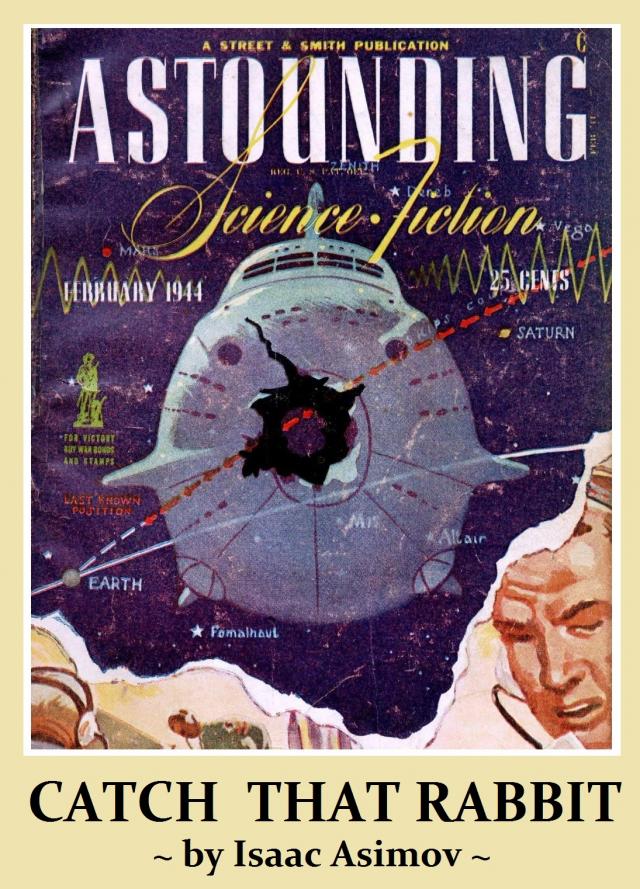


Catch That Rabbit
by ISAAC ASIMOV
When a machine breaks down and stops, an expert can usually fix it.
But their problem was a robot that went crazy—became homicidal— only when there were no homos to cide!
Illustrated by Orban
From Astounding Science Fiction February 1944 edition
Michael Donovan’s face went beety, “For the love of Pete, Greg, get realistic. What’s the use of adhering to the letter of the specifications and watching the test go to pot? It’s about time you got the red tape out of your pants and went to work.”
“I’m only saying,” said Gregory Powell patiently, as one explaining electronics to an idiot child, “that according to spec, those robots are equipped for asteroid mining without supervision. We’re not supposed to watch them.”
“All right. Look—logic!” He lifted his hairy fingers and pointed. “One: That new robot passed every test in the home laboratories. Two: United. States Robots guaranteed their passing the test of actual performance on an asteroid. Three: The robots aren’t passing said tests. Four: If they don’t pass, United i States Robots lose ten million credits in cash and about one hundred million in reputation. Five: If they don’t pass and we can’t explain why they don’t pass, it is just possible two good jobs may have to be bidden a fond farewell.”
Powell groaned heavily behind a noticeably insincere smile. The unwritten motto of United States Robot and Mechanical Men Corp. was well-known: “No employee makes the same mistake twice. He is fired the first time.”
Aloud he said, “You’re as lucid as Euclid with everything except facts. You’ve watched that robot group for three shifts, you* redhead, and they did their work perfectly. You said so yourself. What else can we do?”
“Find out what’s wrong, that’s what we can do. So they did work perfectly when I watched them. But on three different occasions when I didn’t watch them, they didn’t bring in any ore! They didn’t even come back on schedule. I had to go after them.”
“And was anything wrong?”
“Not a thing. Not a thing. Everything was perfect. Smooth and perfect as the luniniferous ether. Only one little insignificant detail disturbed me—there was no ore”
Powell scowled at the ceiling and pulled at his brown mustache. “I’ll tell you what, Mike. We’ve been stuck with pretty lousy jobs in our time, but this takes the iridium asteroid. The whole business is complicated past endurance. Look, that robot, DV-5, has six robots under it. And not just under it—they’re part of it.”
“I know that—”
“Shut up!” said Powell, savagely. “I know you know it, but I’m just describing the hell of it. Those six subsidiaries are part of DY-5 like your fingers are part of you, and it gives them their orders neither by voice nor radio, but directly through positronic fields. Now—there isn’t a roboticist back at United States Robots ^hat knows what a positronic field is or how it works. And neither do I…• and neither do you.”
“The last,” agreed Donovan, philosophically, “I know.”
“Then look at our position. If everything works—fine! If anything goes wrong—we’re up Trash Creek, without any oar. We’re on the spot, Mike.” He blazed away for a moment in silence. Then, “All right, have you got him outside?”
“Yes.”
“Is everything normal now?”
“Well, he hasn’t got religious mania, and he isn’t running around in a circle spouting Gilbert and Sullivan, so I suppose he’s normal.”
Donovan passed out the door, shaking his head viciously.
Powell reached for the “Handbook of Robotics” that weighed down one side of his desk to a near-founder and opened it reverently. He had once jumped out of the window of a burning house dressed only in shorts and the “Handbook.” In a pinch, he would have skipped the shorts.
The “Handbook” was propped up before him. when Robot DV-5 entered, with Donovan kicking the door shut behind him.
Powell said somberly, “Hi, Dave. How do you feel?”
“Fine,*‘said the robot. “Mind if I sit down?” He dragged up the specially reinforced chair that was his, and folded gently into it.
Powell regarded Dave—laymen might think of robots by their serial numbers: roboticists never—with approval. It was not over-massive by any means, in spite of its construction as thinking-unit of an integrated seven-unit robot team. It was seven feet tall, and a lousy half-ton of metal and electricity. A lot? Not when that half-ton has to be a mass of condensers, circuits, relays, and vacuum cells that can handle practically any psychological reaction known to humans. And a positronic brain, which with ten pounds of matter and a few quintillion quintillions of positrons runs the whole show.
Powell groped in his shirt pocket for a loose cigarette. “Dave,” he said, “you’re a good fellow. There’s nothing flighty or prima donna-ish about you. You’re a stable, rock-bottom mining robot, except that you’re equipped to handle six subsidiaries in direct coordination. As far as I know, that has not introduced any unstable paths into your brain-path map.”
The robot nodded, “That makes me feel swell, but what are you getting at, boss?” He was equipped with an excellent diaphragm, and the presence of overtones in the sound unit robbed him of much of that metallic flatness that marks the usual robot voice.
“I’m going to tell you. With all that in your favor, what’s going wrong with your job? For instance, today’s B-shift?”
Dave hesitated, “As far as I know, nothing.”
“You didn’t produce any ore.”
“I know.”
“Well, then—”
Dave was having trouble, “I can’t explain that, boss. It’s been giving me a case of nerves, or it would if I let it. My subsidiaries worked smoothly. I know I did.” He considered, his photoelectric eyes glowing intensely. Then, “I don’t remember. The day ended and there was Mike and there were the ore cars, mostly empty.”
Donovan broke in, “You didn’t report at shift-end those days, Dave. You know that?”
“I know. But as to why—” He shook his head slowly and ponderously.
Powell had the queasy feeling that if the robot’s face were capable of expression, it would be one of pain and mortification. A robot, by its very nature, cannot bear to fail its function.
Donovan dragged his chair up to Powell’s desk and leaned over, “Amnesia, do you think?”
“Can’t say. But there’s no use in trying to pin disease names on this. Human disorders apply to robots only as romantic analogies. They’re no help to robotic engineering.” He scratched his neck, “I hate to put him through the elementary brain-reaction tests. It won’t help his self-respect any.” He looked at Dave thoughtfully and then at the Field-Test Outline given in the “Handbook.” He said, “See here, Dave, what about sitting through a test. It would be the wise thing to do.”
The robot rose, “If you say so, boss.” There was pain in his voice.
It started simply enough. Robot DV-5 multiplied five-place figures to the heartless ticking of a stop watch. He recited the prime numbers between a thousand and ten-thousand. He extracted cube roots and integrated functions of varying complexity. He went through mechanical reactions in order of increasing difficulty. And, finally, worked his precise mechanical mind over the highest function of the robot world—the solution of problems in judgment and ethics.
At the end of two hours, Powell was copiously be-sweated, Donovan had enjoyed a none-too-nutritious diet of fingernail and the robot said, “How does it look, boss?”
Powell said, “I’ve got to think it over, Dave. Snap judgments won’t help much. Suppose you go back to the C-shift. Take it easy. Don’t press too hard for quota just for a while—and we’ll fix things up.” The robot left. Donovan looked at Powell.
“Well—”
Powell seemed determined to pull up his mustache by the roots. He said, “There is nothing wrong with the currents of his positronic brain.”
“I’d hate to be that certain.”
“Oh, Jupiter, Mike! The brain is the surest part of a robot. It’s quintuple-checked back on Earth. If they pass the field test perfectly, the way Dave did, there just isn’t a chance of brain mis-function. That test covered every key path in the brain.”
“So where are we?”
“Don’t rush me. Let me work this out. There’s still the possibility of a mechanical breakdown in his body. That leaves about fifteen hundred condensers, twenty thousand individual electric circuits, five hundred vacuum cells, a thousand relays, and upty-ump thousand other individual pieces of complexity that can be wrong. And these mysterious positronic fields no one knows anything about.”
“Listen, Greg,” Donovan grew desperately urgent. “I’ve got an idea. That robot may be lying. He never—”
“Robots can’t knowingly lie, you fool. Now if we had the McCormack-Wesley tester, we could check each individual item in his body within twenty-four to forty-eight hours, but the only two M.-W. testers existing are on Earth, and they weigh ten tons, are on concrete foundations, and can’t be moved. Isn’t that peachy?”
Donovan pounded the desk, “But, Greg, he only goes wrong when we’re not around. There’s something—sinister—about—that.” He punctuated the sentence with slams of fist against desk.
“You,” said Powell, slowly, “make me sick. You’ve been reading adventure novels.”
“What I want to know,” shouted Donovan, “is what we’re going to do about it.”
&nbs
p; “I’ll tell you. I’m going to install a visiplate right over my desk. Right on the wall over there, see!” He jabbed a vicious finger at the spot. “Then I’m going to focus it at whatever part of the mine is being worked, and I’m going to watch. That’s all.”
“That’s all? Greg—”
Powell rose from his chair and leaned his balled fists on the desk, “Mike, I’m having a hard time.” His voice was weary. “For a week, you’ve been plaguing me about Dave. You say he’s gone wrong. Do you know how he’s gone wrong? No! Do you know what shape this wrongness takes? No! Do you know what brings it on? No! Do you know what snaps him out? No I Do you know anything about it? Nol Do I know anything about it? No*! So what do you want me to do?”
Donovan’s arm swept outward in a vague, grandiose gesture, “You got me!”
“So I tell you again. Before we do anything towards a cure, we’ve got to find out what the disease is m the first place. The first step in cooking rabbit stew is catching the rabbit. Well, we’ve got to catch that rabbit! Now get out of here.”
Donovan stared at the preliminary outline of his field report with weary eyes. For one thing, he was tired and for another, what was there to report while things were unsettled? He felt resentful.
He said, “Greg, we’re almost a thousand tons behind schedule.”
“You,” replied Powell, never looking up, “are telling me something I don’t know.”
“What I want to know,” said Donovan, in sudden savagery, “is why we’re always tangled up with new-type robots. I’ve finally decided that the robots that were good enough for my great-uncle on my mother’s side are good enough for me. I’m for what’s tried and true. The test of time is what counts—good, solid, old-fashioned robots that never go wrong.”
Powell threw a book with perfect aim, and Donovan went tumbling off his seat.
“Your job,” said Powell, evenly, “for the last five years has been to test new robots under actual working conditions for United States Robots. Because you and I have been so injudicious as to display proficiency at the task, we’ve been rewarded with the dirtiest jobs. That,” he jabbed holes in the air with his finger in Donovan’s direction, “is your work. You’ve been griping about it, from personal memory, since about five minutes after United States Robots signed you up. Why don’t you resign?”
“Well, I’ll tell you.” Donovan rolled onto his stomach, and took a firm grip on his wild, red hair to hold his head up. “There’s a certain principle involved. After all, as a trouble shooter, I’ve played a part in the development of new robots. There’s the principle of aiding scientific advance. But don’t get me wrong. It’s not the principle that keeps me going; it’s the money they pay us. Greg l”
Powell jumped at Donovan’s wild shout, and his eyes followed the redhead’s to the visiplate, when they goggled in fixed horror. He whispered, “Holy—howling—Jupiter!” Donovan scrambled breathlessly to his feet, “Look at them, Greg. They’ve gone nuts .”
Powell said, “Get a pair of suits. We’re going out there.”
He watched the posturings of the robots on the visiplate. They were bronzy gleams of smooth motion against the shadowy crags of the airless asteroid. There was a marching formation now, and in their own dim body light, the rough-hewn walls of the mine tunnel swam past noiselessly, checkered with misty erratic blobs of shadow. They marched in unison, seven of them, with Dave at the head. They wheeled and turned in macabre simultaneity; and melted through changes of formation with the weird ease of chorus dancers in Lunar Bowl.
Donovan was back with the suits, “They’ve gone jingo on us, Greg. That’s a military march.”
“For all you know,” was the cold response, “it may be a series of calisthenic exercises. Or Dave may be under the hallucination of being a dancing master. Just you think first, and don’t bother to speak afterward, either.”
Donovan scowled and slipped a detonator into the empty side holster with an ostentatious shove. He said, “Anyway, there you are. So we work with new-model robots. It’s our job, granted. But answer me one question. Why…why does something invariably go wrong with them?”
“Because,” said Powell, somberly, “we are accursed. Let’s go!”
Far ahead through the thick velvety blackness of the corridors that reached past the illuminated circles of their flashlights, robot light twinkled.
“There they are,” breathed Donovan.
Powell whispered tensely, “I’ve been trying to get him by radio but he doesn’t answer. The radio circuit is probably out.”
“Then I’m glad the designers haven’t worked out robots who can work in total darkness yet. I’d hate to have to find seven mad robots in a black pit without radio communication, if they weren’t lit up like blasted radioactive Christmas trees.”
“Crawl up on the ledge above, Mike. They’re coming this way, and I want to watch them at close range. Can you make it?”
Donovan made the jump with a grunt. Gravity was considerably below Earth-normal, but with a heavy suit, the advantage was not too great, and the ledge meant a near ten-foot jump. Powell followed.
The column of robots were trailing Dave single-file. In mechanical rhythm, they converted to double and returned to single in different order. It was repeated over and over again and Dave never turned his head.
Dave was within twenty feet when the play-acting ceased. The subsidiary robots broke formation, waited a moment, then clattered off into the distance—very rapidly. Dave looked after them, then slowly sat down. He rested his head in one hand in a very human gesture.
His voice sounded in Powell’s earphones, “Are you here, boss?”
Powell beckoned to Donovan and hopped off the ledge.
“O.K., Dave, what’s been going on?”
The robot shook his head, “I don’t know. One moment I was handling a tough outcropping in Tunnel 17, and the next I was aware of humans close-by, and I found myself half a mile down main-stem.”
“Where are the subsidiaries now?” asked Donovan.
“Back at work, of course. How much time has been lost?”
“Not much. Forget it.” Then to Donovan, Powell added “Stay with him the rest of the shut. Then, come back. I’ve got a couple of ideas.”
It was three hours before Donovan returned. He looked tired. Powell said, “How did it go?” Donovan shrugged wearily, “Nothing ever goes wrong when you watch them. Throw me a butt, will you?”
The redhead lit it with exaggerated care and blew a careful smoke ring. He said, “I’ve been working it out, Greg. You know, Dave has a queer background for a robot. There are six others under him in an extreme of regimentation. He’s got life and death power over those subsidiary robots and it must react on his mentality. Suppose he finds it necessary to emphasize this power as a concession to his ego.”
“Get to the point.”
“It’s right here. Suppose we have militarism. Suppose he’s fashioning himself an army. Suppose he’s training them in military maneuvers. Suppose—”
“Suppose you go soak your head. Your nightmares must be in technicolor. You’re postulating a major aberration of the positronic brain. If your analysis were correct, Dave would have to break down the First Law of Robotics: that a robot may not injure a human being or, through inaction, allow a human being to be injured. The type of militaristic attitude and domineering ego you propose must have as the endpoint of its logical implications, domination of humans.”
“All right. How do you know that isn’t the fact of the matter?”
“Because any robot with a brain like that would, one, never have left the factory, and two, be spotted immediately if it ever was. I tested Dave, you know.”
Powell shoved his chair back and put his feet on the desk. “No. We’re still in the position where we can’t make our stew because we haven’t caught our rabbit. We still haven’t the slightest notion as to what’s wrong. For instance, if we could find out what that danse macabre we witnessed was all about, we’d be on the way out.”
He paused, “Now listen, Mike, how does this sound to you? Dave goes wrong only when neither of us are present. And when he is wrong, the arrival of either of us snaps him out of it.”


