

Death sentence ss, p.1
Death Sentence (ss),
p.1
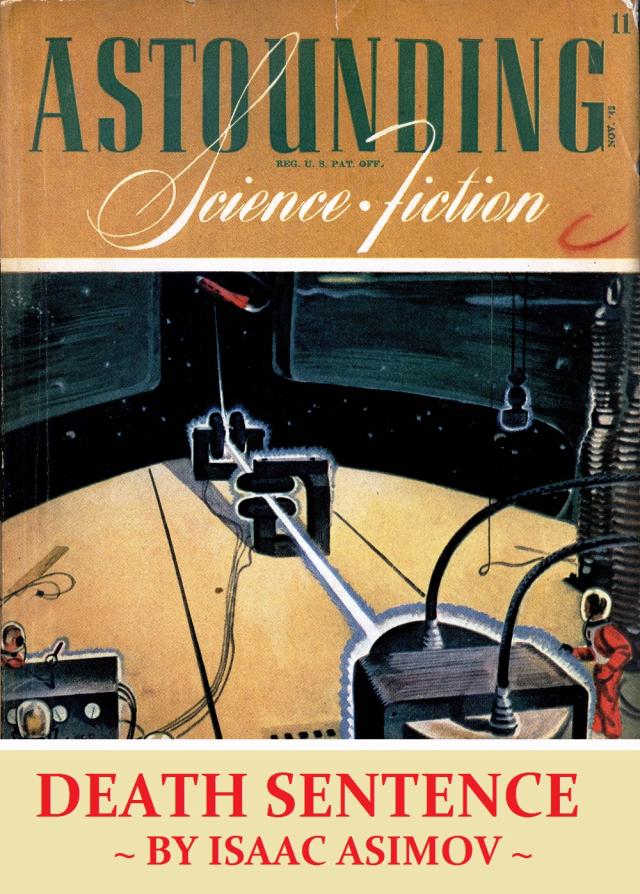


Death Sentence
by Isaac Asimov
Illustrated by Fax
Our psychologists of today have set up colonies of monkeys and other animals as experiments. On a larger scale, with larger means, a greater experiment
could be undertaken—
From: Astounding Science Fiction, November 1943 edition
Brand Gorla smiled uncomfortably, ’ ’These things exaggerate, you know.”
“No, no, no!” The little man’s albino-pink eyes snapped. “Dorlis was great when no human had ever entered the Vegan System. It was the capital of a Galactic Confederation greater than ours.”
“Well, then, let’s say that it was an ancient capital. I’ll admit that and leave the rest to an archaeologist.”
“Archaeologists are no use. What I’ve discovered needs a specialist in its own field. And you’re on the Board.”
Brand Gorla looked doubtful. He remembered. Theor Realo in senior year—a little white misfit of a human who skulked somewhere in the background of his reminiscences.
It had been a long time ago, but the albino had been queer. That was easy to remember. And he was still queer.
“I’ll try to help,” Brand said, “if you’ll tell me what you want.” Theor watched intently, “I want you to place certain facts before the Board. Will you promise that?” Brand hedged, “Even if I help you along, Theor, I’ll have to remind you that I’m junior member of the Psychological Board. I haven’t much influence.”
“You must do your best. The facts will speak for themselves.” The albino’s hands were trembling.
“Go ahead.” Brand resigned himself. The man was an old school fellow. You couldn’t be too arbitrary about things.
Brand Gorla leaned back and relaxed. The light of Arcturus shone through the ceiling-high windows, diffused and mellowed by the polarizing glass. Even this diluted version of sunlight was too much for the pink eyes of the other, and he shaded his eyes as he spoke.
“I’ve lived on Dorlins twenty-five years, Brand,” he said, “I’ve poked into places no one today knew existed, and I’ve found things. Dorlis was the scientific and cultural capital of a civilization greater than ours. Yes it was, and particularly in psychology.”
“Things in the past always seem greater.” Brand condescended a smile. “There is a theorem to that effect which you’ll find in any elementary text. Freshmen invariably call it the “GOD Theorem.”
Stands for ‘Good-Old-Days,’ you know. But go on.”
Theor frowned at the digression. He hid the beginning of a sneer, “You can always dismiss an uncomfortable fact by pinning a dowdy label to it. But tell me this. What do you know of Psychological Engineering?”
Brand shrugged, “No such thing. Anyway, not in the strict mathematical sense. All propaganda and advertising is a crude form of hit-and-miss Psych Engineering—and pretty effective sometimes. Maybe that’s what you mean.”
“Not at all. I mean actual experimentation, with masses of people, under controlled conditions, and over a period of years.”
“Such things have been discussed, It’s not feasible in practice. Our social structure couldn’t stand much of it, and wc don’t know enough to set up effective controls.”
Theor suppressed excitement, “But the ancients did know enough. And they did set up controls.” Brand considered phlegmatically, “Startling and interesting, but how do you know?”
“Because I found the documents relating to it.” He paused breathlessly. “An entire planet, Brand. A complete world picked to suit, peopled with beings under strict control from every angle. Studied, and charted, and experimented upon. Don’t you get the picture?” Brand noted none of the usual stigmata of mental uncontrol. A closer investigation, perhaps—
He said evenly. “You must have been misled. It’s thoroughly impossible. You can’t control humans like that. Too many variables/’
“And that’s the point, Brand. They weren’t humans.”
“What?”
“They were robots, positronic robots. A whole world of them, Brand, with nothing to do but live and react and be observed by a set of psychologists that were real psychologists.”
“That’s mad!”
“I have proof—because that robot world still exists. The First Confederation went to pieces, but that robot world kept on going. It still exists.”
“And how do you know?”
Theor Realo stood up, “Because I’ve been there these last five years!”
The Board Master threw his formal red-edged gown aside and reached into a pocket for a long, gnarled and decidedly unofficial cigar.
“Preposterous,” he grunted, “and thoroughly insane.”
“Exactly,” said Brand, “and I can’t spring it on the Board just like that. They wouldn’t listen. I’ve got to get this across to you first, and then, if you can put your authority behind it—”
“Oh, nuts! I never heard anything as—Who is the fellow?”
Brand sighed, “A crank, I’ll admit that. He was in my class at Arcturus U. and a crackpot albino even then. Maladjusted as the devil, hipped on ancient history, and just the kind that gets an idea and goes through with it by plain, dumb plugging. He’s poked about in Dorlis for twenty-five years, he says. He’s got the complete records of practically an entire civilization.”
The Board Master puffed furiously. “Yeah, I know. In the telestat serials, the brilliant amateur always uncovers the great things. The free lance. The lone wolf. Nuts! Have you consulted the Department of Archaeology?”
“Certainly. And the result was interesting. No one bothers with Dorlis. This isn’t just ancient history, you see. It’s a matter of fifteen thousand years. It’s practically myth. Reputable archaeologists don’t waste too much time with it. It’s just the thing a book-struck layman with a single-track mind would uncover. After this, of course, if the business turns out right, Dorlis will become an archaeologist’s paradise.”
The Board Master screwed his homely face into an appalling grimace. “It’s very unflattering to the ego. If there’s any truth in all this, the so-called First Confederation must have had a grasp of psychology so far past ours, as to make us out to be blithering imbeciles. Too, they’d have to build positronic robots that would be about seventy-five orders of magnitude above anything we’ve even blueprinted. Galaxy! Think of the mathematics involved.”
“Look, sir, I’ve consulted just about everybody. I wouldn’t bring this thing to you if I weren’t certain that I had every angle checked. I went to Blak just about the first thing, and he’s consultant mathematician to United Robots. He says there’s no limit to these things. Given the time, the money, and the advance in psychology—get that—robots like that could be built right now.”
“What proof has he?”
“Who, Blak?”
“No, no! Your friend. The albino. You said he had papers.”
“He has. I’ve got them here. He’s got documents—and there’s no denying their antiquity. I’ve had that checked every way from Sunday. I can’t read them, of course. I don’t know if anyone can, except Theor Realo.”
“That’s stacking the deck, isn’t it? We have to take his say-so.”
“Yes, in a way. But he doesn’t claim to be able to decipher more than portions. He says it is related to ancient Centaurian, and I’ve put linguists to work on it. It can be cracked and if his translation isn’t accurate, we’ll know about it.”
“All right. Let’s see it.”
Brand Gorla brought out the plastic-mounted documents. The Board Master tossed them aside and reached for the translation. Smoke billowed as he read.
“Humph,” was his comment. “Further details are on Dorlis, I suppose.”
“Theor claims that there are some hundred to two hundred tons of blueprints altogether, on the brain plan of the positronic robots alone. They’re still there in the original vault. But that’s the least of it. He’s been on the robot world itself. He’s got photocasts, teletype recordings, all sorts of details. They’re not integrated, and obviously the work of a layman who knows next to nothing about psychology. Even so, he’s managed to get enough data to prove pretty conclusively that the world he was on wasn’t…uh…natural.”
“You’ve got that with you, too.”
“All of it. Most of it’s on microfilm, but I’ve brought the projector. Here are your eyepieces.”
An hour later, the Board Master said, “I’ll call a Board Meeting tomorrow and push this through.”
Brand Gorla grinned tightly, “We’ll send a commission to Dorlis?”
“When,” said the Board Master dryly, “and if we can get an appropriation out of the University for such an affair. Leave this material with me for the while, please.
I want to study it a little more.”
Theoretically, the Governmental Department of Science and Technology exercises administrative control over all scientific investigation., Actually, however, the pure research groups of the large universities are thoroughly autonomous bodies, and, as a general rule, the Government does not care to dispute that. But a general rule Is not necessarily a universal rule.
And so, although the Board Master scowled and fumed and swore, there was no way of refusing Wynne Murry an interview. To give Murry his complete title, he was under secretary in charge of psychology, psycopathy and mental technology. And he was a pretty fair psychologist in his own right.
So the Board Master might glare, but that was all.
Secretary Murry ignored the glare
cheerfully. He rubbed his long chin against the grain and said, “It amounts to a case of insufficient information. Shall we put it that way?”
The Board Master said frigidly, “I don’t see what information you want. The government’s say in university appropriations is purely advisory, and in this case, I might say, the advice is unwelcome.
Murry shrugged, “I have no quarrel with the appropriation. But you’re not going to leave the planet without government permit That’s where the insufficient information comes in.”
“There is no information other than we’ve given you.”
“But things have leaked out. All this is childish and rather unnecessary secrecy.”
The old psychologist flushed. “Secrecy! If you don’t know the academic way of life, I can’t help you. Investigations, especially those of major importance, aren’t, and can’t be, made public, until definite progress has been made. When we get back, we’ll send you copies of whatever papers we publish.”
Murry shook his head, “Uh-uh. Not enough. You’re going to Dorlis, aren’t you?”
“We’ve informed the Department of Science of that.”
“Why?”
“Why do you want to know?”
“Because it’s big, or the Board Master wouldn’t go himself. What’s this about an older civilization and a world of robots?”
“Well, then, you know.”
“Only vague notions, we’ve been able to scrabble up. I want the details.”
“There are none that we know now. We won’t know until we’re on Dorlis.”
“Then I’m going with you.”
“What!”
“You see, I want the details, too.”
“Why?”
“Ah,” Murry unfolded his legs and stood up, “now you’re asking the questions. It’s no use, now. I know that the universities aren’t keen on government supervision, and I know that I can expect no willing help from any academic source. But, by Arcturus, I’m going to get help this time, and I don’t care how you fight it. Your expedition is going nowheres, unless I go with you—representing the government.”
Dorlis, as a world, is not impressive. Its importance to Galactic economy is nil, its position far off the great trade routes, its natives backward and unenlightened, its history obscure. And yet somewhere in the heaps of rubble that clutter an ancient world, there is obscure evidence of an influx of flame and destruction that destroyed the Dorlis of an earlier day—the greater capital of a greater Federation.
And somewhere in that rubble, men of a newer world poked and probed and tried to understand.
The Board Master shook his head and then pushed back his grizzling hair. He hadn’t shaved in a week.
“The trouble is,” he said, “that we have no point of reference. The language can be broken, I suppose, but nothing can be done with the notation.”
“I think a great deal has been done.”
“Stabs in the dark! Guessing games based on the translations of your albino friend. I won’t base any hopes on that.”
Brand said, “Nuts I You spent two years on the Nimian Anomaly, and so far only two months on this, which happens to be a hundred thousand times the job. It’s something else that’s getting you.” He smiled grimly. “It doesn’t take a psychologist to see that the government man is in your hair.”
The Board Master bit the end off a cigar and spat it four feet. He said slowly, “There are three things about that mule-headed idiot that make me sore. First, I don’t like government interference. Second, I don’t like a stranger sniffing about when we’re on top of the biggest thing in the history of psychology. Third, what in the Galaxy does he want? What is he after?”
“I don’t know.”
“What should he be after? Have you thought of it at all?”
“No. Frankly, I don’t care. I’d ignore him if I were you.”
“You would,” said the Board Master violently. “You would! You think the government’s entrance into this affair need only be ignored. I suppose you know that this Murry calls himself a psychologist?”
“I know that.”
“And I suppose you know he’s been displaying a devouring interest in ail that we’ve been doing.”
“That, I should say, would be natural.”
“Oh! And you know further—” His voice dropped with startling suddenness. “All right, Murry’s at the door. Take it easy.” Wynne Murry grinned a greeting, but the Board Master nodded unsmilingly.
“Well, sir,” said Murry bluffly, “do you know I’ve been on my feet for forty-eight hours? You’ve got something here. Something big.”
“Thank you.”
“No, no. I’m serious. The robot world exists.”
“Did you think it didn’t?”
The secretary shrugged amiably. “One has a certain natural skepticism. What are your future plans?”
“Why do you ask?” The Board Master grunted his words as if they were being squeezed out singly.
“To see if they jibe with my own.”
“And what are your own?”
The secretary smiled. “No, no. You take precedence. How long do you intend staying here?”
“As long as it takes to make a fair beginning on the documents involved.0
“That’s no answer. What do you mean by a fair beginning.”
“I haven’t the slightest idea. It might take years.”
“Oh, damnation.”
The Board Master raised his eyebrows and said nothing.
The secretary looked at his nails. “I take it you know the location of this robot world.”
“Naturally. Theor Realo was there. His information up to now has proven very accurate.”
“That’s right. The albino. Well, why not go there?”
“Go there! Impossible?”
“May I ask why?”
“Look,” said the Board Master with restrained impatience, “you’re not here by our invitation, and we’re not asking you to dictate our course of actions, but just to show you that I’m not looking for a fight, I’ll give you a little metaphorical treatment of our case. Suppose we were presented with a huge and complicated machine, composed of principles and materials of which we knew next to nothing. It is so vast we can’t even make out the relationship of the parts, let alone the purpose of the whole. Now, would you advise me to begin attacking the delicate mysterious moving parts of the machine with a detonating ray before I know what it’s all about?”
“I see your point, of course, but you’re becoming a mystic. The metaphor is farfetched.” •
“Not at all. These positronic robots were constructed along lines we know nothing of as yet and were intended to follow lines with which we are entirely unacquainted. About the only thing we know is that the robots were put aside in complete isolation, to work out their destiny by themselves. To ruin that isolation would be to ruin the experiment. If we fo there in a body, introducing new unforeseen factors, inducing unintended reactions, everything is ruined. The littlest disturbance—”
“Poppycock! Theor Realo has already gone there.”
The Board Master lost his temper suddenly. “Don’t you suppose I know that? Do you suppose it would ever have happened if that cursed albino hadn’t been an ignorant fanatic- without any knowledge of psychology at all? Galaxy knows what the idiot has done in the way of damage.”
There was a silence. The secretary clicked his teeth with a thoughtful fingernail. “I don’t know…I don’t know. But I’ve got to find out. And I can’t wait years.”
He left, and the Board Master turned seethingly to Brand, “And now what’s he getting at? And how are we going to stop him from going to the robot world if he wants to?”
“I don’t see how he can go if we don’t let him. He doesn’t head the expedition.”
“Oh, doesn’t he? That’s what I was about to tell you just before he came in. Ten ships of the fleet have landed on Dorlis since we arrived.”
“What!”
“Just that.”
“But what for?”
“That, my boy, is what I don’t understand, either.”
“Mind if I drop in?” said Wynne Murry, pleasantly, and Theor Realo looked up in sudden anxiety from the papers that lay in hopeless disarray on the desk before him.


