A very old man, p.1
A Very Old Man,
p.1


ITALO SVEVO (1861-1928), whose given name was Aron Ettore Schmitz, was born in Trieste into a Jewish family of Italian and German descent. Svevo published two novels in the 1890s, A Life and As a Man Grows Older (available as an NYRB Classic), but after they were dismissed by critics and ignored by the public, he abandoned literature and went to work in his father-in-law’s paint business. He returned to writing only after the young man whom he had hired to tutor him in English, James Joyce, asked to see his novels and expressed admiration for them. With Joyce’s support, he published Zeno’s Conscience in 1923 to international acclaim. Svevo had finished a new book (The Tale of the Good Old Man and of the Lovely Young Girl) and was at work on another (published here as A Very Old Man) when he was killed in a car crash.
FREDERIKA RANDALL (1948-2020) was a writer, reporter, and translator. Among her translations are Ippolito Nievo’s Confessions of an Italian and, for NYRB, Guido Morselli’s The Communist and Dissipatio H.G. She received the National Endowment for the Arts Literature Fellowship for Translation and the PEN/Heim Translation Fund Grant, and with Sergio Luzzatto, the Cundill Prize. She finished her translation of A Very Old Man shortly before her death in Rome.
NATHANIEL RICH is the author of the novels King Zeno, Odds Against Tomorrow, and The Mayor’s Tongue. His translation of The Wrench appears in The Complete Works of Primo Levi.
A VERY OLD MAN
ITALO SVEVO
Translated from the Italian by
FREDERIKA RANDALL
Introduction by
NATHANIEL RICH
NEW YORK REVIEW BOOKS
New York
THIS IS A NEW YORK REVIEW BOOK
PUBLISHED BY THE NEW YORK REVIEW OF BOOKS
435 Hudson Street, New York, NY 10014
www.nyrb.com
Translation and afterword copyright © 2022 by Frederika Randall Introduction copyright © 2022 by Nathaniel Rich.
All rights reserved.
This book was translated in part thanks to a grant awarded by the Italian Ministry of Foreign Affairs and International Cooperation
Frederika Randall is grateful to the National Endowment for the Arts for a 2020 grant to support this translation.
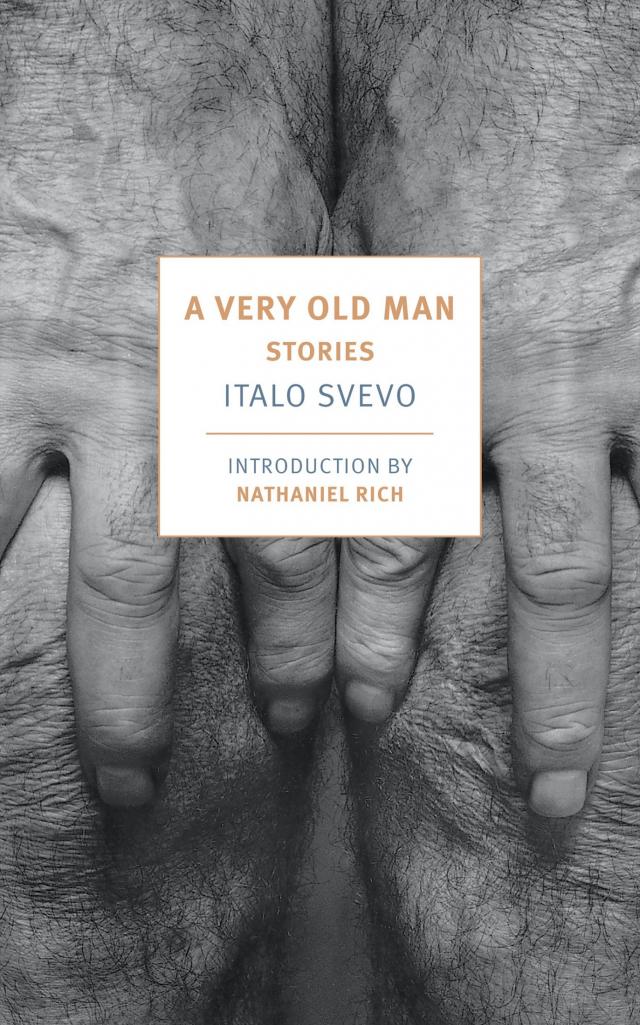
Cover image: John Coplans, Hands Spread on Knees, 1985; © the John Coplans Trust
Cover design: Katy Homans
Library of Congress Cataloging-in-Publication Data
Names: Svevo, Italo, 1861-1928, author. | Randall, Frederika, translator. | Rich, Nathaniel, 1980- writer of introduction.
Title: A very old man : stories / by Italo Svevo ; translated from the Italian by Frederika Randall ; introduction by Nathaniel Rich.
Description: New York : New York Review Books, [2021] | Series: New York Review Books classics | This is an original selection of short stories translated into
English. It has no equivalent Italian edition. |
Identifiers: LCCN 2021004663 (print) | LCCN 2021004664 (ebook) | ISBN 9781681375939 (paperback) | ISBN 9781681375946 (ebook)
Subjects: LCSH: Svevo, Italo, 1861-1928—Translations into English. | LCGFT: Short stories.
Classification: LCC PQ4841.C482 V4713 2021 (print) | LCC PQ4841.C482 (ebook) | DDC 853/.912—dc23 LC record available at https://lccn.loc.gov/2021004663 LC ebook record available at https://lccn.loc.gov/2021004664
ISBN 978-1-68137-594-6
v1.0
CONTENTS
Cover
Biographical Notes
Title Page
Copyright and More Information
Introduction
A VERY OLD MAN
The Contract
The Confessions of a Very Old Man
Umbertino
My Leisure
Foreword
Translator’s Afterword: Why Translate Svevo Again
INTRODUCTION
"I AM A man born in inopportune times,” says Zeno Cosini in A Very Old Man, a line thick with dramatic irony, since the description applies much better to his creator, Italo Svevo, for whom it could serve as an epitaph. In Zeno’s case, the meaning of “inopportune” is narrow. As a young man, his elders didn’t respect him. In the aftermath of World War I, having finally won senior status, Zeno discovers that the youth are not only running the world, but his own family business. He is left out again.
But Zeno’s creator had it worse. Inopportunity in all its manifestations—bad timing, rotten luck, missed connections—is the dominant theme of Italo Svevo’s life, work, and afterlife. Aron Ettore Schmitz was born of German and Italian descent in Trieste, itself a city of mixed parentage, the subject of a paternity dispute between Italy and the Austro-Hungarian Empire, and largely populated by Slovenians. Svevo spoke Triestine, a dialect that borrows from Slovenian, Greek, and German, and is unintelligible to other Italians. Although he wrote in formal Tuscan Italian, following national literary convention, it was for him a second language, and one he despaired of mastering. “Every Tuscan word we write,” he says in Zeno’s Conscience, “is a lie.” Schmitz’s cultural sensibility was neither Italian nor Triestine, however, but German. He attended boarding school in Swabia, where he was heavily influenced by the deterministic philosophy of Arthur Schopenhauer, and chose a pseudonym that reflected his mongrel identity (“Italo Svevo” means “Italian Swabian”). He was a Jew who converted to Catholicism to appease his wife, though only after receiving a dispensation for refusing to learn the catechism, leaving him in good standing in neither religion.
One of Italy’s greatest authors spent most of his life too ashamed to admit he was a writer. He hid his passion from public view—he even avoided discussing it with his wife—while working for nearly two decades in the correspondence department of the local branch of the Union Bank of Vienna. During this period he wrote Una Vita (A Life), about the simmering desperation of white-collar life, and Senilità (As a Man Grows Older, a title suggested by Joyce), about an affair between a failed writer and a woman of dubious morals. The novels, quietly radical in their subversion of nineteenth-century literary convention, were published at his own expense and roundly ignored, apart from a couple of reviews that scolded him for his low subject matter. A fellow banker, upon later hearing that his colleague had published novels, exclaimed, “Who? Not that jerk Schmitz?”
For the second half of his professional life he worked for his father-in-law, manufacturing protective paint for ships’ hulls. By his fortieth birthday he had renounced his literary aspirations. “The writer in him,” wrote his wife, Liva, in her Memoir of Italo Svevo, “seemed fast asleep.” He spent the next two decades, the prime of many novelists’ careers, making varnish.
Svevo’s one stroke of fortune was so extreme—one of the great lucky breaks in literary history—that in retrospect it seems only inevitable, only Svevian, that it should be followed by a final cruel thud of fate. In Svevo’s life, as in his fiction, no pleasant surprise went unpunished.
When his firm opened a new factory in a London suburb, Svevo resolved to improve his poor command of English. He arranged for private lessons from a twenty-five-year-old Berlitz instructor who had developed the reputation, as Livia put it, of “a fashionable teacher of Trieste’s rich bourgeoisie.” Svevo called him “Professor Zois.” For one lesson, James Joyce asked Svevo to critique the first three chapters of a novel that had stymied him; Svevo’s homework assignment encouraged Joyce to finish A Portrait of the Artist as a Young Man. When Svevo admitted that he, too, had written fiction as a young man, Joyce read his novels within days. At their next lesson Joyce declared that Svevo had been unjustly neglected by his critics and was the most important Italian writer of his era. He recited passages of Svevo’s fiction from memory.
Emboldened, the paint manufacturer returned to his private hobby. After the outbreak of World War I freed him of his professional obligations, he began a new novel. La coscienza di Zeno was published in 1923, three years after Ulysses. In Italy, Zeno enjoyed the same response as its predecessors. Belatedly, however, thanks to Joyce’s enthusiastic advocacy to a cohort of influential Parisian critics, Zeno became a Continental phenomenon. His life, as Svevo put it, underwent a “revolution.” He was celebrated at aristocratic literary salons in Paris and Versailles, hailed as “the Italian Proust,” cheered in the streets of Milan, and mobbed by young artists and writers at his local café.
Thus began the most prolific—the only prolific—period of Svevo’s life. For the next three years, Svevo tried to make up for lost time. He edited translations of his work, campaigned for the republication of Senilità, conducted a lively correspondence with editors and critics and patrons, lectured on Joyce, read Kafka and Proust, wrote new stories and plays, and, as early as January 1927, began a new novel about an old man named Giovanni Respiro. (“Respiro” is the first-person present tense form of respirare, “to breath easily again, as after a period of exertion or trouble.”) In later drafts, Giovanni became Zeno Cosini, and Svevo accepted that he was writing a sequel.
His wife reports in her memoir that Svevo, approaching his seventieth birthday, “worked with a certain difficulty.” He had experienced a series of heart problems and complained of weakness, worrying that a great “blow,” usually imagined as a stroke, was coming for him. Nevertheless he managed to produce a manuscript of nearly book length by the time he died on September 13, 1928, following a minor automobile accident that overstrained his heart.
Like its author, A Very Old Man is stuck in between. It’s neither a novel nor a story collection but a series of attempted openings, scenes, subplots, and character sketch
es. Livia retrieved the new Zeno fragments from a chaos of unsorted papers in his study and published them in a volume together with some of his short fiction. The collection was introduced by Svevo’s most important Italian champion, the young poet and future Nobel laureate Eugenio Montale, who called Svevo “the greatest novelist our literature has produced from Verga’s day to our own.”
Yet in the century since, readers hoping for further encounters with Svevo’s genius have typically turned to the earlier novels, with disappointing results. While Una Vita and Senilità were ahead of their time, they also lagged well behind Zeno’s Conscience; the novels belong to the realist tradition that Svevo undermines, but does not fully escape, until his masterpiece. The audacious, indefatigable Frederika Randall, who completed this new translation shortly before her death, was right to identify A Very Old Man as Zeno’s legitimate heir. The lineage extends well beyond the identity of the protagonist. The dark irony, self-flagellating introspection, manic obsessiveness, and unapologetic moral perversity—the qualities that make Zeno one of the most thrilling works of the twentieth century—cackle from every page.
•
A Very Old Man begins not long after Zeno ends. The war, which descends upon the Cosinis in Zeno’s final pages, is over. Zeno, an inveterate gambler, has squandered his wartime profits through a hoarding scheme gone bad, but little else has changed, despite some chronological eccentricity that the author had yet to sort out. Zeno, depending on the chapter, is sixty-one or sixty-three or seventy; his son and daughter, young children when we last saw them, seem to have aged approximately two decades during the war. Beautiful Antonia has chosen a disappointing match in the dull Valentino, a union redeemed only by its blessing of a grandson, Umbertino, whose curiosity about the world brings Zeno back to his own youth. Zeno’s son, Alfio, is a struggling painter, ripe with bohemian hauteur; as Zeno tries to navigate his disappointment about his son’s artistic pursuits, he finds himself crudely impersonating his own father, whose paternal disapproval dominates the early pages of Zeno’s Conscience. Zeno’s business partner, old Olivi, has been replaced by his son, young Olivi. Zeno has a few new servants and a new mistress, but the Cosini milieu is largely the same: burgher-comfortable, intimate, and largely amicable, its routine disrupted only by Zeno’s periodic paroxysms. Augusta, Zeno’s wife, also remains constant: homely, predictable, skittish, faithful, and unwavering in her love for her undeserving husband.
The major shift comes within Zeno himself. Though he continues to speak of life in terms of a fatal disease, obsess over his health, and gleefully catastrophize (“when I see a mountain I always expect it to become a volcano”), his aged heart’s not entirely in it. The old angst has dried up. Zeno is no longer imprisoned by his desires; now, instead, he finds himself “in a rather enjoyable state of freedom. . . . Long life cures all ailments.” He even discovers that his accursed cigarette addiction, by inhibiting his appetite, has helped ward off” his weight problems. In short, the miracle cure proscribed by Dr. S. on the opening page of Zeno has succeeded. The act of writing his autobiography has rejuvenated him.
Yet it is only his writing that feels alive. Rereading the diary entries that constitute Zeno’s Conscience, Zeno concludes that his account of his life story is “the only important thing that has ever happened to me. . . . How alive that life is, and how definitively dead the part I didn’t recount.” He finds himself back in one of the recursive loops that define his character. He lives what he writes, writes what he lives, and loses sight of where one activity ends and the other begins. He’s hit upon the premise—that literature is more honest, more real, than life itself—that helped launch the modern novel.
Readers of A Very Old Man will find themselves in the same position as Zeno—uncertain where his story begins, where it’s going, or where it ends. This is a consolation, of sorts. It’s impossible to know what shape the novel would have taken had Svevo’s chauffeur never run the family car into a tree. Each previous edition, in Italian and in translation, has presented the chapters in different combinations. Given the Escher-like quality of Svevo’s narrative style, a series of fragments, linked by the weak connective tissues of memory and free association, seems as appropriate a form as any for the novel to take. One could imagine it ending where it begins, like his former tutor’s Finnegans Wake, or perhaps with a sudden arbitrary blow, such as a stroke—or a car crash. No unfinished novel in literary history has better claim to remaining unfinished. A Very Old Man delivers a particularly Svevian thrill: the joy of reuniting with a long-lost friend who, while older and wiser, still has a long life ahead of him.
—NATHANIEL RICH
A VERY OLD MAN
THE CONTRACT
I’VE NEVER quite understood how I came to be so idle at present, when during the war I was thought to be a pretty industrious fellow. There’s my nephew Carlo—I talked it over with him, as it, too, bears on my health—who told me I did well to take it easy. I can get back to work when the next world war comes around, he says.
He does have a way with words, that young devil with his Argentine-Triestine patter. It’s true, I was very busy during the war, and when peace came I couldn’t get moving at all. Like a windmill when the wind’s not blowing.
Let me try to recall.—If only I had slowed down sooner; I just didn’t register the great revolution taking place. I welcomed the Italian soldiers on the streets, for I knew it meant this city of mine would finally emerge from its Middle Ages. But then I’d go to my office and conduct my business as if the Austrian troops were still there, and Austrian lassitude. And when communications with Italy were restored, I wrote a nice letter to old Olivi, who spent the war in Pisa. It was a perfectly innocent letter; you could see I expected that, when the war ended, things would continue just as if the war had gone on. Fate, I wrote, had decreed just what my poor father had deemed impossible: that I should become the master of my own affairs. I told Olivi how prosperous our firm had become, about the many deals I’d signed, and how much we’d earned. All this very calmly and without boasting. Words were unnecessary: the facts alone were enough to make him explode with rage. And in fact, he exploded.
When a few days later I learned he was dead, I thought my letter was to blame. But no, he died of the flu. I had somewhat bluntly suggested we let things continue as fate had disposed, allowing my father’s last wishes to slip my mind, now that they were pretty much ancient history. I invited Olivi and his son to continue in my employ, but I told him I would remain the boss. He’d have a free hand to resume any of his old arrangements as he liked; I would take on the more important business, and of course I’d have absolute freedom too. He could deal with employee relations. I was pretty weary of all that, although I’d had very few employees during the war.
I’m not sure, but it might have been a good thing if I’d learned of old Olivi’s death right off—rather than eight days after the fact. I wasn’t keeping track of the dates, but it might have been convenient if he’d died a few days earlier.
All in all, my lack of attention was certainly to blame for my falling into that disastrous business. I kept thinking that the war was still on, when I knew full well that peace had broken out. But I was in a hurry to close an important deal, so that when Olivi came back he’d have reason to admire me. Had I known he was dead, I might have felt much more carefree.
All this to explain why a large number of railcars full of soap arrived in Trieste from Sicily. During the war, soap had been everyone’s fondest desire, and especially the desire of those who hoped to make a profit on it. I procured it greedily and paid in cash. During the war, I was never in any hurry to sell. But as I was preparing to now, I discovered that Trieste didn’t want soap. People were no longer used to it, apparently. And then something worse happened: from all over Italy I began to get offers of soap at a lower price than I’d paid. At this point I became rattled and realized that for the soap, too, this new thing, peace, had interfered. However, there might be a way out, I thought. My soap was already here in Trieste, while the competition was farther away. I prepared to ship my soap to Vienna to get it there first and sell it off. I still don’t understand exactly why my soap was then impounded. The free movement of goods was, it seems, obstructed for two reasons: people urgently needed soap, and the ingredients didn’t meet the requirements of certain Austrian laws that I, too, knew a little something about. Negotiations went on for several months. Finally my soap was freed, but in the meantime everyone had been able to stock up on that painfully slow-to-be-consumed product, and I had to sell it at a loss, and for Austrian kronen, which only came in when it was too late to exchange them. They were worth almost nothing. This last operation demolished just about all the profits I’d accumulated with such enterprise and good fortune during the war. It was hard to accept, and all the more so because the young Olivi, who had since shown up still wearing his sublieutenant’s uniform, laughed out loud when he looked at my balance sheets, all my big earnings absorbed by that last unfortunate operation. He seemed to have nothing but contempt for wartime affairs, and one day he said he thought it was natural that those involved in war commerce should come to ruin in times of peace. “If I’d been in charge I’d have had them all shot, the ones doing business during the war.” Then he thought for a moment and, unsmiling, said, “Apart from you, obviously.”