A perfect hoax, p.1
A Perfect Hoax,
p.1
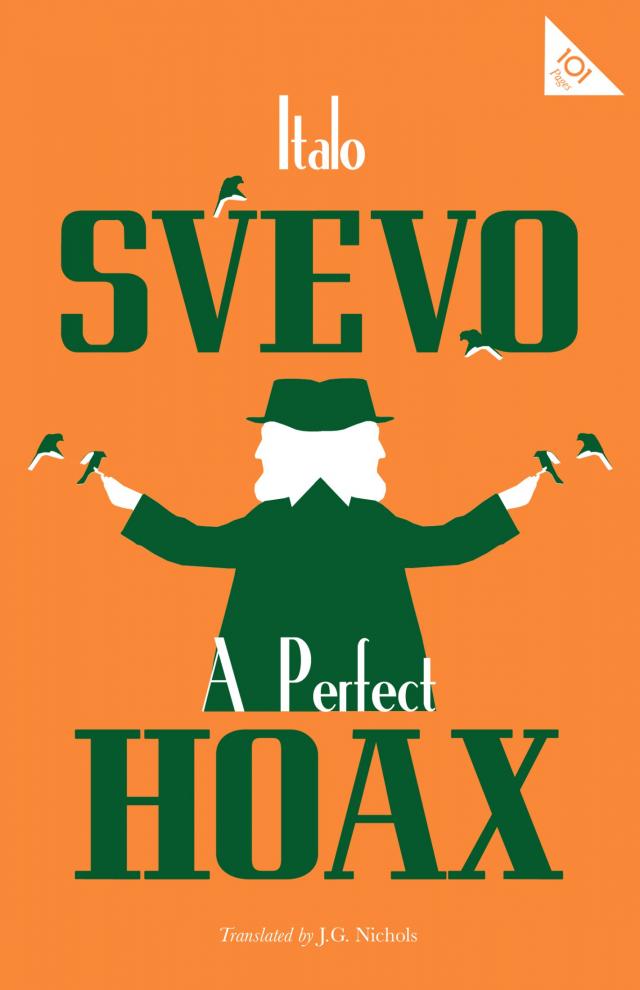


A Perfect Hoax
Italo Svevo
Translated by J.G. Nichols
ALMA CLASSICS
alma classics
an imprint of
alma books ltd
3 Castle Yard
Richmond
Surrey TW10 6TF
United Kingdom
www.101pages.co.uk
The Perfect Hoax first published in Italian in 1929
This translation first published by Hesperus Press Ltd in 2003
This revised edition first published by Alma Classics in 2019
Translation and Introduction © J.G. Nichols, 2003, 2019
Cover design: Will Dady
Printed in Great Britain by CPI Group (UK) Ltd, Croydon CR0 4YY
isbn: 978-1-84749-775-8
All rights reserved. No part of this publication may be reproduced, stored in or introduced into a retrieval system, or transmitted, in any form or by any means (electronic, mechanical, photocopying, recording or otherwise), without the prior written permission of the publisher. This book is sold subject to the condition that it shall not be resold, lent, hired out or otherwise circulated without the express prior consent of the publisher.
Contents
Introduction
A Perfect Hoax
Note on the Text
Notes
Introduction
Italo Svevo’s A Perfect Hoax, although a slighter work than the three long novels on which his reputation most firmly rests, is clearly cut from the same cloth. It is not difficult to trace autobiographical influences in the novels: in this shorter work I have the impression that Svevo went out of his way to stress its relation to his own life, almost as though he intended it to be read as a personal confession.
His pseudonym Italo Svevo (which translates literally as “Italian Swabian” and mirrors his true Italian forename, Ettore, and German surname, Schmitz) emphasizes his dual background: his mother was Italian and his father of German descent. His protagonist in A Perfect Hoax has a purely Italian name, and (fortunately for his tormentor) knows almost no German. Nevertheless, the importance of Austria and the German language in his, and his author’s, native city of Trieste is obvious throughout. More strikingly, the protagonist’s surname, Samigli, was one that Svevo had already used as a pseudonym in his journalism: the choice of it here can hardly be an accident. Mario Samigli, like Svevo, is a literary man, involved also in the world of business, although it must be admitted with less success than Svevo. Literary success came to Svevo very late in life, as did Samigli’s short-lived illusion of success. Svevo’s enjoyment of his genuine success was also cut short, by his death in a car accident – an instance of what Oscar Wilde described as life imitating art and, strangely enough, something Svevo always feared. With Samigli, literary success seems to come bound up with translation, as it really did for Svevo: he made his name with his last novel, La coscienza di Zeno, and its success was initiated to a large extent by its translation into French.
It is significant that the translators of that novel into English have to begin by coping with the difficulties posed by the word coscienza. This means both consciousness and conscience, and there is no exact equivalent in English, so that the translator must be partly wrong whichever he chooses, or else be guilty of an evasion, by translating it as, say, The Confessions of Zeno. This is not irrelevant to A Perfect Hoax, because in this story, too, consciousness automatically implies conscience. The story is a study in psychology, but, for all Svevo’s great interest in his contemporary Freud, the psychology is never a morally neutral matter of scientific cause and effect: the characters are seen as responsible for what they do, despite their remarkable ability to deceive themselves.
Some twenty years after Svevo’s death, his friend, the poet Umberto Saba, mentions Svevo describing how, as a businessman before the First World War, he more or less strolled into a contract for the supply of an anti-corrosive underwater paint to the British Navy – in those days an almost unbelievably lucrative deal. Saba uses this as an example of how matters of great importance are often decided rapidly, while trivialities can take up time: “It had taken five minutes for his precious underwater paint to be adopted by the most powerful fleet of warships in the world.” Saba mentions how Svevo had afterwards a vague feeling of guilt mixed with his elation. With that mixture of feelings, and that wholly unjustified and yet all too human feeling of guilt, we are in the world of Mario Samigli.
The story’s mixture of tones – from the solemn to the ludicrous, from the gentle and affectionate to the sheerly hateful, from the trivial to the impressive – is at one, of course, with the absurdity of the events. This absurdity includes what happens inside people’s minds. As an instance, it is ridiculous that Samigli should be taken in by such a hoax, and yet all too believable also, for reasons which Svevo spells out later in the story. Similarly, the strange way in which he comes to realize he has been deceived (strange in the way the action unfolds, and strange in the way his mind responds) is not only believable but also uncomfortably and comically familiar to the reader. The story is not short on external incident, but it is the internal action which matters most.
This is why the objection that has sometimes been made to Svevo’s work – that he deals with trivial matters in a provincial backwater – is quite beside the point. He clearly shies away from the grand and portentous, but this story is, in its own refreshingly gentle way, concerned with some of the outstanding themes of late-nineteenth- and twentieth-century literature. There is, for instance, the apparent opposition between the worlds of business and of art, or between the artist and the bourgeois world around him – an important theme in the last century: we need but mention Thomas Mann. There is also acute insight into the nature of the literary artist himself, and how he cannot help trying to transpose experience into an objective form: Mario Samigli is a mostly ineffectual writer, but he has the true artistic urges, and in fact his fables are, in their small way, quite effective. In his blundering way, too, Samigli does, despite his apparent ignorance of it, have a good intuition of how the literary market works.
It is not difficult for any writer to present us with absurd events. The trick is to present absurdities which are reminiscent of our own experience and therefore utterly believable. There are many such in this book: the relationship between Mario and his brother, which is based on a series of half-conscious pretences on both sides, and yet based very securely and affectionately; the strange and yet perfectly natural way in which Mario unconsciously colludes in his own deception; the even stranger way in which he finally realizes what he has, in some corner of his mind, known all along; and, the best example of all, the totally unexpected double denouement.
It is in this denouement that the story reaches its artistic perfection. The last thing we expect from Mario Samigli is physical violence, and yet we ought to have expected it. The incident also reveals something about ourselves if – as I must admit I do – we delight in the battering of Gaia. Unconsciously we have been hoping for something like this to happen, and the fact that Gaia is evil does not make our own reaction any more admirable. With the second denouement, the fulfilment of an ambition which Samigli did not have (commercial success) at the instant of finding that the success he hoped for is still eluding him – an achievement which comes by happy chance and the unselfish kindness of an uncomprehending friend – means that the cruelties along the way are ultimately subsumed into the benign, tolerant atmosphere which is the final impression the book leaves us with. As Saba noted, “He was a nice man, old Schmitz!”
– J.G. Nichols
A Perfect Hoax
1
Mario Samigli was a man of letters, getting on for sixty years old. A novel he had published forty years before might have been considered dead if in this world things could die even when they had never been alive. Mario, on the other hand, faded and feeble as he was, went on living very gently for years and years the kind of life made possible by the bit of a job he had, which gave him very little trouble and a very small income. Such a life is healthy, and it becomes healthier still when, as happened with Mario, it is flavoured with some beautiful dream. At his age he continued to think of himself as destined for glory, not because of what he had done or hoped to do, but because a profound inertia – the same inertia which prevented any rebellion against his lot – held him back from the effort of destroying a conviction formed in his mind so many years before. And so in the end it became clear that even the power of destiny has its limitations. Life had broken a few of Mario’s bones, but it had left intact his most important organs – his self-respect, and even to some extent his respect for others, on whom glory certainly depends. In his sad life he was accompanied always by a feeling of satisfaction.
Few could suspect him of such presumption, because Mario concealed it with the almost unconscious shrewdness of the dreamer, which allows him to protect his dream from any conflict with the hard facts of this world. Nevertheless, his dream did at times become apparent, and then those who liked him defended that harmless presumption of his, while the others, when they heard Mario judging living and dead authors decisively, and even citing himself as a precursor, laughed, but gently, seeing him blush as even a sixty year old can, when he is a man of letters and in that situation. And laughter, too, is a healthy thing and not wicked. And so things went very well with all of them: with Mario, his friends and even his enemies.
Ma
rio wrote very little. In fact, for a long time all he had which marked him out as a writer were the pen and the blank sheet of paper ready on his work desk. And those were his happiest years, so full of dreams and void of any troublesome experience, a splendid second childhood, preferable even to the maturity of the more fortunate writer who is able to pour himself out on paper, helped rather than hindered by the word, and who is then left like an empty husk which is nevertheless regarded as succulent fruit.
That era could only remain a happy one so long as he was making an effort to escape from it. As far as Mario was concerned, this effort, though not too violent, was always there. Fortunately he never found a route that would have taken him away from his great happiness. To write another novel like his old one, born out of admiration for the life of those who were superior to him in wealth and status, a life with which he had become acquainted using a telescope, was an impossible undertaking. He continued to love that novel of his because he could love it without a great effort, and it seemed alive to him, like anything which seems to have some rhyme and reason. But when he tried to set about working again on those shadowy people, in order to project them onto paper in the form of words, he experienced a healthy revulsion. The utter, although unconscious, maturity of sixty years prevented such an activity. And he did not think of describing more humble lives – his own life for instance, exemplary in its virtue, and so much the stronger through that resignation which controlled it, unassuming and not even explicit, so much had it by now set its mark on his ego. He lacked the means and even the affection to be able to do that, which was a real drawback, but one common among those who were prevented from knowing any higher life. And he finished up by abandoning people and their lives, whether high or low – or at least he thought he had abandoned them, and dedicated himself, or so he thought, to animals, by writing fables. And so some very short and stiff little mummies (not corpses, because they did not even have a smell) were produced by him at odd moments. Childlike as he was (not through old age, because he had always been like this), he considered them a start, a useful exercise, an improvement, and he felt he was younger and happier than ever.
At first, repeating the error of his youth, he wrote about animals which he hardly knew, and his fables resounded with roars and bellows. Then he became more human, if we can put it that way, writing about animals with which he thought he was acquainted. So the fly presented him with a large number of fables, showing itself to be a more useful creature than one would have thought. In one of those fables he admired the speed of the dipterans, a speed which was wasted because it neither enabled the creatures to reach their prey nor guaranteed their own safety. Here the tortoise provided the moral. Another fable exalted the fly for destroying those filthy things which it loved so much. A third fable marvelled that the fly, the creature best endowed with eyes, had such imperfect sight. Finally, one fable told of a man who, after squashing a troublesome fly, cried out to it, “I’ve done you a good turn. Look, you’re not a fly any more.” With a system like this, it was easy to have a fable ready every day with the morning coffee. It took the war to teach him that a fable could become an expression of his own mind, which inserted the little mummy into the structure of life, like one of its organs. And this is how that happened.
At the outbreak of the Italian war, Mario was afraid that the first act of persecution that the Royal Police would carry out in Trieste would involve him – one of the few Italian men of letters remaining in the city – in a fine old trial which might send him to dangle on the gallows. This filled him with terror and at the same time with hope, making him now exult and now blanch with terror. He imagined that his judges, a full council of war, composed of representatives of the whole military hierarchy from the general down, must have read his novel and – if there was any justice in the world – studied it. Then, without doubt, a rather distressing moment would arrive. But if the council of war was not composed of barbarians, one might hope that, having read the novel, they would spare his life as a reward. And so he wrote much during the war, shivering with hope and terror even more than an author who knows that there is a public waiting on his words in order to judge them. But out of prudence, he wrote only fables of doubtful meaning, and, between hope and fear, the little mummies came alive for him. The council of war could certainly not condemn him lightly for the fable which treated of a big, strong giant who fought on a marsh against creatures lighter on their feet than he was, and who perished, still victorious, in the mud which could not bear his weight. Who could prove that this was about Germany? And what reason was there to think of Germany in relation to that lion, which always won because it never went too far away from its own nice big den, until it was discovered that the nice big den lent itself to a smoking-out which was bound to succeed?
But in this way Mario got used to going through life accompanied always by fables, as if they were the pockets of his suit. A literary development he owed to the police, who, however, showed themselves to be quite ignorant of the local literature, and who, during the whole course of the war, left poor Mario in peace, disappointed and reassured.
Then there was a further small development in his work with the choice of more suitable protagonists. There were no longer elephants (such distant creatures), or flies with their eyes quite void of expression, but the dear little sparrows he enjoyed the luxury (a great luxury in Trieste in those days) of feeding in his courtyard with crumbs of bread. Every day he spent some time looking at them moving about, and that was the brightest part of the day, because it was the most literary – more literary perhaps than the fables which resulted from it. He wished he could kiss the things he wrote about! In the evening, on the neighbouring roofs and on a withered sapling in the courtyard, he heard the sparrows twittering, and he thought that, before turning their little heads right round in sleep, they were telling each other about the events of the day. In the morning there was the same lively and sonorous chattering. They must be talking about the dreams they had had during the night. Like himself, they were living between two experiences – real life and the life of dreams. In short, they were creatures with heads in which thoughts could nestle, and they had colours, attitudes, and even a weakness to arouse compassion, and wings to arouse envy, and so their own real true life. The fable still remained the little mummy stiffened with axioms and theorems, but at least it could be written with a smile.
And Mario’s life became enriched with smiles. One day he wrote: “My courtyard is small, but, with practice, one could throw away there ten kilograms of bread a day.” That was a true poet’s dream. Where could one find in that period ten kilograms of bread for birds that had no coupons? Another day he wrote: “I wish I could abolish the warfare on the little horse chestnut in my courtyard in the evening, when the sparrows try to find the best place in which to spend the night, because it would be a good sign for the future of humanity.”
Mario covered the poor sparrows with enough ideas to hide their little limbs. His brother Giulio, who lived with him, professed to like his writings, but his liking did not extend to the birds in them. He claimed that they had no expressions. But Mario explained that they were themselves an expression of nature, and complementary to things that lie or walk, by being above them, like an accent on a word, a true musical sign.
The happiest expression of nature: in birds not even fear is pallid and despicable, as it is in men. And this is by no means because it is concealed by their feathers. It is in fact obvious, but it does not change their elegant bodies in any way. One ought rather to believe that their little brains do not ever experience it. The alarm comes from sight or hearing, and in its haste passes directly into the wings. What a fine thing it is to have a little brain void of fear in a body in flight! One of the little fellows has been startled? They all fly off, but in a way which seems to say, “This is the right time to be afraid.” They know no hesitation. It does not take much to fly when you have wings. And their flight is confident. They avoid obstacles by skimming them, and they go through the densest tangle of a tree’s boughs without ever being held up or injured. They only start thinking when they are far away, and then they try to understand the reason for their flight, examining places and things. They bend their little heads gracefully to right and left, and wait patiently until they can return to the place from which they flew. If fear were involved in every flight, they would all be dead. And Mario suspected that they deliberately procured these moments of agitation for themselves. They could in fact eat the bread that was given to them in utter calm, and instead they close their cunning little eyes, and they are convinced that every mouthful is a theft. And this is precisely how they flavour dry bread. Like true thieves they do not eat the bread in the place where it has been thrown, and there is never any squabbling among them there, because it would be dangerous. The dispute over the crumbs breaks out in the place at which they arrive after their flight.