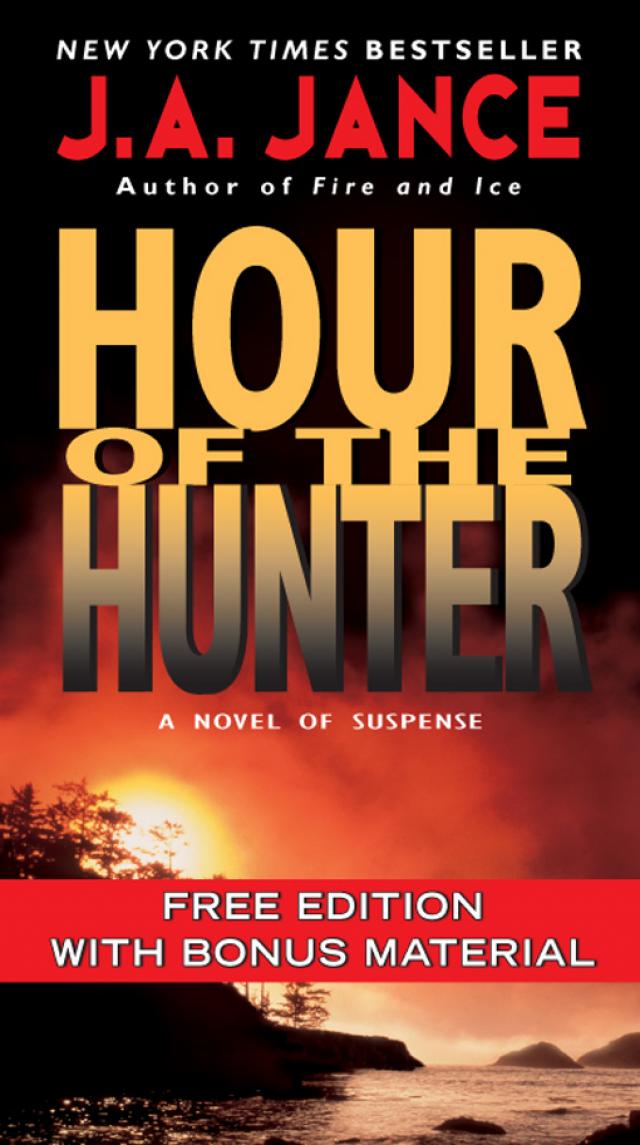
Hour of the hunter, p.33
Hour of the Hunter,
p.33


Squaring her shoulders, she found a butcher knife and attacked the aging layers of duct tape that sealed the box shut. The labeling may have been done by Francine, her stepmother, but the profligate use of duct tape was Max’s specialty. Diana remembered the stack of boxes he had brought down to the car on the morning she left for school in Eugene.
Some of the other girls in her class had got real cedar chests for high school graduation, “hope chests” they called them. When Max came with the boxes, Diana had no idea what they were.
“Those aren’t mine,” she said. “I can’t take all that stuff.”
“Your mother says you’re taking it,” Max said sourly.
She left, taking the boxes with her. It wasn’t until she was unpacking in her tiny apartment over the garage that she discovered Iona had made a hope chest for her, too, one in cardboard not cedar, but with hand-embroidered tea towels and napkins, crocheted doilies and tablecloths, a brand-new service-for-four set of Safeway-coupon Melmac dishes, and a heavy hand-pieced quilt. There were a few pots and pans, some cheap silverware, and a brand-new percolator.
Opening each box was an adventure, a reprise of a dozen Christmas mornings. Cloth goods were neatly ironed and folded, the edges crisp and straight. Glassware—there was even some of that—was individually wrapped in store-bought tissue paper.
One at a time, as she took out each item and admired each bit of handiwork, Diana wondered how and when her mother had managed to amass such a treasure without arousing Diana’s suspicions. After opening the last box, she rode her bike over to the Albertsons’ and called home from the grocery-store pay phone.
“What’s wrong?” Max demanded when he heard her voice. “Long distance calls cost money. Did you get in a car wreck, or what?”
“Nothing’s wrong,” Diana told him. “Just let me talk to Mom.”
But when Iona came on the phone, Diana was so overcome with emotion that she could barely speak. “When did you have time to make all that stuff, Mom? It’s wonderful, but how did you do it?”
For years, Diana kept her mother’s answer buried in the furthest reaches of her memory. Now, it came back to her. “Love always makes time,” Iona had said.
Remembering those words now left Diana awash in a sea of guilt. Love always makes time. Measured against her mother’s performance, Diana’s relationship with Davy seemed a gigantic failure. She was too busy with her own concerns and ambitions to pay attention to Davy’s day-to-day needs. Stung by guilt, she was still so busy justifying her continued survival in the face of both her mother’s death and her husband’s suicide that she forgot to pay attention to the quality of that survival. Luckily for her and for Davy, Rita was there to take up the slack.
I’ll do better, Diana promised herself. If I live long enough, I swear I’ll do better.
She peeled the final layer of tape from the box, releasing the lid. In moments, Diana went from remembering her cardboard “hope chests” to what could only be called hopeless chests, from boxes filled with promise to ones packed with crushed dreams and dashed hopes. That’s all Iona Dade Cooper’s boxes contained.
All the while the unopened boxes are stored in the root cellar, Diana had imagined them packed with her mother’s few prized possessions, the treasures arranged with the same loving care Iona had used to pack the boxes she sent to Eugene. Except those boxes held no treasures. What was stowed there hardly qualified as personal effects.
Francine Cooper had gone through her new husband’s house, Iona’s house, packing up only what she didn’t want—the inconvenient onion chopper with its broken blade, the battered metal pie tins Iona used only as a last resort when the season’s current crop of fruit—pumpkin in the fall, mincemeat in the winter, rhubarb in the spring, and fresh peach in the summer—had swamped her supply of good Pyrex pie plates. There were ragged hot pads and oven mitts, not the good ones Iona had used for company meals and church dinners, but the old ones she had used only for canning, and that, by rights, should have been thrown out with the trash long before they were stuffed into boxes.
Resolutely now, Diana ripped open the tape on each succeeding box. One rattled ominously as soon as she picked it up. At the bottom of that one, she found the smashed remains of the only really nice thing Iona Dade Cooper had ever owned—a Limoges salt-and-pepper-shaker set she had inherited from her own Grandma Dade—clattered brokenly around in the bottom of the box without even a paper towel as protection against breakage.
Grim-faced, Diana set a few things aside on the table to keep. The rest was swept into a waiting trash can. Only in the bottom box, the heaviest one, did Diana strike gold. There were books in there—the whole frayed green set called My Book House from which Iona had read her daughter countless fairy tales and poems and fables.
Seeing the books, Diana felt a flash of recognition. From these volumes, she had gained her love of reading, her fascination with the written word. She pulled out each book individually, thumbing through the pages, glancing at the familiar illustrations, remembering her favorite stories, wishing Davy knew them the way she did.
And then, in the very bottom of the box, stuffed in hastily perhaps so Max wouldn’t see, was the real treasure, the one item of her mother’s that Diana had really wanted and had counted lost—her mother’s well-worn Bible. Reverently, she picked it up. One corner of the cover had been permanently bent back. She opened the book gently, trying to smooth out the wrinkle.
As she did so, a paper fell out. Picking it up, she found it was actually three papers, welded by age into a tightly folded, brittle mass. Carefully, she undid them. The outside was a letter. Folded into that were two other pieces of paper—a yellowed newspaper article and a small, flower-covered funeral program dated August 16, 1943.
She glanced at that first, wondering whose it was—Harold Autry Deeson. Harold Deeson? Who was he? She had never heard of anybody by that name, although she read right there on the program that Harold’s parents were George R. and Ophelia Deeson.
George had a son? Diana wondered. How come she never knew about him? How come nobody ever mentioned him by name?
She turned to the newspaper article. The paper was brittle and flaked apart in her hand, but it was from the La Grande Herald on August 11, 1943, and it told how Harold Autry Deeson, only son of George R. and Ophelia Deeson, had died in a one-car crash on the highway halfway between Wallowa and Enterprise. Heading back to base at Fort Lewis, near Seattle, after being home for a weekend, Harold’s car had slammed into the highway embankment and then skidded across the road, ending up in the river. There was no clue as to what caused the accident, although the sheriff theorized that he may have braked to avoid hitting an animal that had wandered onto the road or else he had fallen asleep. Either way, Harold Autry Deeson was dead on impact.
Reading through the account of the accident, the whole picture of Diana’s family history suddenly shifted into focus. She started crying long before she ever picked up the letter. It was little more than a note, but Diana knew instinctively what was written there—not exactly, not the details, but the general outline.
“Dearest Iona,” Harold had written in a hastily scrawled, immature hand. “Thank you for tonight. I don’t care what my mother says. You may be Catholic, and my mother’s Mormon, but that doesn’t matter, not to me, and it’s not a good enough reason for us not to be together.
“I can’t make it home from Seattle again for at least a month, but when I do, we’ll run away together to La Grande or Pendleton, or maybe even all the way to Spokane. If we come back married, no one will be able to do anything about it, not even my mother. Please be ready. Love, Harry.”
Diana let the paper drift from her hands onto the table. She didn’t need to count on her fingers. Max and Iona Cooper were married in September of ’43. She was born in May of ’44. No wonder George Deeson had brought her Waldo. George Deeson had been her real grandfather, but why hadn’t someone told her the truth?
Under normal circumstances, Davy would have fought tooth and nail at any suggestion of a nap, but that day, when Rita lay down on her old-fashioned box spring mattress with its frail metal headboard, Davy climbed up onto the bed, while Bone settled down comfortably on a nearby rug. Because of the cast, Rita lay on her back with her arm elevated on pillows. Davy nestled in close to her other side and fell sound asleep.
Davy slept, but Rita didn’t. She looked around the room, grateful to be home, glad to have survived whatever the Mil-gahn doctors had dished out. To be fair, Dr. Rosemead was a whole lot different from the first white doctor she’d met, an odd-looking little man with strange, rectangular glasses and huge red-veined nose who had been called in for a consultation when she first got sick in California.
The Baileys hadn’t needed another girl-of-all-work, so Gordon found her a job at a farm a few miles up the road. There, barely a month later, she began to feel tired. A cough came on, accompanied by night sweats. She tried to hide the fact that she was sick, because she didn’t want to risk losing her job and being sent home, but finally, when the lady found her coughing up blood, she sent Rita to bed and summoned the one itinerant doctor who treated the valley’s Indian and Mexican laborers.
Dr. Aldus was his name, and Rita never forgot it, no matter how hard she tried. He came to see Dancing Quail in the filthy workers’ shack where she lay in bed, too sick to move. He examined her and then spoke to the foreman who waited in the background to take word to the farm owner’s wife.
“We’ll have to take the baby,” the doctor said. “The girl may live, but not the baby. Go bring my things from the car. Ask the cook to set some water boiling.”
The doctor came back to the bed and loomed over Dancing Quail. “It’s going to be fine,” he said. “Everything’s going to be okay.”
Those were the exact same words Dr. Rosemead had used all these years later, but with Dr. Aldus, everything was definitely not okay. His breath reeked of alcohol. He swayed from side to side as he stood next to her bed.
“No,” Dancing Quail pleaded, struggling to get up. “Leave my baby alone,” but he pushed her back down and held her pinned until the foreman returned, bringing with him the doctor’s bag and a set of thick, heavy straps. Somehow the two of them strapped her to the bed frame, imprisoning her, holding her flat. The doctor pressed an evil-smelling cloth to her face. Soon Rita could fight no longer.
She woke up much later, once more drenched in sweat. The straps were gone. She felt her flattened belly and knew it was empty. She was empty. The straps were gone, and so was her baby.
She cried out. Suddenly, Gordon was there, leaning over her in the doctor’s stead, his broad face gentle and caring. “Why didn’t you call me?” he asked, speaking in Papago. “Why didn’t you send someone to tell me you were sick so I could come take care of you?”
Rita couldn’t answer. All she could do was cough and cry.
* * *
Around four, Rita shook Davy. “Wake up,” she said. “Fat Crack will come soon and I must be ready.”
Davy sat up, rubbing his eyes, “Ready for what? Where are you going?”
“To Sells. For a ceremony.”
“What kind of ceremony? Do you have to leave again? You just got here.”
“It’s important,” she said. “The ceremony’s for you, Olhoni.”
His eyes widened. “For me? Really?”
She smiled. “Really. The singers will start tonight. On the fourth night, you will be baptized. A medicine man will do it.”
“A real medicine man? What will he do?”
“Don’t ask so many questions, Little One. You will see when time comes. He will baptize you in the way of the Tohono O’ odham. Have you spoken to the priest yet?”
“Priest?” Davy returned. “Oh, the one out at San Xavier?” Rita nodded. “Mom saw him, this morning. She said he was coming to see me today, this afternoon, I guess. I don’t know why.”
Rita sighed in relief. Father John had asked, and Diana had consented. “I do,” she said. “Listen, Olhoni, you must listen very carefully. You are very old not to be baptized, not in your mother’s way and not in the Indian way, either. Most people are baptized when they are babies. This is not good, so we are going to fix it. I asked Father John to speak to your mother, because where the Anglo religion is concerned, it is better for Mil-gahn to speak to Mil-gahn. Do you understand?”
Davy nodded seriously, but Rita doubted she was making sense. “When Father John comes to see you, do whatever he asks.”
“But what will he ask?”
“He will speak to you of the Mil-gahn religion, of your mother’s religion.”
“But I thought you said a medicine man . . .”
“Olhoni,” Rita said sternly. “You are a child of two worlds, a child with two mothers, are you not?” Davy nodded. “Then you can be a boy with two religions, two instead of none, isn’t it?”
Davy thought about it a moment before he nodded again.
“So tonight,” Rita continued, “whenever Fat Crack comes to get me, I will go out to Sells and be there for the start of the ceremony. I will return during the day, but each night I must go again. On the fourth night, the last night, you will come, too. Either your mother will bring you, or I will come back for you myself.”
“Will there be a feast?” he asked.
“Yes, now get up. I need your help.”
Davy scrambled off the bed. “What do you want, Nana Dahd?”
“Over there, in the bottom drawer of my dresser, there is a small basket. Bring it.”
Davy did as he was told, carrying the small, rectangular basket back to the bed. “What’s this?” he asked.
“My medicine basket.”
As he handed it to her, something rattled inside. “What’s in it, Nana Dahd? Can I see?”
With some difficulty, Rita had managed to pull herself up on the side of the bed. Now, she patted the mattress, motioning for Davy to sit beside her. “You’ll have to.” She smiled. “I can’t.”
Davy worked at prying off the tight-fitting lid. It was a testimony to Understanding Woman’s craftsmanship that even after so many years, even with the repairs Rita had made from time to time, the lid of the basket still fit snugly enough that it required effort to remove it. When it finally came loose, Davy handed the opened basket back to Rita.
One at a time, she took items out and held them up to the light. After looking at each one, she handed it to Davy. First was the awl, the owij, Rita called it. Davy knew what that was for because he had often watched her use the sharp tool to poke holes in the coiled cactus to make her baskets.
Next came a piece of pottery.
“What’s that?” Davy asked.
“See the turtle here?” Rita asked, pointing to the design etched into the broken shard. Davy nodded. “This is from one of my great-grandmother’s pots, Olhoni. When a woman dies, the people must break her pots in order to free her spirit. My grandmother kept this piece of her mother’s best pot and gave it to me.”
Next she held up the seashell. “Grandfather brought this back from his first salt-gathering expedition, and this spine of feather is one my father once gave to his mother when he was younger than you are now. The clay doll was used for healing.”
Next, Davy saw a hank of black hair. “What’s that?” he asked.
“It’s something we used to use against the Ohb, the Apaches,” Rita explained. “Something to keep our enemies away.”
At the very bottom of the basket were two last items—a piece of purple rock and something small made of metal and ribbon.
“What are those?”
“A spirit rock,” Rita answered, holding up the fragment of geode. “A rock that’s ordinary on the outside, but beautifully colored on the inside.”
“And that?” he asked.
“That is my son’s,” she said softly, fingering the frayed bit of ribbon. “Gordon’s. His Purple Heart. The army sent it to me after the war.”
“What war?”
“The Korean,” she said.
“Did your son die, too?” Davy asked.
“I guess,” she answered. “He joined the Army during World War II and stayed in. He never came home after Korea. The Army said he was missing, but he’s been missing for twenty-six years now. I don’t think he’s coming home. His wife, Gina’s mother, ran off some place. With no husband, she didn’t want a baby. I took care of Gina the same way I take care of you.”
Rita looked down at the little cache of treasure lying exposed on the bedspread. “Put them all back for me now, Davy. I want to take them with me.”
One at a time, with careful concentration, Davy put Rita’s things back in the basket then he fitted the lid on tight.
“I’ve never seen this basket before, have I?” he asked, handing it back to her.
She took it and slid it inside the top of her dress, where it rested out of sight beneath her ample breast and above her belt. “No, Olhoni. You have to be old enough before you can look at a medicine basket and show it proper respect.”
“Am I old enough now?”
“You have not yet killed your first coyote,” she said, “but you are old enough to see a medicine basket.”
By four o’clock that afternoon, Carlisle had set up camp on the rocky mountainside overlooking Diana Ladd’s home in Gates Pass. Using Myrna Louise’s cash, he had bought an AMC Matador from a used-car dealer downtown who claimed to be “ugly but honest.” So far that seemed to be true of the car as well. The layers of vinyl on the roof were peeling off and the paint was scarred, but the engine itself seemed reliable enough.
He had constructed a rough shelter of mesquite branches. The greenery not only provided some slight protection from the searing heat, it also offered cover from which he could spy on the house below without being detected. Sitting there with his high-powered binoculars trained on the house, he watched the comings and goings, counted the people he saw, and planned his offensive. During the long hours, he had to fight continually to stave off panic. In all his adventures, this was the very first time things had gone so totally wrong. He bitterly resented the fact that his own mother was the main fly in the ointment.