Gwens ghosts complete.., p.1
gwens ghosts - complete series,
p.1
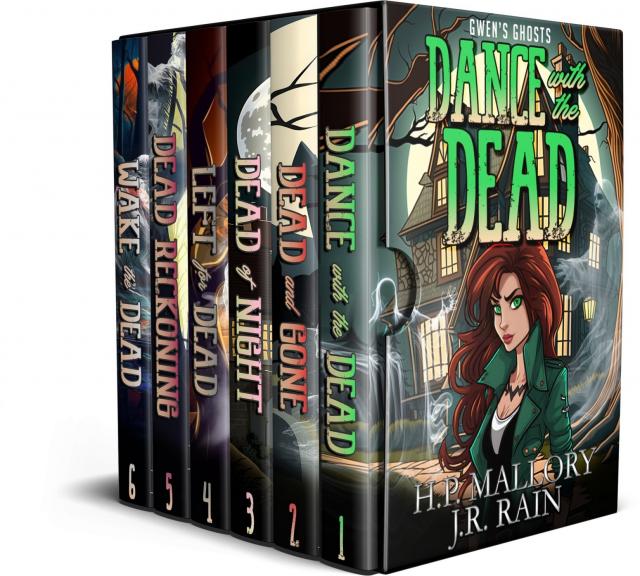


GWEN’S GHOSTS
The Complete Series
DANCE WITH THE DEAD
DEAD AND GONE
DEAD OF NIGHT
LEFT FOR DEAD
DEAD RECKONING
WAKE THE DEAD
by
J.R. Rain &
H.P. Mallory
Other Books by J.R. Rain
VAMPIRE FOR HIRE
Moon Dance
Vampire Moon
American Vampire
Moon Child
Christmas Moon (novella)
Vampire Dawn
Vampire Games
Moon Island
Moon River
Vampire Sun
Moon Dragon
Moon Shadow
Vampire Fire
Midnight Moon
Moon Angel
Vampire Sire
Moon Master
Dead Moon
Lost Moon
Vampire Destiny
Infinite Moon
Vampire Empress
Moon Elder
Wicked Moon
Winter Moon
Moon Blade
Sasquatch Moon
Wild Moon
Moon Magic
Moon World
Vampire Deep
Moon Matador
Sun Dance
Unicorn Moon
SAMANTHA MOON ADVENTURES
Banshee Moon
Moon Monster
Moon Ripper
Witch Moon
Moon Goddess
Moon Blaze
Golem Moon
Moon Maidens
SAMANTHA MOON CASE FILES
Moon Bayou
Blood Moon
Parallel Moon
SAMANTHA MOON ORIGINS
New Moon Rising
Moon Mourning
Haunted Moon
Other Books by H.P. Mallory
Paranormal Women’s Fiction Series:
Midlife Mysteries
Midlife Spirits
Haven Hollow
Misty Hollow
Trailer Park Vampire
Gwen’s Ghosts
Paranormal Romance Series:
Witch, Warlock & Vampire
Lily Harper
Dulcie O’Neil
Gates of the Underworld
Paranormal Reverse Harem:
Happily Never After
My Five Kings
Gwen’s Ghosts: The Complete Series
Published by Rain Press
Copyright © 2024 by J.R. Rain and H.P. Mallory
All rights reserved
Ebook Edition, License Notes
This ebook is licensed for your personal enjoyment only. This ebook may not be re-sold. Thank you for respecting the hard work of this author.
TABLE OF CONTENTS
Dance with the Dead
Dead and Gone
Dead of Night
Left for Dead
Dead Reckoning
Wake the Dead
Reading Sample: Lone Wolf
About the Author: J.R. Rain
About the Author: H.P. Mallory
DANCE WITH THE DEAD
Gwen’s Ghosts #1
by
J.R. RAIN
&
H.P. MALLORY
Dance With the Dead
Published by Rain Press
Copyright © 2023 by J.R. Rain & H.P. Mallory
All rights reserved.
Dance With the Dead
Chapter One
Petra and Me
The vacation I took to England’s West Country was one of my best and earliest memories.
I was eight or so at the time and it was my first time on a plane, my first time out of the country and the first time I remember leaving New York and its environs. For a child who’d known nothing but the city and its suburbs, the rolling fields and majestic hills of Somerset and Wiltshire (our American pronunciation of which greatly amused the locals) was a fantasy landscape, like the Shire from The Lord of the Rings.
My parents and I stayed in a bed and breakfast in a village called Morley-on-Avon, through which the river lazily snaked. It was a wonderland that imprinted itself on my young mind and I swore I would someday return.
But the trip was mostly memorable because it was the location where Petra became my constant companion, the ‘imaginary friend’ about whom my parents smiled quietly and for whom they even set a place at the table (as recommended by various parenting guides on the subject of ‘invisible friends’). Of course, that was before I patiently explained that Petra didn’t need to eat.
The day I met Petra is still etched in my mind in such vivid detail, it feels as if it were only yesterday.
“Petra Shearwater,” the tour guide had announced, an almost circular man with a moustache that appeared to be trying to take over his face. He was dressed in a red, velvet outfit that looked as if it was meant to mimic something Henry VIII would have worn, though the guide’s was a cheap imitation. I was fairly sure it was mustard that was staining the ruff around his neck. While the guide’s outward appearance was bland (with the notable exception of his monstrous moustache), he seemed to make up for that blandness with the shrillness of his voice and the theatrical waving of his arms. He looked like a man about to take off for the clouds.
“It was within this house, or just outside it, that she died and some say, she still haunts it.” He pointed at the dirt patch on which he stood and then did a strange little jig, as if Petra were reaching up from her grave to tickle the undersides of his feet. “On this very spot here, that I’m currently standing upon.”
We were standing in the mighty shadow of one of the great stately homes of the county. Not the biggest or most expensive that Britain had to offer (not quite Downton Abbey scale) but an impressive ‘country pile’ never the less. It was called Chambon Hall.
“Though, of course, it only got that name in the sixties when a pair of monied hippies,” the guide raised his eyebrows to show what he thought of said monied hippies, “Lucius and Delphine Chambon—better known as ‘Thor’ and ‘Feather’ to their circle of unwashed ragamuffins—bought it up for a song after the de Crecy family, who had lived on this site since the fifteenth century, went broke following bad investments. On the ponies,” he added with a wink and then did a little twirl that seemed to surprise all those in attendance.
“But back to Petra,” the guide continued. “She didn’t live in Chambon Hall, but she was a guest of the de Crecy family, from back when they were at their peak,” the guide went on, nodding at everyone in turn. “This was in the late nineteenth century, mind you. The Victorian era.” The guide cleared his throat and his voice rang out even louder. “Petra was invited to stay because young Roger de Crecy,” at which point the guide winked at my parents and continued, “Roger by name and Roger by nature—saving your daughter’s presence, aye?” My parents nodded uncertainly, and the guide continued on. “Roger had taken a fancy to Petra, who was renowned as a bit of a looker—which was perhaps exactly what had appealed to Roger. So, Petra was invited to stay and quite quickly into her stay, she died, some say by mysterious circumstances,” (accompanied by much wiggling of fingers). “She fell to her death, right here on this here spot.”
“Not true,” said a woman’s voice from beside me. “I fell over there,” and then she pointed to a place that was a few feet away. When she faced the guide again, she cocked an irritated brow in his direction. “And I certainly do not appreciate the fact that every time you tell this story erroneously, it is my reputation that suffers as you fail to mention that the de Crecy’s were cousins to my family and thus, I was not simply visiting an unattached man with whom I had no affiliation.”
The woman, presumably Petra, appeared to be in her early twenties with dark hair that was done up in curls around her face. She wore a bonnet and was dressed in a long and beautiful, emerald gown with bilious skirts that sashayed around her and touched the ground. I couldn’t help noticing that she was slightly transparent, so I could see through her to the tree line at the fringes of the lawn. Of course, I assumed that had to mean she was a ghost, but I wasn’t in the least bit frightened of her.
“Some believe Petra was killed by Roger’s father, who thought her to be ill-suited to marry his son,” the guide continued.
She, meanwhile, scowled at him. “Yes, yes, always this about my being ill-suited for the rascal Roger de Crecy. The truth was, I had no interest in marrying the scoundrel! And as to the particulars of my death...” the woman went on, shaking her head as she made a dismissive gesture at the guide who had, apparently, gotten it all wrong. “I can’t recall why I was killed or by whom. Perhaps it was simply an accident.” Then she shook her head like the whole thing was one big shame and sighed. “You get the details incorrect every day on every tour and you never listen to me correcting you because you can’t hear me. None of you can.”
“I can hear you,” I said.
The transparent woman looked down at me and her mouth dropped open in shock.
“Well, that’s nice to know, little lady,” smiled the guide. “But I’m over here.”
There’s no need to go over the rest of the conversational cross purposes because you can probably guess how the rest of it went. The important thing is that, at the end of the day, Petra sat beside me in the back of our rental car, heading to the hotel in which we were staying. And it was no surprise either, because for over a hundred years she’d had no one
to talk to but other departed spirits, whose conversation was apparently ‘limited and self-involved’, and who usually ‘moved on’ pretty quickly. Now she had a companion, and she wasn’t letting me go.
I was perfectly happy with my strange, new friend, and still happier when Petra regressed to childhood, appearing my own age and dressing in appropriate clothes for a Victorian child. As an only child, I’d sometimes struggled to make friends—now I had one who came with me everywhere. When we left for New York a week later, Petra was in tow.
It should be relatively clear by this point that Petra was not an imaginary friend, she was, for want of a better word, a ghost. But I didn’t really think of her as a ghost because there was nothing about her that was ghostlike or frightening. To me, she was more like a magical fairy who could change her appearance at will and who mostly just wanted to gossip. But she wasn’t the only deceased person I could see.
Maybe it was owing to my first seeing Petra, to whom I had some indefinable connection, but that day in Morley opened the floodgates, and from then on, I saw ghosts on a semi-regular basis. Only a few were like Petra, though: clear and almost solid to look at. Most were varying degrees of flickering translucency, some barely even human-shaped. I don’t recall ever being scared of them, though—they simply became a part of my life.
As I grew older, and began to better understand what it was I was seeing, then I also began to understand, mostly through Petra, what the rules were about the deceased and how it all worked.
The majority of people, after they died, moved on almost instantly, to that incredibly bright light that was the afterlife. Those with some unfinished business might linger around in a place Petra described as a sort of Limbo which existed in its own space and time. The walls between Limbo and the living world were pretty thin though, and those spirits would often manifest here, intentionally or otherwise, usually in the place where they died. Initially, the confusion of death made them unfocused, unable to communicate in words, but only able to radiate their emotions—I called those sorts of spirits ‘apparitions’. The longer they remained in Limbo, the more ‘normal looking’ they became—Petra being the ultimate result, a full-on ghost. Most didn’t stay anywhere in this realm nearly as long as Petra had. Once they understood what had happened to them and accepted it, they went elsewhere.
But even though Petra fully understood that she was dead and had been for a long while, she never seemed interested in moving on. And she never seemed able to recall what exactly had happened to her that caused her death in the first place. At first, I thought she just didn’t like to think about it—that her death had traumatized her and, thus, she didn’t want to focus on it. But as the years went on, I became more and more convinced that she really couldn’t remember the particulars. It was almost as though the whole thing was so terrible, that she’d simply forgotten all details—maybe as a way to protect herself? I wasn’t sure.
But as to moving on to the other side and Petra’s inability to do so, she said she liked things just as they were and that was why she stuck around. That was just fine with me because Petra became the sister I’d never had—only my sister was see-thru.
“Can you look any age you want?” I’d asked her once.
Petra shook her head. “Only an age I’ve been. It’s the same with clothing—I can’t dress like you because such clothes weren’t around when I was. And thank the good Lord for that—what passes as fashion these days should be criminal!”
Petra had many opinions regarding the modern era—most of which weren’t necessarily positive opinions. And I supposed that made sense, seeing as how she was brought up during a time in history that was known for being especially prudish and repressed. The ideal Victorian woman was ‘pure, chaste, refined and modest’ as Petra would tell me time and time again (usually in response to something I’d said or done that was decidedly not pure, chaste, refined or modest).
How much was choice and how much instinct, I never fully understood, but Petra always appeared my age, so as I grew up, she grew up with me. Until, that is, I passed twenty-two, at which age she’d died. And so, somewhat irritatingly, she stopped aging while I continued to do so for another (at the time of writing) twenty years.
By the time Petra and I were twenty-two, I’d already embarked on the career to which I’d devote my life. I’d always written stories, and maybe it was the presence of Petra that dictated the direction those stories would eventually take. Without making a conscious decision, the genre I always seemed drawn to was in the direction of mystery, often with a folk horror twist. I’d become fascinated by mythology and legends, and spun those threads into my books in a way that, without any false modesty, seemed to appeal to the public. And so it was that I celebrated my twenty-fifth birthday with a first bestseller under my belt, and at the party thrown for me by my literary agent, I met the man with whom I was to spend much of the next fifteen years.
When talking about Ian, I don’t know whether to speak from my head or my heart. Maybe it’s better to stick to the facts because otherwise I’d be here all day and Ian is a relatively small part of this story—as in, he’s part of the set-up, not the narrative.
Anyway, we never got married, so maybe there was always something in the back of both of our heads telling us this relationship was only for as long as it lasted, not forever. But for as long as it lasted, it was good enough.
In the end, we still liked each other, but we’d ceased to love each other. Maybe you don’t notice that happening when you’re so used to a person, when you see them every single day. Making the final break can be hard, even when it’s preceded by months of tense, sexless silence, while waiting for the other person to step up and say something.
It was Ian who finally stepped up and said something, and my major regret was that I hadn’t said something sooner. Maybe we could have revived our relationship if I’d said something sooner—maybe there would have been something there worth saving if we’d found it in time? I didn’t know and supposed I never would. Regardless, the end of the relationship meant that someone had to move out of the apartment we’d comfortably shared for the last fifteen years. It also coincided with the release of a retrospective anthology of my ‘best’ work.
Looking at that volume, I found myself feeling dissatisfied, not with what I’d done, but with the idea that it was all I was ever going to do. Skimming through stories I’d written a decade earlier, I realized how similar they were to those I’d written last year. And that meant one thing: I was in a rut, and there would never be a better time to make a change.
I told Ian to keep the apartment.
The day after my forty-second birthday, I boarded a plane to keep a promise I’d made to myself when I was just an eight-year-old girl.
I was going back to Morley-on-Avon.
“Going home!” Petra enthused and beamed the biggest grin I’d seen in quite a while.
“Nothing was stopping you from going back a long time ago,” I pointed out.
“It’s quite a long walk.”
“Couldn’t you just go into Limbo and come back out in Morley?” I teased.
She gave me a look. “Gwendolyn,” (she always insisted on calling me as such, even though Gwendolyn wasn’t even my name. It was simply: Gwen). You know that is not how the afterlife works.”
I knew. I wasn’t sure exactly how it did work, but I knew she couldn’t just come and go as she pleased.
A housing agency in the UK had set up some viewings for me in Morley, but there was one place that appealed to me beyond all others, a place that was right in the heart of Morley—a real British cottage. Little and proper and completely adorable. How could I not buy it? And it was almost crazily cheap, presumably because if you’re English, then you don’t appreciate how wonderful such sorts of things are.
“I should imagine there’s quite a bit more to it than that,” said Petra, eyeing me in that way of hers, which meant she knew something I didn’t. Or thought she did. Strangely, for being alive over a hundred years, Petra didn’t really know much more than I did. And the things she did feign to know, were usually wrong. I wasn’t sure if it was owing to the fact that she hadn’t been a very informed person when she was alive, or maybe she just became confused after death, but Petra would quite literally just make stuff up. “The cottage shouldn’t be so inexpensive—you know what they say about such things.”