Killer whale the rain co.., p.4
Killer Whale (The Rain Collective Book 7),
p.4
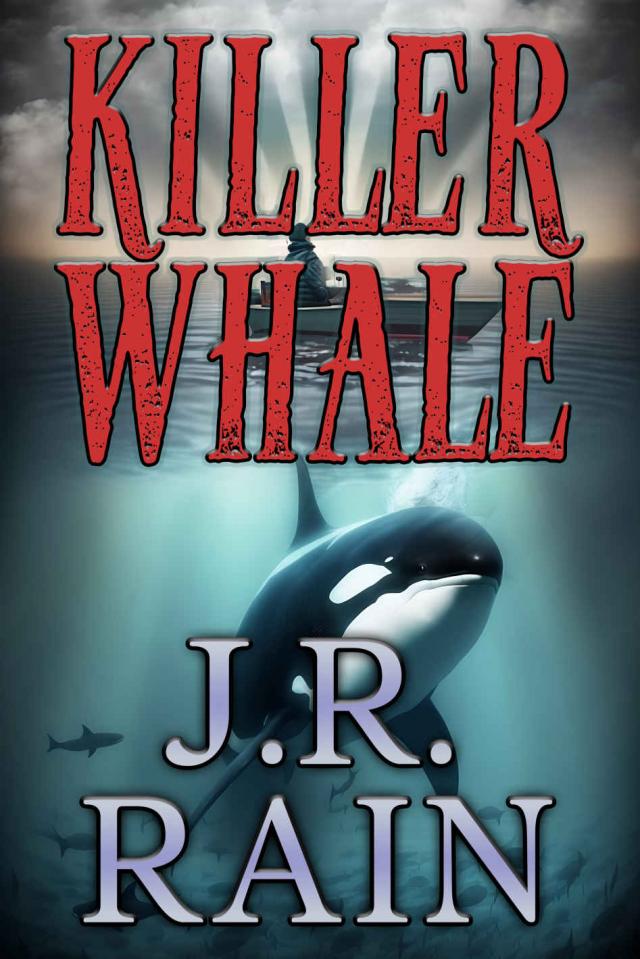


Panic sets in. My phone! My lifeline! Hadn’t it been in my cargo shorts pocket? It had been. I am sure of it. But there it goes... spinning and arching... and splashing down into water. The rifle plunks down next to it, making a bigger splash.
Both are gone... all while my little skiff careens through the ice field.
The orca has slowed. My guess is the effort of grazing against the first ice shelf took a lot out of it. Also, I’m sure trying to peel away the harpoon was pure agony. Indeed, we are slowing... and I can actually push some of the smaller floating chunks away with my arms and feet.
Still, the ice is sliding and grinding across both sides of the boat, often threatening to tip me into the water. I grunt from the effort of pushing off the ice to keep level. Truth is, so much can go wrong. Though going slower, I could lose my grip, or lose an arm or leg. Hell, I could be dead now or in ten minutes. I quietly apologize to my son in case this ends badly.
Kimko misses the next ice floe, but not by much. The harpoon is still in his back, but it’s definitely hanging limp. He must’ve scraped it against the bottom of some of these ice floes. There’s so much blood coming out, I can’t imagine what kind of pain he’s going through. There’s a high-pitched sound not coming from the ice scraping against the hull. I think it’s a sound Kimko is making. I want to say I hope it’s the sound of his suffering, but it’s so mournful, in a way I hope it’s not.
“Why won’t you just die?” I whisper through chapped lips. “You don’t have to go through all this. Just give up and let go. It’s not worth…”
The words fall from my lips as if they’re marbles from a tipping plate. I realize I almost said it’s not worth it. I am telling the orca to give up. I am telling him he doesn’t have to go through all this. But... I don’t know if I’m talking to Kimko, or if I’m speaking to myself.
We hit another piece of ice, but it’s small and I don’t think it’ll do a lot of damage. We’re reaching the edge of the floe and based on what I’m hearing and seeing, I don’t think the whale will be going back for another go-around. It’s still doing what I think of as groaning, and it’s definitely moving a lot more slowly.
I open a fresh water bottle and take a sip—just enough to provide my parched tongue with some relief.
“One of us is going to die first,” I say. “Which one do you think it’s going to be, fish? I’m betting on you, because I’m the one in the right. I’m the one who lost a son, and you’re the murderer.”
The whale dives. Twenty seconds later, he comes up for air, blowing a fine mist into the air. The harpoon wags from side to side. I wince. I can’t help it. I have a vivid imagination, and can imagine what the spearhead would feel like if it were in my body. I’d probably pass out long before I bled to death.
My heart almost stops when I see what he’s doing next. Kimko turns to port and begins heading back into the ice. No, no, no!
Crap, crap.
He’s trying to sink me or kill himself. Or both. I might not be so lucky on this next roller coaster ride. I’ve got to get ahead of this.
Thinking, my gaze settles on the back seat. It’s removable. I hurry to the bow, grab the crescent wrench out of the tool bag hanging there, and peek under the seat. The wingnuts holding the seat in place are easy to spot, but might be tough to remove. I added threadlocker last time I performed maintenance on the boat, and I can’t remember if I used the blue or red kind. I’m hoping it was blue because it’s easier to remove. If it’s red, I might not be able to get the seat off. I might break the wingnut before I get it off. If that happens, the seat won’t come loose no matter what I do.
Adjusting the wrench, I place it over the nut and give it a twist. Blue appears, and I sigh in relief. It only takes about thirty seconds to remove it and the one on the other side. The aluminum seat is light enough to deftly handle. I hurry to the front of the boat, holding the seat like a knight’s shield, but this can backfire, doing even more damage than the ice alone.
I don’t have a plan, really. I’m hoping to deflect the boat from the ice to keep it from capsizing and preventing a hole from being ripped all the way down one side. That’s it.
Here’s comes the next bit of ice, a medium-sized chunk that could possibly do some real damage. Luckily, we’re not moving as fast. And by “we,” I mean the boat and me.
The ice approaches. I brace the seat against my shoulder and arm... and stand my ground. Unfortunately, the bastard seems to have picked up a little speed, and swings me into the ice floe harder than I’m expecting. I might as well have run full speed into a brick wall holding some section of aluminum siding. Fat lot of good it does me.
An explosion of light in my head. I stagger back and fall on my butt inside the boat. Better than landing in the drink. But wow. Bad idea.
Maybe even a bad idea for the whale, as it’s dragging. This last ditch effort to jar the harpoon loose failed, and it’s had enough.
Rather than slow down completely and just, well, die, the beast continues back around, out of the ice field... and back toward the open ocean, moving slowly but determinedly. And there’s not a damn thing I can do about it.
With any luck, it’ll give up soon.
Then again, I’m pretty sure this whole endeavor is absent of luck.
No, not true. The harpoon is embedded in my son’s killer.
Some luck went into that. A lot of planning, granted, but a lot of luck too.
Kimko moans again as he dives under what appears to be the final sheet of ice, so small I didn’t bother to try to deflect it. The harpoon scrapes audibly against the obstacle, and again I wince.
I’m doing what’s right. I know I am. Right is on my side. This thing is a killer in every sense of the word. It did not have to drown my son, but it did, and now it has to pay. Maybe after this I’ll finally be able to get a good night’s sleep. Maybe, but all this might conjure more nightmares.
Speaking of which, I am exhausted. Sleep sounds damn nice. At this current, languid pace, I am going to nod off sooner or later. I’m not the one who’s bleeding with a harpoon sticking out of his back. So I can rest easy.
I pick up my water bottle, take another sip. Then two more. Screwing the lid back on, I consider how long it’s going to last. Eating and digesting utilizes water, so I ignore my grumbling stomach and focus on relaxing and breathing through my nose. It’ll help me conserve fluids and hopefully will prevent me from buying the farm before this fish does. I close my eyes and try to relax. The lapping of the whale’s fluke in the water is slow and rhythmic.
The creature cries out again and again.
I’m right; he’s wrong. I did not start this fight, but I will finish it.
***
Some time later, I awaken. It’s night, and I can feel the heat rising off my sunburned skin.
I’m thirsty, but rather than searching for my bottle, I take a moment to look around. It’s easier to navigate by night. I’ve been doing it since I was a kid. The waning moon is low on the horizon. I can see the northern star, but when I look behind me, I don’t see any lights. None at all. Not even the glow on the horizon from the cities. No airplanes. Only stars. It’s like I left civilization, went through some kind of time warp, and ended up hundreds of years in the past. Moonlight shimmers on the water in a wide swath, like some silver road to nowhere. Or everywhere.
I can hear the whale swimming, the gentle splashing of its undulating motion, the passing of a great beast over the great ocean. “Any idea where we’re going, fish?”
It continues moving over the surface of the world, in pain, confused, dying, bleeding.
I reach into the bottom of the boat, searching for something to throw at it and find a water bottle. It’s empty, so I unscrew the lid, fill it with salt water from the bottom of the boat, and screw the lid back on.
Taking careful aim, based only on sound, I throw the bottle as hard as I can. There’s an instant of silence before I hear a wet thunk. A savage grin touches the corners of my mouth, but fades when I realize how petty I’m being. Who throws a water bottle at a wounded creature?
A wounded father. Still, I feel like shit for long minutes after.
“Just die, already, so that I can cut you loose and try to find a way back home.”
But the whale keeps swimming, and keeps dragging me further out to sea, along the silver path.
I settle in against the back of the boat, adjusting a few times to get comfortable. Worst case scenario, the whale will die during the night and I can spend the rest of tomorrow using the seat to paddle myself home.
Chapter Nine
I realize I’ve fallen asleep again, and it takes me a half minute to figure out where I am and what I’m doing. It’s still nighttime. The moon is higher; the stars brighter.
The orca is still alive, unfortunately. He’s still flapping his tail, weaving his way ever westward, but he’s crawling. Maybe he’s finally dying, or maybe he’s sleeping. I heard they can swim while they sleep.
Instead of waking him, I take the opportunity to get a closer look at the burned-out engine. Maybe it’s not as badly damaged as I think it is. If I can get it running, I’m sure I still have plenty of gas to get back to shore—or close enough to see land, anyway. I can paddle the rest of the way.
After retrieving a few tools, I carefully remove the cowling. Part of it cracks as soon as I try to pull it loose, and the surface feels bubbled. It’s no surprise with it running on full throttle for as long as it had. In fact, it appears it might have even caught fire.
If so, why hadn’t I seen the flames? Was so I so distracted?
I think so, yes.
Weird, the fuel line is unhooked. Had I done that too, when I saw the fire? Makes sense, why literally add fuel to the fire?
But... I don’t remember the fire or unhooking the fuel line.
Yet, I clearly remember loading the .308 rifle. But it hadn’t been loaded, had it?
Something is off. Something’s wrong with my memory.
Can’t worry about it now.
Back to the engine. I lean close and sniff. It smells like poison. There are burnt wires inside, but how bad they are, I don’t know. Next, I find the pull-start and give it a gentle tug. There’s a ripping-peeling kind of sound that makes me think the nylon rope has welded together.
I close my eyes and think clearly about the steps for engine repair I taught Julien all those years ago. I haven’t actually done any of my own repairs in about ten years. Instead, I’ve taken my engines to a guy who lives a few houses down. The old man charges twenty bucks and a six-pack of beer for most repairs. It’s worth it not to bust my knuckles and spend the time the repairs take. But, I still remember the basics.
“Fuel, electricity, air,” I murmur to myself. “An engine needs all three to run. I could try to start it, but to do that I’d need to hook up the fuel. If there’s a gas leak, which seems likely, I could start another fire, even though I don’t remember the first one. If the fuel goes up in flames, I’ll basically be trying to stay alive while swimming in a pool of hellfire. Either that or take my chances with the sharks. No thanks.”
I try to remember where the wires are on this thing. Most outboards, if I recall, have a built-in wire harness. The wires should be protected from fire. But... my engine is older. Tracing my fingers gently along the motor hood, I find the first wire. Then two more, but they feel like they’re stuck together in the middle like their insulation has melted. What I wouldn’t give for some electrical tape right now. And a flashlight. Hindsight, as they say.
I’ll cut the wires apart after the sun comes up if the rest of it looks salvageable. Otherwise, I’ll go with paddling.
The carburetor is so covered in soot, I consider taking my shirt off to use it as a cleaning rag. Instead, I remove a shoe, then a sock. I can always wash it out in the bottom of the boat.
Cleaning it doesn’t really help. It’s still too dark to see anything, but at least it’ll be ready for the morning. I spend a few minutes washing my sock out before setting it next to me on the bench. Then I wait for morning. I’ll be able to see more then.
The orca is still swimming. I finish another bottle of water, fill it up from the bottom of the boat, and toss it at the whale. It hits, and I hear another grunt. It sounds mournful, and truth be told, pulls at my heartstrings a little. At least I know Kimko is awake.
“Why’d you do it?” I ask. “Why’d you kill my boy? Curiosity? If so, why haven’t the millions or billions of other orcas that have ever existed ever killed another human? Why you? Why my son? Why, dammit?”
I wait for the thing to answer me. Maybe like in the movies where animals sometimes make a sound to let you know what they’re thinking. Like dogs sometimes do in real life.
Nothing. Just another six or seven flaps of its tail as it propels us through the water to who-knows-where.
I consider cracking open one of the beers, but I know better. It’ll dehydrate me nearly as fast as drinking the sea water. No, only fresh water will keep me alive. Beer would be suicide. But oh, what a way to go.
Sometime later, the faint glow of sunrise forms on my left. It takes me a few seconds to realize what it means. We’re no longer moving away from land—at least not directly. The whale has turned south, but why? Maybe it’s trying to rejoin its pod.
I contemplate this for several minutes later, but I’ve got nothing. Not a damn clue, so I go back to work on the motor.
As the sun rises, it seems more and more like the engine is beyond my expertise. But it’s not like I have anything else to do at the moment, so I get to work.
“Fuel, electricity, air,” I repeat to myself as I begin my inspection. First thing’s first—I check the fuel line. Sure enough, it’s cracked and scorched in several places. Parts of it have even turned to ash. This can’t be good.
Luckily, the fuel line running from the motor to the gas can is a couple of feet longer than I needed it to be. I’d bought it that way, and didn’t bother to cut it later. Turns out my laziness has paid off, and might possibly save my ass.
I retrieve the knife from the bag at the bow and carefully fold the blade out. Once done, pick up the extra line where it broke, trim it, and cut off what I need to complete the repair.
The hose clamp gives me some trouble. The fuel line has melted around it, preventing me from easily rotating it to get a good grip with the pliers. I slip once, nearly flinging the pliers out to sea, but manage to hang on. The other end comes off without any trouble at all.
“Great,” I mumble and give the damaged end a closer inspection. It’s going to take me a while to remove all the melted hose from the clamp so I can reuse it. I’ve also managed to bend it a little out of shape. I’ll have to be careful and take my time, so I don’t break the damned thing. Running the engine without it would be risky.
So, I settle in with the little folding knife and get to work, picking and scraping at the hose. Kimko is still swimming south, as he’d been doing all morning. His wound is still bleeding, though not as profusely as before.
“Let me tell you about Julien,” I say loud enough for the whale to hear. “Let me tell you about the young man you took from me. He was twenty-two years old, a college senior, and my son. Of the three of those, the last is most important to me.”
The knife slips and bites me, but I barely notice the fresh cut on the side of my thumb. The blood makes working on the hose more difficult, though, so I have to switch the knife to my other hand.
Stupid, reckless. Focus.
Except I can’t stop myself from talking. Then again, it’s not often you get to confront the killer of your son.
“I wasn’t there when he took his first steps,” I say. “I was working—taking care of people, enforcing traffic laws. But, I was there when he learned to ride a bicycle. He and I planned it out. It took the whole weekend, but he did it. I was so proud. He rode it to school the next day and never looked back. Except, of course, he had forgotten to tell us about this little change in plans.
“Well, I was hot—madder than I’d ever been in a while. But when I saw the look on that little boy’s face, well, I just couldn’t bring myself to tell him how angry I was. Not with that big smile he wore. But you wouldn’t know anything about that, would you? Showing kindness, I mean.”
I pull experimentally at a tiny piece of melted fuel line to see if it will come loose. It doesn’t, so I go back to work.
“No, you wouldn’t, no matter how smart you may or may not be. You and your kind only care about swimming and eating and making more orcas. Oh, and killing. Apex predator, they say.”
Another pull removes the rest of the melted hose. A few minutes of scraping later and both hose clamps look good. I test one on the fuel line running to the gas can and I’m relieved it fits securely.
My stomach rumbles again. I’ve put off eating long enough, so I grab my last sandwich and take a thoughtful bite. The air is still cool—probably somewhere in the high fifties or low sixties. It’ll get warmer... and windier.
I’ve got three bottles of water left, and this damned fish just keeps going south. Flukes and tail propel us forward, while the rest of the world goes about its business, unaware of the struggle happening off the coast out here somewhere in the Pacific Ocean. Just living their lives, worried about their own business. As it should be.
I really ought to cut him loose, but something stops me from doing it. Weirdly, I like to be connected. I also don’t feel so alone. What do they call it? Stockholm Syndrome, where one aligns with one’s torturer. Except this bastard is only torturing my mind.
That said, I really need to know that he is, once and for all, dead. And the only way to do that is to continue doing what I’m doing: riding it out and waiting for him to die.
The sun keeps rising, and I’m out in the middle of nowhere without any shelter, with only three bottles of water, a little bit of granola, and a couple of beers. I’m also not feeling good about the outboard motor. I try it again, and again. It’s dead as dead can be. I’ve reached the limit of my expertise when it comes to small engines. My guess is the piston froze. There’s two of them in this one. If so, this engine is done. No way to fix it. Assuming I survive to make it back to shore, I’m going to need to replace it.