The deadly isles, p.1
The Deadly Isles,
p.1
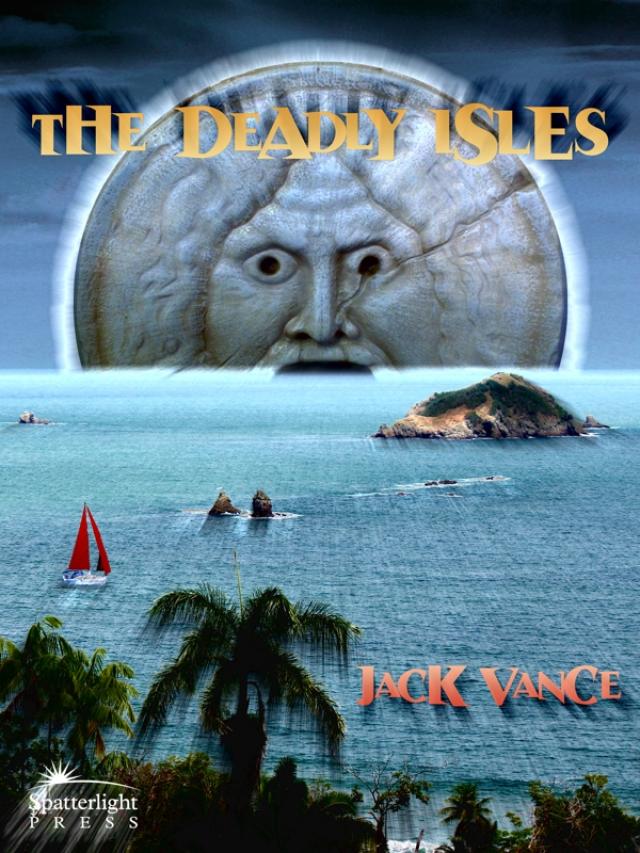


The Deadly Isles
Copyright 1966, 2013 by Jack Vance
Cover art by Howard Kistler
Published by
Spatterlight Press
ISBN 978-1-61947-025-5
2013-06-24
Visit jackvance.com for more
Spatterlight Press releases
This title was created from the digital archive of the Vance Integral Edition, a series of 44 books produced under the aegis of the author by a worldwide group of his readers. The VIE project gratefully acknowledges the editorial guidance of Norma Vance, as well as the cooperation of the Department of Special Collections at Boston University, whose John Holbrook Vance collection has been an important source of textual evidence. Special thanks to R.C. Lacovara, Patrick Dusoulier, Koen Vyverman, Paul Rhoads, Chuck King, Gregory Hansen, Suan Yong, and Josh Geller for their invaluable assistance preparing final versions of the source files.
Source: Paul Rhoads, Digitize: Richard Chandler, Jurriaan Kalkman, Gan Uesli Starling, Billy Webb, Format: Lori Hanley, Diff: David A. Kennedy, David Reitsema, Tech Proof: Bob Moody, Text Integrity: Patrick Dusoulier, Tim Stretton, Suan Hsi Yong, Implement: Derek W. Benson, Hans van der Veeke, Security: Tim Stretton, Compose: John A. Schwab, Comp Review: Christian J. Corley, Charles King, Bob Luckin, Robin L. Rouch, Update Verify: Robert Melson, Paul Rhoads, Robin L. Rouch, RTF-Diff: Charles King, Textport: Patrick Dusoulier, Proofread: Michel Bazin, Malcolm Bowers, Patrick Dusoulier, Harry Erwin, Ed Gooding, Peter Ikin, Jody Kelly, David A. Kennedy, Chris McCormick, Bob Moody, Till Noever, Axel Roschinski, Bill Sherman, Mark Shoulder
Ebook Creation: Arjen Broeze, Christopher Wood, Artwork (maps based on original drawings by Jack and Norma Vance): Paul Rhoads, Christopher Wood, Proofing: Arjen Broeze, Evert Jan de Groot, Gregory Hansen, Menno van der Leden, Koen Vyverman, Management: John Vance, Koen Vyverman, Web: Menno van der Leden
THE COMPLETE WORKS
of
Jack Vance
The Deadly Isles
THE VANCE DIGITAL EDITION
Oakland
2012
Contents
Chapter I
Chapter II
Chapter III
Chapter IV
Chapter V
Chapter VI
Chapter VII
Chapter VIII
Chapter IX
Chapter X
Chapter XI
Chapter XII
Chapter XIII
Chapter XIV
Chapter XV
Chapter XVI
Chapter XVII
Chapter XVIII
Chapter XIX
Chapter XX
Chapter XXI
Chapter I
From the social news of the San Francisco Chronicle, November 20, 1967:
LIA WINTERSEA ANNOUNCES TROTH
TO YACHTSMAN BRADY ROYCE
At a Saint Francis Hotel luncheon Lia Wintersea told six close friends of her engagement to popular socialite and yachtsman Brady Royce. Lia is daughter of the talented oboeist Paul Wintersea, who plays with the San Francisco Symphony, and Maude Ridlow Wintersea, an accomplished pianist in her own right. Lia’s sister Jean is a flautist of professional caliber who instead of a career in music has chosen the field of industrial psychology to make her mark.
The wedding will take place in the late spring at Golconda, the fabled Royce town house, and will be followed by a cruise aboard Brady’s schooner Dorado IV to remote and romantic islands in the South Seas.
Present at the luncheon were Lia’s sister Jean, Kelsey McClure, Mrs. Christian deBrouf (Peggy Satterlee) …
From the San Francisco Examiner, January 26, 1968:
DANCER TORTURED, STRANGLED;
APARTMENT RIFLED
Inez Gallegos, 23, a specialty dancer employed by the Martinique, 619 Ellis Street, this morning was found dead in her apartment at 1526 Powell Street. She had been strangled with a stocking. On her face, neck, legs and body were numerous burns, inflicted with a cigar, according to Detective Inspector William Reinhold.
The body was discovered at 11:10 A.M. by Richard B. Cody, 34, a bartender at the Polka Dot Bar, 320 O’Farrell Street, who had come to take Miss Gallegos to breakfast.
The apartment had been ransacked; Miss Gallegos’ purse and belongings had been rifled but she apparently had not been subjected to sexual assault.
Cody states that a metal document box containing Miss Gallegos’ birth certificate, car ownership certificate and other papers is missing.
Chapter II
Brady Royce, at forty-eight, was heavy-shouldered, a trifle ungainly, with overlarge features, a heavy jaw and mouth, coarse dark hair thinning across the scalp: not a handsome or even a distinguished-appearing man; but, in the words of his friend Dorothy McClure: “With money like Brady’s got, who needs looks?” Brady’s humor was broad and sometimes unkind, but generally his bark was worse than his bite and his friends liked him in spite of his faults. His enemies thought him obstinate, domineering, peevish, narrow-minded, unsympathetic.
Brady’s engagement to Lia Wintersea gave rise to predictable sniffs: “Dear Brady. Who’d ever think he’d go all senile, gamboling with pretty young things and all?” When such remarks were brought to Brady’s attention he only smiled with grim complacence. Lia was as extravagantly beautiful as Brady was wealthy, and if the marriage derived from considerations other than mutual rapture, each party seemed satisfied with the contract.
Lia, while she looked a year or two younger than her twenty-two years, was a woman of poise, charm and dignity. She was deliciously shaped, supple and slender, with an ease of motion that was almost musical. From a Spanish grandmother came rich black hair, Castilian complexion, a look of latent Spanish passion; a Welsh grandfather gave her eyes of magic grey. Lia was casual and low-key; she never preened nor wore exhibitionistic clothes, and achieved an effortless elegance. Brady’s friends scrutinized her with care. Some commended her lack of vanity, others suspected reverse arrogance; Lia would have recognized herself in neither point of view. She was herself, just as she had been all her life, with her unique and particular problems. She had no delusions regarding the marriage, though she rather liked Brady and thought him virile and masterful. She might have liked him even had he not been wealthy.
By the San Francisco time-scale the Royces were an old family, having arrived shortly after the Gold Rush.
In 1859 at Bodie, Nevada, a hobo named Ham Royce filled an inside straight and won three demonstrably worthless mining claims near Virginia City (although a man named Comstock thought he had detected silver nearby). Of the two hundred and twenty million dollars yielded by the Comstock Lode, Ham Royce took thirty million.
Easy come, easy go, but not for Ham Royce. He invested in farmlands, cattle, railroad stock, real estate. Money came so easily that by 1880 the zest was gone. Ham Royce, one-time hobo, traveled to Europe. At Fiesole he admired the Villa Portinari, which, so it happened, was not for sale. Ham Royce tapped a pencil against his yellow old teeth, drew a set of sketches in his notebook, despatched a shipload of Carrara marble, rugs, candelabra, tapestries, Hellenistic urns, Spanish armour, early Italian paintings, antique oak beams and walnut paneling to San Francisco, where, on Pacific Heights, with a clear view from the Golden Gate to Yerba Buena Island, he built Golconda.
In 1890 he acquired the first Dorado, a sea-going yawl, which he sailed to the Aleutians for the purpose of hunting Kodiak bear.
Ham’s only son was William. At the age of twenty William drank too much champagne and married a chorus girl. The experience had much to recommend it; a week later William drank more champagne and married another chorus girl. Ham Royce declared both marriages null and void and sent William off to Japan on the Dorado.
Ham Royce now gave serious thought to the future. The episode had cost relatively little: a hundred thousand to each of the girls, another twenty or thirty thousand in incidental expenses — but William was not a satisfactory son. He had never worked a day in his life; he condescended toward his father; he could not hold his liquor. Ham walked gloomily around Golconda, wondering what would become of his wonderful Italian palace when William was able to drink all the champagne he liked. Ham, a man predisposed toward extreme solutions, acted immediately. He paid the totality of his wealth into a trust fund dedicated to the maintenance of Golconda and its various adjuncts, such as the Dorado. The administrator he stipulated to be that legally sane, legitimately born Royce in the line of succession as established by the English common law schedule of primogeniture. A spouse would qualify as ‘resident administrator’ only when consanguinity to the third degree had been exhausted. For personal expenses the ‘resident administrator’ drew upon the income of the fund, but was subject to a set of provisions which made his remuneration precisely equal to his expenses. Legally the administrator was a pauper; practically he was a millionaire. William could drink champagne, he could marry chorus girls as he chose, at their own risk. When it came time to sue, William could truthfully assert that he was allowed no funds for any such contingencies. By this means Ham hoped to protect William against himself and to preserve Golconda against sequestration and folly.
William’s two sons were Philip and Lemuel. Philip, upon becoming administrator, urged that Lemuel continue to make his home at Golconda. Lemuel refused and sued for a share of the estate, claiming that the Golconda Fund constituted an illegal entail. The courts decided otherwise. Lemuel moved south to La Jolla and never returned to San Francisco. His son Luke, less inflexible, was a f
requent visitor to Golconda during his undergraduate years at the University of California and crewed aboard both Dorado III and Dorado IV.
Philip’s only son Brady began his career as a typical Royce. He married Hortense Lejeune, a French cinema star, by whom he bred a son, Carson, then, at a scandalous trial, divorced her for flagrant adultery. Hortense haughtily returned to France, leaving Carson, the future administrator, in Brady’s custody.
For a dozen years Brady reigned as San Francisco’s most eligible bachelor. Then, at the home of his friend Malcolm McClure, Kelsey McClure introduced him to Lia Wintersea.
The marriage of Brady Royce to Lia Wintersea on May 10, 1968, was the grandest event of the season. The guest list defined San Francisco quality; and those who felt that they should have been, but were not, invited found compelling reasons why they could not be on hand: excursions to Europe, conferences in Washington, in one instance a canoe trip down the Athabasca River to the Great Slave Lake.
The ceremony took place in the ballroom at Golconda. The reception was lavish beyond the experience of anyone present: like his great-grandfather Ham, when Brady Royce did something, he did it right. The honeymoon would be in the same scale: a week at Brady’s lodge in the Sawtooth Mountains, then an extended cruise aboard the Dorado IV, touching at Honolulu, the Marquesas Islands, Tahiti, and wherever else the winds blew: Rarotonga? Samoa? Bali? The Philippines? One was as likely as the other, declared Brady.
Aboard the Dorado IV would be a number of guests: Carson, now nineteen; Jim and Nancy Crothers; Malcolm and Dorothy McClure; their daughter Kelsey, who had introduced Lia to Brady; Don Peppergold, a young attorney to whom Brady had taken a fancy. At Honolulu Jim and Nancy Crothers would leave the party, while Lia’s sister Jean would come aboard, as would Brady’s cousin Luke at Tahiti.
The wedding proceeded with the pomp and pageantry of a coronation; the bride by general agreement was the most beautiful woman ever to become a Royce. Malcolm McClure was Brady’s best man; the single bridesmaid was Jean Wintersea, who appeared pinched and colorless beside her white jade, rose and jet sister.
The reception followed; Lia cut an enormous cake, then she and Jean slipped away to change clothes.
Lia seemed listless and wan — even dejected. Jean, two years older than Lia, and well-acquainted with her sister’s temperament, felt completely baffled.
After the maids carried off the wedding gown Lia dropped upon a couch to stare out the window. Jean watched a careful moment, then seated herself beside her sister. “What on earth is the matter? You act as if you’re headed for a concentration camp!”
Lia grimaced, gave her hands a nervous little shake. “Don’t be silly.”
“Better show a little more enthusiasm when you’re with Brady,” warned Jean, “or he’ll think you don’t like him.”
Lia drew a deep breath. “I like him well enough. It’s not that. In fact, he’s very considerate.” She put her chin in her hands. “The truth is shocking. I’m three months pregnant. Now you know.”
“Good heavens,” breathed Jean. “By Brady, I hope?”
Lia gave a bitter laugh. “That’s the tragic part … It’s that wretched you-know-who.”
Jean considered a long moment, watching her sister sidelong. Then she said, “I thought that was all over long ago.”
“I thought so too,” said Lia in a dreary voice. “It wasn’t my idea.”
“But why?” demanded Jean. “It’s incredible! It’s insane!”
Lia gave another bitter little laugh. “I couldn’t help it. He made me. I guess I don’t have much will-power.”
“I still don’t understand. How could he make you? Do you mean force?”
Lia considered a moment. “No. Not exactly. I don’t want to talk about it. Really.”
“Poor little Lia.” Jean gave her sister a slow frowning inspection, while Lia, chewing at her lip, stared out the window.
Lia said, “If Brady found out — after a six months’ engagement — he’d be very upset. He’d be worse than upset. Do you know,” she spoke in hushed wonder, “he’s actually quite strait-laced!”
“You’ll have to get rid of it,” said Jean flatly.
“I know,” said Lia. “But where? Aboard the Dorado? With a belaying pin? Or a boat-hook? Whatever they’re called.”
“Why didn’t you have it done before?”
“I wasn’t sure till a couple weeks ago. I missed the second month. After that — well, I didn’t have time. There was so much to do.”
“It doesn’t show. You’ll be in Honolulu in two or three weeks. Have it done there.”
“Yes,” said Lia. “I suppose I’ll have to … You could telephone me that Mother was sick, and I’d fly back to San Francisco for a few days.”
“He’d want to come with you: dutiful new husband and all.”
“I suppose he would … Oh, heavens, how do I ever get in such messes?”
“I know how,” said Jean with a grim smile. “But it wouldn’t do any good to tell you.”
On May 30th Jean received a letter from Lia, postmarked May 29th, at Honolulu:
Well, we arrived. Intact. The ship is beautiful; all are very nice, though puzzled. I blame everything on seasickness. Carson is a brat, and very cynical. He won’t keep his hands off Kelsey, who is bored with him. I’ve made a few discreet inquiries, but I can’t find anything except some Chinese herb doctors. If nothing this afternoon I may have to fly back to San Francisco. Brady is visiting Kona for a few days, to look at a coffee plantation somebody wants to sell him. I told him I wanted to do some shopping and recover from my seasickness, so I’ll be staying at the Royal Hawaiian.
Kelsey is visiting friends and will not get to Kona either. I wouldn’t be surprised if she suspects things. She looks at me with a funny half-grin. If I could only find a you-know-what! In San Francisco there wouldn’t be any trouble. I wonder how long I’d be sick? Maybe I could fly over and fly right back. Well, we shall see. I’ll go to the beauty salon; they always know about these things. Important! Brady has set departure date for June 6. He’s very stern about such matters; he thinks he’s a sea-captain or something. Anyway, plan to be here by the 5th or earlier. Try the Royal Hawaiian first, then the Kamehameha Yacht Club.
Love,
Lia
Sard’s was situated south of Market at 69 Homan Street, half-way along a disreputable alley, between the Embarcadero and the railroad yards: not a fashionable district, but then Sard’s clientele was, by and large, not a fashionable crowd. The façade was self-consciously smart: heavy squares of earth-colored Mexican tile set in rough black grout. There was a door of iron-bound oak, and SARD’s spelled out in small black back-lit letters.
Within all was different — or perhaps the same? The bar, the tables, the chairs, the walls — all were rude and rough, as if the proprietor had sought to reproduce an old cow-town saloon. The effect was accentuated by carefully dramatic lighting, and the room seemed more like a stage-set than a tavern.
The patrons were almost exclusively young men, some with low side-burns, others with drooping mustaches, others with heads shaved bald. Excessively tight trousers with heavy leather belts were much in evidence, and two persons wore boots with spurs. Almost everyone drank straight Scotch and stood at the bar, thumbs hooked in belts, legs splayed. One wall was vivid with bullfight posters; at the back of the bar was a human skull in a Reichswehr helmet, a red rose clenched between the teeth.
At nine o’clock on the night of Sunday, June 2nd, a strange-looking woman came into Sard’s bar. Her face was unnaturally white; her hair was pulled tightly back under a black scarf. She wore a long black coat, large dark glasses; her mouth was a black smear of lipstick. Just inside the entrance she paused to look along the bar. Failing to find whom she sought she went to a table at the back wall. Only two other women were present: a pair of thin nervous blondes with bushes of teased hair. They sat at a table with two young bucks in black turtleneck sweaters, and all took turns telling dirty jokes.