The secret, p.1
The Secret,
p.1
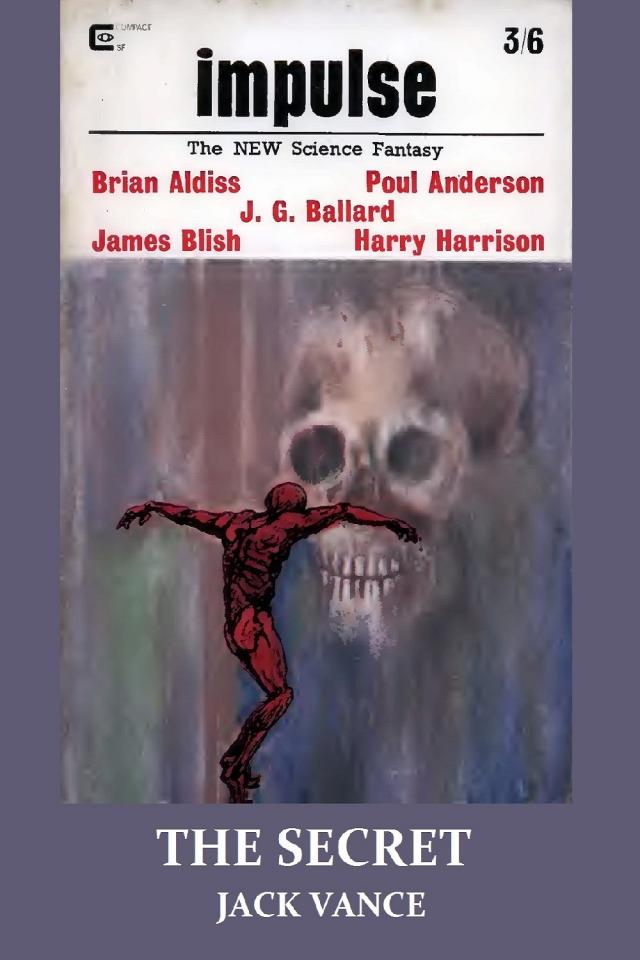


THE SECRET
by Jack Vance
From : Impulse, March 1966 – Short Story
Sun-beams slanted through chinks in the wall of the hut; from the lagoon came shouts and spindling of the village children, Rona ta Inga at last opened his eyes. He had dept far past hit usual hour of arising, far into the morning. He stretched his legs, cupped hands behind his head, stared absently up at the ceiling of thatch. In actuality he had awakened at the usual hour, to drift off again into a dreaming doze—a habit to which lately he had become prone. Only lately. Inga frowned and sat up with a jerk. What did this mean? Was it a sign? Perhaps he should inquire from Takti-Tai. … But it was all so ridiculous. He had dept late for the most ordinary of reasons: he enjoyed lazing and drowsing and dreaming.
On the mat beside him were crumpled flowers, where Mai-Mio had lain. Inga gathered the blossoms and laid them on the shelf which held his scant possessions. An enchanting creature, this Mai-Mio. She laughed no more and no less than other gills; her eyes were like other eyes, her mouth like all mouths; but her quaint and charming mannerisms made her absolutely unique: the single Mai-Mio in all the universe. Inga had loved many maidens All in some way were singular, but Mai-Mio was a creature delightfully, exquisitely apart from the others. There was considerable difference in their ages. Mai-Mio only recently had become a woman—even now from a distance die might be mistaken for a boy—while Inga was older by at least live or six seasons. He was not quite sure. It mattered little, in any event It mattered very little, he told himself again, quite emphatically. This was his village, his island; he bad no desire to leave. Ever!
The children came up the beach from the lagoon. Two or three darted under his hut, swinging on one of the poles, chanting nonsense-words. The hut trembled; the outcry jarred upon Inga’s nerves. He shouted in irritation. The children became instantly silent, in awe and astonishment, and trolled away looking over their shoulders.
Inga frowned: for die second lime due morning he felt dissatisfied with himself. He would gain an unenviable reputation if he kept on in such a fashion. What had come
over him? He was the same Inga that he was yesterday……
Except for the fact that a day had elapsed and he was a day older.
He went out on the port* before his hut, stretched in the sunlight. To right and left were forty nr fifty other such huts as his own. with intervening trees; ahead lay the lagoon blue and sparkling in the sunlight. Inga jumped to the ground, walked to the lagoon, swam, dived far down among the glittering pebbles and ocean growths which covered the lagoon floor. Emerging he felt relaxed and at peace—once more himself; Rona ta Inga, as he had always been, and always would be I
Squatting on his porch he breakfasted on fruit and cold baked fish from last night’s feast and considered the day ahead. There was no urgency, no duly to fulfil, no need to satisfy. He could join the party of young bucks now on their way into the forest hoping to snare fowl. He could fashion a brooch of carved shell and goana-nut for Mai-Mio. He could lounge and gossip; he could fish. Or he could visit his best friend Takti-Tai — who was building a boat. Inga rose to his feet. He would fish. He walked along the beach to his canoe, checked equipment, pushed off, paddled across the lagoon to the opening in the reef. The winds blew to the west as always. Leaving the lagoon Inga turned a swift glance downwind—an almost furtive glance —then bent his neck into the wind and paddled cast.
Within the hour he had caught six fine fish. and drifted back along the reef to the lagoon entrance. Everyone was swimming when he returned. Maidens, young men. children. Mai-Mio paddled to the canoe, hooked her arms over the gun whales, grinned up at him, water glistening on her checks. “Rona ta Inga! Did you catch fish? Or am I bad luck?”
“Set for yourself.”
She looked. “Five — no, Six: All fat silver fins! I am good luck! May I sleep often in your hut?”
“So long as I catch fish the following day.”
She dropped back into the water, splashed him, sank out of sight Through the undulating surface Inga could see her slender brown form skimming off across the bottom. He beached the canoe, wrapped the Ash in big sipi-leaves and stored them in a cool cistern, then ran down to the lagoon to join the swimming.
Later he and Mai-Mio sat in the shade; she plaiting a decorative cord of coloured bark which later she would weave into a basket, he leaning back, looking across the water. Artlessly Mai-Mio chattered—of the new song Ama ta Lalau had composed, of the odd fish she had seen while swimming underwater, of the change which had come over Takti-Tai since he had started building his boat.
Inga made an absent minded sound, but said nothing
“We have formed a band.” Mai-Mio confided. “There are six of us: Ipa, Tulti, Hali-Sai-lano. Zoma, Oiu-Ngo and myself. We have pledged never to leave the island. Never, never, neves. There is too much joy here. Never will we sail west—never. Whatever the secret we do not widi to know.”
Inga smiled, a rather wistful smile. “There is much wisdom in the pledge you have made.”
She stroked his arm. “Why do you not join us in our pledge? True, we are six girls-but a pledge is a pledge.”
“True.”
“Do you want to sail west?”
“No.”
Mai-Mio excitedly rose to her knees. “I will call together the band, and all of us all together: we will recite the pledge again, never will we leave our island! And to think, you are the oldest of all at the village!”
“Takti-Tai is older,” said Inga.
“But Takti-Tai is building bi« boat! He hardly counts any morel”
“Vai-Ona is as old as I. Almost as old.”
“Do you know something? Whenever Vai Ona goes out to Ash. he always looks to the west. He wonders.”
“Everyone wonders ”
“Not I! “ Mai-Mio jumped to her feet. “Not I—not any of the band. Never, never, never—never will we leave the island! We have pledged ourselves I” She reached down, patted Inga’s cheek, ran off to where a group of her friends were sharing a basket of font.
Inga sat quietly for five minutes. Then he made an Impatient gesture, rose and walked along the shore to the platform where Takti-Tai worked on his boat. This was a catamaran with a broad deck. a shelter of woven withe thatched with sipi-leaf, a stout mast. In silence Iqga helped Takti-Tai shape the mast, scraping a tall well-seasoned pa-siao-tui sapling with sharp shells. Inga presently paused, laid aside the shell. He said, “Long ago there were four of us. You. me Akara and Zan. Remember?”
Takti-Tai continued to scrape. “Of course I remember.”
“One night we sat on the beach around a Are—the four of us. Remember?”
Takti-Tai nodded.
“We pledged never to leave the eland. We swore never to weaken, we spilled Wood to seal the pact. Never would we sail west.”
“Now you sail.” said Inga. “I will be the last of the group.”
Takti-Tai pruned In his scraping, looked at Inga, as if he would speak, then bent once more over the mast. Inga presently returned up the beach to the hut. where squalling on the porch he carved at the brooch for Mai-Mio.
A youth presently came to sit beside him. Inga, who had no particular wish for companionship, continued with his carving. But the youth, absorbed in his own problems, failed to notice. “Advise me. Rona ta Inga. You are the oldest of the village and very sage.” Inga raised his eyebrows. then scowled, but said nothing.
“I love Hali Sai Iano. I long for her desperately. but
neck of Hope. What should I do?”
The situation b quite simple,” said Inga. “She prefers Hopu. You need merely select another girl. What of Talau Io? She it pretty and affectionate, and seems to like you. The youth vented a sigh. “Very well. I will do as you
nicest. After ell one girl is much like another.” He departed, unaware of the sardonic look Inga directed at his back. He asked himself, why do they come to me for advice? I am only two or three, or at most four or five, seasons their senior. It is as if they think me the fount and source of all sagacity!
During the evening a baby was bom. The mother was Omei Ni lo. who for almost a season had slept in Inga’s hut. Since it was a boy-child die named it Inga ta Omei. There was a naming ceremony at which Inga presided. The singing and dancing lasted until late, and if Jl were not for the fact that the child were his own. with his name. Inga would have crept off early to his hut. He had attended many naming ceremonies.
A week later Takti-Tai sailed west, and there was a ceremony of a different sort. Everyone came to the beach to touch the hull of the boat and bless h with water. Tears ran freely down all checks, including Takti-Tai’s. For the last time be looked around the lagoon, into the faces of those he would be leaving. Then he turned, signalled; the young men pushed the boat away from the beach, then jumping into the water, towed it across the lagoon, guided It out into the ocean. Takti-Tai cut brails, tightened halyards ; the big square sail billowed in the wind. The boat surged west. Takti-Tai stood on the platform, gave a Anal flourish of the hand, and those on the beach waved fare-well. The boat moved out into the afternoon, and when the tun sank, it could be seen no more.
During the evening meal the talk was quiet; everyone stared into the Are. Mai-Mio finally jumped to her feet. “Not I,” she chanted. “Not I—ever, ever, ever!”
“Nor I.” shouted Ama ta Lalau, who of all the youths was the most proficient musician. He reached for the guitar which he had carved from a black soa-gum trunk, struck chords, began to sing.
Inga watched qui
etly. He was now the oldest on the island, and it seemed as if the others were treating him with a new respect. Ridiculous! What nonsense I So little older was he that it made no difference whatever! But he noticed that Mai-Mio was laughingly attentive to Ama ta Lalau, who responded to the flirtation with great gallantry.
Inga watched with a heavy feeling around the bean, and presently went oil to his hut. That night, for the lint time in weeks Mai-Mio did not deep beside him. No matter, Inga told himself: one girl is much like another.
The following day be wandered up the beach to the platform where Takti-Tai had built ha boat. The area was dean and tidy, the tools were hung carefully in a nearby shed. In the forest beyond grew fine makara trees, from which the staunchest hulls were fashioned.
Inga turned away. He look his canoe out to catch fish, and leaving the lagoon looked to the west. There was nothing to see but empty horizon, precisely like the horizon to east, to north and to south—except that the western horizon concealed the secret. And the res* of the day he felt uneasy. During the evening meal he looked from face to face. None were the faces at his dear friends; they all had built their boats and had sailed. His friends had departed; his friends knew the secret.
The next morning, without making a conscious decision. Inga sharpened the tools and felled two fine makara trees He was not precisely building a boat—so he assured himself—but it did no harm for wood to season.
Nevertheless the following day he trimmed the trees, cut the trunk to length, and the next day assembled all the young men to help carry the trunks to the platform. No one seemed surprised; everyone knew that Rona ta Inga was building his boat. Mai-Mio had now (rankly taken up with Ann ta Lalau and as Inga worked on his boat he watched them play in the water, not without a lump of bitterness in his throat Yes, he told himself, it would be pleasure indeed to join his true friends the youths and maidens he had known since he dropped his milk-name, whom he had sported with, who now were departed, and (or whom he felt an aching loneliness. Diligently he hollowed the hulls, burning. scraping, chiselling. Then the platform was secured, the little shelter woven and thatched to protect him from rain. He scraped a mast from a flawless pa-siao-tui sapling, supped and stayed it. He gathered bast, wove a coarse but sturdy sail, hung it to stretch and season. Then he began to provision the boat. He gathered nut-meats. dried fruit, smoked fish wrapped in sipi-leaf. He
Ailed Mow-Ash bladders wish water- How long was the trip to the west? No one knew. Best not to go hungry, best to Hock the boat well: once down the wind there was no turning back
One day he was ready. It was a day much like all the other days of his life. The sun shone warm and bright, the lagoon glittered and rippled up and down the beach in little gushes of play-surf Rena ta Inga’s throat felt tense and stiff; he could hardly trust his voice. The young folk came to line the beach; all blessed the boat with water. Inga gazed into each face, then along the line of huts, the trees, the beaches, the scenes he loved with such intensity… . Already they seemed remote. Tears were coursing bis chocks. He held up his hand, turned away. He felt the boat leave the beach, float free on tbe water. Swimmers thrust him out into the ocean. For the last lime he turned to look back at the village, fighting a sudden maddening urge to jump from the boat, to swim back to the village. He hooted the sail, the wind thrust deep into the hollow. Water surged under the hulls and he was coasting west, with the island astern.
Up the blue swells, down into the long troughs, the wake gurgling, the bow raising and falling. The long afternoon waned and became golden; sunset burned and ebbed and became a halcyon dusk The stars appeared, and Inga, sitting silently by his rudder held the sail full to the wind. At midnight he lowered the sail and slept, the boat drifting quietly.
In the morning he was completely alone, the horizons blank. He raised the sail and scudded west, and so passed the day, and the next, and others. And Inga became thankful that he had provisioned the boat with generosity. On the sixth day he seemed to notice that a chill had come into the wind; on the eighth day he sailed under a high overcast, the like of which he had never seen before. The ocean changed from blue to a grey which presently took on a green tinge, and now the water was cold. The wind blew with great force, bellying his bast sail, and Inga huddled in the shelter to avoid the harsh spray. On the morning of the ninth day he thought to see a dim dark shape loom ahead, which at noon became a line of tall cliffs with surf beating against jagged rocks. roaring back and forth across coarse shingle. In mid-afternoon he ran his boat up on one of the Shingle beaches, jumped gingerly ashore. Shivering in the whooping gusts, he took stock of the situation. There was no living thing to be seen along the foreshore but three or four grey gulls. A hundred yards to ho right lay a battered hulk of another boat, and beyond was a tangle of wood and fibre which might have been still another.
Inga carried ashore what provisions remained, bundled them together, and by a faint trail climbed the cliffs. He came out on an expanse of rolling grey-green downs. Two or three miles inland rose a line of low hills, toward which the trail seemed to lead.
Inga looked right and left; again there was no living creature in sight other than gulls. Shouldering his bundle he set forth along the trail.
Nearing the hilts he came upon a hut of turf and stone, beside a patch of cultivated soil. A man and a woman worked in the Add. Inga peered closer. What manner of creatures were these? They resembled human beings; they had arms and legs and faces—but how warned and scared and grey they were I How shrunken were their hands, how bent and hobbled as they worked! He walked quickly by. and they did not appear to notice him.
Now Inga hastened, as the end of the day was drawing on and the hills loomed before him. The trail led along a valley grown with gnarled oak and low purple-green throbs, then slanted up the hillside through a stony gap. where the wind generated whistling musical sounds. From the gap Inga looked out over a flat valley. He saw copses of low trees, plots of tilled land, a group of huts. Slowly he walked down the trail. In a nearby field a man raised bis head. Inga paused, thinking to recognize him. Was this not Akara (a Oma who had sailed west ten or twelve seasons back? It seemed impossible. This man was fat. the hair had almost departed his head, his cheeks hing loose at the jaw-line. No, this could not be lithe Akara ta Oma I Hurriedly Inga turned away, and presently entered the village. Before a nearby hut stood one whom he recognised with joy. Takti-Tai
Taki-Tai nodded “Rona la Inga. I knew you’d be coming soon.”
“I’m delighted 10 see you! Bui kt us leave this terrible place; lei us return to the island!”
Takti-Tai smiled a little, shook his head.
Inga protested heatedly, “Don’t tell me you prefer this dismal land? Come! My boat it still seaworthy. If somehow we can back it off the beach, gain the open sea…
The wind sang down over the mountains, strummed through the trees. Inga’s words died In his throat, b was clearly impossible to work the boat off the foreshore,
“Not only the wind.” said Takti-Tai. “We could not go back now. We know the secret.”
Inga stared in wonderment. “The secret? Not I.”
“Come. Now you will kara.”
Takti-Tai took him through the village to a structure of stone with a high-gabled roof shingled with slate. “Enter, and you will know the secret.”
Hesitantly Rom ta Inga entered the stone structure. On a stone table lay a still figure surrounded by sin tall candles. Inga stared at the shrunken white face, at the white sheet which lay motionless over the narrow chest. ‘Who is this? A man? How thin he is. Dots he deep? Why do you show me such a thing?”
“This is the secret,” said Takti-Tai. “It is called ’death’”
— JACK VANCE
Jack Vance, The Secret
Thanks for reading the books on GrayCity.Net