Chateau dif and other st.., p.8
Chateau d'If and Other Stories,
p.8


“You filthy misbegotten dung-thief, do you hope to live? You venom, you stench. It would soil me to kill you. But I shall!”
Mario stepped back. The man was a stranger. “I’m sorry. You must be mistaken,” he said, before it dawned that Ralston Ebery’s deeds were now accountable to him.
A hand fell on the young-old man’s shoulder. “Beat it, Arnold!” said a hard voice. “Be off with you!” The young-old man fell back.
Mario’s rescuer turned around — a dapper young man with an agile fox-face. He nodded respectfully. “Good morning, Mr. Ebery. Sorry that crank bothered you.”
“Good morning,” said Mario. “Ah — who was he?”
The young man eyed him curiously. “Why, that’s Letya Arnold. Used to work for us. You fired him.”
Mario was puzzled. “Why?”
The young man blinked. “I’m sure I don’t know. Inefficiency, I suppose.”
“It’s not important,” said Mario hurriedly. “Forget it.”
“Sure. Of course. On your way up to the office?”
“Yes, I — I suppose so.” Who was this young man? It was a problem he would be called on to face many times, he thought.
They approached the elevators. “After you,” said Mario. There was such an infinity of detail to be learned, a thousand personal adjustments, the intricate pattern of Ralston Ebery’s business. Was there any business left? Ebery certainly would have plundered it of every cent he could endow his new body with. Ebery Air-car was a large concern; still the extracting of even ten million dollars was bound to make a dent. And this young man with the clever face, who was he? Mario decided to try indirectness, a vague question.
“Now let’s see — how long since you’ve been promoted?”
The young man darted a swift side-glance, evidently wondering whether Ebery was off his feed. “Why, I’ve been assistant office manager for two years.”
Mario nodded. They stepped into the elevator, and the young man was quick to press the button. Obsequious cur! thought Mario. The door snapped shut, and there came the swoop which stomachs of the age had become inured to. The elevator halted, the doors flung back, they stepped out into a busy office, filled with clicking machinery, clerks, banks of telescreens. Clatter, hum — and sudden silence with every eye on the body of Ralston Ebery. Furtive glances, studied attentiveness to work, exaggerated efficiency.
Mario halted, looked the room over. It was his. By default. No one in the world could deny him authority over this concern, unless Ralston Ebery had been too fast, too greedy, raising his ten million plus. If Ralston Ebery had embezzled or swindled, he — Roland Mario in Ebery’s body — would be punished. Mario was trapped in Ebery’s past. Ebery’s shortcomings would be held against him, the hate he had aroused would inflict itself on him, he had inherited Ebery’s wife, his family, his mistress, if any.
A short middle-aged man with wide disillusioned eyes, the bitter clasp of mouth that told of many hopes lost or abandoned, approached.
“Morning, Mr. Ebery. Glad you’re here. Several matters for your personal attention.”
Mario looked sharply at the man. Was that overtone in his voice sarcasm? “In my office,” said Mario. The short man turned toward a hallway. Mario followed. “Come along,” he said to the assistant office manager.
Gothic letters wrought from silver spelled out Ralston Ebery’s name on a door. Mario put his thumb into the lock; the prints meshed, the door slid aside; Mario slowly entered, frowning in distaste at the fussy decor. Ralston Ebery had been a lover of the rococo. He sat down behind the desk of polished black metal, said to the assistant office manager, “Bring me the personnel file on the office staff — records, photographs.”
“Yes, sir.”
The short man hauled a chair forward. “Now, Mr. Ebery, I’m sorry to say that I consider you’ve put the business in an ambiguous position.”
“What do you mean?” asked Mario frostily, as if he were Ebery himself.
The short man snorted. “What do I mean? I mean that the contracts you sold to Atlas Airboat were the biggest money-makers Ebery Air-car had. As you know very well. We took a terrible drubbing in that deal.” The short man jumped to his feet, walked up and down. “Frankly, Mr. Ebery, I don’t understand it.”
“Just a minute,” said Mario. “Let me look at the mail.” Killing time, he thumbed through the mail until the assistant office manager returned with a file of cards.
“Thank you,” said Mario. “That’s all for now.”
He flicked through them, glancing at the pictures. This short man had authority, he should be somewhere near the top. Here he was — Louis Correaos, Executive Adviser. Information as to salary, family, age, background — more than he could digest at the moment. He put the file to one side. Louis Correaos was still pacing up and down, fuming.
Correaos paused, darted Mario a venomous stare. “Ill-advised? I think you’re crazy!” He shrugged. “I tell you this because my job means nothing to me. The company can’t stand the beating you’ve given it. Not the way you want it run, at any rate. You insist on marketing a flying tea-wagon, festooned with ornaments; then you sell the only profitable contracts, the only features to the ship that make it at all airworthy.”
Mario reflected a minute. Then he said, “I had my reasons.”
Correaos, halting in his pacing, stared again.
Mario said, “Can you conjecture how I plan to profit from these circumstances?”
Correaos’s eyes were like poker chips; his mouth contracted, tightened, pursed to an O. He was thinking. After a moment he said, “You sold our steel plant to Jones and Cahill, our patent on the ride stabilizer to Bluecraft.” He gazed narrowly askance at Mario. “It sounds like you’re doing what you swore you’d never do. Bring out a new model that would fly.”
“How do you like the idea?” asked Mario, looking wise.
Louis Correaos stammered, “Why, Mr. Ebery, this is — fantastic! You asking me what I think! I’m your yes-man. That’s what you’re paying me for. I know it, you know it, everybody knows it.”
“You haven’t been yessing me today,” said Mario. “You told me I was crazy.”
“Well,” stammered Correaos, “I didn’t see your idea. It’s what I’d like to have done long ago. Put in a new transformer, pull off all that ormolu, use plancheen instead of steel, simplify, simplify —”
“Louis,” said Mario, “make the announcement. Start the works rolling. You’re in charge. I’ll back up anything you want done.”
Louis Correaos’s face was a drained mask.
“Make your salary anything you want,” said Mario. “I’ve got some new projects I’m going to be busy on. I want you to run the business. You’re the boss. Can you handle it?”
“Yes. I can.”
“Do it your own way. Bring out a new model that’ll beat everything in the field. I’ll check on the final setup, but until then, you’re the boss. Right now — clean up all this detail.” He pointed to the file of correspondence. “Take it to your office.”
Correaos impulsively rushed up, shook Mario’s hand. “I’ll do the best I can.” He left the room.
Mario said into the communicator, “Get me the African Federal Bank … Hello —” to the girl’s face on the screen “— this is Ralston Ebery. Please check on my personal balance.”
After a moment she said, “It’s down to twelve hundred dollars, Mr. Ebery. Your last withdrawal almost wiped out your balance.”
“Thank you,” said Mario. He settled the thick body of Ralston Ebery into the chair, and became aware of a great cavernous growling in his abdomen. Ralston Ebery was hungry.
Mario grinned a ghastly sour grin. He called food service. “Send up a chopped olive sandwich, celery, a glass of skim milk.”
V
During the afternoon he became aware of an ordeal he could no longer ignore: acquainting himself with Ralston Ebery’s family, his home life. It could not be a happy one. No happy husband and father would leave his wife and children at the mercy of a stranger. It was the act of hate, rather than love.
A group photograph stood on the desk — a picture inconspicuously placed, as if it were there on sufferance. This was his family. Florence Ebery was a frail woman, filmy, timid, over-dressed, and her face, peering out from under a preposterous hat, wore the patient perplexed expression of a family pet dressed in doll clothes — somehow pathetic.
Luther and Ralston Jr. were stocky young men with set mulish faces, Clydia a full-cheeked creature with a petulant mouth.
At three o’clock Mario finally summoned up his courage, called Ebery’s home on the screen, had Florence Ebery put on. She said in a thin distant voice, “Yes, Ralston.”
“I’ll be home this evening, dear.” Mario added the last word with conscious effort.
She wrinkled her nose, pursed her lips and her eyes shone as if she were about to cry. “You don’t even tell me where you’ve been.”
Mario said, “Florence — frankly. Would you say I’ve been a good husband?”
She blinked defiantly at him. “I’ve no complaints. I’ve never complained.” The pitch of her voice hinted that this perhaps was not literally true. Probably had reason, thought Mario.
“No, I want the truth, Florence.”
“You’ve given me all the money I wanted. You’ve humiliated me a thousand times — snubbed me, made me a laughing-stock for the children.”
Mario said, “Well, I’m sorry, Florence.” He could not vow affection. He felt sorry for Florence — Ebery’s wife — but she was Ralston Ebery’s wife, not his own. One of Ralston Ebery’s victims. “See you this evening,” he said lamely, and switched off.
He sat back. Think, think, think. There must be a way out. Or was this to be his life, his end, in this corpulent unhealthy body? Mario laughed suddenly. If ten million dollars bought Ralston Ebery a new body — presumably his own — then ten million more of Ralston Ebery’s dollars might buy the body back. For money spoke a clear loud language to Mervyn Allen. Humiliating, a nauseous obsequious act, a kissing of the foot which kicked you, a submission, an acquiescence — but it was either this or wear the form of Ralston Ebery.
Mario stood up, walked to the window, stepped out on the landing plat, signaled down an aircab.
Ten minutes later he stood at 5600 Exmoor Avenue in Meadowlands, the Chateau d’If. A gardener clipping the hedges eyed him with distrust. He strode up the driveway, pressed the button.
There was, as before, a short wait, the unseen scrutiny of spy cells. The sun shone warm on his back, to his ears came the shirrrrr of the gardener’s clippers.
The door opened.
“Please come in,” said the soft commercial voice.
Down the hall, into the green and brown reception room with the painting of the three stark nudes before the olden forest.
The girl of fabulous beauty entered; Mario gazed again into the wide clear eyes which led to some strange brain. Whose brain? Mario wondered. Of man or woman?
No longer did Mario feel the urge to excite her, arouse her. She was unnatural, a thing.
“What do you wish?”
“I’d like to see Mr. Allen.”
“On what business?”
“Ah, you know me?”
“On what business?”
“You’re a money-making concern, are you not?”
“Yes.”
“My business means money.”
“Please be seated.” She turned; Mario watched the slim body in retreat. She walked lightly, gracefully, in low elastic slippers. He became aware of Ebery’s body. The old goat’s glands were active enough. Mario fought down the wincing nausea.
The girl returned. “Follow me, please.”
Mervyn Allen received him with affability, though not going so far as to shake hands.
“Hello, Mr. Mario. I rather expected you. Sit down. How’s everything going? Enjoying yourself?”
“Not particularly. I’ll agree that you’ve provided me with a very stimulating adventure. And indeed — now that I think back — nowhere have you made false representations.”
Allen smiled a cool brief smile. And Mario wondered whose brain this beautiful body surrounded.
“Your attitude is unusually philosophical,” said Allen. “Most of our customers do not realize that we give them exactly what they pay for. The essence of adventure is surprise, danger, and an outcome dependent upon one’s own efforts.”
“No question,” remarked Mario, “that is precisely what you offer. But don’t mistake me. If I pretended friendship, I would not be sincere. In spite of any rational processes, I feel a strong resentment. I would kill you without sorrow — even though, as you will point out, I brought the whole matter on myself.”
“Exactly.”
“Aside from my own feelings, we have a certain community of interests, which I wish to exploit. You want money, I want my own body. I came to inquire by what circumstances our desires could both be satisfied.”
Allen’s face was joyous, he laughed delightedly. “Mario, you amuse me. I’ve heard many propositions, but none quite so formal, so elegant. Yes, I want money. You want the body you have become accustomed to. I’m sorry to say that your old body is now the property of someone else, and I doubt if he’d be persuaded to surrender it. But — I can sell you another body, healthy, handsome, young, for our usual fee. Ten million dollars. For thirty million I’ll give you the widest possible choice — a body like mine, for instance. The Empyrean Tower is an exceedingly expensive project.”
Mario said, “Out of curiosity, how is this transfer accomplished? I don’t notice any scar or any sign of brain graft. Which in any event is probably impossible.”
Mervyn Allen nodded. “It would be tedious, splicing several million sets of nerves. Are you acquainted with the physiology of the brain?”
“No,” said Mario. “It’s complicated, that’s about all I know of it — or have cared to know.”
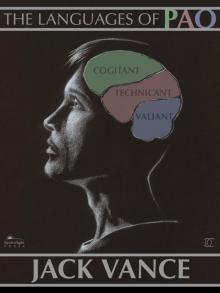
Allen leaned back, relaxed, spoke rapidly, as if by rote. “The brain is divided into three parts, the medulla oblongata, the cerebellum — these two control involuntary motions and reflexes — and the cerebrum, the seat of memory, intelligence, personality. Thinking is done in the brain the same way thinking is done in mechanical brains, by the selection of a route through relays or neurons.
“In a blank brain, the relative ease of any circuit is the same, and the electric potential of each and every cell is the same.
“The process is divided into a series of steps — discovered, I may add, accidentally during a program of research in a completely different field. First, the patient’s scalp is imbedded in a cellule of what the original research team called golasma — an organic crystal with a large number of peripheral fibers. Between the golasma cellule and the brain are a number of layers — hair, dermal tissue, bone, three separate membranes, as well as a mesh of blood vessels, very complicated. The neural cells however are unique in their high electric potential, and for practical purposes the intervening cells do not intrude.
“Next, by a complicated scanning process, we duplicate the synapses of the brain in the golasma, relating it by a pattern of sensory stimuli to a frame that will be common to all men.
“Third, the golasma cellules are changed, the process is reversed, A’s brain is equipped with B’s synapses, B with A’s. The total process requires only a few minutes. Non-surgical, painless, harmless. A receives B’s personality and memories, B takes on A’s.”
Slowly Mario rubbed his fat chin. “You mean, I — I — am not Roland Mario at all? That thinking Roland Mario’s thoughts is an illusion? And not a cell in this body is Roland Mario?”
“Not the faintest breath. You’re all — let me see. Your name is Ralston Ebery, I believe. Every last corpuscle of you is Ralston Ebery. You are Ralston Ebery, equipped with Roland Mario’s memories.”
“But, my glandular makeup? Won’t it modify Roland Mario’s personality? After all, a man’s actions are not due to his brain alone, but to a synthesis of effects.”
“Very true,” said Allen. “The effect is progressive. You will gradually change, become like the Ralston Ebery before the change. And the same with Roland Mario’s body. The total change will be determined by the environment against heredity ratio in your characters.”
Mario smiled. “I want to get out of this body soon. What I see of Ebery I don’t like.”
“Bring in ten million dollars,” said Mervyn Allen. “The Chateau d’If exists for one purpose — to make money.”
Mario inspected Allen carefully, noted the hard clear flesh, the beautiful shape of the face, skull, expression.
“What do you need all that money for? Why build an Empyrean Tower in the first place?”
“I do it for fun. It amuses me. I am bored. I have explored many bodies, many existences. This body is my fourteenth. I’ve wielded power. I do not care for the sensation. The pressure annoys me. Nor am I at all psychotic. I am not even ruthless. In my business, what one man loses, another man gains. The balance is even.”
“But it’s robbery!” protested Mario bitterly. “Stealing the years off one man’s life to add to another’s.”
Allen shrugged. “The bodies are living the same cumulative length of time. The total effect is the same. There’s no change but the shifting of memory. In any event, perhaps I am, in the jargon of metaphysics, a solipsist. So far as I can see — through my eyes, through my brain — I am the only true individual, the sole conscious intellect.” His eye shadowed. “How else can it be that I — I — have been chosen from among so many to lead this charmed life of mine?”
“Pooh!” sneered Mario.
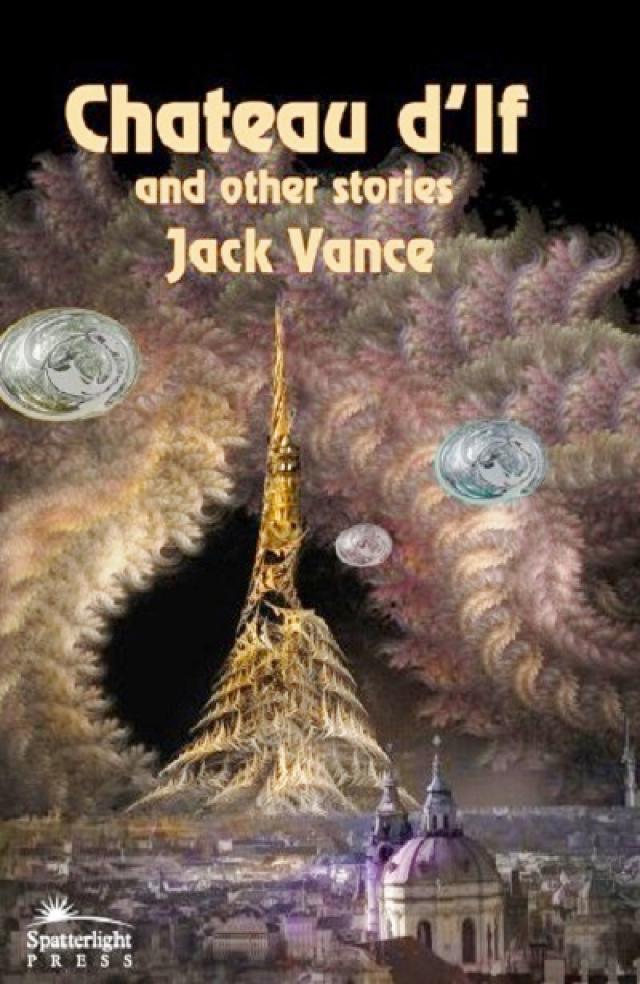
“Every man amuses himself as best he knows how. My current interest is building the Empyrean Tower.” His voice took on a deep exalted ring. “It shall rise three miles into the air! There is a banquet hall with a floor of alternate silver and copper strips, a quarter mile wide, a quarter mile high, ringed with eight glass balconies. There will be garden terraces like nothing else on earth, with fountains, waterfalls, running brooks. One floor will be a fairy-land out of the ancient days, peopled with beautiful nymphs.