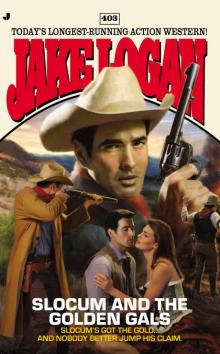
Holding down the ranch, p.2
Holding Down the Ranch,
p.2


He reined Concho around a prickly pear patch, and scared up a covey of quail in the process. The parents darted off, crested heads bobbing, their young trailing behind like a series of those wind-up toys the drummers sold.
Concho, however, wasn’t disturbed in the least, and merely nodded his head to match his gait, never breaking the slow, steady rhythm of it. That was one thing Slocum liked about the tall, chestnut, leopard Appaloosa—he didn’t have a spooky bone in his body. Of course, the gelding didn’t have much “jump” in him, but you couldn’t have everything.
Slocum figured that Concho’s surefootedness over bad terrain, his steadiness when other horses would fly off the handle and run for cover—and the not-incidental fact that he was one of the best reining and even-gated horses that Slocum had ever had the pleasure to ride—more than made up for his lack of speed.
Then again, maybe if Concho had a good reason to really run flat out, he would. Slocum had never pushed the issue with either his spurs or his quirt. No sense in it.
He came to a fork in the trail, reined up Concho, and sat there for a moment in the late afternoon sun, considering. He was at loose ends, and he could go any way he wanted. Elk City was to the southwest, Indian Springs was to the north, or he could ride due south to Plumville.
But then, Elk City wasn’t more than a wide spot in the road, as he recalled. Their silver had given out years ago, and most of the population had given out along with it.
Plumville was a going concern, though, as he remembered. Several saloons, three whorehouses—and a sheriff who wasn’t nearly so thoughtful as Hawkins, back in Bedrock.
Slocum wasn’t in the mood for trouble, not right at the moment.
After a few moments of further internal debate, he reined Concho north, toward Indian Springs.
Last month he’d finished up a job for Roy Tanner, down along the border, and had been wandering ever since. Wandering with six hundred dollars in his pocket, he would have hastened to add, had he been asked.
Well, it had started out as six hundred. Now, it was more like two-fifty or so. It would have been more if he hadn’t gotten into that poker game back in Sawdust, but there you were.
A man had a right, he guessed, to spend his money any way he wanted, even if he gambled it away like a damned fool.
He contented himself that the next time or the time after, he’d come out richer than he went in. Poker was like that. He’d planned on having a little fun gaming back in Bedrock, too, but then, he hadn’t counted on Tansy being there. And Tansy had been more fun than a game of cards, anyhow.
In Indian Springs, he’d stick to pasteboards, though. Pasteboards, a good cigar or three, and some fine champagne. Now, those would fit the bill, wouldn’t they?
Tansy’s place had been short of good cigars, and they hadn’t seen any champagne in there since the rail was laid. Which was why, come to think of it, he’d spent most of his time up in Tansy’s room.
But on the whole, he hadn’t minded moving on to greener pastures. Or at least, richer ones. He hoped. Indian Springs wasn’t a big town, but the last time he’d been through it had two saloons—with cigars and champagne—and a pretty fair whorehouse.
And Becky.
Suddenly, he smiled. Becky. He sure hoped Becky Sawyer was still hanging around Indian Springs, and that she hadn’t gone and done anything foolish, like marrying up with some farmer or rancher.
He’d last seen her about three years ago, when she was fresh from the east. Blonde, peach-ripe, and creamy-complected, she’d been nineteen and had come out to the territory to settle her late father’s estate.
It had turned out to be a real mess, what with Roy Wheeler having his grubby mitts tangled up in her daddy’s business, and Slocum had killed a man and wounded two others before it was over.
He didn’t suppose the town of Indian Springs at large would be all that overjoyed to see him back—Roy Wheeler had owned most of it, and the folks had gone lax, what with Wheeler looking out for them. He’d been a benevolent dictator, so to speak, but what the folks hadn’t known was what Wheeler had planned for them, once he got hold of the rest of town. Now Wheeler was doing fifteen years in the Territorial Prison at Yuma.
Becky, however, would be another matter.
If she hadn’t married.
Or gone back east.
Or entered a goddamn convent.
He snorted. “Fat chance of that,” he muttered beneath his breath. If ever there was an unlikely candidate for a life of chastity and poverty (not to mention those other vows, which he had forgotten a long time ago), it was Becky Sawyer.
Yessir, Becky Sawyer at Indian Springs.
Why the hell hadn’t he thought of that a couple of weeks ago? Well, he’d just circle around town and go straight on out to her daddy’s ranch. Her ranch, now: the Bar S.
He urged Concho into a smooth jog, and as he did, he began to whistle.
Rebecca Sawyer Jamison knelt by the grave she had just placed flowers on, paused for a moment of silent prayer, genuflected, then rose again.
She had cast aside her mourning black months ago, although she still deeply missed Jack. She hadn’t loved him, not really, and she supposed that he hadn’t loved her. But he had been an anchor for her, someone to lean on, and someone to oversee her business affairs—and broaden them—once Slocum had ridden off into the sunset.
Damn that Slocum anyway!
Jack had been good to her. Always polite, always thanked her for the few meals she herself concocted, and remarked on how good they were, even when she knew they weren’t. Which was most of the time. She’d always been a poor excuse for a cook.
Jack had been terribly sweet, she’d give him that: a widower, gray-haired and mustachioed, tall and sinewy with a ready laugh, and he’d owned the ranch that bordered the Bar S to the north. He’d been a friend of her father’s, too.
She brushed dust from her skirts. “I could have done a lot worse than you, Jack Jamison,” she whispered to his headstone. “Yes, a whole lot worse.”
Turning, she walked back toward the ranch house. She had moved from the Bar S and into the Cross J with Jack, and they had combined the two ranches to create a new, much larger one with a new brand: the S Bar J. These days, there was a skeleton crew staying over at the old Bar S’s bunkhouse to mind the stock, greet what few visitors came there, and oversee Becky’s flock of milk goats, but that was about it.
The S Bar J was an entirely different matter, however. The house was twice as big as the one at the Bar S, and the outbuildings far more numerous. Jack Jamison had been successful, far more successful than her daddy, bless his dear old soul, had ever dreamt of being.
Becky was a rich woman now—or at least better off than most—although she didn’t know how much longer that would last. When Slocum had come, he’d gotten rid of Roy Wheeler for her, all right—and, in the process, ruined her for any other man, damn his eyes. But a newer, bigger fish had stepped in to take Roy Wheeler’s place.
Tate McMahon.
Just the thought of his name sent shivers of dread and loathing through her.
She would not marry Tate McMahon, no matter how many times he asked, no matter how many times he begged, no matter how many times he demanded it. She had a feeling that the time for asking and begging—and demanding—would be done with shortly, though. Next time, or the one after that, or the one after that, he’d ride out towing his damned pet judge and wed her at gunpoint.
He’d threatened it. Just like he’d threatened Jack’s life.
And now Jack was gone.
“Miss Becky?” said a soft voice at her elbow.
Becky had trudged all the way from the grave, around the house, and to the front porch without realizing it.
She turned toward the intrusive voice. “Yes, Tia Juanita?”
The round Mexican housekeeper smiled softly, dimples sinking into her chubby cheeks, and lifted the thin shawl from Becky’s shoulders. “And how was Mr. Jamison today?” she asked.
“Same as usual,” Becky said with a tired sigh. “Still dead.”
Tia Juanita shook her head. She had come with Becky from her father’s ranch, having been his servant of long standing. She wasn’t anybody’s aunt that Becky knew of, but everybody called her Tia—or “aunt”—Juanita.
Even Jack had.
Even Slocum had.
Stop it! she told herself. Just stop thinking about some man who’s long gone! What’s got into you lately, anyway?
She had known he wasn’t coming back. She’d known it since the first time she’d seen him. He was a wanderer, a nomad, and with him, everything had to be taken day by day.
Which was the exact opposite of Jack. With Jack, everything was forever. Once Jack moved a piece of furniture into the house, you knew it was going to stay in exactly the same place until hell froze over. You didn’t like it so much—it was like beef and beans compared to candy and cake—but it was nourishing. And she had thought that it—and Jack—would be there forever. After all, he was too damned stubborn to die.
Slocum, she figured, had been all frosting and sweet insofar as loving went. Mighty fine when you had it, but a brief treat. You couldn’t live on it. Not forever.
It had turned out you couldn’t live too long or well on Jack’s kind of love, either.
Not when there was somebody lurking out there with a long-range rifle.
Tia Juanita opened the screened door and ushered her through, into the house. The inside was cooler by about ten degrees than the outside, the walls being made of thick adobe. Jack had built it well, to last forever.
Across the big parlor, which was actually in the same open space as the dining room, stood a large stone fireplace, built from rocks that Jack had collected around the ranch. And over the mantel, all by itself, hung a portrait of the man himself: steely hard, rail-thin, with that gray hair and mustache and those cool eyes, and holding his ever-present Stetson in his hands. He wasn’t smiling, but he wasn’t mad. The little creases that winged out from the corners of his eyes all but said, “I feel damned stupid sitting for this harebrained portrait, but I’ll do it for you, Becky.”
The last rays of the afternoon sun slanted in through the western windows, covering the big, dark dining room table with wide stripes of white light, and Becky pulled out a chair. She sat, propped her head in her hands, and asked, “What are we going to do, Tia Juanita?”
The housekeeper, knowing a rhetorical question when she heard one, didn’t reply. Instead, she said, “I have enchiladas baking.”
“That would be good,” Becky said absently.
Slocum made camp just before sunset, in a little gorge about ten miles out of Indian Springs.
As he curried Concho, his thoughts were mostly filled with Becky Sawyer. He’d been musing on her most of the afternoon, and the idea of her was sounding better and better to him all the time.
In his mind, he’d just about decided that she couldn’t have gone back east, or married, or any of those other things he’d been thinking about. Not Becky Sawyer. No, she’d be waiting for him with open arms.
He wondered if she still made that good pot roast—and that god-awful gravy.
“Man, that was tough stuff,” he said to the horse. Well, this time they’d let that Mexican gal—what was her name? Tia something or other?—do all the cooking. He figured they’d be otherwise occupied.
Giving Concho a last pat on the neck, a smiling Slocum put his curry comb and body brush away, then set off to gather wood for the fire.
3
Tate McMahon peered between the toes of his boots—which were resting on the polished cherry desk before him—at the clock.
It was 9:30 in the morning. Another two and a half hours before he gathered Judge Radnor and a couple of witnesses (quite a few, actually, and all bearing guns) and took a little ride out to the Jamison place. Another two and a half hours until he’d be a married—and very rich—man.
He smiled.
Through the front window, he watched the panorama of Main Street. Well, it wouldn’t have been much of a panorama compared to, say, New York City. But out here in the godforsaken middle of nowhere, it was fairly grand.
Every single place on the street which used to bear the name of Wheeler now had McMahon emblazoned in its place. McMahon Dry Goods, the McMahon Livery, McMahon Feed and Grain, and the local saloon, the McMahon Palace: these were just four such properties he could see out the front window.
The bank didn’t bear his name. That was still the Indian Springs Bank. But he owned it.
He owned just about everything.
God bless whoever it was that had put Roy Wheeler in jail, that was all he had to say. He had forgotten the name of the man who’d done it, but he gathered it was some sort of saddle bum with a grudge, and he didn’t much care. What he did care about was that it had cleared the way for him, and he was eager to fit right in.
He had.
Except that where old, short-sighted Roy Wheeler had failed to sew up the majority of property around town, Tate McMahon had succeeded. After all, he had a more pressing reason to grab it, and grab it fast. Tate McMahon had offered a bit more—and more persistently—than Wheeler had.
Times were changing, and things moved faster. Why, they had a telegraph and a train station right here in town! A man had to be persistent these days if he wanted to get anything done.
And Tate McMahon was nothing if not a persistent man.
Except that nothing had worked on Becky Jamison, absolutely nothing. Not even killing her husband, Jack Jamison. Criminal, really. Why, Jack had been old enough to be her father!
Outside of his land holdings, which had grown considerably since he started scooping up titles and deeds and mortgages like they were going out of style, Becky Jamison held the single largest spread around: the Bar S and the Cross J, which were now combined into the S Bar J.
Once he had that, he’d have a lock-tight hold on Indian Springs, and all the land around it for a good hundred miles in every direction. He needed a hundred miles, if only for a buffer zone between himself and the world.
Again, he stared out the window. There went Homer Dain. Probably going into the feed store to pick up a few more hundred-pound bags of oats. McMahon congratulated himself on having been smart enough to lease back the ranches to the families who had originally owned them. Why, Roy Wheeler had kicked them off their properties!
Stupid, that’s what Wheeler had been. Eventually, had Wheeler gotten his way, there would have been no one left in town outside Wheeler himself and his henchmen, and the place would have fair dried up. No one to run the shops, to mind the bank, to do all those little jobs McMahon considered beneath him, no one to buy the doodads that only women bought. No one to keep the economy bubbling along.
He didn’t mind that he didn’t own the tobacconist or the haberdasher or the gunsmith or any manner of smaller enterprises. He didn’t care about them, and he left them in peace. As long as he had his hands in all the major businesses and all the land—and the mineral rights—he would be content.
He wasn’t greedy, after all.
He checked the wall clock again. The hands had only moved fifteen minute’s worth.
He wondered if Judge Radnor had yet woken from his usual drunken coma. Probably not. Probably not until eleven or so.
Ah, well. He had waited this long to get married; he could wait a little longer. He wondered if there was a piano out at the S Bar J. He couldn’t remember. He hoped there was, though. Music would be nice. It made things more . . . official.
He smiled. “Da, da, duh-dum,” he began to sing softly.
Slocum was in a pretty good mood when he jogged Concho into the yard at the Bar S Ranch at along about eleven that morning. He rode through a flock of bleating goats, which seemed to be milling all over the yard, made his way up to the porch, dismounted, and gave Concho a jovial pat on the neck.
Wearing a giant-sized grin, he threw his reins around the hitching rail and went on up to the front door.
But when he knocked, it wasn’t opened by Tia What’s-her-name, as he had expected. Instead, it was answered by a lone, rangy cowhand wearing nothing but his long johns, his boots, his hat, and a red-checkered napkin tucked high under his chin.
Furthermore, he was holding a fried chicken leg and was looking just a touch annoyed—to have been disturbed during his late breakfast, Slocum figured. Or early lunch.
The hand didn’t look half as annoyed as Slocum felt, though. His anticipatory grin had long since evaporated.
“Mornin’, friend,” the hand drawled lazily, and took a bite of chicken. Through a mouthful of half-masticated meat, he said, “Can I help you with somethin’ or other?”
Slocum clenched his hands into fists, but didn’t raise them. If Becky had sunk so low as to take this good-for-nothing cowpoke to her bed, well, she could have him and he could have her.
But he said, “Becky Sawyer around?”
The cowpoke scratched his head. “You ain’t seen her for a while, have you, Mister?”
Slocum didn’t reply.
His silence didn’t faze the cowpoke, though. “Because Miss Becky up and got herself wed ’bout two years back,” he continued. “Well, now that I come to think about it, it might have been two and a half. Moved up the road to the Cross J,” he went on lazily, pointing toward the north with his drumstick while he held the screen door wide with the other hand.
“Used to be the Cross J, that is,” he went on. “Course, it’s the S Bar J, now.” From horizon to horizon, he swept out the arm with the half-eaten chicken leg in it, nearly poking Slocum in the nose, which didn’t make him any happier about the situation. “All this is,” the cowhand said.
“Is what?” Slocum asked tersely.
The cowpoke swallowed another bite of chicken. “The S Bar J, what’d you think? See now, Mr. Jack Jamison, he was the Cross J, and Miss Sawyer, her papa was the Bar S. Course, that was a long time before I come to work here. Anyways, when she—”