Xaros jungle planet gu.., p.6
Xaros - Jungle Planet: Guns of the Federation Book 1,
p.6
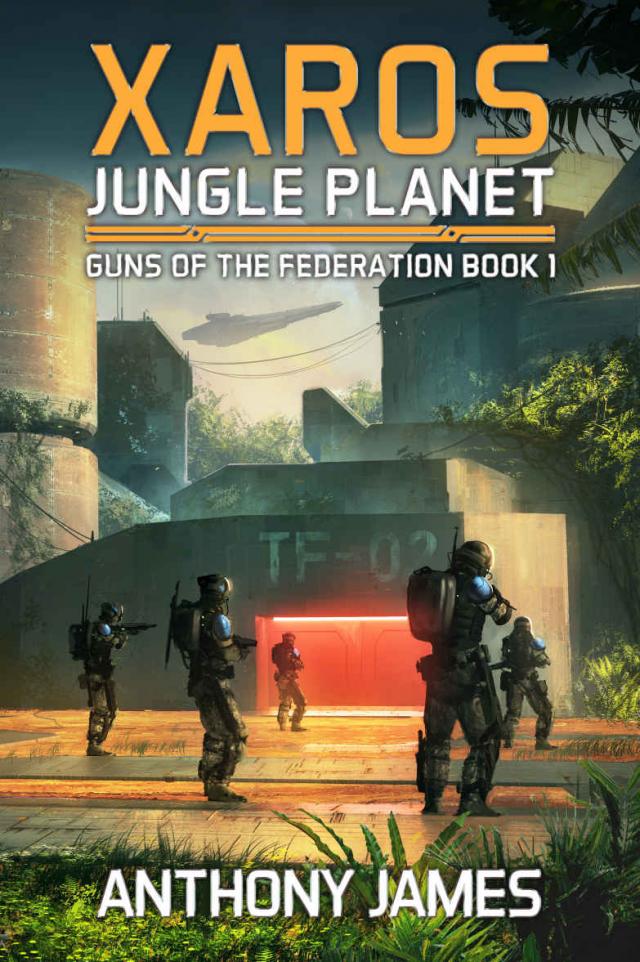


Maxwell’s expression was neutral. “I never did like mysteries, sir.”
“Do you know anything about Xaros?”
“Only what I found in the Marauder’s databanks after I read the mission files. Looks like a nice place.”
“Yeah, real nice,” said Private Ralf Barkley from further along the table. “Trees and mountains. Just like home.”
“We should be kicking ass in Landol sector,” said Private Olivia Diaz, addressing nobody in particular. “I hear the Kijol took over one of our Terylium mines.”
Grisham hadn’t heard that, and he hid his surprise. Different people had access to different grapevines, and it was always worth stopping by to hear what the ground troops had to say. In fact, it was the primary reason for his visit to the mess room.
“This is war, Private,” Grisham said. “We win some, they win some. Eventually, we sign a peace accord, bury our dead and pretend like it never happened.”
“Do you believe that, sir?” asked Maxwell, his gaze intense.
“I hear some things, the same way you hear them, Sergeant,” said Grisham. The response was evasive, and he regretted the words at once. Trust and loyalty were hard earned, and so far, there was little of either between the Marauder’s crew and these soldiers. He came clean. “It’s not going well for us.”
“Ten years and more we’ve been fighting,” said Private Johnny Lowe, standing close enough that he could hear what was being said over the background propulsion. “Most people I’ve talked to in the last year reckon we’ve been talking peace. In the background, all hush-hush, so nobody’d know about it if it went south.”
“And now it has gone south,” said Chau. “Big time south.”
“Those new Kijol ships are chewing through our fleet way faster than we can build replacements,” said Diaz. “And here we are heading out to Xaros to check on a bunch of crazies, instead of putting bullets through Kijol skulls.” She raised both hands and mimicked shooting her gauss rifle.
Having initiated the conversation, Grisham listened to the talk while he drank his metallic juice and ate his flavourless burger. As he’d suspected, the soldiers knew of various rumours that hadn’t reached his own ears. Some of the talk was obviously either total crap or enormously exaggerated, but some of the other stuff – like the loss of the Terylium mine – was both believable and worrying.
Soon, the talk died down. Grisham guessed the soldiers resented his presence, like he’d intruded onto their turf. He took his leave. It seemed as if, from out of nowhere, everything had been turned on its head.
In a war fought across such distances, where the comms required days – weeks sometimes – to reach their destination, many officers fought in effective isolation, where their only contact with other personnel happened during brief returns to base. And then, all the updates from scattered sources, which were likely already outdated, were stirred together, forming a muddy pool into which an officer might peer and learn effectively nothing.
Grisham returned to the bridge, wondering where the hell it all would lead.
Chapter Seven
Eight days wasn’t by any means the longest time Grisham had spent at lightspeed, but this mission to Xaros had him on edge and he was unable to settle. To keep himself occupied, he frequented the Marauder’s tiny gym, and it was possible – just – to run laps around the passages on the upper levels.
Aside from that, Grisham had access to books, along with a host of recorded media he could watch on a wall screen in his room. That room, however, was so compact, that spending time there for anything other than sleep or showering was an exercise in abject tedium.
Consequently, Grisham, no doubt like everyone else on the Marauder, found the journey tough. Overall discipline was good, though this came as no surprise. Having familiarised himself with their personnel records, Grisham knew the soldiers were all veterans of many campaigns. They’d evidently learned to cope with the travel time blues.
With a couple of hours remaining before the Marauder’s scheduled exit from lightspeed, Grisham was woken from sleep by his alarm. This would potentially be the start of a long period on duty, so he was glad to feel fresh. The hot water from the shower washed away the vestiges of sleep and he dressed in his combat suit with practised ease.
Once that was done, he grabbed his suit helmet from the alcove next to his narrow bed and headed for the bridge. Lieutenant Lopez was also returning to duty and the two of them arrived at the same time.
“Anything to report?” Grisham asked once he’d taken his seat.
“No, sir,” said Deneuve. “Today is the big day and everything is a-okay.”
Grisham ran his eyes over his console, and he detected nothing to contradict Deneuve’s assessment.
“This is our last chance to prepare,” he said. “Let’s go over the details again. Tell me about Xaros.”
“The planet is mostly oceans and jungles,” said Lopez. “It has ice at the poles, some grasslands and some mountains. The atmosphere is breathable, though the oxygen concentrations are a little lower than is ideal for human habitation and the gravity is a little higher than most of us are used to.”
“Initial surveys – following the discovery of the planet - indicated that exploitation of Xaros offered no economic benefits, owing to a combination of its distance and the low value of its predominant ores,” Bishop continued. “Under the Planetary Expansion Act Z-93, the Church of Everlasting Serenity staked its claim on Xaros fifteen years ago and were granted a renewable one-hundred-year lease on the planet, subject to the usual conditions and the HF’s right to reclaim for the wider good if the predominant ores were subsequently found to be in requirement.”
“Thank you,” said Grisham. “What else?”
“The CES established a settlement on the Xaros equator, using standard transport-and-drop habitation modules and equipment,” said Lopez. “Where their funding came from isn’t something we have access to, but the HF can make discretionary grants depending on various criteria.”
“Reading between the lines, I’d guess that Ivey Metz received all the grant money she needed,” said Adler.
Grisham suspected likewise, but he kept the thought to himself. “So that’s what we’re heading into, folks,” he said. “We’ll break out of lightspeed and attempt short-range comms, in case the Xaros main transmitter hardware failed. If nobody’s answering the comms, we’ll scan the surface facility and, if necessary, I’ll order a deployment.”
The crew understood the plan, such as it was, and nobody asked further questions. After that, it was a matter of waiting out the final minutes before the Marauder re-entered local space.
When Adler shouted the two-minute warning, Grisham felt relief that things would soon start moving.
“We’ve targeted a quarter of a million klicks from Xaros, sir,” said Lopez. “Assuming the lightspeed calcs work out right and we end up on the visible side to the CES installation, the range will be too great for a clear picture of what’s happening on the ground.”
“That’s fine, Lieutenant. I’m not intended to rush into this – we’ll see what we can discover from a distance first and then we’ll go in for a closer look.”
The lightspeed timer finished and the Marauder vibrated with the stresses of re-entry to local space. Grisham retched a couple of times and then he was fine. Nothing on his status panel indicated a cause for concern, and Lieutenant Adler confirmed the same thing a few moments later.
For several long seconds, the sensor feeds were blank as the main arrays came back online. Then, the feeds appeared, all darkness and faraway pinpoints of light.
“Area scans underway,” said Lopez. “There will definitely be zero Kijol warships at Xaros.”
“There’s no way the enemy will know about this place,” said Deneuve.
It was a conversation Grisham had heard several times over the last eight days. While he didn’t think the Kijol had located Xaros, he was keeping an open mind about the potential dangers.
“The area scans are clear, sir,” said Lopez.
“I’ve put Xaros on the main screen,” said Bishop. “It looks like the range is what we intended, and I believe the CES facility should be on the visible side.”
“Scan and confirm,” said Grisham.
“Yes, sir.”
The planet looked inviting enough. Greens and blues were the predominant colours, along with cold white to the north. A Tibor class lacked both the quantity of sensor arrays and the processing power to filter the data when compared to a larger fleet warship. Consequently, the details were lacking, being only colours and not much else. Two moons orbited Xaros, both oversized, their surface greys in sharp contrast to the vibrancy of the planet. One of those moons was in full view, circling clockwise at three hundred thousand kilometres from the planet, while the other – more distant - satellite was partially obscured by Xaros.
“The ground facility is definitely within our sensor arc, sir,” said Bishop. “I’m zooming on the known coordinates.”
“Lieutenant Lopez, run a scan for ground receptors,” said Grisham.
“Yes, sir…scanning. No receptors found. Scanning again…no receptors found.”
“From that, I take it the surface hardware is either out of action, destroyed, or they configured their comms unit to hide its receptors,” said Grisham.
“It’s either A or B, sir. The records indicate the church is in possession of a civilian comms unit. That hardware is deliberately set up so that it’s always visible to military comms systems.”
“Even if they powered down the console?”
“Those comms units never power down entirely, sir,” said Lopez. “I guess if the people living down there were determined enough, they could have cased the unit in something dense enough to block the receptor, or pushed the whole lot down a deep hole.”
“Doesn’t sound likely,” said Deneuve.
“Not much,” Grisham agreed. “So, no comms. Is the feed enhancement complete?”
“Just finished now, sir,” said Bishop. “It’s up on the screen.”
Grisham was expecting low details and that’s exactly what he got. Zooming and over-enhancement of the feed left it grainy, and it shimmered as the backend computers tried to fill in the missing data. As a result, the CES compound appeared as little more than a blurred patch of grey on the northern edge of a vast lake, with an expansive area of jungle east, west and north.
Leaning closer, Grisham narrowed his eyes. “The place could have been destroyed and we wouldn’t know it from here.”
“Not quite true, sir,” said Lopez. “We’d detect smoke and residual heat even from this range – at least if there were sufficient quantities of either.”
“There’s no smoke and there’s no heat,” said Bishop in confirmation.
“Xaros has been off-comms for weeks already,” said Grisham. “If it was attacked, the fires would have burned out long ago.”
“Bring us to ten thousand klicks and I’ll you what colour toilet paper they use, sir,” said Bishop.
“Let’s stay where we are for a few minutes,” said Grisham. “Scan the ground buildings if you can and look for anything of interest within a hundred klicks.”
He had a feeling the scans wouldn’t reveal anything new, but like he’d told his crew, he wasn’t intending to risk the mission by heading straight in for a closer look. If the ground comms hardware had failed, the people would still have ample supplies according to the shipping schedules. If something more sinister had occurred, nothing Grisham could do would change that.
“Fifteen minutes of scanning and we’ve found nothing new, sir,” said Lopez at last. “Should we keep doing what we’re doing?”
“Let’s head in a little closer,” said Grisham. “It’ll be a chance to find out what effect all those extra engine modules have had on our maximum velocity.”
In truth, he knew full well that the Marauder would go as high as 250 kilometres per second. Sliding the controls to their farthest extent, Grisham felt himself pushed into the padding of his seat as the warship accelerated. The engines howled and the muscles in his forearms, shoulders and neck fought against the strain until the life support unit caught up and the accelerative forces lessened.
“Two-fifty klicks per second,” said Grisham once the velocity gauge stopped climbing.
“Not bad,” said Adler. “Our fastest warship yet.”
“Bringing comms units to the forsaken in double-quick time,” said Deneuve. “Sixteen minutes to planetary orbit.”
“We’re heading to fifty thousand klicks,” said Grisham. “If the scans are clear, then I’ll think about approaching to ten thousand.”
Thirteen minutes later, he brought the Marauder to a standstill. A glance at the status readouts gave Grisham no cause for worry. A few more lightspeed transitions and a couple of high velocity flights at a low altitude - where the Marauder would be subjected to heat and particle erosion - and he knew he’d stop thinking about possible failure in the hardware.
“Here’s the feed of the ground buildings, but from fifty thousand klicks,” said Bishop.
The feed was appreciably improved. Now, Grisham could make out the individual buildings and how the habitation units had been arranged. Nothing stood out as unusual. Within the compound, the innermost prefabs – out of nearly three hundred in total - had been placed in a square around a much larger, central structure, this possibly being the communal heart of the establishment.
Other prefabs further from the centre had been positioned more haphazardly, and the entire habited area measured approximately two-point-five kilometres from east to west and about two kilometres from north to south.
Three hundred metres from the westernmost structure, a reinforced concrete slab, about a hundred metres square, indicated where the twice-yearly supply vessel set down. A couple of twenty-metre shuttles – small enough that they were little more than smears on the feed - were parked on the edge of the slab.
Circling everything, an alloy wall offered protection from whatever fauna called Xaros their home. Grisham had already checked what the initial planetary surveys had learned about the planet’s indigenous species, and those surveys hadn’t classified anything as a high threat. However, the survey results weren’t always one hundred percent accurate, given the limited time allotted to initial planetary investigations.
The accuracy or otherwise of the surveys didn’t matter too much here on Xaros. The repeater turrets placed at strategic intervals around the walls would ensure that any wild animals able to climb or fly over the walls would quickly be reduced to a bloody pulp.
“Everything looks…fine,” said Lopez. “It’s a textbook off-world compound, with standard defences and no sign of anything amiss.”
“We’re still too far to reliably detect ground movement, sir,” said Bishop. “Those people down there could be holding a carnival in the streets and we wouldn’t know about it.”
“I want more scans,” said Grisham. “You’ve got ten minutes to find something, and then we’ll approach to ten thousand klicks.”
Lopez and Bishop got on with the search, while Grisham stared closely at the feeds. Nothing was visibly out of place, though his sense of unease had returned. Maybe at ten thousand kilometres, the situation in the compound would become clearer.
After ten minutes scanning the ground structures and hunting for signs the Kijol had visited Xaros, Lieutenant Lopez declared the lack of significant findings.
“Ten thousand klicks it is,” said Grisham.
The Marauder covered the distance in not much more than three minutes and when Grisham again brought the warship to a halt, he studied the sensor feeds. While the visible details were enormously improved – enough for him to be absolutely certain the compound hadn’t suffered any kind of heavy-arms assault – the streets still appeared empty. The sun was directly overhead and the shadows were few. If the church members were out and about, they were doing a good job of staying hidden.
Elsewhere, the surrounding trees were undisturbed, and the waters of the huge lake were the pristine blue of a tropical paradise. Everything looked fine, except for the lack of people.
“Why can’t I see anyone?” asked Grisham. “This is approximately midday on Xaros. The planetary survey doesn’t mention intolerable heat or humidity, so why would everyone be indoors?”
“I don’t have an answer for you, sir,” said Lopez. “But there’s definitely no movement. There are a few dozen gravity cars across the compound, but they’re all empty.”
Grisham’s gaze was drawn once more to the landing pad. “I count two shuttles down there,” he said. He accessed a file on his console and scanned the contents. “According to the inventory list, the CES have two shuttles and no more, so they didn’t all take off on a field trip somewhere.”
“What next, sir?” asked Deneuve. “We could be ultra-cautious and circle the planet a few times to see what we can find, or we could drop into orbit in case we’re missing something from up here at ten thousand klicks.”
“Something’s wrong,” said Grisham. “I can feel it.”
“I’m getting that feeling too,” said Deneuve.
Memories of the Kijol destroyer jumped into Grisham’s mind and he pushed them aside. “Lieutenant Lopez, if I positioned the Marauder twenty klicks over that base, is there a chance you’ll detect something which you’re missing now?”
“Only if you’re looking for an escaped mouse, sir,” said Lopez. “I can tell you right now that if there are any people in that compound, they’re indoors.”
Grisham made up his mind. “Lieutenant Bishop, contact Sergeant Maxwell and order him and his squads to the deployment vehicle. Unless something changes and soon, he’s heading down there for a look.”
“The order is given, sir,” said Bishop after a few moments speaking on the internal comms. “Sergeant Maxwell says he’ll be ready to go in less than ten minutes.”
“Are we heading into the atmosphere, sir?” asked Deneuve.