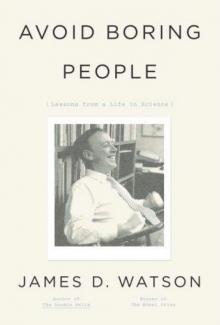
The double helix, p.2
The Double Helix,
p.2


Somewhere between Bragg the theorist and Perutz the experimentalist was Francis, who occasionally did experiments but more often was immersed in the theories for solving protein structures. Often he came up with something novel, would become enormously excited, and immediately tell it to anyone who would listen. A day or so later he would often realize that his theory did not work and return to experiments, until boredom generated a new attack on theory.
There was much drama connected with these ideas. They did a great deal to liven up the atmosphere of the lab, where experiments usually lasted several months to years. This came partly from the volume of Crick’s voice: he talked louder and faster than anyone else and, when he laughed, his location within the Cavendish was obvious. Almost everyone enjoyed these manic moments, especially when we had the time to listen attentively and to tell him bluntly when we lost the train of his argument. But there was one notable exception. Conversations with Crick frequently upset Sir Lawrence Bragg, and the sound of his voice was often sufficient to make Bragg move to a safer room. Only infrequently would he come to tea in the Cavendish, since it meant enduring Crick’s booming over the tea room. Even then Bragg was not completely safe. On two occasions the corridor outside his office was flooded with water pouring out of a laboratory in which Crick was working. Francis, with his interest in theory, had neglected to fasten securely the rubber tubing around his suction pump.
At the time of my arrival, Francis’ theories spread far beyond the confines of protein crystallography. Anything important would attract him, and he frequently visited other labs to see which new experiments had been done. Though he was generally polite and considerate of colleagues who did not realize the real meaning of their latest experiments, he would never hide this fact from them. Almost immediately he would suggest a rash of new experiments that should confirm his interpretation. Moreover, he could not refrain from subsequently telling all who would listen how his clever new idea might set science ahead.
As a result, there existed an unspoken yet real fear of Crick, especially among his contemporaries who had yet to establish their reputations. The quick manner in which he seized their facts and tried to reduce them to coherent patterns frequently made his friends’ stomachs sink with the apprehension that, all too often in the near future, he would succeed, and expose to the world the fuzziness of minds hidden from direct view by the considerate, well-spoken manners of the Cambridge colleges.
Though he had dining rights for one meal a week at Caius College, he was not yet a fellow of any college. Partly this was his own choice. Clearly he did not want to be burdened by the unnecessary sight of undergraduate tutees. Also a factor was his laugh, against which many dons would most certainly rebel if subjected to its shattering bang more than once a week. I am sure this occasionally bothered Francis, even though he obviously knew that most High Table life is dominated by pedantic, middle-aged men incapable of either amusing or educating him in anything worthwhile. There always existed King’s College, opulently nonconformist and clearly capable of absorbing him without any loss of his or its character. But despite much effort on the part of his friends, who knew he was a delightful dinner companion, they were never able to hide the fact that a stray remark over sherry might bring Francis smack into your life.
Francis next to a Cavendish X-ray tube.
2
BEFORE my arrival in Cambridge, Francis only occasionally thought about deoxyribonucleic acid (DNA) and its role in heredity. This was not because he thought it uninteresting. Quite the contrary. A major factor in his leaving physics and developing an interest in biology had been the reading in 1946 of What Is Life? by the noted theoretical physicist Erwin Schrödinger. This book very elegantly propounded the belief that genes were the key components of living cells and that, to understand what life is, we must know how genes act. When Schrödinger wrote his book (1944), there was general acceptance that genes were special types of protein molecules. But almost at this same time the bacteriologist O. T. Avery was carrying out experiments at the Rockefeller Institute in New York which showed that hereditary traits could be transmitted from one bacterial cell to another by purified DNA molecules.
Given the fact that DNA was known to occur in the chromosomes of all cells, Avery’s experiments strongly suggested that future experiments would show that all genes were composed of DNA. If true, this meant to Francis that proteins would not be the Rosetta Stone for unraveling the true secret of life. Instead, DNA would have to provide the key to enable us to find out how the genes determined, among other characteristics, the color of our hair, our eyes, most likely our comparative intelligence, and maybe even our potential to amuse others.
Of course there were scientists who thought the evidence favoring DNA was inconclusive and preferred to believe that genes were protein molecules. Francis, however, did not worry about these skeptics. Many were cantankerous fools who unfailingly backed the wrong horses. One could not be a successful scientist without realizing that, in contrast to the popular conception supported by newspapers and mothers of scientists, a goodly number of scientists are not only narrow-minded and dull, but also just stupid.
Francis, nonetheless, was not then prepared to jump into the DNA world. Its basic importance did not seem sufficient cause by itself to lead him out of the protein field which he had worked in only two years and was just beginning to master intellectually. In addition, his colleagues at the Cavendish were only marginally interested in the nucleic acids, and even in the best of financial circumstances it would take two or three years to set up a new research group primarily devoted to using X rays to look at the DNA structure.
Moreover, such a decision would create an awkward personal situation. At this time molecular work on DNA in England was, for all practical purposes, the personal property of Maurice Wilkins, a bachelor who worked in London at King’s College.* Like Francis, Maurice had been a physicist and also used X-ray diffraction as his principal tool of research. It would have looked very bad if Francis had jumped in on a problem that Maurice had worked over for several years. The matter was even worse because the two, almost equal in age, knew each other and, before Francis remarried, had frequently met for lunch or dinner to talk about science.
It would have been much easier if they had been living in different countries. The combination of England’s coziness—all the important people, if not related by marriage, seemed to know one another—plus the English sense of fair play would not allow Francis to move in on Maurice’s problem. In France, where fair play obviously did not exist, these problems would not have arisen. The States also would not have permitted such a situation to develop. One would not expect someone at Berkeley to ignore a first-rate problem merely because someone at Cal Tech had started first. In England, however, it simply would not look right.
Even worse, Maurice continually frustrated Francis by never seeming enthusiastic enough about DNA. He appeared to enjoy slowly understating important arguments. It was not a question of intelligence or common sense. Maurice clearly had both; witness his seizing DNA before almost everyone else. It was that Francis felt he could never get the message over to Maurice that you did not move cautiously when you were holding dynamite like DNA. Moreover, it was increasingly difficult to take Maurice’s mind off his assistant, Rosalind Franklin.
Not that he was at all in love with Rosy, as we called her from a distance. Just the opposite—almost from the moment she arrived in Maurice’s lab, they began to upset each other. Maurice, a beginner in X-ray diffraction work, wanted some professional help and hoped that Rosy, a trained crystallographer, could speed up his research. Rosy, however, did not see the situation this way. She claimed that she had been given DNA for her own problem and would not think of herself as Maurice’s assistant.
I suspect that in the beginning Maurice hoped that Rosy would calm down. Yet mere inspection suggested that she would not easily bend. By choice she did not emphasize her feminine qualities. Though her features were strong, she was not unattractive and might have been quite stunning had she taken even a mild interest in clothes. This she did not. There was never lipstick to contrast with her straight black hair, while at the age of thirty-one her dresses showed all the imagination of English blue-stocking adolescents. So it was quite easy to imagine her the product of an unsatisfied mother who unduly stressed the desirability of professional careers that could save bright girls from marriages to dull men. But this was not the case. Her dedicated, austere life could not be thus explained—she was the daughter of a solidly comfortable, erudite banking family.
Clearly Rosy had to go or be put in her place. The former was obviously preferable because, given her belligerent moods, it would be very difficult for Maurice to maintain a dominant position that would allow him to think unhindered about DNA. Not that at times he didn’t see some reason for her complaints—King’s had two combination rooms, one for men, the other for women, certainly a thing of the past. But he was not responsible, and it was no pleasure to bear the cross for the added barb that the women’s combination room remained dingily pokey whereas money had been spent to make life agreeable for him and his friends when they had their morning coffee.
Unfortunately, Maurice could not see any decent way to give Rosy the boot. To start with, she had been given to think that she had a position for several years. Also, there was no denying she had a good brain. If she could only keep her emotions under control, there would be a good chance that she could really help him. But merely wishing for relations to improve was taking something of a gamble, for Cal Tech’s fabulous chemist Linus Pauling was not subject to the confines of British fair play. Sooner or later Linus, who had just turned fifty, was bound to try for the most important of all scientific prizes. There was no doubt that he was interested. Our first principles told us that Pauling could not be the greatest of all chemists without realizing that DNA was the most golden of all molecules. Moreover, there was definite proof. Maurice had received a letter from Linus asking for a copy of the crystalline DNA X-ray photographs. After some hesitation he wrote back saying that he wanted to look more closely at the data before releasing the pictures.
All this was most unsettling to Maurice. He had not escaped into biology only to find it personally as objectionable as physics, with its atomic consequences. The combination of both Linus and Francis breathing down his neck often made it very difficult to sleep. But at least Pauling was six thousand miles away, and even Francis was separated by a two-hour rail journey. The real problem, then, was Rosy. The thought could not be avoided that the best home for a feminist was in another person’s lab.
Maurice Wilkins.
3
IT WAS Wilkins who had first excited me about X-ray work on DNA. This happened at Naples when a small scientific meeting was held on the structures of the large molecules found in living cells. Then it was the spring of 1951, before I knew of Francis Crick’s existence. Already I was much involved with DNA, since I was in Europe on a postdoctoral fellowship to learn its biochemistry. My interest in DNA had grown out of a desire, first picked up while a senior in college, to learn what the gene was. Later, in graduate school at Indiana University, it was my hope that the gene might be solved without my learning any chemistry. This wish partially arose from laziness since, as an undergraduate at the University of Chicago, I was principally interested in birds and managed to avoid taking any chemistry or physics courses which looked of even medium difficulty. Briefly the Indiana bio chemists encouraged me to learn organic chemistry, but after I used a bunsen burner to warm up some benzene, I was relieved from further true chemistry. It was safer to turn out an uneducated Ph.D. than to risk another explosion.
So I was not faced with the prospect of absorbing chemistry until I went to Copenhagen to do my postdoctoral research with the biochemist Herman Kalckar. Journeying abroad initially appeared the perfect solution to the complete lack of chemical facts in my head, a condition at times encouraged by my Ph.D. supervisor, the Italian-trained microbiologist Salvador Luria. He positively abhorred most chemists, especially the competitive variety out of the jungles of New York City. Kalckar, however, was obviously cultivated, and Luria hoped that in his civilized, continental company I would learn the necessary tools to do chemical research, without needing to react against the profit-oriented organic chemists.
Then Luria’s experiments largely dealt with the multiplication of bacterial viruses (bacteriophages, or phages for short). For some years the suspicion had existed among the more inspired geneticists that viruses were a form of naked genes. If so, the best way to find out what a gene was and how it duplicated was to study the properties of viruses. Thus, as the simplest viruses were the phages, there had sprung up between 1940 and 1950 a growing number of scientists (the phage group) who studied phages with the hope that they would eventually learn how the genes controlled cellular heredity. Leading this group were Luria and his German-born friend, the theoretical physicist Max Delbrück, then a professor at Cal Tech. While Delbrück kept hoping that purely genetic tricks could solve the problem, Luria more often wondered whether the real answer would come only after the chemical structure of a virus (gene) had been cracked open. Deep down he knew that it is impossible to describe the behavior of something when you don’t know what it is. Thus, knowing he could never bring himself to learn chemistry, Luria felt the wisest course was to send me, his first serious student, to a chemist.
He had no difficulty deciding between a protein chemist and a nucleic-acid chemist. Though only about one half the mass of a bacterial virus was DNA (the other half being protein), Avery’s experiment made it smell like the essential genetic material. So working out DNA’s chemical structure might be the essential step in learning how genes duplicated. Nonetheless, in contrast to the proteins, the solid chemical facts known about DNA were meager. Only a few chemists worked with it and, except for the fact that nucleic acids were very large molecules built up from smaller building blocks, the nucleotides, there was almost nothing chemical that the geneticist could grasp at. Moreover, the chemists who did work on DNA were almost always organic chemists with no interest in genetics. Kalckar was a bright exception. In the summer of 1945 he had come to the lab at Cold Spring Harbor, New York, to take Delbrück’s course on bacterial viruses. Thus both Luria and Delbrück hoped the Copenhagen lab would be the place where the combined techniques of chemistry and genetics might eventually yield real biological dividends.
Their plan, however, was a complete flop. Herman did not stimulate me in the slightest. I found myself just as indifferent to nucleic-acid chemistry in his lab as I had been in the States. This was partly because I could not see how the type of problem on which he was then working (the metabolism of nucleotides) would lead to anything of immediate interest to genetics. There was also the fact that, though Herman was obviously civilized, it was impossible to understand him.
I was able, however, to follow the English of Herman’s close friend Ole Maaløe. Ole had just returned from the States (Cal Tech), where he had become very excited about the same phages on which I had worked for my degree. Upon his return he gave up his previous research problem and was devoting full time to phage. Then he was the only Dane working with phage and so was quite pleased that I and Gunther Stent, a phage worker from Delbrück’s lab, had come to do research with Herman. Soon Gunther and I found ourselves going regularly to visit Ole’s lab, located several miles from Herman’s, and within several weeks we were both actively doing experiments with Ole.
At first I occasionally felt ill at ease doing conventional phage work with Ole, since my fellowship was explicitly awarded to enable me to learn biochemistry with Herman; in a strictly literal sense I was violating its terms. Moreover, less than three months after my arrival in Copenhagen I was asked to propose plans for the following year. This was no simple matter, for I had no plans. The only safe course was to ask for funds to spend another year with Herman. It would have been risky to say that I could not make myself enjoy biochemistry. Furthermore, I could see no reason why they should not permit me to change my plans after the renewal was granted. I thus wrote to Washington saying that I wished to remain in the stimulating environment of Copenhagen. As expected, my fellowship was then renewed. It made sense to let Kalckar (whom several of the fellowship electors knew personally) train another biochemist.
There was also the question of Herman’s feelings. Perhaps he minded the fact that I was only seldom around. True, he appeared very vague about most things and might not yet have really noticed. Fortunately, however, these fears never had time to develop seriously. Through a completely unanticipated event my moral conscience became clear. One day early in December, I cycled over to Herman’s lab expecting another charming yet totally incomprehensible conversation. This time, however, I found Herman could be understood. He had something important to let out: his marriage was over, and he hoped to obtain a divorce. This fact was soon no secret—everyone else in the lab was also told. Within a few days it became apparent that Herman’s mind was not going to concentrate on science for some time, for perhaps as long as I would remain in Copenhagen. So the fact that he did not have to teach me nucleic-acid biochemistry was obviously a godsend. I could cycle each day over to Ole’s lab, knowing it was clearly better to deceive the fellowship electors about where I was working than to force Herman to talk about biochemistry.
At times, moreover, I was quite pleased with my current experiments on bacterial viruses. Within three months Ole and I had finished a set of experiments on the fate of a bacterial-virus particle when it multiplies inside a bacterium to form several hundred new virus particles. There were enough data for a respectable publication and, using ordinary standards, I knew I could stop work for the rest of the year without being judged unproductive. On the other hand, it was equally obvious that I had not done anything which was going to tell us what a gene was or how it reproduced. And unless I became a chemist, I could not see how I would.