Blood mountain, p.7
Blood Mountain,
p.7
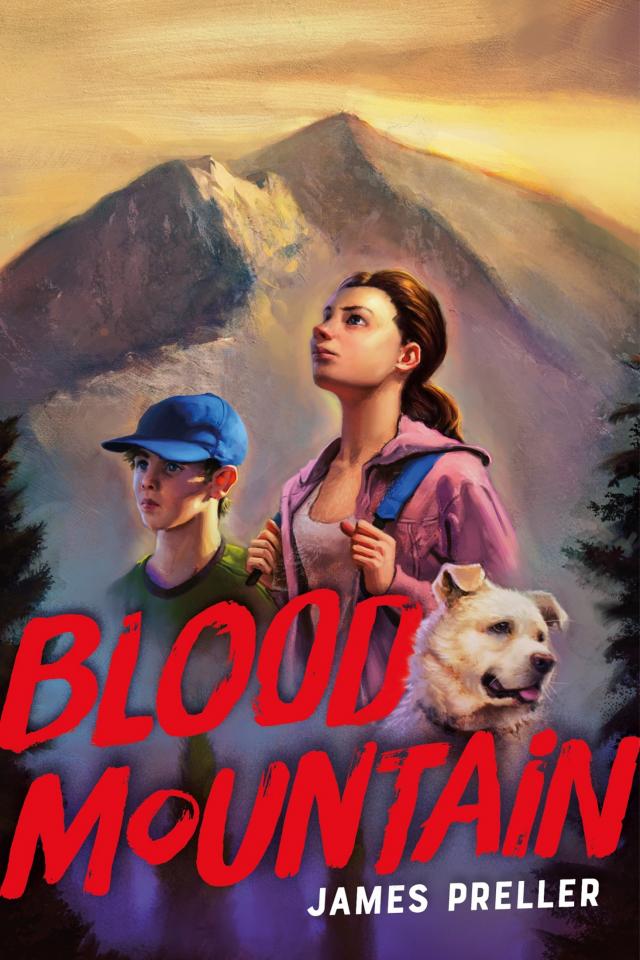


It is a fine place to think. But Carter knows it is time to move. He imagines the route as if it were as simple as going around the block to buy milk. He’ll descend into the valley, then circle around and to the right, then straightaway to reach the lake. Piece of cake. There will be people there. A man fishing. A young family camping, children swimming in the water, laughing. Eating s’mores.
His stomach churns. He remembers food.
Hold on, Grace, he thinks.
Carter climbs down, swings from the lowest branch, drops soundlessly to the earth.
29
[TRACKS]
It is not his nature to speak. The angular man is like a solitary fir with roots in soil, branches reaching to the sun. There are no words for this. It is enough to be, to stand, to watch, to sleep. Once he came upon a lone hiker, gave a terse nod, uttered a hoarse Hey, and never broke stride. His throat dry, his voice a rasp. On night raids, he moves around the outskirts of town like a furtive fox in the dusky, slate-gray meadow. On the rare times he ventures into town, for bulk items at the food co-op or essentials at Walmart, he washes his hands, files his fingernails, trims his beard. He shrinks himself, becomes anonymous. He selects his supplies, avoids eye contact, pays in cash, and vanishes.
He still thinks in words, of course. But less and less. The angular man knows the names of things: hickory, sweetleaf, black cherry, chestnut. Which mushrooms he can eat, which to avoid. On and on with the names of things. But he no longer feels compelled to make those noises with his mouth. For why? For whom? For what purpose?
Simpler, and safer, this way.
He once lived in a world of words and commands and roadside bombs and snipers and death. A world of IEDs buried underground, “improvised explosive devices,” a nine-syllable way of saying “homemade bombs.” Where a false step—no, not false—just a step, an unfortunate footfall, a true step—and the whole world explodes. Bodies tossed into the air like confetti. The boot is gone. The foot, the leg up to the knee, the soft undersides of the groin, and then the screaming starts, cries of “Help me!” and “Oh my God!” and “Morphine, morphine!”
Always the shouting. Everything said in exclamation points. But it was the sounds before words that haunt him. How when you are hit—a sniper bullet to the shoulder from a Russian-built, semiautomatic rifle nearly half a mile away—the body makes a cracking noise, and it is the body that talks first. Sounds that can’t be typed or imitated or unheard. A river of gurgling blood.
He recalls feeling relieved that it wasn’t his turn yet.
The wood helps silence those sounds, and replaces them with new wonders—the natural world.
Peace and quietude.
Most days, anyway.
The man of the forest stops in his tracks, drops to his haunches to stare at a print in the mud. He lightly touches it with his fingertips, measures the size against his own hand. He notes the distinctive M-shaped pad pattern, with three lobes on the rear of the heel. Could he be mistaken? It is easy to confuse dog tracks for lion tracks. They are incredibly similar. He checks for claw marks—cats rarely show claw marks in their track—the toe position, and the overall shape of the heel pad. Finally, he’s sure. His head lifts, scans the underbrush for signs. A tangle of sumacs, black locust, buckthorn. He listens to the activities all around him: the trills of songbirds, the calls of the crickets, the chitchatting of chipmunks. The print puzzles him. A cat? Here? He’s never seen signs of mountain lions in this region before.
The idea unsettles him.
Lions are furtive killers.
The expression he heard from a father he once knew: “If you see a mountain lion, son, it is already too late.”
He thinks of the boy, traveling alone. Surely headed into a world of hurt. Bogland.
30
[BOG]
There is no discernible trail. To Carter, it is simple: he is here and wishes to be there. So he opts to bomb straight down like a daredevil at a ski resort. Seems faster that way, but it isn’t. He bushwhacks through rough terrain, stumbling on rocks and roots, getting tangled up in prickly thickets. The downward movement is tough on his joints. His toes jam into the front of his boots, blisters form on the bottoms of his feet. With each painful step, Carter grows more distressed. Fresh fears about Grace push into his consciousness; he feels guilty about leaving her behind. What if this is another mistake? He misses Sitka’s calming presence. Feels so alone. After a brief rest to regroup, Carter determinedly blunders downhill—only to later realize he’s forgotten his water bottle. Carter pictures it in his mind, exactly where he set it down. He can’t face the thought of going back uphill for it, so he stumbles forward, blind and bottleless.
He sneezes and puts on his second shirt; it makes no difference. Plowing forward, Carter takes a hard hit from an overhanging branch. The blow staggers him, knocks him to his knees. He stays on all fours, woozy. He touches his head, his fingers are wet and red. He sits back, resting on one arm, dazed, holding the shirtsleeve of his outer wrist against the wound. The shirt becomes wet with blood. Streaks trickle down the left side of his face. He gathers himself, continues the descent. He trips on roots, skids on slick surfaces, and falls against jagged rocks, slicing his fingers. Carter finds that his legs no longer work properly. A bloody gash forms on his left knee, bleeding into his boot. Each blow, each misstep drains something vital out of him. Slowly his energy leaks away, deflated like a forgotten birthday balloon.
Despite all this, Carter remains determined to plunge forward. He walks unquestioningly into a wall of dense vegetation. The summer tangle of branches grope like sinister arms. Hellish snags claw at his flesh, rip his shirt. Carter fails to recognize that he is headed into acidic bogland. Plants do not thrive here. Trees suffer from the lack of nutrients. The bog smells foul, of rot and dank decay. His mind is a lawn mower that won’t start. It sputters and fails to catch.
The boy keeps going. Traveling blind, he feels drugged, exhausted. He steps into mud, slips again, falls. His eyes shut for an instant, and he doesn’t remember falling asleep. A droning chorus of insects wakes him. His eyes widen, he pitches forward, panicked, and sinks into three inches of murky, muddy water. The ground wants to swallow him whole. He grabs his leg by the knee and yanks it from the sucking earth. His boot comes back black. Both of his feet are soaked to the skin.
Carter keeps fighting, keeps moving forward.
Bog all around him.
He longs for firm footing, a drying fire.
Twilight drops down like a quivering leaf. The bugs gather in swarms. For the first half hour, Carter slaps at them, waves his hands, rubs his arms and legs, scratches furiously, even howls out loud; mosquitoes, gorged with his blood, explode when slapped on his forearms and legs. Reinforcements come to take their place. In desperation, Carter smears black ooze all over his skin and face, gets it in his mouth and ears. Eventually, he surrenders. His tender face reduced to a swollen welt, blistered and raw. Black flies take turns tormenting him. They dive and bite and veer away. His eyelids swell, his left eye nearly shut.
He weaves, falls, despairs, rises again.
He cannot stop here.
He cannot die.
Carter Taylor is eleven years old, and he feels his life wavering on some great precipice.
Grace, his feverish mind recalls.
In the relative openness of the bog, he easily sees the stars in the velvet sky. When did it become night? When in the world have there ever been so many pinpricks of light?
He feels cold to the core.
Shivering, wet, bone-tired.
He keeps walking, staggering, reeling through the reeds, bumping into dead, bare, nutrient-starved trees.
His boots fill with water. White wormlike bugs discover his flesh. Carter can’t seem to compel his feet to move. He finds himself leaning against a dead tree. He pauses to rest for a moment, a minute, an hour. He doesn’t remember. His mind blank, a void. Fear slaps him awake. Instinct yanks at his collar, shakes him. If he stays in this grievous bog, he won’t live to see the morning. It is the one clear thought in his muddled mind. Can’t stay here.
The temperature drops.
He blunders into the black.
He steps and his foot does not sink.
Another step. The ground holds.
Another, and another.
Carter hangs his head, drops to his knees, begins to crawl, feels the firm earth under his hands.
He’s made it through.
So tired, so tired.
Carter stumbles another seventy-five yards, losing his hat in the process. He collapses, curls into a ball beneath a weeping willow that has taken root in the rot. He does not wonder at the way the graceful giant’s branches sweep downward, or how its long, slender leaves resemble tears of tree sorrow and tree remorse. How did it come to grow so sad? He does not wonder at all. Just knows in his bones. The cold presses against him. He shivers in anguish. His body begins to shake convulsively. He rolls and looks to the sky.
I am not lost, he thinks. The world is lost.
I am right here. I am right here. And there is the moon, right where it is supposed to be.
31
[SEEKING]
Walking has always been the engine for Makayla’s deepest thoughts. All her adult life, she’s happiest out on the trail. It gives a body time to think. Her thought is focused like a laser on those two lost children. She knows their names and ages now, since the DEC has been able to contact their mother: Grace, thirteen, and Carter, eleven. Plus the dog, a mutt named Sitka.
The weather report is suboptimal. More fog tonight. Not unusual around here this time of year—moisture carried by the nearby lakes, the cooling land meets a warm front. Plus something about the dew point. Makayla isn’t the world’s greatest meteorologist. Not her strong suit. The lowered visibility should be just enough to make her job impossible. Might be best to rest up and hit this full force in the morning.
Every once in a while she pauses, cups her hands around her mouth, calls out, “Grace! Carter!” She listens. Raises her binoculars, glasses the terrain. Keeps moving. In fog, when water molecules have a dampening effect on sound, Makayla knows that low-pitched notes travel best. It is why foghorns on the water use that low-pitched, haunting moan.
There won’t be large search parties out past dusk. Barely time to get organized. The escaped “man-killer” lion—as the media tells it—has siphoned off some resources. But you do the best you can. Makayla walks and focuses on the trail. She asks herself: How do people get lost? What mistakes do they make? If Makayla can think like those kids, turned-around and lost in unknown parkland, maybe it will help her find them.
It’s easy enough to stray off the trail. Head down, maybe moving too quickly, eager to get there, not vigilant enough for markers. Everyone does it, even the most experienced hikers. But then you figure it out. The smart ones backtrack. She remembers something an instructor once told her during training: We have eyes in front of our head. It was his way of explaining why so many people keep moving forward when they should stay still. The three rules every lost hiker should know: stay put, stay warm, stay dry. But their heartbeats accelerate, they begin to panic, their emotions take over. She thinks of stories where people drown in three feet of water. They flail wildly, overcome by sheer terror, when all they needed to do was calm down and stand up. Lost hikers are the same. They begin to go even faster, desperate to get there. It’s just around the bend; it’s just over that ridge. The physical strain takes its toll, dulls their minds. In this way they take themselves from temporary confusion to deeply lost. Only they don’t admit it to themselves. For starters, they can’t quite believe it, Makayla muses. They don’t want to believe it. And it’s the denial that brings them deeper into trouble. But eventually, they know. The stark awareness of that single fact—lost in the wild!—hits like a sledgehammer.
The ranger pauses. She drinks through a hose connected to her Camelbak. Loves that thing. Small sips all day long. She shifts the backpack on her shoulders, tightens the belt to take more of the weight on her hips. She’s back thinking about the weather service information. A minor cold front. Nothing severe, but cold and wet is a recipe for hypothermia. Even in the summer, it can get chilly some nights. Especially if they’re underprepared. Staying dry, that’s number one. Then they can deal with the cold. If they get wet … it’s hard to ever feel warm again. A person with early stages of hypothermia gets a case of what rangers call “the umbles.” They fumble, stumble, mumble. The brain not working right. They have a hard time walking, talking, doing simple tasks like zipping a coat. After that, the body shuts down. It’s over.
She remembers the expression used by survivalists. You can go three minutes without air, three hours without warmth, three days without water, and three weeks without food. That’s basically about right.
An eleven-year-old boy.
A thirteen-year-old girl.
Out there somewhere.
Still alive, she figures.
It’s late summer. If it were colder, they’d already be dead.
So what was she thinking? Oh, yes. That horrible moment when they realize they are lost. As things become more unfamiliar, some hikers in that position totally freak. They run and scramble and do risky things. Others just give up. Those are the ones who are dead within forty-eight hours. She checks her watch. By Makayla’s reckoning, it’s already been more than fifty hours, but no more than sixty. There’s not a real lot of time left. This thought gets her on the move again, taking on altitude now, the trail abruptly more vertical.
“Where are you?” she whispers out loud.
And then: I hope you’re smart.
She pauses, cups her hands, calls out again.
Listens.
Keeps walking.
32
[CARTER]
That night, the trees of the forest began talking.
Carter overhears their murmuring.
Of course, he knows little of trees and nothing of their primordial tongue. To his ears it is only wind through the moonlit, shimmering leaves. He doesn’t comprehend that roots intermingle, that electrical impulses pass from root tip to root tip, tree to tree, in a vast unfathomable social network of interconnected forest. How all trees of the forest are one tree continuous. A community, an underground wood-wide web. Carter hears the moan of a heavy branch, the groan of another, and the sporadic signals of tree parts dropped to the ground: sticks, stems, detritus falling all around him, delivering messages in a complex code. If these sounds were translated into words from a human world, Carter still could not grasp their meaning, as foreign to him as the tongue of a lost tribe. No boy can talk to trees.
Time is different for trees and rocks and the human species. Trees live for decades, centuries; generations pass through in a continuous ecosystem through the ages. Trees have existed on the planet since long before the first hominids walked upright, and trees will remain long after humankind is wiped off the earth’s surface. A smudge on a windowpane. The great trees persist, and wait, and watch, and whisper.
Alone and cold and closing in on hypothermia in the wild unknown, the boy half hears below consciousness the sounds of the trees—those feral, nighttime communications of the wood makers, the carbon eaters, the sunseekers, the water gulpers. From the beginning, roots have turned toward the things they desired: water, nutrient-rich soil, a firmer grip. Beneath Carter, below the understory, the roots of the forest send out messages to one another.
The trees are talking about the boy.
It is time.
Long limbs reach toward him.
33
[LIFT]
In his fever, shivering cold and yet somehow his body a furnace of fire, Carter’s scrambled mind recalls stories. The tales from his earliest days, just a small boy in his parents’ bed, listening as his mother’s voice dances across the ceiling, drifts down the windows like rainwater, seals his eyes shut.
He remembers the story of how Jack’s mother sent the boy on a long journey to the marketplace to sell their last cow, to save what was left of the family. No father around, Carter remembers now, so the terrible mission was left to the boy. Was there a dog in that tale?
Carter drifts toward that unknown land. He asks himself if there was a sister in the story. Was she alone and afraid, too? And in his fevered visions, Carter dreams of Grace and Jack, impossibly linked together in the same tall tale.
The story of Jack—foolish Jack!—leaps electrically across synapses. How he traded the last cow for six magic seeds. Swindled, cheated, robbed! His mother, Jack’s mother, not his mother, furiously scattering the seeds out the window. The family ruined! All lost! A sister forsaken. The mother cries, “We’ll never survive now!”
Oh how they cried and cried. How does Carter recall this story? Is it stored somewhere in his mind, one item in a warehouse of dust? Does it float in a cloud of collective unconsciousness? Does he venture up to retrieve it, even now, in his feverish dream? Or does the story come for him unbidden? Does the tale seek him out and submerge through his skin? Like a message rooted out from some dark understory.
Come, listen.
Let us tell you a tale about a boy named Jack.
And the seeds do grow. Up and up to impossible heights. Climb the beanstalk, Jack. Only do this one impossible thing. Don’t look down, don’t imagine your failure, the epic fall. Cling tight. Pull with your tired arms, strain with the stretched and weary ligaments of your back, push your trembling legs. Strive with your quivering heart.