The lilac cadillac, p.23
The Lilac Cadillac,
p.23


“It looks like a really nice hotel,” I said carefully, “but nice hotels are pretty expensive. I know you said you’d pay for me and Joe, but…”
She held up a hand. “I’m going to stop you there, Fiona. I may be old but I’m not feeble-minded. I know exactly how much the Bellagio costs and it is none of your concern.”
I looked at Joe helplessly, but Dolly held my arm with a surprisingly firm grip.
“It’s not for you to worry about. Either of you. Now put the top down and let’s arrive in style.”
As Joe lowered the Cadillac’s roof, I decided if the worst came to the worst, I’d max out every credit card I had … and spend the next ten years paying for it.
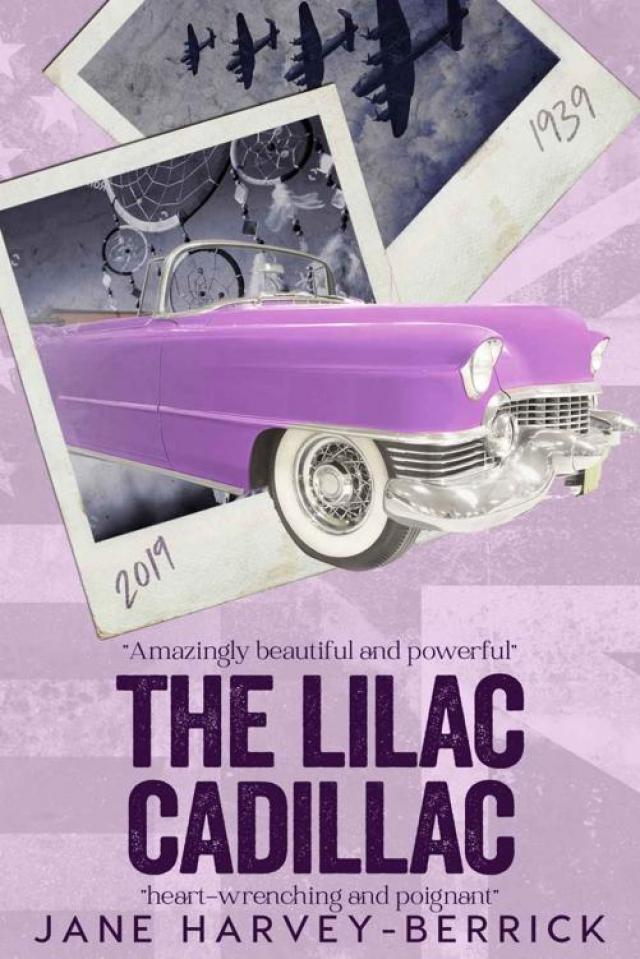
We certainly turned heads driving down the Strip in a lilac colored Cadillac with Dolly’s hair a close match. I saw people filming our arrival, and Dolly waved regally, chuckling quietly to herself.
Chapter Thirty-Five
Devon, April 1943
Sylvia
I woke to the wonderful sensation of Charlie stroking my hair.
“Morning, beautiful,” he said.
His smile was intoxicating, the dawn light catching the angles of his face, those dark eyes glittering wickedly as his body hardened against me.
“Oh! You’re already … you’re, I mean…”
He gave a shrug. “Yeah, I want you. I’m always going to want you, but we can just lie here.”
I ran my fingers across his face, finding only a few bristles on his chin.
“My people don’t have much in the way of facial hair,” he said, rubbing his chin. “Saves me ten minutes every morning and a fortune in razors.”
“Ten minutes,” I mused. “What on earth can we do in ten minutes?”
We made love again, taking a deliciously long time, much more than ten minutes. He woke my body as from a long sleep, showing me how I could respond and the pleasure of which I was capable. He taught me what pleased him, let me learn the ways of his body, and then finally showed me how to use the strange prophylactic, but even that he turned into a game, and we laughed as much as we loved.
I touched every inch of his wonderful, strong body; I cupped my hands around him and felt the rough hair of his thighs, the softness of his male skin, the heat as his need rose. For the first time, he positioned me on top of him, and we moved with wild abandon, without shame, with full pleasure; and the whole time I stared into his beautiful face, learning the fierceness in his eyes as he reached the peak of pleasure.
We scrambled out of bed just twenty minutes before breakfast service ended, Charlie tucking in his wrinkled shirt while I brushed my hair and slipped on a pair of sandals.
But then we had to get past the desk clerk. I went first, asking him to explain again how to get to the cliff train, so Charlie could dodge past him then pretend to ‘meet’ me in the breakfast room. I was smiling so brightly, that I’m not sure we fooled anyone.
The best thing about breakfast was the fresh eggs—two each. Imagine!
I wanted mine soft boiled so I could make soldiers with the hotel’s delicious freshly baked bread. Charlie asked for ‘eggs over easy’ then spent several minutes explaining to our waitress that he wanted fried eggs, cooked both sides, but with the yolk still runny.
There was real butter for the bread and real milk for the tea, none of that nasty powered stuff we usually had. Charlie asked for coffee, but of course there wasn’t any.
“What shall we do today?” I asked eagerly.
“Well, seeing as you know the timetable for the cliff train, I guess we should go there.”
“Yes, you’re right,” I laughed. “It would be jolly rude not to after Mr. Bevan took the time to read the entire timetable to me!”
The sun came out to greet us although the air was still cool. We walked briskly to the funicular railway, and learnt that the two equally weighted carriages ran on water power alone. Charlie was fascinated, and I could see his clever mind working on the engineering problems posed.
I was more interested in the fact that the artist Gainsborough had honeymooned in Lynmouth, and the poets Shelley and Wordsworth had visited, too. Was I romantic at heart? Perhaps. But I could never quite forget that Charlie was a married man. I’d never dreamed that I could ever be the other woman, but until I met Charlie, I had not known myself.
Tickets for the train were a penny each, and we weren’t the only ones having a morning away from the war: there was an older couple my parents’ age, as well as a group of happy and noisy schoolchildren. The married pair said that they’d been coming to Lynmouth for their holidays since before the Great War, and that “a little pip-squeak like Hitler” was not going to stop them. The schoolchildren cheered and everyone laughed.
Then the older man asked how long we’d been married. I’m sure I blushed bright red, but Charlie just held my hand.
“We met in the summer of ’42, sir.”
His wife patted my arm. “You still have the newlywed glow about you. I hope that you’ll be as happy as me and Albert. Thirty-two years married and never a cross word, but only because he knows I’m always right,” she smiled, as Albert nodded agreeably.
Their kindness stung. I was no one’s wife and my happiness was stolen.
Charlie put his arm around me, but there was nothing he could say.
The view from the top was spectacular. Lynmouth nestled below us on the other side of the gorge, with the sea a sparkling and serene slate-blue. We could see the hill that we’d climbed yesterday, and behind it the flat, almost bleak expanse of Exmoor; in the far distance, the silhouette of Wales across the Bristol Channel.
We left the children to their nature ramble and headed into the bustling little town. Here, the war was more obvious. Although there were no ugly bomb craters marring the streets, unlike London or other cities, each shop window was still crisscrossed with brown tape in case they were blown out: it helped prevent flying glass. The long queues outside the butcher and the greengrocer were other signs of how daily life had changed, as women wielded their ration books like weapons.
After looking in all the shop windows and passing the time of day chatting to several locals, and after Charlie finished his cigarette, we found our way to a small teashop.
“Barbara and Skip would like it here,” I sighed. “I miss her.”
“She’s a great gal,” Charlie agreed. “And Skip says…”
A strident voice cut into our conversation.
“It’s wicked, that’s what it is! Absolutely wicked! Those brutes! Never did any harm to anyone, and here longer than any of us. They should be arrested!”
Our waitress, arriving with the tea, rolled her eyes. “Don’t mind Mrs. Walker.”
“She seems rather upset.”
“She says they’ve been shooting ponies again. Up on Exmoor. Soldiers use ‘em for target practice, but some ‘as ‘em for the meat, I reckon.”
Charlie scratched his head as the waitress walked away. “What was all that about?”
“Oh, they have wild ponies on Exmoor. Short, scrubby little things, quite sweet really. They’re completely untamed and don’t belong to anybody. How awful that soldiers are shooting at them! That makes me angry, too.”
“She could report it to the Military Police.”
“Would they do anything, do you think?”
Charlie shrugged. “It’s worth a try. It’s not right that animals are being hurt. I’d understand if it was for food, but target practice? No, ma’am.”
We watched with interest as an elderly Special Constable escorted her from the teashop, talking to her kindly.
“Tell me more about these Exmoor ponies. Do people tame them and ride them?” Charlie asked, looking interested.
“D’you know, I’ve no idea. Why? Are you going to lasso one like a cowboy?” I teased.
“Nah,” he said, leaning forward, his dark eyes shining with mischief. “I’d lasso it like an Injun; you’re the paleface here.”
I laughed out loud, so happy to see him being playful.
“Do you ride?” I asked. “You never told me.”
He smiled, his eyes crinkling at the corners. “Darn near born in the saddle. I reckon I could ride before I could walk.”
“Do you miss it?”
He gave a half smile. “I miss being around animals, although I guess I could count Skip.”
I giggled. “Well, it was jolly nice of him to give you five days leave, so I shall have to be on his side.”
“Fair enough,” he said, taking a sip of tea and grimacing. “I don’t know how you drink so much of this stuff. Give me coffee any day.”
“I’ve had an idea!” I said suddenly, interrupting his familiar complaint. “Shall we see if we can find someone who’ll let us go riding for an hour or two? It would be such fun!”
“I didn’t know you could ride either.”
“You don’t know everything about me, Sergeant Black,” I teased.
His gaze became serious. “I’d sure like to. I’d like to know everything about you, Sylvia.”
“Oh, Charlie! There’s nothing I’d like better.”
And because our time was measured in days and hours, and because there was no future beyond that, we held hands, clinging to each other like driftwood tossed in a wild and unforgiving sea, afraid to let go.
More people came into the teashop, so we sat back in our chairs and pretended that our hearts weren’t breaking.
Charlie attempted a smile. “We could ask the waitress if she knows somewhere we can get our hands on a couple of horses.”
“Yes, that’s a good idea,” I said, dabbing at my eyes with the napkin. “A very good idea.”
The waitress sucked on the end of her pencil as she thought about our request.
“You could try at the Manor House. Milady used to hunt but I think the Army had all her horses off her at the start of the war. They might have let her keep one.”
She shook her head sadly, then gave us directions to the Manor House, but when we arrived, I realised that it had been turned into a school for evacuee children.
One of the older girls told us that Lady Wetherby lived in the old gamekeeper’s cottage around the back. She showed us the way and we knocked on the cottage door.
An elderly woman with thin white hair, an upright posture, and large, gnarled hands opened the door.
“Good morning, ma’am,” said Charlie. “I’m Charlie Black and this is my friend Sylvia Woods. We’re sorry to disturb you, but we’re down here on a few days leave and had a hankering to go horseback riding. We were told in the town that you might have a couple of horses we could borrow.”
The woman may have been old, but her eyes were sharp and knowing as they swept over us, her gaze resting on my wedding ring.
“You say you’re both on leave?”
“Yes, ma’am.”
“American Army, yes?”
“That’s right, ma’am.”
“And you, young lady?”
“I’m in the WAAF.”
“Married?” she asked sharply.
“Widowed,” I said quietly.
Her expression softened, but she nodded briskly. “Follow me.”
She led us to a paddock at the side of her cottage where two fine but elderly mares grazed peacefully, a grey and a chestnut. They looked up when they saw her and ambled over, nickering softly, pushing their whiskery noses over the split rail fence. The white hair around their eyes, ears, foreheads and muzzles showed their advanced years.
“Meet Ginger and Merrylegs,” said Lady Wetherby.
“Oh!” I said, recognizing the names. “From Black Beauty. That was one of my favourite books as a girl.”
Lady Wetherby smiled. “As it was mine, Mrs. Woods.” Her smile faded. “I’m afraid these two are getting rather long in the tooth, but we keep each other company. My hunters were requisitioned by the Army. I do hope they treat them better than all those poor horses in the Great War. But, I mustn’t grumble. You’re welcome to take them for a gentle hack. There’s life in us old girls even if they’ve put us out to pasture, isn’t that right, Ginger, Merry?”
As she rubbed their noses and pulled their ears gently, the horses’ eyes half-closed with contentment.
I liked Lady Wetherby immediately. Although an aura of sadness clung to her, she was one of those doughty dowagers that you could imagine climbing the Himalayas wearing crinolines in another lifetime.
She took us to the tack room and was soon discussing the differences between an English saddle and Western saddle that Charlie was used to. Lady Wetherby argued that the English saddle was lighter and easier to tack up, and Charlie gently contradicted her by saying that Western saddles were more comfortable on long distances, and sturdier when used for roping cows. I could tell that Lady Wetherby was thoroughly enjoying the debate.
There wasn’t much involved in catching the mares; they simply stood yawning while Charlie slipped halters over their necks, and walked behind him like a pair of docile dogs.
Ginger snuffled at my pockets, disappointed that I didn’t have a piece of carrot or apple for her. I wished I had something, but stroked her flanks instead.
As we mounted, Lady Wetherby described the route we should take, a five-mile round trip that started along the coast path and came back across part of Exmoor.
The horses seemed to know where we were going and ambled off, tossing their manes in the breeze and sniffing the salty air.
“I didn’t think I’d be doing this in England,” Charlie said.
“It is rather wonderful, isn’t it,” I agreed happily.
He grinned. “Did you see the way I lassoed these wild mustangs?”
“Yes, very impressive. I was afraid that they’d turn into bucking broncos at any moment.”
I stroked Ginger’s neck to let her know that I was teasing.
Charlie laughed, his smile bright and relaxed.
“I think we should give them Indian names,” I said. “Something noble to remind them of their wild youth.”
“Our word for horse is nêkatôshkashâha.”
“Gosh, I’m going to have to practise that. Tell me something else.”
“Red is meshkwâwi, so a red animal like Ginger here would be meshkwethiwa.”
“I can’t just name her after a colour, she deserves something grander than that, don’t you, girl?”
Ginger’s ears twitched, knowing we were talking about her.
“Okay, how about Kee-o-kuk. He was a famous Fox chief, his name means ‘the Watchful Fox’.”
“Yes, we like that don’t we, Ginger, because you’re a lovely foxy-red colour. From now I’ll call you Kee-o-kuk. But we still need a Meskwaki name for Merrylegs.”
“What about Taimah? He was another famous Fox chief. His name means ‘thunder’.”
“And she is grey like a stormy sky. I think that’s perfect. Although you do realise that you’ve given them both boys’ names. Aren’t there any famous Meskwaki women? No women chiefs?”
“My mother is Sokanon—her name means ‘rain’.”
“Oh, that’s pretty, but should we call a horse after your mother?”
He laughed. “I don’t think she’d mind—I’ve gotten my love of horses from her. My Meskwaki name is Chogan—it means ‘blackbird’, a play on my surname I guess.”
“But … you never told me. That’s … well, it’s lovely.”
He shrugged. “I was baptised Charles. I don’t go by that name either.”
“My middle name is Dorothy. Very dull.”
“There’s nothing dull about you,” he said, his voice sincere. “You’re smart, real smart; you’re kind, good fun, and so damn beautiful, I wish…”
As my heart began to beat faster, his words ground to a halt.
“What do you wish?” I whispered.
His eyes searched the horizon for an answer. “I wish I’d met you in another life.”
“Won’t this one do?” I asked, my voice trembling.
He closed his eyes. “I wish I’d met you in a life where I wasn’t already married.”
Chapter Thirty-Six
Day Six, June 2019
Fiona
The Bellagio was everything you’d imagine a top class Vegas hotel to be: luxurious, ornate, over-the-top—an oasis of opulence rising out of the desert.
A doorman leapt to attention, smiling at Dolly and admiring the car as a parking valet appeared.
“Cool ride, man,” he whispered to Joe, his voice full of admiration and envy.
“Thanks,” said Joe. “Drives like a bus. Knock yourself out,” and he tossed the keys to the star-struck valet.
“Welcome to the Bellagio, ma’am, sir, miss,” said the doorman, helping Dolly into her wheelchair.
Then a bellhop, an honest to God bellhop in a uniform (but no cute little cap), took charge of our bags. I was embarrassed to see my tatty suitcase being placed on a shiny brass luggage trolley.
Walking inside was like entering a dream-world. I stared up at the ceiling decorated with hundreds of glowing glass flowers, ethereal and beautiful, a crazy, upside-down meadow. Below, a silver statue of a horse seemed to prance between the lush velvet sofas, and warm, yellow lighting bathed everything in a golden glow.
A well-dressed man in a suit, who introduced himself as Eduardo, seemed to have been waiting for our arrival and escorted us into the elevator, swiping the keycard that would allow us to go up and up and up to the penthouse suite.
“Welcome to the Bellagio! We hope you’ll have a magical stay in a city where magic happens. When the Bellagio opened in 1998, it was the most expensive hotel ever built, and our eight acre lake with dancing fountains is definitely a sight worth seeing.”
Eduardo took his time showing us around the rooms as if he’d designed them himself, but my eyes were drawn to the view from the floor-to-ceiling windows. The whole of Vegas was spread out below, and I could see the grid system of roads, all ordered and human scale, with Frank Sinatra Drive running straight as a ruler; in the background loomed a vast mountain range which I later learned was Red Rock Canyon.