The colossus, p.13
The Colossus,
p.13
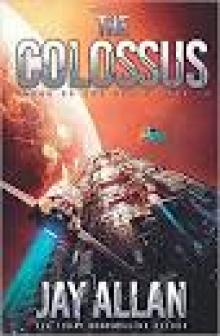


And the fact that Successor was alone, with no sign of the task force the flagship had led, only fanned the flames of her fear.
There were innumerable clichés about one’s ‘worst fears coming true,’ but Akella realized that was just what was happening to her.
“Number One…we have received a communique from Santarus.” Sevilla was one of her aides, a Kriegeri of moderately high rating, if one still ranked low enough to make such close service to a Number One seem odd. Akella paid some heed to ratings, of course. That could only be expected from the individual rated first among hundreds of billions, but in actual fact, she tended to judge people by their actions and knowledge. She trusted Sevilla, and the aide had always been reliable and capable. Unlike most of her predecessors, Akella had not replace her lower-ranked staff members and aides when she’d ascended to her place as the head of the Council. She was fiercely loyal by nature, and not prone to becoming starstruck by her own position and power. “They have dispatched a wedge of assault shuttles with a Kriegeri team. They will board Successor in moments.”
That wasn’t exactly news of course, not to Akella’s view. She’d ordered just what the aide had described, and she was accustomed to her orders being carried out. But she knew Sevilla was only keeping her apprised, and she nodded her acknowledgements before taking the last few steps into her Sanctum.
The office was large and opulent, almost embarrassingly so, though that had been the work of the man who had held her post before her. She had inherited many things, in both her work areas and living quarters, but she’d proven to be quite austere for a Hegemonic Number One. Aside from a few personal modifications in her most private quarters—mostly eradicating the worst of the previous occupant’s appalling taste—she had left almost everything as she’d found it.
“Sevilla…” She turned and looked back at her aide. “I do not wish to be disturbed until the boarding party has reported in. And, I want Commander Josias brought to me as soon as he arrives.”
If he arrives…
She had no idea if Josias was still alive. From what she’d seen of the scanner images of Successor, she gave that about a fifty percent chance.
* * *
“I must commend you on getting back here with your scanner data, Commander. You were quite correct to surmise the urgency of reporting this disturbing development at all costs.” Akella was far from convinced Josias hadn’t been more concerned with saving his own hide than salvaging the intelligence collected by his doomed command. She found it distasteful praising an officer who had abandoned his forces, left his people to die so he could return, but there was little to be gained by pushing the officer onto the defensive. Josias was a Master, and there was little doubt any assertions of cowardice or wrongdoing would spur a pointless defensive reaction, one that would spread to his friends and supporters, and cause dissension at a time when she very likely needed absolute unity among her colleagues. It was better to make him comfortable, to learn everything he knew, and then just to let him go.
She would, at least, make certain he never received another significant command. She could do that quietly, without creating a costly and troublesome scene.
“Thank you, Number One. Your words do me honor.”
Akella watched the fool bow in front of her, so utterly oblivious to her true thoughts. That amazed her, and it confirmed an uncomfortable realization that had been growing in her mind. We Masters are the most genetically-gifted, but too many of us allow arrogance to sap our intellect and cripple our capabilities. A hundred Kriegeri on my staff could see through my words right now, divine my true thoughts toward Josias and his actions. Yet, the fool is oblivious, despite his rankings.
There was no doubt in her mind that Josias was a perfect specimen of a disturbing phenomenon, one that had become increasingly of concern to her. He was clearly intelligent and knowledgeable, but just the same, as far as she could tell, he was close to useless.
“I know you must be exhausted, and that your wounds need further tending, but first I would have you fully debriefed. In light of the area of space in which you were attacked, I feel we must review the situation in the fullest detail.”
She looked over at Josias’s left arm, which he was cradling in his right. She could see a few abrasions, and a small cut that appeared to be fully dressed, but nothing that looked like it needed more than a good washing and a fresh bandage. Still, Josias seemed to be in considerable discomfort.
She compared Josias’s demeanor to that of the Kriegeri veterans she’d seen on Megara and Dannith, or to Masters like Chronos and Ilius, whose type seemed rarer and rarer in recent years. The vibrancy of the Hegemony’s ruling class, the toughness and drive of those who had founded the nation and its ruling principles from the ashes of empire, seemed a dying breed, at least among the Masters. If the enemy from the coreward marches of space had indeed returned—and she couldn’t imagine any other explanation—would they find a Hegemony that was stronger for a century of growth and scientific advancement, or one that had withered into decadence and weakness? Had warriors been replaced by debaters? Heroes by entitled ruling classes who’d shed their devotion to responsibility even as they’d demanded ever more rewards and undeserved respect?
Would a century of preparation be for naught, leaving a Hegemony less prepared to face the threat?
Akella was trying to be as non-committal as she could manage, and as calm. She knew what the attack on Josias’s task force meant, and the mere thought of it made her insides go cold. But she had to stay focused. Her people needed her, and more so, they needed her to remain calm, controlled, to ensure her intellect and wisdom prevailed over fear. They needed her ready to face the threat she was beginning to believe was finally coming.
She tried to imagine what else could have attacked Josias’s task force. Some previously unknown entity, renegade forces of some kind, even first contact with an alien race? Even some Rim force that had managed to sneak all the way across the Hegemony to disrupt things. But she knew in her gut it was none of those things.
She knew what had attacked Josias and his ships, yet even as she followed the logic, realized the inescapable result of her deductive analysis, she found herself struggling to accept her conclusions.
She’d feared it for years, spent late nights staring into the darkness deep in thought, argued with those who’d been skeptical, endured the burning in her stomach as she’d approved one order after another, denuding the Hegemony’s coreward defenses to feed the insatiable appetite of the Rim War.
Now, it had come, her worst fears realized, and even as she faced it, begun to accept it, the whole thing seemed somehow unreal.
But it was real, as real as it was terrifying, and there was no alternative explanation, none that was reasonable.
They were back. They were coming.
The Others had returned.
Chapter Sixteen
Grand Alliance Strike Force
1,150,000,000 Kilometers from Planet Danovar
Santara System
Year 321 AC
“I said all squadrons abort…now!” Stockton repeated the order, his voice fueled by undisguised rage, by pure, caustic fury…as if the sharp edge of his words could somehow overrule the physics at play, the unbreakable laws of motion that stripped him of any viable option to save his people.
He raged inside at himself, recounted how many times he’d worried about the Hegemony developing fighters, about one day encountering enemy squadrons. But those fears had waned as the years passed, as the enemy showed no signs of fielding such forces.
Now he realized, of course, that such things weren’t conjured out of thin air, that it took time to develop a system from nothing. The fact that he’d allowed time to lesson his worries only made him a fool. Each passing year had increased, not decreased, the chance of facing…what his people were now facing.
Every ship in his strike force was outfitted with bombing kits. Worse, most of them were double-loaded. He’d been relieved enough when they’d all managed to launch without incident, but the thought of those thousands of bombers, heavy and unmaneuverable, facing sleek enemy fighters—and he’d confirmed from his first scans, the Hegemony ships looked very much like interceptors—seemed almost ridiculous.
Given some of his own interceptors, he might have relied on the experience of his people to fend off the raw Hegemony pilots. But everyone he had, ace, veteran, or green rookie, was sitting in a clumsy tub, loaded down with ordnance.
His mind raced. Should he send his people in to launch their payloads at Colossus? The empty bombers wouldn’t be what he’d call sleek and maneuverable, but they’d definitely be better off.
And, does it matter…as long as we take out that…thing?
Stockton didn’t think lightly of throwing the lives of his pilots, or his own for that matter, away, but saving the Rim from the new enemy monstrosity was important enough to risk losing every ship he had in exchange for success.
But the thought faded quickly as the enemy fighters formed up and moved out from Colossus. They were fast, their thrust levels at least the equivalent of an unburdened Lightning. They were blasting at full, directly toward his strike force, and his gut told him, before either his mind or his ship’s AI had completed actual calculations, that they were going to reach his wings before any of them got into launch range.
Stockton knew the destructive power his ships carried, and he understood that they were the only thing that had a chance of taking out Colossus. But he didn’t have a single fighter outfitted as an interceptor, and he had some idea what so many enemy fighters—and there were almost two thousand of them out now—could do to a formation of bombers with no interceptors of their own.
He had to get as many of his ships back as possible. He had no idea what portion of the strike force could escape, but it wasn’t going to be many if they were still burdened with their bombing loads. The waste of it all was infuriating, and it cut a deep swath through his morale, but he had no choice.
“All ships, eject bombing ordnance at once.” The words flew from his mouth, almost as though some part of him was forcing them out before he could change his mind. As if to set the example, he reached down and pulled the eject lever under his own control panel. His ship lurched as it expelled the deadly weapons, the warheads he’d been so determined to plant into the guts of the Hegemony’s massive new warship.
His goals had changed in an instant. Gone were images of destroying Colossus, of planting cluster bombs and torpedoes into the heart of the massive battleship. Now, he had only a single hope.
To get his fighters the hell out of there, and back to their base ships.
Some of them, at least.
* * *
The ship shook hard, jerking in what seemed like every direction. It was uncomfortable, difficult to operate, and it felt almost like being out in deep space itself. But Krimack had adapted quickly to the small cockpit, and to the incredible responsiveness of his new ship.
Fighters—at least that’s what the Confeds called the small attack craft—were something quite different to most of the Red Kriegeri who manned the Hegemony navy, but there was something about the cramped little craft that meshed almost instantly with Krimack.
The kiloron was the overall flight commander, the first warrior in Hegemony history to lead fighters into battle. The ships were new, fresh off the assembly lines. Their design borrowed much from the Confed Lightnings, but it added some bits of advanced Hegemony technology as well, perhaps none of it as profound a potential advantage as the neural link.
The link was an amazing invention, though Krimack had to admit, connecting to it hurt like hell. He’d gone through a surgical procedure to prepare for the linkup, all of his pilots had, but now, he could partially control the tiny ship with his thoughts as well as his hands. Given time to master both the links and the routine of flying the attack craft, Krimack believed his new wings could match, and then exceed, the effectiveness of their Rim foes.
“He sent a thought through the link, directing the ship to increase thrust and alter its vector. He’d been through the rushed training sessions, logged what had seemed like endless hours flying with only mental impulses to control his fighter. In fact, as the designated commander of the Hegemony’s first small craft strike force, he was the single individual who’d logged the most flight time connected to the neural net.
He’d reviewed enough videos and intelligence reports on Rim fighter combat to know he’d have a much harder time when he had to face enemy ships rigged as interceptors, like his own craft were, but in their first mission, his wings faced only bombers, and from the looks of things, overloaded bombers at that. The enemy force was larger than his, but his best guess was, the heavily-loaded strike craft would be virtually helpless when his wings sliced into their confused and frantically-decelerating ranks.
He would know in just a few minutes just how good a guess that was.
“All wings, forward at full thrust. Close and engage.” His two thousand, four hundred fighters were organized into squadrons and wings, borrowing structure and nomenclature from their enemies, who had so badly damaged Hegemony fleets over the past six years. But there and then, in that place and at that time, Krimack’s fighters were copies of the Confederation’s interceptors, craft outfitted not to strike at opposing capital ships but to engage and destroy enemy fighters.
He reached out, his hand grasping his controls. The neural link was still new and uncomfortable. He saw the utility in it, and he knew when he had to face enemy interceptors in the desperate engagements the Rimdwellers called ‘dogfights,’ the enhanced response times would be invaluable. But for his first assault against the confused and disorganized bomber squadrons, he chose to keep most of the controls manual.
Not that the entire exercise of flying a fighter—with hands or with the neural link—wasn’t new. Krimack had been a veteran of ten years when he’d been transferred into the fledgling program, a pilot, but of escorts ships, and in his last posting, a cruiser.
The high command had looked to the ranks of naval pilots to seed the new fighter wings, though Krimack had quickly come to the conclusion that there was little overlap in the two skillsets. He had a minor jump on a Kriegeri who’d served in gunnery or engineering, but not all that much of one. He’d started mostly from scratch learning to fly, and he knew his people had been rushed into battle far too quickly. When the enemy recovered from their surprise, when they launched their own interceptors, he suspected his people would be in desperate danger.
But that didn’t matter, not in that moment. Bombers were lightly-armed, beyond their payloads in any case, but it looked like the ships his wings were approaching had doubled bombing loads…and he guessed that had come at the expense, not only of maneuverability, but also what little fighter-to-fighter weaponry the attack ships normally carried.
The situation was perfect, better than he could have hoped. Maybe—just maybe—if he could hit the enemy hard enough, devastate their wings, the war would end sooner.
Before he had to face the Confeds flying their own interceptors.
His eyes drifted to the display. Less than one minute to attack range. The enemy formation was a complete mess. The bombers were clearly trying to decelerate, to turn about and flee back to their motherships. But their intrinsic velocities were still bringing them forward.
Into the maw of death.
* * *
“What the hell is going on out there?”
Clint Winters sat on Constitution’s bridge, unmoving, his eyes locked on the horror unfolding on the display. The bombing strike was in trouble, serious trouble. The formation had lost all cohesion, and individual wings and squadrons—and in some cases, pilots, singly and in groups of two or three—were desperately trying to decelerate, to come about and return to the base ships.
But even as he watched in slowly-building horror, Winters realized there was no way they were going to make it. Not in time.
“Get me Admiral Barron on Dauntless!” His voice was loud, with a cutting edge. He could feel the rage growing inside him, the anger and self-recrimination. What he saw happening, he’d imagined a hundred times…but as the years passed, he’d allowed his concerns to slip into the background, pushed aside by more pressing matters.
But now it had happened. The Hegemony had developed their own fighters.
Fielding a force of small attack craft wasn’t a simple thing, and he suspected Jake Stockton and his squadrons could face off and defeat any Hegemony opposition. At least, if every one of them wasn’t in a virtually helpless bomber.
Even in interceptors…how rusty is our ship to ship combat? How many of those pilots have even faced other fighters in battle?
The losses in the war had been brutally heavy, and nowhere more so than in the fighter wings. Thousands of veterans had been lost and, and as he waited for Barron to come on the line, he tried to guess what percentage of the fighter jocks in Stockton’s command had combat experience facing interceptors.
Ten percent? Less?
“Clint, we’ve got a problem…” Barron’s voice was as haggard as Winters knew his was.
“Damn right, we’ve got a problem, all kinds of problems actually, but right now, what the hell are we going to do? The bombers are in big trouble now. We need to move the battle line forward.”
“No.” There was a coldness in Barron’s voice.