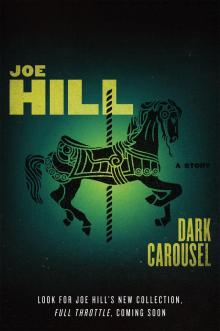
Dark carousel, p.2
Dark Carousel,
p.2


The cat turned its head to look back at me, too, and I shut my eyes and shuddered and looked again, and of course it wasn’t staring at me.
Our rides rushed us on into the night, rushed us into the darkness in a kind of mad fury, round and round and round, but in the end none of us went anywhere.
For the next three hours, the wind blew us up and down the harbor walk, while Nancy completed her shift. I had already had too much beer and knew it and drank more anyway. When a gust got behind me, it felt dangerously close to swooping me off the ground, as if I were as light as newspaper.
Jake and I banged away at pinball in Mordor’s Marvelous Machines for a while. Afterward Geri and I had a walk on the beach that started out romantic—teenage lovers holding hands, looking at the stars—and predictably devolved into our usual giddy game of roughhouse. Geri wound up dragging me by both hands into the water. I staggered in up to my knees and came out with my sneakers squishing, the legs of my jeans soaked and caked in sand. Geri, on the other hand, was wearing flip-flops and had thoughtfully rolled up the cuffs of her Levi’s and made it out breathless with laughter and largely unscathed. I warmed myself back up with a pair of hot dogs smothered in bacon and cheese.
At ten-thirty the bars were so full the crowds spilled onto the boardwalk. The road along the harbor was jammed bumper to bumper, and the night resounded with happy shouts and honking horns. But almost everything else around the pier was closing down or already shut. The Bouncy House and the SS Fuck No had gone dark an hour before.
By then I was staggering with beer and fairground chow and feeling the first nervous clench of nausea. I was beginning to think that by the time I got Geri to bed, I’d be too tired or maybe too sick to report for action.
Funhouse Funnel Cakes was at the foot of the pier, and when we got there, the electric sign over the order window had been shut off. Nancy used a rag to sweep the cinnamon and powdered sugar from the dented counter, said good night to the girl who’d been working the stand with her, and let herself out the side door and into Jake’s arms. She stood on her toes for a lingering kiss, her book under one arm: All the Pretty Horses by Cormac McCarthy.
“Want to get another six on our way out of town?” Jake asked me over her shoulder.
The thought turned my stomach, so naturally I said, “We better.”
“I’ll pay,” Nancy said, and led the way to the curb, just about skipping to be free and with her guy, to be eighteen and in love, on a night where it was still seventy degrees at nearly 11:00 p.m. The wind crazed her curly hair, blowing it around her face like seagrass.
We were waiting for a break in traffic when it all began to go wrong.
Nancy smacked herself on the butt—a provocative thing to do, a little out of character, but then she was in high spirits—and fumbled in a pocket for her cash. She frowned. She searched her other pockets. Then she searched them again.
“Shhhhhoooot . . .” she said. “I must’ve left my money at the stand.”
She led us back to Funhouse Funnel Cakes. Her co-worker had shut off the last lights and locked up, but Nancy let herself in and pulled the dangling cord. A fluorescent tube came flickering on with a wasplike buzz. Nancy searched under the counters, checked her pockets again, and looked in her hardcover to see if she’d been using her money as a bookmark. I saw her check the book myself. I’m sure of it.
“What the heck?” Nancy said. “I had a fifty-dollar bill. Fifty dollars! It was so new it looked like no one had ever spent it before. What the frickenfrack did I do with it?” She really did talk that way, like a brainy girl genius in a young-adult novel.
As she spoke, I flashed to a memory of the carousel operator helping her up onto a horse, his hand on her waist and a big smile on those juicy lips of his. Then I remembered catching a glimpse of him as we were spun past on our steeds. He hadn’t been smiling then—and he’d been poking some fingers into his front pocket.
“Huh,” I said aloud.
“What?” Jake asked.
I looked at Jake’s narrow, handsome face, his set chin and mild eyes, and was struck with a sudden premonition of disaster. I shook my head, didn’t want to say anything.
“Spill it,” Jake said.
I knew better than to reply—but there’s something irresistible about lighting a fuse and waiting for it to sizzle down to the charge, just to hear a loud bang. And there was always something exciting about winding up a Renshaw, for much the same reason. It was why I went into the bouncy house with Geri and why I decided to give Jake a straight answer.
“The operator on the carousel. He might’ve been putting something in his pocket after he helped Nan—”
I didn’t get any further.
“That motherfucker,” Jake said, and turned on his heel.
“Jake, no,” Nancy said.
She grabbed his wrist, but he pulled free and started out along the dark pier.
“Jake!” Nancy called, but he didn’t look back.
I trotted to keep up with him.
“Jake,” I said, my stomach queer with booze and nerves. “I didn’t see anything. Not really. He might’ve been reaching into his pocket to adjust his balls.”
“That motherfucker,” Jake repeated. “Had his hands all over her.”
The Wild Wheel was dark, its stampeding creatures frozen in midleap. A heavy red velvet rope had been hung across the steps, and the sign that dangled from it said shh! the horses are sleeping! don’t disturb them!
At the center of the carousel was an inner ring lined with mirrored panels. A glow showed around one of those panels, and from somewhere on the other side you could hear swanky horns and a tinny, crooning voice: Pat Boone, “I Almost Lost My Mind.” Someone was at home in the secret cabinet at the heart of the Wild Wheel.
“Hey,” Jake said. “Hey, pal!”
“Jake! Forget it!” Nancy said. She was frightened now, scared of what Jake might do. “For all I know, I put my money down for a moment and the wind grabbed it.”
None of us believed that.
Geri was the first to step over the red velvet rope. If she was going, I had to follow, although by then I was scared, too. Scared and, if I’m honest, jittery with excitement. I didn’t know where this was heading, but I knew the Renshaw twins, and I knew they were getting Nancy’s fifty dollars back or getting even—or both.
We wove through the leaping horses. I didn’t like their faces in the dark, the way their mouths gaped as if to shriek, the way their eyes seemed to stare blindly at us with terror or rage or madness. Geri reached the mirrored panel with the light leaking out around its edges and rapped her fist against it. “Hey, are you—”
But no sooner had she touched the panel than it swung inward to reveal the little engine room at the center of the Wheel.
It was an octagonal space with walls of cheap plywood. The motor that drove the central pole might’ve been half a century old, a dull steel block shaped vaguely like a human heart, with a black rubber drive belt at one end. On the far side of the pole was a sorry little camp bed. I didn’t see any photographs of Judy Garland, but the wall above the cot was papered in Playboy centerfolds.
The operator sat at a folding card table, in a ratty, curiously grand chair. It had curved wooden armrests and horsehair cushions. He was slumped over, using one arm as a pillow, and didn’t react as we entered. Pat Boone pitied himself, tunefully, from a little transistor radio on the edge of the table.
I glanced at his face and flinched. His eyelids weren’t fully shut, and I could see the slick, gray-tinted whites of his eyes. His fleshy red lips were wet with drool. The thermos was open nearby. The whole room reeked of motor oil and something else, a stink I couldn’t quite identify.
Geri shoved his shoulder. “Hey, jack-off, my friend wants her money back.”
His head lolled, but otherwise he didn’t stir. Jake crowded into the room behind us, while Nancy stood outside among the horses.
Geri picked up his thermos, had a whiff, and poured it out on the floor. It was wine, a rosé, and it smelled like vinegar.
“He’s pissed,” she said. “Passed out drunk.”
“Guys,” I said. “Guys, is he— We sure he’s even breathing?”
No one seemed to hear me. Jake pushed past Geri and began to dig around in one of the guy’s front pockets. Then, abruptly, he recoiled, yanked his hand back as if he’d been stuck by a needle. At that moment I finally identified the rank odor that had only been partially masked by the aroma of WD-40.
“Pissed is right,” Jake said. “Holy fucking shit, he’s drenched. Christ, I got piss all over me.”
Geri laughed. I didn’t. The thought took me then that he was dead. Wasn’t that what happened when your heart stopped? You lost control of your bladder?
Jake grimaced and went through the guy’s pockets. He dug out a battered leather wallet and a knife with a yellowing ivory handle. Three scrimshaw horses charged across the grip.
“No,” Nancy said, entering the room at last. She grabbed Jake’s wrist. “Jake, you can’t.”
“What? I can’t take back what he stole?” Jake flipped the wallet open and picked out two wrinkly twenties, all that was in there. He dropped the wallet on the floor.
“I had a fifty,” Nancy told him. “Brand-new.”
“Yeah, that fifty is in the cash register at the liquor store now. Ten bucks is just about exactly what it would’ve cost for another bottle. Anyway, what are you arguing about? Paul saw him pocket the money.”
I hadn’t, though. I was no longer sure I’d seen anything more than an old man with a weak bladder adjusting his junk. But I didn’t say so, didn’t want to argue. I wanted to make sure the old bastard was alive, and then I wanted to go, quickly, before he stirred or anyone else wandered by the carousel. Whatever grubby sense of delight there’d been in this expedition had fled when I caught a whiff of the operator and saw his gray face.
“Is he breathing?” I asked again, and again no one replied.
“Put it back. You’ll get in trouble,” Nancy said.
“You going to report me to the cops, buddy?” Jake asked the operator.
The operator didn’t say anything.
“Didn’t think so,” Jake said. He turned and took Geri’s arm and pushed her toward the door.
“We need to turn him on his side,” Nancy said. Her voice was unhappy and shaky with nervousness. “If he’s passed out drunk and he vomits, he could choke on it.”
“Not our problem,” Jake said.
Geri said, “Nan, I bet he’s passed out this way a thousand times. If he hasn’t died yet, he probably won’t die tonight.”
“Paul!” Nancy cried, sounding almost hysterical. “Please!”
My insides were knotted up, and I felt as jittery as if I had chugged a pot of coffee. I wanted to leave more than anything and can’t explain why I reached for the operator’s wrist instead, to search for his pulse.
“He’s not dead, asshole,” Jake said, but he waited nonetheless.
The operator’s pulse was there—raggedy and irregular but measurable. Close up he smelled bad, and not just of urine and booze. There was a cloying odor of caked, rotten blood.
“Paul,” Nancy said. “Put him on his bed. On his side.”
“Don’t do it,” Jake said.
I didn’t want to, but I didn’t think I could live with myself if I found myself reading his obituary in the weekend paper, not after we jacked him for forty bucks. I put my arms under his legs and behind his back and lifted him out of his chair.
I lumbered unsteadily to the camp cot and set him on it. A dark stain soaked the crotch of his green velvet pants, and the smell aggravated my already twitchy stomach. I rolled him onto his side and put a pillow under his head, the way you’re supposed to, so if he threw up, it wouldn’t go back down his windpipe. He snorted but didn’t look around. I circled the room, pulled the cord hanging from the ceiling to switch off the light. On the radio, the Gypsy was telling Pat Boone’s fortune. It wasn’t good.
I thought we were done, but when I came out, I found Geri getting her own revenge. She’d helped herself to the operator’s pocketknife, and she was carving a message into Judy Garland’s horse: fuck you. It wasn’t poetry, but it made a point.
On the walk back to the boardwalk, Jake tried to hand the forty dollars to Nancy, but she wouldn’t accept it. She was too angry with him. He stuck the bills in her pocket, and she took the twenties out and threw them on the pier. Jake had to chase them down before the wind could snatch them away and cast them to the darkness.
When we reached the road, the traffic was already tapering off, although the bars were still doing brisk business. Jake told Nancy he was going to get the car and asked if she would please buy the beer, because obviously they weren’t going to have sex now and he was going to need more alcohol to drink away his blues.
This time she took the money. She tried not to smile but couldn’t quite help herself. Even I could see that Jake was adorable when he made himself pathetic.
When we took off for my parents’ summer cottage, I was in the passenger seat of the Corvette, with Geri on my lap and Nancy squeezed between my hip and the door. They all had bottles of Sam Adams, even Jake, who drove with one nestled between his thighs. I was the only one who wasn’t drinking. I could still smell the operator on my hands, an odor that made me think of decay, of cancer. I didn’t have the stomach for any more, and when Geri rolled down the window to chuck her bottle out into the night, I was glad for the fresh air. I heard her empty Sam Adams hit with a musical crunch.
We were careless, irresponsible people, but, in our defense, we didn’t know it. I’m not at all sure I’ve made you see the times clearly. In 1994 those Mothers Against Drunk Driving ads were just background noise, and I had never heard of anyone getting a ticket for littering. None of us wore seat belts. It never even crossed my mind.
I’m not sure I have properly shown you Geri or Jake Renshaw either. I’ve tried to show you they were dangerous—but they weren’t immoral. Maybe they even had a stronger sense of morality than most, were more willing to act if they saw someone wronged. When the universe was out of whack, they felt obliged to put it back to rights, even if that meant defacing an antique horse or robbing a drunk. They were entirely indifferent to the consequences to themselves.
Nor were they thoughtless, unimaginative thugs. Nancy and I wouldn’t have been with them if they were. Jake could throw knives and walk a tightrope. No one had taught him how to do those things. He just knew. In his last year of high school, after showing no interest in drama for his entire life up until then, he tried out for the Senior Shakespeare. Mr. Cuse cast him as Puck in A Midsummer Night’s Dream, and damn it, he was good. He said his lines as if he’d been speaking in iambic pentameter all his life.
And Geri did voices. She could do Princess Di, and she could do Velma Dinkley. She could do an amazing Steven Tyler from Aerosmith; she could talk like him, sing like him, do his acka-acka-acka-yow!, and dance like him, whipping her hair from side to side, hands on her narrow waist.
I thought she was beautiful and gifted enough to be an actress. I said we should go to New York together after I finished college. I’d write plays, and she’d star in them. When I told her this, she laughed it off—and then gave me a look I didn’t understand, not then. It was an emotion with which I was not familiar, a feeling no one had ever turned on me before then. I know now it was pity.
There was no moon, and the road grew darker the farther north we traveled. We followed a winding two-lane state highway through marsh and pines. For a while there were streetlights, spaced at quarter-mile intervals. Then there weren’t. The wind had been strengthening all evening, and when the gusts blew, they shook the car and sent the cattails in the swamps into furious motion.
We were almost to the mile-and-a-half-long dirt track that led to my parents’ cottage and the end of the evening when the Corvette swung around a horseshoe curve and Jake hit the brakes. Hard. The tires shrieked. The back end fishtailed.
“What the fuck is . . . ?” he shouted.
Nancy’s face struck the dash and rebounded. Her hardcover, All the Pretty Horses, flew out of her hand. Geri went into the dash, but she rolled as she slid forward and caught it with her shoulder.
A dog looked at us—its green eyes flashed in the headlights—and then it slunk out of the road and lumbered into the trees. If it was a dog . . . and not a bear. It certainly looked big enough to be ursine rather than canine. We could hear it crashing through the brush for several seconds after it disappeared.
“Christ,” Jake said. “Now I’m the one who looks like he pissed himself. I dumped my beer all over my—”
“Shut up,” Geri said. “Nan, honey, are you okay?”
Nancy leaned back, her chin lifted, her eyes pointed at the ceiling of the car. She cupped her nose with one hand.
“I smached my node,” she said.
Geri twisted around to stretch an arm into the rear of the car. “There’s some rags in the back.”
I contorted myself to reach past Geri’s feet to collect Nancy’s book. I grabbed All the Pretty Horses—then hesitated, my gaze caught by something else on the carpet. I plucked it off the floor.
Geri settled back into my lap, clutching a ratty Pink Floyd tee.
“Here, use this,” she said.
“That’s a good shirt,” Jake said.
“That’s your girlfriend’s face, you prick.”
“Fair point. Nan, you okay?”
She balled up the T-shirt and held it to her thin, delicate nose, dabbing at blood. With her other hand, she gave a thumbs-up.
I said, “I got your book. Hey . . . um. This was on the floor with it.”
I handed her the novel—and a crisp fifty-dollar bill, so clean and new-looking it might’ve been minted that morning.