

Live free or die second.., p.47
Live Free or Die, Second Edition,
p.47
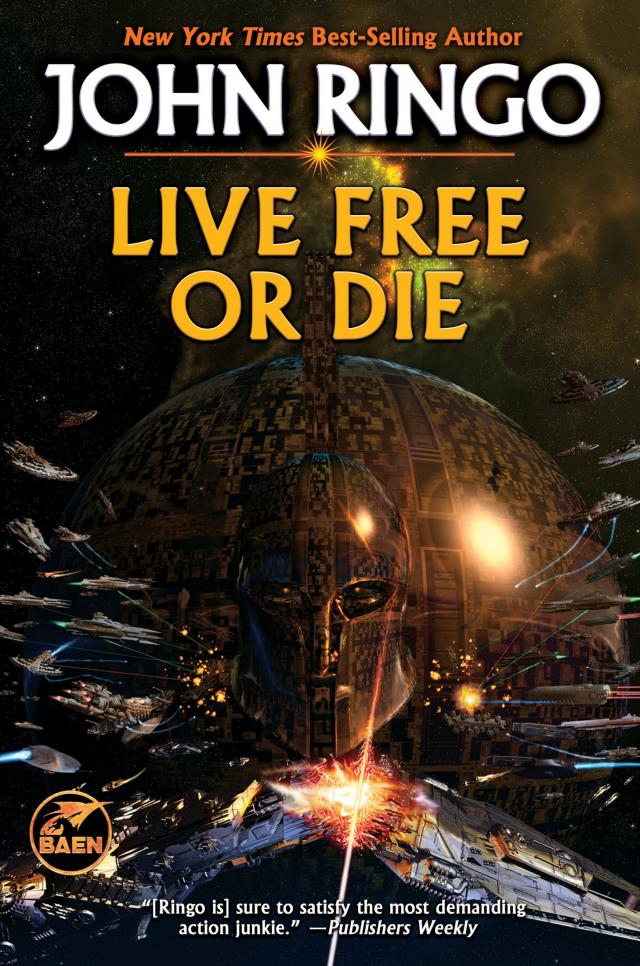


I liked the book for those reasons, too, but what made me a “fanboy” was something quite different. I am a Professional Engineer with nearly a half-century of experience in nuclear energy that began after I was chewed out by Admiral Hyman G. Rickover, himself. It should come as no surprise, then, that “hard” SF appeals to me more than fantasy or “softer” SF.
Another quotation attributed to John Campbell begins something like, “You’ve invented an atomic chicken plucker. Don’t tell how it works. I don’t care!”
I do care!
Sure, I want character-driven stories full of drama and action. Yes, pile on the g’s and pile up the loot! Fire off ginormous volleys of missiles! Romance is great and character growth is wonderful. And, of course, the plot should make sense. At least mostly.
But conservation of energy and momentum are natural laws, not some political party’s talking points.
And I want the machines to work! And Ringo’s do.
Yes, there’re no space gates (yet). Nor are there hydrogen-3 power plants (again, yet). Things like that that do not exist are the staples of SF, often called “handwavium.” The challenge of SF is not to justify them, but to introduce them early in the story and then “to play fair” thereafter by not “saving the day” with some new, convenient handwavium later.
Hard SF greatly enhances reader immersion when numbers help propel readers from page to page without burying them. The math better be accurate, though, because readers will double-check. The success of The Martian (by Andy Weir) is often credited to making the numbers part of the story and getting them right. Getting them wrong, on the other hand, is not a good thing.
Physics pratfalls and mathematical miscues can totally break the suspension of disbelief so critical to hard SF. In fact, I have been on multiple SF convention panels devoted entirely to regaling audiences with SF calculational cockups, scientific absurdities, and technological gaffes. One example that has never failed to draw guffaws was where a soldier used a hand-held weapon to fire a quarter-kilo projective at Mach 25 without any mention of recoil. (Exactly where did his hand end up, anyway?)
Ringo avoids such mistakes, but the real source of his appeal for me is something else.
He extrapolates, and he does it so damn well.
One SF genre in the early-middle twentieth century was “Gadget Fiction.” The story would center about some invention that, once it worked, essentially solved all the story’s problems. Consider, for example, any of the Tom Swift (or Tom Swift, Jr.) books.
Engineers know that real life is not like that. Whatever problems an advance or invention might solve, it inevitably leads to others. Sometimes they are not predictable, but sometimes they are. When a friend once recounted how his car got stuck again, I asked him why he refused to get a 4-wheel drive. He said it was because he’d still get stuck, but then he would be someplace further from help.
Tyler Vernon identifies that maple syrup is worth a truly astronomical fortune to an alien race, but they do not pay him in cash. He must find a way to convert his potential wealth into negotiable wealth, but solving this problem simply brings him to the next one. Becoming literally the richest person in human history changes his societal status instantly, but his challenges change just as quickly.
The advances in technology follow the same pattern. After some setbacks, Vernon essentially masters asteroid mining using methods made possible by buying tools due to his new off-Earth wealth. The mining products become part of the next tool, and so on. No single technological advance solves the larger problem. Even apparently sapient AIs become simply solutions to interim problems, while creating issues of their own.
Space combat proves no exception. Smart missiles lead to smarter counter-missiles and terawatt lasers give way to petawatt ones until it is back to brute force with quantity having a quality all its own, exactly as Stalin (allegedly) proclaimed over three-quarters of a century ago. And Tyler Vernon happens to have the most “quantity” in the forms of an armored battlestation the size of an asteroid and the focused light from our very sun.
Biological warfare leverages advances in medical technology to produce multiple, very specifically targeted agents so stealthy that they cannot be detected until after infection. The pattern reprises, however, as ultra-advanced information technology counters with the quick development of cures that can be administered by the high-tech equivalent of wi-fi.
It was the immersive power of plausible extrapolation that kept this engineer turning the pages.
Sure, the characters experienced growth just like all the literary critics preach, but so did the technologies they employed, and the latter had consequences all their own. One Old English proverb (translated from ancient Greek!) is “Clothes maketh the man.” That may or may not be true, but engineers know that technologies maketh the culture. Skeptics need only contrast societies based on horses with ones using automobiles, or electricity versus candles, or antibiotics versus bloodletting.
Some people wholeheartedly embrace significant technological changes, a few with a sense of wonder, others with simply a workmanlike utilitarianism. Many cannot adapt, however, and seek to evade or deny it. The novel includes examples along those and other lines, including one world-famous astrophysicist professor who signs on as a cook just to get into space, and Earth’s second-richest man who simply wants to remain a tree farmer but who nonetheless happily spends more than a king’s ransom for an alien laser rifle to better defend his trees.
Societies respond along similar lines; some readily adapt while others refuse. How this all plays out with the scale of changes in Live Free or Die (and its sequels) is more extrapolation. It gets even wilder when new societies are born in the midst of the constantly changing technological landscape (and even “spacescape”!).
Technology does not stand still, especially when scientists and engineers see their families and all they love under mortal threat. Inventions beget inventions. Habits change as new options and capabilities emerge (smartphones!). Societies and culture are dynamic, but technological changes are often the driver.
It’s all about extrapolation, and plausible extrapolation is immersive.
And, like I said, John Ringo is damn good at it.
John Ringo, Live Free or Die, Second Edition


