Suborbital 7, p.4
SubOrbital 7,
p.4
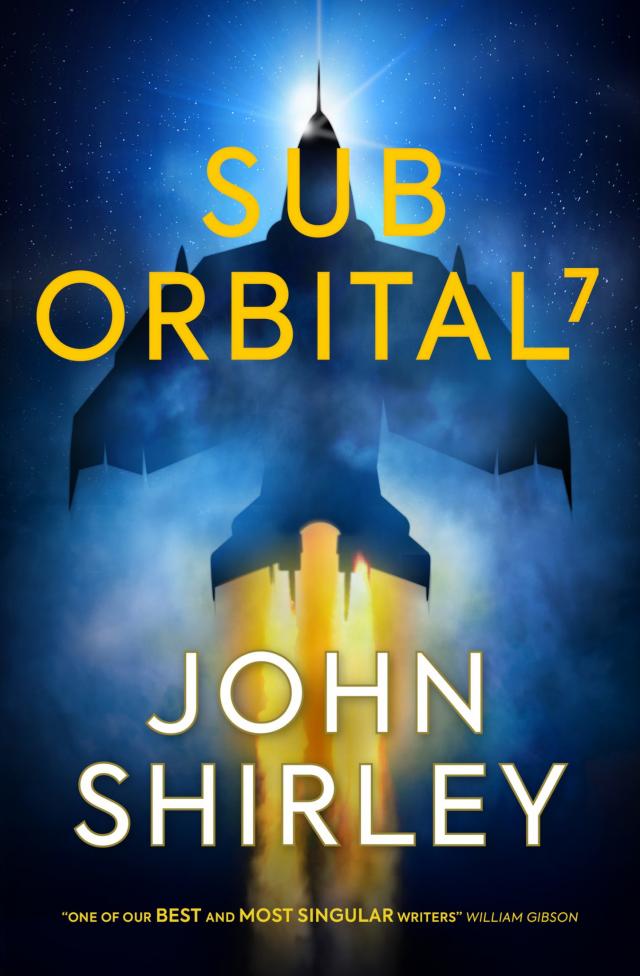


In a pinch, the S-7 could land on its tail like something from a 1950s science-fiction flick, and at end of mission it could take off from that position, as well. A vertical landing was complex, though, tough for problematic terrain, and too slow for a Drop-Heavy assault, which was all about quick deployment, getting to far places rapidly and quick ground action upon arrival.
Far below, the sharp points of light became few as the orbcraft traveled over the Atlantic Ocean. Ike and Linda muttered over indicator readings and slight changes of course as they corrected for Moldovan airspace.
“Better get back to our seats, Art,” Mayweather said.
Burkett grunted agreement and carefully turned around in the open hatch—sudden movements ended with bruises, at the very least—then stretched a hand to grab a ring in the ceiling and tugged himself aft. Queasy but not in any real distress, he drifted past the squad and then caught another ring to turn and angle his body into his seat. This part required some wriggling, but he was soon in his belt and netting again.
“Less than thirty to Zero Point,” Mayweather called, settling into his own seat. “Prep for regravitation.”
Once strapped in and netted, all Burkett could do to “prep for regravitation” was relax, hold onto the armrests, and prepare himself psychologically.
The pilots began descent, and the S-7 pitched down as sharply as possible while still within tolerable range for atmospheric friction and craft control. G-force on the way down to the Earth’s surface was far less, just a pressure on the chest, and a need to control their breath.
The heat was the thing.
As they plunged into the atmosphere, it would reach a thousand degrees on the hull. The titanium-alloy hull was specially treated to lessen drag, which reduced friction, and an under-layer of carbon nanotubes resisted heat build-up. Even so, a cherry-red plume formed around the swept-back wings as they picked up descent speed.
The orbcraft retained one of the old stratolauncher’s features—a tail that could be tilted up and over the fuselage, “feathering” against atmospheric pressure to slow them enough to assist braking and keep the vessel controllable.
Sergeant Strickland activated feathering and the orbcraft jolted as the tail tilted into the wind. Carney made a little soft moaning noise as the vessel slipped slightly off course, briefly shaking from side to side, but Ike quickly guided it back into the mapped trajectory.
As they passed through thermosphere, mesosphere, stratosphere, and troposphere, an array of high-artificial-intelligence computers—layered into the hull—controlled deceleration rockets with precise control, firing them rapidly on and off, spreading inertia along the hull so no one area received too much stress. The tiny rockets hissed close inboard, rippling from nose to tail, slowing the vessel. Coming down at so steep a pitch had called for special engineering.
Just ten klicks northerly, Ike eased out of a planned, gradual spiral and flattened trajectory for landing. He and Linda had studied the satellite images, but if some unseen obstacle cropped up at the last moment—some outcropping hidden by an optical flaw—they had to be able to react in time. And there was always the chance that someone at the dear old NSA had erred with respect to the length of the impromptu landing strip. Even if the analysts were right, there was no room for pilot error.
Lights out, coming in low, and fully stealth-clad, the orbcraft was only visible against the dark night if its rocketry was spotted. The engines were designed for as much quiet as possible. Methane burned clean and dark blue, and they were landing more than two miles from St. Basil’s.
* * *
On the wall of the old monastery, four members of the Thieves in Law were caught up in an argument about a pass to go to the village.
As the dispute went on, Stepan Bohdan thought he heard a strange sound and peered off to the south. Was that the rumble of an engine? Then again, there was a road not far away. Probably just a passing truck supplying the military base over at Kezn.
He had his thick, tattooed fingers on the tripod machine gun—but there was nothing to shoot. It was just a cloudy night, few stars visible, no moon. The stand of pines and spruce south of the old monastery nodded in the wind.
Olek Syrkin, alone of the four men, knew something was coming. He’d personally recommended the landing zone, but he was careful not to look in that direction.
Ildeva wagged a stubby finger at him.
“You don’t get a pass to go into the village, Olek, because you don’t do the work,” Ildeva said in Bulgarian. “Half the time I find you wandering around—aimless!”
Not aimless, Olek thought, but he kept his tongue. Instead, he put on a look that was sad and offended. “Mikhail, I am looking around for security! We have prisoners. Some of the locals, they spy on us. Maybe they work for Moldovan secret police. Sometimes I think I hear them breaking in!”
Ildeva gave out a loud, sneering laugh. “Olek, you worry about those pig-slopping oafs? Ha! And as for Moldovan secret police, who do you think gave us this place to use? You’re not searching for intruders—you’re looking for liquor, that’s what you’re doing.” He was a heavyset man with out-of-proportion thick arms and a beard that looked too small for his round face. When he laughed, the multitude of temhota tattoos on his neck and bare arms seemed to squirm in shared amusement. There was a sharp wind cutting across the plateau, yet Ildeva wore only paramilitary togs, untied boots, and a sleeveless T-shirt.
“So, there is liquor hidden here?” Dmytro, a wiry man with a red beard that whipped in the wind, slapped his submachine gun against a bony hip, which was as close as he ever came to laughing. “In this mess of old rocks?”
“Ah, for a time there was,” Bohdan declared. He was a stocky, bald machine-gunner, tattooed on his head and cheeks with gorgeous swirls around Slavic crosses. He was half-Russian. A tattered mustache hung over his harelip. “The monks made pear brandy here. Some old bottles, smashed, still stink of it in the cells!”
“Yet you hope to find some hundred-year-old liquor behind a stone, eh, Olek?” Ildeva jeered. “Let me help you, then. You can search for it down in the cells, when you go help Ilyov guard them!”
Olek grimaced as if this wasn’t exactly what he wanted. “The devil loves you, Mikhail.”
“Go! Or I will tie you face down on Bohdan’s bunk! You know Bohdan, he’ll fuck anything, and he has no sheep to love here.”
The men laughed at that. Bohdan the loudest.
Shaking his head and grumbling, Olek went to the stairs, fingering his submachine gun as he went. He pretended to be resigned, and even a bit bored, but his gut was quivering with rising dread.
They are coming. He was sure of it, and if he could manage not to get killed in the next few hours, he could leave here with them and to hell with the CIA. Yet the risk of getting his head blown off during the incursion was quite high.
His CIA handlers wanted him to stay with TiL, to encourage the others to abandon the monastery—to go with them if they bolted, and continue to be a source of intelligence—but it was in his mind to surrender to the Rangers the instant he got the chance. To declare himself to the American commandos who were coming, and demand to be exfiltrated.
He’d had enough of being a spy. The constant fear of being exposed, weariness of perpetual dissimulation. Now, Olek Syrkin wanted the reward the Americans had promised him for more than two years.
* * *
The orbcraft’s only light as it approached its landing was in its flight deck—a glow unseen from outside, thanks to the one-way windshield. The S-7 rushed toward the LZ.
A computer-generated replica of the landing topography unrolled toward the pilots, with arrows and numbers superimposed over high-risk spots. A large boulder appeared but the ship’s computers—controlling the now-extended wheels—saw it too, and the aft wheels lifted precisely enough to avoid the obstacle. A split second later they lowered again, just in time to touch down.
Ike did the last of the braking himself.
Theoretically the computer could accomplish it, but it wasn’t fine-tuned to the feel of the ship in the way Ike was. Forward braking rockets feathered on and off under his controlling fingertips. The wheels braked, too. The orbcraft rollicked as it rushed over uneven, rocky ground toward a hulking granite boulder…
The S-7 slowed… and stopped unnervingly close to the boulder.
FOUR
I don’t know what you’re complaining about,” Ilyov said.
“How can you not complain in such a place?” Olek replied.
Olek Syrkin and Nerhiy Ilyov stood in the musty, ill-lit corridor outside the prisoners’ cells. Ilyov was a much-scarred, remarkably unbathed older man in heavy green paramilitary jacket and combat trousers. He had a matted thatch of white hair. Olek was passing time talking with Ilyov, but his mind was far from chitchat as he looked through the bars in the cell’s little window. The three scientists were sullen, listless but, so far, not in bad shape.
Olek sighed. He was already sick of this hallway. The confinement, the cold, the gloominess, the stench. He tried to think of some excuse to slip away, get some fresh air. Perhaps he might have time to take his satellite phone from concealment. To call for word on the Americans.
“Ilyov—maybe I will go and have a pee.”
“You piss like a sieve today. This is three times.”
“I think that whore in Chișinău gave me the clap. I should not be here. I should go to a clinic.”
“Remember, Olek, when you asked to come on this job? You asked! None of the rest of us asked for it. Moldova? Out in the wastelands? A monastery? But Mikhail insisted that those with military skills must come. He even brought more men than he needed to… and then came you! An amateur! Hardly blooded!”
“Oh please, I have done my share of bloodletting for the brotherhood,” Olek growled.
“And you begged to come, Olek! Mikhail was suspicious, but he is your uncle so he turns a blind eye! Me—I know you are not enterprising enough to be a traitor.”
Oh indeed.
“Mikhail is not an uncle—only second cousin. It was my Uncle Denys who told him to let me come. I wanted to prove myself, Ilyov, I always get stuck in small jobs. I wanted to do something big this time.”
“Feh! With Thieves in Law you prove yourself by bringing in women and money and drugs! That’s what we like. This ransom business—it’s not a job for a real soldier. They will give us a share, but still…” Ilyov shifted his assault rifle from one shoulder to the other and nodded toward the cell door. “Watching these frightened, spoiled teacher-doctors. Bah!”
“I am not so happy now that I’m here,” Olek admitted, as he wondered if he would have to kill Ilyov before the night was over. Quite possibly.
“So you said, boy—as if you were surprised! No women here, no vodka, not even wine—what did you expect in such a place? Once a week, if we are good little boys, a trip to the tavern. Must be very careful with locals. ‘Don’t force yourself on the women.’ Bah!” He spat at the stone floor.
“Yes, I agree. I think we should have a tot or two of vodka, or at least nalyvka—every night! And—” He lowered his voice. “—Mikhail has his own vodka! I smell it on his breath. He forbids it to us, but he has his own supply!”
“You should not talk of such things. Your uncle won’t keep Mikhail from kicking your ass!” Chuckling, Ilyov turned away and lit one of his precious cigarettes, instinctively keeping his back turned so Olek would be discouraged from asking for one.
But Olek didn’t smoke—except, back home, a little hashish. He looked again through the small window in the door. There was a yellow electric light in a cage hanging from the ceiling, connected to a thick orange cable running to a hole in the wall, and out to the generator. It was always lit so they would know what the prisoners were doing.
Two of the men sat on the floor, talking softly, their backs to the least damp wall, their faces hidden by a shadow cast from the corner of a bunk. He had not dared to tell them what might be happening tonight. Ilyov spoke some English, and French—Ilyov had been in a French prison for six years. The prisoners might say something in his hearing.
The nearer one, huddled in his bunk, Frederic Dupon—he would be a problem. Lutzoff had used the vise to break the man’s right foot; then he had cracked Dupon’s ankle and the lower part of the shin. Olek had to stand guard in the interrogation cell during one of these sessions, and he had no taste for it.
“Up your limbs we will go over many days, Dupon!” Lutzoff had said sweetly. “And yet you are willing to put up with anything for the swine who allowed you to be brought here! Do you think they did not know your danger? They didn’t care! A couple of EuroIntel imbeciles to guard a man like you! Now then… let’s use rawhide ball to close your mouth, because the screaming disturbs my concentration…”
Dupon could not walk. He screamed when they moved him, but the Americans would send their strongest men. They would carry him out quickly.
Olek glanced at Ilyov. Yes. It would be necessary to kill him, and soon. Well, the old fellow had lived a long time—he was past fifty. He’d enjoyed many women in his day, and had spawned many children. Every night Ilyov prayed to the saints and made his peace with God.
So then, send him to God.
* * *
Hearing voices, Burkett walked up to the S-7’s nose, trudging over gravel in the dull red glow of the orbcraft’s underlighting—switched on only because they were in a valley below the enemy’s line of sight. He could feel the heat coming off the metal above him.
Dabiri and Faraday were staring up at the cliff.
“Look at that!” Tafir said, shaking his head and pointing at the beetling granite wall. “Two meters! You stopped two meters from a fucking wall of granite, Ike! You practically kissed it!”
“This may be the shortest landing strip, if you wanna call it that, I ever landed on,” Ike said, as he peered at the snout of the S-7. “You got my finesse to thank that you’re not splashed on that granite wall.”
“What’d you do, stick your foot out the hatch?”
Burkett cleared his throat. “Cast your mind back, Tafir, to the last time you looked at the bars on Ike’s collar.” There was tolerance around rank protocol in the team, but Tafir always pushed it too far.
“Sorry, sir,” Tafir said, nodding. “Lieutenant Faraday, you stopped two meters from a big fucking wall of—”
“Corporal?” Burkett snapped. “Captain wants you to suit up in that piss pot.”
“Yes sir.” Tafir hurried off into the darkness.
“Piss pot?” Ike asked.
“One of Carney’s little test-’ems. Newest Talos combat suit.”
“You’re fucking kidding me. Sir.”
“Nope.” Burkett looked up at the cliff wall. “Ike—you did cut it damned close. Did you inspect the wings?”
“Yes sir.”
“You send the damage assessment drones?” Launching the DADs was standard procedure.
“Flew ’em over every inch. We’re copacetic.” He hefted the MK-21 in his hands. “Am I cannon fodder tonight?”
“No, you watch your baby and be ready to support if we call. Set up a tripod defilade near the ramp.”
“Roger that.”
“Come on.” They walked back the length of the orbcraft together. Partway along they met Lemuel, who was skidding down a goat path worn into one of the rugged, steep ridges enclosing the valley. He had night-vision telescopic goggles dangling around his neck, MK-21 SCAR-H in his hands. The 7.62mm × 51mm weapon was a combination of carbine, assault rifle, and medium sniper rifle. A beautiful, eclectic, relatively light weapon—Burkett carried his own on a strap over a shoulder.
“Clear to the west, sir, so far as I can see,” Lemuel said, taking off his patrol cap to wipe his forehead with the back of his hand. “And to the east. Megan—Sergeant Lang—reported all clear from there. North looked good but there’s rocky spurs blocking line of sight some places.”
“We’ll get a better look from the drones. Call Lang, tell her I want you both to check out the exit route, then hustle back for final load-out. And put on a helmet, Dorman.”
“Yes sir.” Lemuel touched his headset, and as Burkett walked off, he heard Lem talking to Megan. “Sarge? Lieutenant wants us to check south AO together, rapid return.”
Burkett and Ike continued through knee-high grass and over crumbling rock to the aft of the S-7. A wind whistled over the little valley and a faint precipitation, little more than mist, came and went.
They found Mayweather personally backing the Bravo 7 blast-resistant light-terrain vehicle down the ramp onto the rocket-scorched ground. The armored, tan-colored LTV was a hybrid, capable of using gas if need be but mostly electric, so it would be quiet. It had separate electric cells in its composite armor, to neutralize armor-piercing rounds, the electrical field dampening them before they could explode. There was a 16mm turret up top of the vehicle, and a small launching deck for the two-meter-square armed drones stacked up there.
The LTV had adaptive camouflage that adjusted to backdrop, and its armor was layered for heat suppression, making it hard to see, especially at night, even with heat-signature goggles. It had 360-degree cameras, screen-view remote-control of the drones, and secure comm frequencies. All in all, it was a mobile Tactical Operations Center, dented and scarred because they had used it in combat three times before. Mayweather had never had the superficial damage spruced up. Said it was a good reminder.
Sometimes Burkett thought the Captain was in love with the damn thing. Mayweather’s nickname for it was “the Light-Up.” As in, “Let’s light the bastards up.”
“Stand clear till she one-eighties!” Mayweather said from the cab’s windows. They gave way and he spun the LTV around, facing south. The cliffs around the little valley were steep; the only way the LTV could get out was a rocky slope to the south. They’d head south and double back to the north for the assault.
Burkett went to stand by the open window, watching as Mayweather pulled the drone control screen out from under the dashboard and tapped in commands. Drone 1 started humming, its blades whirling. Its fastener unhooked and it lifted up, wobbling a little before stabilizing about ten meters over the vehicle and to one side, leaving room for the other two. Drones 2 and 3 lifted up, and the trio shifted into a triangle formation, then elevated above the rock walls of the ravine and flew off to the north.