Ghost moon, p.11
Ghost Moon,
p.11


Harvey’s dead, but I don’t have time to mourn. McSween, the two remaining Regulators and Chavez’s men are piling out the door. I follow. The old man from La Luz is beside me.
“Recuerde el Alamo,” he says to me with a smile. Remember the Alamo. I will. If I live.
The eleven of us in McSween’s group rush around the corner of the house in the opposite direction from Bill. It’s a mistake. There are Dolen men there, and they haven’t been distracted by Bill’s escape.
The first volley drops three of Chavez’s men in a heap. The rest of us scatter in all directions, except for McSween, who stands frozen in the middle of the yard, illuminated by the blaze behind him.
I crash through a low fence and collapse, gasping, behind a pile of lumber.
“Didn’t expect we’d meet again this soon.” I roll over to see Bill lying beside me, grinning. A strange, unreal quiet has fallen over everything, a sharp contrast to the clamor of gunshots a moment ago. We stare back at McSween.
“You ready to give up?” a voice shouts from the darkness.
McSween drops the pistol he has been holding limply in his hand and spreads his arms wide. A figure stands up and walks toward him.
“That’s Bob Beckwith,” I hear Bill say as the figure enters the firelight. “He’s the snake that shot me in the leg when we got Brady and Hindman. I been after him since then.”
“No!” I yell as I realize what Bill’s about to do. I’m too late. Bill’s shot hits Beckwith in the right eyeball, killing him instantly. He drops at McSween’s feet.
For what seems like an age, there’s a shocked silence. McSween stares down at Beckwith. Then, his arms still held wide, he raises his head and stares around at the silent darkness. The volley of bullets tears into McSween’s chest. He staggers two steps back and drops his arms to his side, before collapsing forward beside Beckwith.
“What’d you do that for?” I shout at Bill as ragged firing breaks out all around.
“Beckwith deserved it,” Bill says casually.
“But Alex McSween didn’t. Neither did Harvey, or any of the men who’ve died because of you.” I’m swamped by anger. All my frustration at Bill and his callous self-interest boils over and I have my revolver cocked and pointed at Bill’s head before I realize what I’m doing.
Bill only smiles at me, his hazel eyes twinkling in the firelight.
“You ain’t going to shoot me, Jim,” Bill says.
I want to shoot him, more than anything else in the world, but he’s right. I’m not like him. I can’t shoot a man in cold blood, however much I hate him. I release the hammer and lower my weapon.
“Till we meet again,” Bill says. Then he’s gone into the darkness.
I don’t have time to think much about what has happened. A bullet chips the piece of lumber by my head, reminding me I need to keep running.
Holding myself low and keeping to the darkest shadows, I work my way to the riverbank. Behind me the shooting dies away and I begin to hear the excited shouts of the victorious Dolan men. The war’s over, and I’m on the losing side.
At the river I see a crowd of figures, but I avoid them. I head south, around the edge of town and back up to the livery stable. There are men down here, drinking and dancing in the street, but I keep out of the way and no one pays me any attention.
I find Alita and Coronado and saddle them both. As I’m about to leave, the stable boy appears in the light of the lantern by the door, but a single look at my revolver and the grim look of determination on my face and he scuttles off into the darkness.
I lead the horses until I am well clear of town; then I mount Coronado and, leading Alita, I head slowly through the darkness to Fort Stanton and whatever a new life without Bill has to offer me.
JOHN WILSON is the author of thirty-one books for juveniles, teens and adults. His self-described “addiction to history” has resulted in many award-winning novels that bring the past alive for young readers. John spends significant portions of the year traveling across the country speaking in schools, leaving his audiences excited about our past. Learn more about John and his books at johnwilsonauthor.com.
The following is an excerpt from Volume One of
The Desert Legends Trilogy by JOHN WILSON.
9781554692705 $12.95 PB
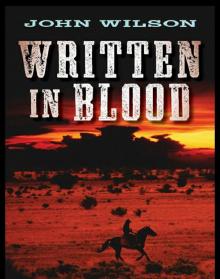
Set in the harsh desert world of the Arizona Territory and northern Mexico during the 1870s, Written in Blood, the first installment of the Desert Legends Trilogy, follows young Jim Doolen as he attempts to find some trace of the father who abandoned his family ten years earlier. As he travels through a scorched landscape very different from the lush West Coast forests of his home, Jim crosses paths with an assortment of intriguing characters, including an Apache warrior, a cavedwelling mystic, an old Mexican revolutionary and a mysterious cowboy. And with each encounter he learns something more of the strange world he has entered and adds one more link in a chain that leads back to his father—and back to a dark, violent past. As his story approaches its thrilling conclusion in a ruined Mexican hacienda, Jim comes to realize that his father's life was much more complex than he had imagined, and that, in discovering his past, he has opened the way to his future.
This is a world whose history is written in blood. Blood drenches the black dried scabs of the rocks, the rusty desert sands and the distant crimson mountains bathed in the dying light of the setting sun. It is the blood that has drained from conquistadores, Apaches, Mexicans, Americans, leaving their empty bodies to dry out in the unforgiving sun. Not for the first time, I wonder what the hell I’m doing here on this fool’s errand.
I am camped on the edge of an eroded bluff of black volcanic rock. The only sounds are the quiet chomping of my tethered horse eating the nearby clumps of grass sprouting from cracks in the rock and the sizzle of the skinned jackrabbit on the stick over the crackling fire in front of me. The sky above is the deepest black I have ever seen and the stars so bright and close I feel I could reach out and pluck them.
I stare over my fire to the west, across the desert plain I crossed today, at the barely discernable black outline of the mountains where I camped last night. The tiny flickering campfire out on the plain is the only light. Every night for the past five days I have seen this fire as darkness falls. There is probably a man sitting by it looking up at the light of my fire. Who is he? Perhaps he is simply a traveler, taking the same route as I, but the loneliness of this place makes me think not. What his purpose is, I cannot guess. All I know is that every evening his campfire is a little closer.
I chose this place to camp because these low hills command a view of the way I have come, because there are some stunted trees for shelter should the clouds I saw building at twilight turn into a storm, and because there is a nearby spring for fresh water. It’s a good spot, but it’s not the land I have left.
Three months ago, on my sixteenth birthday, I was leaning on the rail of the schooner Robert Boswell, watching porpoises leap around us as we tacked across the Strait of Georgia toward the Strait of Juan de Fuca and the Pacific Ocean. My world then was blue—the dark blue of the water below, the pale blue of the sky above and blue-gray of the mountains at my back. I have not seen blue since I stepped off the ship in San Diego and launched myself into this land of rusty brown, burnt ocher and blood. The eternal snow on the peaks of the mountains back home is merely the memory of a dream.
My thoughts drift back to the modest parlor of the stopping house in Yale that my parents built in 1859 with gold my father had clawed from the Fraser River. I was born two years later, by which time business was booming as thousands of hopeful miners flooded through Yale on their way to the goldfields of the Cariboo, nursing their dreams of untold wealth.
I remember my mother telling me, “Your father found gold in the Fraser River, but we made a lot more money from the fools going to look for gold in the Cariboo.”
My father came up from California to look for gold in the District of New Caledonia in May of ’58. By the time New Caledonia became British Columbia later that year, he had staked and was working three good claims near Yale. Before a year was out, he had sold them, met and married my mother and bought the lot where our stopping house was to stand. But my father was not a man to let the grass grow beneath his feet. By the time British Columbia became the sixth province of Canada in 1871, he had been gone for four years.
I don’t think my mother even resented my father leaving. I suspect she had known since they first laid eyes on each other that he would move on one day. He had what my mother called an impatient soul.
“Some folks just can’t settle down in one place,” she used to say. “They aren’t made that way. With people like that you’ve got two choices: give up everything and accompany them, or accept that one day they’ll be gone and enjoy the time that you are in the same place with them.
“Your father gave me two very precious things when he left me the stopping house: financial security and independence. Both of them are great rarities for women, and I wasn’t about to give them up easily. And then there was you. I knew you’d leave one day too. I saw your father’s restless spirit in your eyes the day you were born, but even a rambler needs roots and a strong foundation. I stayed and ran the stopping house to give you that.”
On the last day before I left, my mother and I stood on opposite sides of the polished oak table in the parlor. She looked sad but not angry or tearful.
“Well, James, if you’re heart-set on going, all I can do is wish you luck and give you this.” She handed me a tin box that I knew well. I set it on the table, undid the latch and lifted the lid. Inside, Dad’s Colt Pocket revolver lay nestled in a bed of worn red felt. Beside it was a powder horn, a bullet mold, a box of percussion caps and a collection of lead bullets. It’s an old gun; you have to load each of the six chambers individually with powder, shot and percussion cap; but my father always said that was no disadvantage over the new fancy revolvers that took the ready-made cartridges.
“A handgun’s only good for shooting at something closer than a hundred feet away,” he used to say. “If you’re that close to a man and you need more than one or two shots, you’re probably already dead.”
I practiced with the revolver until I became a pretty good shot, and I feel comfortable knowing that it’s lying with my saddlebags across the fire from me.
“Won’t you need it once I’m gone?” I asked my mother when she gave me the gun.
“No use for a gun here now,” she said with a smile. “This is 1877. When your father first came up here, it was a different matter. There were a lot of rough characters coming through then and not much law to control them, but all that’s changed. We’ve got laws and government now. A lady doesn’t have need of a handgun here, but you may where you’re going.”
“I have to go and find out what happened to Dad,” I said. “I always said I would as soon as I was old enough and able. I’ll be sixteen in three days and I’ve got some money saved, so there’s no point in waiting.”
Mother nodded slowly. “When you make up your mind, nothing changes it. You’re stubborn, just like him. He kept his thoughts close to himself, but once his mind was made up, God Almighty himself couldn’t change it. I know I can’t stop you going but, remember, you may not find him. He told me he was going to Mexico, but Mexico’s a big place. Besides, he may not wish to be found or,” she hesitated, “something may have happened to him.”
“That’s true, but somewhere down there, someone knows where he is or what happened to him, and I aim to find that out.”
“Even if you find him,” mother said thoughtfully, “he may not be what you expect. You were only six years old when he left, and he’ll be forty-five by now. What do you remember about him?”
“I can see him like it was yesterday, not tall but strong. He could lift me like I was a feather. His hair was dark, but I was always fascinated by how red it was at the ends, especially his mustache where it dropped down the sides of his mouth. When I was little, I always thought he grew that mustache to try and pull down the edges of the smile he always wore.
“I remember him teaching me Spanish and telling me stories. He told me about the vaqueros and Spanish grandees in Mexico, the wild Apache Indians and cowboys in Arizona and New Mexico, and the gold prospectors and gamblers in California. I promised myself that I would go and see these places for myself one day.”
“He was a good storyteller,” mother said wistfully. “But there was a lot about his life before I met him that he never did tell, and God knows I asked often enough. For all his talk and tales, he was a secretive man, never wanted anyone to really know him. I wondered sometimes if he had something dark in his past that he was running from. He used to have nightmares, you know. I’d wake to find him sitting in the bed beside me, bathed in sweat, his eyes wide and staring as if the room was full of ghosts. I used to ask what he saw in the night, but he never told me. Always passed it off as something he ate for supper that disagreed with him.”
“I didn’t know.”
“No reason for you to know. Mostly they were in the years after I first met him. They eased off after we got the stopping house set up and running, but they came back in the months before he left. I guess what I’m trying to say is that there was more to your father than the stories he told. You might be disappointed when you meet him.”
I opened my mouth to protest, but Mother went on. “I’m not trying to talk you out of going. I know you’ve got his obsessions, and nothing I can say will change that. I just want you to go down there with your eyes open, because, even if all his stories were true, things have changed. It’s not the world he knew down there twenty years ago. There are cattlemen, cowboys and gunfighters moving in there now. Civilization’s creeping in, but it’s a slow, violent process.”
“But I have to try,” I repeated.
“I know, and I’ve tried to give you the best tools I can. You’re a fair shot with that revolver, you can at least stay on the back of a horse, and I’ve encouraged you to keep up with the Spanish he taught you. I also hope I’ve given you the sense to know when to stand and fight and when to run. So I guess all that’s left is to wish you luck.”
We embraced, and the next morning at daybreak I was gone to New Westminster to catch the Robert Boswell.
John Wilson, Ghost Moon