

Space fleet academy year.., p.1
Space Fleet Academy: Year One (Biostellar Book 1),
p.1
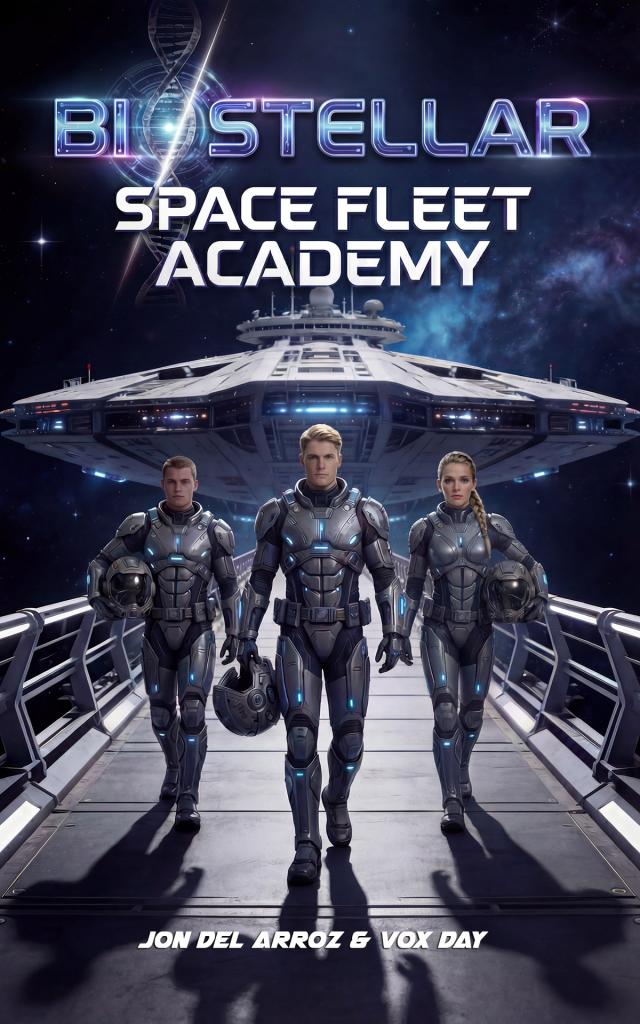


Space Fleet Academy: Year One
Jon Del Arroz and Vox Day
Castalia House
Table of Contents
Space Fleet Academy: Year One
DEDICATION
PREFACE
Chapter 1: THE WALL OF NAMES
Chapter 2: THE FILTER
Chapter 3: FIRST WEEK
Chapter 4: THE GAUNTLET
Chapter 5: FIRST CONTACT
Chapter 6: EMPTY BUNKS
Chapter 7: MENTOR’S WISDOM
Chapter 8: FIRST BLOOD
Chapter 9: CRACKS IN THE FACADE
Chapter 10: THE BURDEN OF COMMAND
Chapter 11: EMPTY CHAIRS
Chapter 12: MIDNIGHT MEETING
Chapter 13: DANGEROUS KNOWLEDGE
Chapter 14: THE GENETIC REVELATION
Chapter 15: PROFESSOR VEGA’S OFFER
Chapter 16: TRUST AND BETRAYAL
Chapter 17: GRIEF AND RESOLVE
Chapter 18: CONFRONTATION IN THE DARK
Chapter 19: THE GAUNTLET RUN
Chapter 20: THE MEMORIAL STANDOFF
EPILOGUE
APPENDIX: The Science of Biostellar
Space Fleet Academy: Year One
Copyright © 2026 Jon Del Arroz
Published by Castalia House
All rights reserved.
version 002
DEDICATION
For Robert Picardo.
Please state the nature of the genetic emergency.
PREFACE
A Brief History of the Genomic Crisis and the Human Dispersion Mandate
In the late twenty-second century, a team of population geneticists at the Zurich Institute for Genomic Studies made a discovery that would forever reshape human civilization. They were not looking for it. They were running routine models of allele frequency change across global populations when the numbers refused to behave. Beneficial mutations were not spreading. Deleterious mutations were not being purged. They discovered that the human genome, across every population they sampled, had stopped responding to selective pressure more than two centuries ago.
The mechanism was not mysterious. It was, in retrospect, obvious. Natural selection requires differential reproduction: individuals carrying advantageous variants must, on average, leave more surviving offspring than those carrying disadvantageous ones. For this to work, a meaningful fraction of each generation must fail to reproduce. In the Neolithic period, roughly forty-five per cent of all deaths occurred during the reproductive years between fifteen and forty-five. The Selective Turnover Coefficient—the measure of how efficiently selection operates on a population—stood at approximately 0.53. Selection was brutal, but it worked. Harmful variants were purged. Beneficial variants spread. The genome was systematically cleansed.
By the twenty-second century, that coefficient had collapsed to 0.015. Modern medicine had reduced reproductive-age mortality to less than five per cent. More than eighty per cent of all deaths occurred after age sixty-five, long after the individual’s genetic contribution to the next generation was complete. When nearly everyone survives to reproduce, and when survivors produce similar numbers of children regardless of their genetic endowment, selection has nothing to select. The engine that had driven human evolution for six million years had been turned off.
The genome was frozen in both directions. Beneficial mutations could not spread because there was no selective mortality to favour their carriers. Deleterious mutations could not be purged because there was no mechanism to remove them. Humanity’s accumulated burden of harmful variant had been increasing with each generation, invisibly, inexorably, for two hundred and eighty years. The projections were unambiguous: total functional genomic degradation within thirty generations, approximately 700 years. The species was not dying in a way that could be observed in a single lifetime. It was dying across centuries, at the level of the code that defined it.
The shocking discovery provoked immediate debate about solutions, and the most seductive solution was the most direct: if the genome was accumulating errors, simply edit them out. By 2140, precision genomic editing had reached extraordinary sophistication. The technology could target any sequence with 99.97 per cent accuracy. Germline modification for single-gene disorders was already routine. A consortium of geneticists, politicians, and wealthy patrons—adherents of the transhumanist vision that the historian Yuval Noah Harari had articulated more than a century earlier—proposed the Geneva Genomic Initiative: a coordinated programme to screen all human embryos for the approximately ten thousand known deleterious variants and correct them at conception. Within three generations, they promised, humanity’s genetic load would be reduced to near zero. No need for hardship. No need for sacrifice. Engineering would accomplish what nature no longer could.
It was an elegant proposal. It was also catastrophically wrong.
The Initiative launched in 2147. By 2156, it had killed nearly eighteen thousand children.
The editing technology worked flawlessly. But the human genome did not cooperate. Two centuries of genetic mapping had treated the human genome as a simple blueprint—identify the defective components, excise them, replace them with functional alternatives. What the genetic engineers had failed to appreciate was that the genome is not a blueprint. It is an integrated system of staggering complexity, shaped by seven million years of natural selection into a web of interdependencies that no mapping project had fully characterised.
Epistasis and pleiotropy meant that modifications that appeared clean in cell cultures produced developmental catastrophes in living embryos.
The Geneva children—the first generation born under the Initiative—showed highly increased rates of autoimmune disorders, neurological abnormalities, and a previously unknown syndrome of systemic developmental instability. Mortality before age twenty was 640 per cent higher than in the unmodified population. The survivors showed reduced fertility. The Cascade Failure, as it came to be called, was the single greatest iatrogenic disaster in human history.
The Initiative was terminated in 2158. The Genomic Sovereignty Accords followed in 2161, establishing the legal framework that governs genetic manipulation to this day. Enhancement modification of the human germline—changes intended to improve traits beyond the normal human range—was absolutely prohibited. Therapeutic modification was restricted to a narrow list of severe single-gene disorders, limited to a maximum of three edits per genome, and subject to fifty years of mandatory lineage monitoring. The Accords were not gentle. They were not meant to be. The Cascade had demonstrated, with the lives of thousands of children, that the genome is not a text to be edited but an active system with its own logic, and that human understanding of that logic remained dangerously incomplete.
But the Accords only addressed half the problem. They prevented humanity from making the genome worse through engineering. They did nothing to address the frozen genome itself. The mutational load was still accumulating. The species was still in the process of dying.
The solution came from an unlikely synthesis of population genetics and astropolitics. Small, isolated populations experience stronger genetic drift—alleles fix or are lost more rapidly. They also experience more efficient selection, because the Selective Turnover Coefficient increases when mortality is higher and lifespans are shorter. Frontier colonies, by their very nature, provided both conditions: smaller effective population sizes, harsher environments, and the demographic instability that reactivates the selective engine. The genome, frozen on Earth, could thaw on the frontier.
This insight gave birth to the Human Dispersion Mandate. The Federation’s expansion programme was transformed from an economic or political enterprise into a biological imperative. Continuous colonisation was required not to acquire resources or spread ideology, but to maintain a genetically healthy species. Thousands of frontier colonies, each holding populations in the low thousands, would serve as distributed selection laboratories. Variants that failed under harsh conditions would be purged. Variants that succeeded would propagate. Periodic gene flow between colonies and the core worlds would reintroduce adaptive variants while preventing the genetic fragmentation that leads to speciation. The Federation became, in effect, a managed metapopulation: a structure designed to keep humanity’s genome dynamic across seven thousand worlds.
The irony was bitter. Humanity had spent centuries conquering nature, eliminating the selection pressures that had shaped the species. Survival now required reintroducing those pressures—not on the core worlds, where such measures would be politically impossible, but on the frontier, where hardship was simply the cost of expansion. Less than one percent of humanity’s seven hundred billion people would carry the genetic burden for the rest. The stars were not merely humanity’s destiny. They were its therapy.
Maintaining this structure—a civilisation of seven hundred billion souls spread across seven thousand worlds, connected by the Resonance Network’s instantaneous communications but separated by the Cascade Drive’s months-long transit times—requires officers of extraordinary capability. Pathfinders to chart new worlds. Administrators to manage the delicate balance between colonial development and the Mandate’s demographic requirements. Defenders to protect the frontier against threats both alien and human. Seeders to establish the pioneer outposts where selection operates at its most intense.
This is the purpose of th
e Space Fleet Academy. Twelve academies across human space train the officers who hold the structure together, but Earth’s Academy is the oldest and the most demanding. Its four-year programme does not merely teach tactics and navigation. It forges courageous leaders capable of making decisions that will be hated by the people they are meant to protect—decisions driven not by the politics of a single world or the comfort of a single generation, but by the survival requirements of the entire race of Man.
The cadets who enter the Academy arrive believing they understand what is asked of them. They do not. True understanding can only come later, in the crucible of training, in the weight of choices that permit no easy answers and the recognition that someone must ensure the sacrifice of millions is not made in vain.
This is their story.
Chapter 1: THE WALL OF NAMES
The granite stretched two hundred metres in a gentle curve, fifteen metres high, and every centimetre of it held the dead.
Constantine Ramsey stood alone before the Wall of Names, reading the carved letters that caught the morning light. The names were arranged chronologically, starting with the researchers and geneticists who had triggered the Cascade, moving outward to include the politicians who had authorised the programme, the medical staff who had administered the treatments, and finally the 17,847 young adults and children who had paid for humanity’s hubris with their lives.
Maria Delgado, Age 14. Thomas Reeves, Age 7. Priya Sharma-Williams, Age 62.
He touched the cool stone, his fingers resting on the name of a child who had died two centuries before he was born. Jennifer Tanoyue, Age 4. She would have been ancient now. She might have had grandchildren, great-grandchildren, a legacy of ordinary human lives stretching into a future that never came. Instead she was a name on a wall, four years old forever, one small body among seven thousand marking the boundary between what humanity had tried and what humanity had learned.
On New Carthage, the memorial was a single column in the capital plaza. Ten metres of black basalt etched with the same 17,847 names, scaled small enough to require a person to press close to read them. Constantine’s father had taken him there at age twelve and made him stand until he’d found the youngest name on the stone.
Elise Montclair, Age 2.
Two years old. Modified in the womb by parents who thought they were giving their daughter every advantage. Dead before she could speak a full sentence, her neural architecture collapsing as the engineered genes cascaded into failure across three generations of compounding error.
"That’s why the Accords exist," his father had said. "That’s why we chose the Mandate instead. Pain and sacrifice and frontier worlds, but at least we survive. At least we stay human."
Constantine had accepted that at twelve. At eighteen, standing before the original Wall, he accepted it still, but with reservations his father wouldn’t have understood.
The Mandate worked. The mathematics were clear: small isolated populations under environmental stress reactivated the selective engine that modern medicine had silenced on the core worlds. Frontier colonies provided the conditions that purged the deleterious variants accumulating in Earth’s frozen genome. The species survived because colonists suffered and died at barbaric rates.
Constantine had grown up on a Tier 2 world. New Carthage was three generations past its frontier days, developed enough for proper hospitals and schools, still raw enough that the SPVA inspectors visited every five years to measure the colony’s selective turnover coefficient and frown at graphs trending in the wrong direction. His grandparents had buried children. His parents had buried none. The SPVA considered this a problem.
He’d spent two years studying New Carthage’s transition from Tier 3 to Tier 2 for his entrance essay. Not the colony’s official history, but its mortality records. And in those records he’d found something that kept nagging at him: the transition hadn’t been smooth. It had come in lurches. Periods of stability punctuated by crises, a viral outbreak in his grandparents’ generation, a crop collapse a decade later, a seismic event that destroyed the southern settlements. Each crisis spiked the death rate, and each spike purged variants more efficiently than the grinding constant mortality of pure frontier life.
The average d coefficient during those decades was lower than what a standard Tier 3 colony maintained. But the genomic results were comparable.
His entrance essay had asked a question the admissions board found ambitious: What if the Mandate’s colony design protocols are incorrect? What if episodic crisis produces comparable genomic health with lower cumulative mortality?
He hadn’t answered the question. He was eighteen and knew enough to know he couldn’t answer it yet. But the question itself had been enough to place him third in a cohort of four thousand, ahead of applicants from Earth and the core worlds who’d had access to better schools, better resources, better everything.
Ahead of everyone except Sebastien Cabot-Winthrop, who’d placed first, and Elena Sørensen, who’d placed second.
Constantine stepped back from the Wall and let the full scope of the Memorial resolve in the early light. Twenty hectares of maintained grounds centred on the Wall of Names, extending outward to the Reflection Pool, the Museum of the Cascade, the Chapel of Remembrance. The Oath Ground, where first-years would swear their commitment tonight. The campus beyond: stone buildings housing humanity’s officer corps for nearly a century, training facilities and simulation centres and barracks arranged around the central quad.
He’d dreamed of this place since childhood. Exploration vessels pushing into uncharted space, first contact with alien civilisations, new worlds catalogued and opened. Those dreams felt different now. The exploration he craved would come measured in human lives. Every new world meant colonists sent to struggle and suffer on the frontier. Every expansion of humanity’s reach meant more raw material for natural selection’s indifferent machinery.
He recalled the woman who ran the pharmacy on Broad Street back home, who still kept her dead son’s shoes on the shelf behind the counter, twelve years after the outbreak took him. A d coefficient of 0.35 looked like a horror when it wasn’t a number on a spreadsheet but a boy’s shoes gathering dust.
The Mandate was necessary. But necessary and optimal were different things, and the gap between them was measured in graves.
* * *
"Inspiring, isn’t it?"
The voice came from his left, cultured, carrying an accent he couldn’t place. Constantine turned to find a tall young woman standing a few metres away, studying the Wall.
Dark auburn hair pulled back from a composed face. Green eyes moved across the carved names with the systematic attention of someone cataloguing data, as if she’d already calculated her trajectory through this place and found it satisfactory.
"Couldn’t sleep," Constantine said. "Seemed like a good time to come out here and pay my respects."
"Respects." She tested the word. "Everyone else considers this as a chore to tick off before orientation."
"They're wrong. It's why we're here."
She gave him an appraising look. "Elena Sørensen. Exploration track."
"Constantine Ramsey. Same."
"I know who you are." She turned back to the Wall. "Your entrance scores were in the preliminary rankings. Third in our cohort. Impressive, for a colonial."
The emphasis on that last word wasn’t subtle enough to be accidental. Constantine kept his voice level. "And you scored second. Impressive for anyone."
Her lips curved in an acknowledgement of a point scored. "Close enough. I read your entrance essay, by the way. The admissions office publishes the top five."
"They do?"
"I take it you haven’t read mine."
"I’m afraid not. What did you think of it?"
"Ambitious premise. Underdeveloped argument. You noticed something real in the New Carthage transition data, but you didn’t control for the difference between random crisis mortality and selective mortality. A storm kills indiscriminately. The Mandate’s grinding frontier hardship kills preferentially — the sick, the weak, the genetically compromised. Your episodic-crisis model might produce fewer total deaths, but it accomplishes less genomic work per death."


