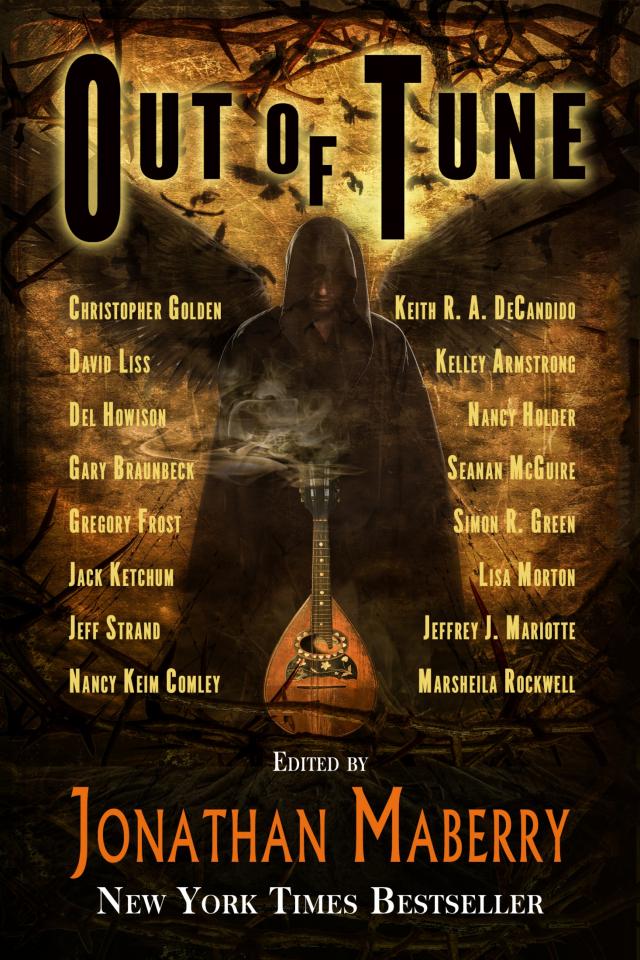
Out of tune, p.11
Out of Tune,
p.11


. English Folk Dance and Song Society.
FISH OUT OF WATER
By
Keith R.A. DeCandido
I knew something was wrong when I saw the twenty-eight-foot Coast Guard boat coming toward us.
I cut back on the throttle to slow us down. It wasn’t a collision course, but if the Coasties were coming this way, going the way they came from might not be such a hot idea. It was a Response Boat–Small, one of the new Defiant Class, and if an RBS was here, it probably meant something and/or someone went missing at sea. After double-checking the code painted on the other boat’s hull, I grabbed the radio.
“USCG 25119, USCG 25119, this is Groucho on 16, over.”
“Groucho, this is 119, over.” I recognized the tinny voice that squawked over the radio as Boatswain’s Mate 1st Class Cole Howard, who worked out of the USCG station located on Marathon Key.
“119, Groucho, wasn’t expecting you guys out here. Something we can help with?”
“Groucho, 119, thanks very much. Don’t suppose you’ve seen Soleado? It’s a rec boat that usually launches from the Azucar Di—“
I interrupted before he could start describing a boat I already knew quite well. “Cole, it’s Cassie—have those jackasses gone missing again?” Over Thanksgiving weekend, boats from the Azucar Dive Shop up on Big Pine Key had gone missing twice. In fact, Cole was the one who found them the second time.
“Groucho, 119, that’s affirmative.” Formal as ever, was Cole. “Last radio contact was at 1100 hours.” Then he got less formal and more skeptical and sardonic when he added, “Said they saw a mermaid.”
Last time they said it was the Loch Ness Monster, so at least they were getting more local. On the other hand, I numbered among my close friends and acquaintances the ghost of a wrecker captain, an immortal barfly, and four Norse gods, so I really wasn’t in any position to poo-poo someone who said they sighted a mermaid. Or Nessie.
“119, Groucho, I’ve got six tourists who really want to dive Pickles Reef. Okay if I proceed there?”
“Groucho, 119, that is in our search pattern, but not for a bit. Proceed as planned, but be advised that we’ve received reports of an odd storm front over that way. Nothing on the radar, but a few boats radioed in tornado warnings.”
That didn’t make sense on any level. For starters, I’d checked the weather before we came out. And for another… “119, Groucho, those boats do know we’re in the Florida Keys, right? We don’t generally get tornadoes.”
“Groucho, 119, wanted to mention it just in case. Good sailing.”
“You too. Out.” I thumbed the radio off and hit the throttle, zipping around the RBS.
The half-dozen tourists who had come to the Seaclipse Dive Shop on Stock Island and hired me to take them scuba diving were a bunch of martial artists from a dojo in Denver visiting Key West for the week. The woman who seemed to be the ringleader, a short, lithe Filipino named Isabel (all the others called her “Senpai Bel”), poked her head into Groucho’s tiny bridge. “Everything okay?”
“Yeah, just touching base with the Coast Guard about a dive boat that’s gone missing.” I filled her in on what happened. “So good thing you went with us instead of Azucar.”
Bel smiled and shook her head. “Our kaicho told us we should try Azucar, but it was too far up the Keys. We wanted somewhere closer to Old Town. Don’t usually go against his wishes, but damn.”
“Anyhow, we’ll be at Pickles Reef in no time.”
“Can I ask you something, Ms. Zukav? Kaicho told us the reef was named for the pickle barrels at the ocean floor. What he didn’t tell us was why the barrels were left there.”
My bosses at Seaclipse didn’t warn me when I took the part-time job as dive-master last year that the job description included playing tour guide for the entirety of south Florida, but I quickly became quite the expert on the history and trivia of the Keys. “So many ships got wrecked on the reefs around here for centuries, there’s no way to get everything back up above water. And these barrels are full of concrete, so hauling ‘em up would be a major pain. No one’s really sure where they came from—might be a wreck, might be a construction project gone bad. They used to think it was concrete to construct the forts they started to build during the Civil War, but they did an analysis a few years back that shows that it was a type of concrete made between 1890 and 1925. Might’ve been for the railroad they built through the Keys.”
“What railroad?”
I smiled. “You guys drove down from Miami, right?”
Bel nodded. Flying into Key West International Airport was often more expensive than flying into Miami International Airport and renting a car. That had the added bonus of getting to drive on Route 1 through almost all of the Keys, which is some of the most scenic driving you’ll ever see.
“The Overseas Highway is mostly on what used to be the railroad that went from Miami to Key West. It opened in 1912 and closed down after it got hammered by a hurricane in 1935. They built the road over the same right-of-way.” I shrugged. “Anyhow, I’d rather they focused on cleaning up the actual litter that people throw down there. There’s so much sh—so much crap down there...”
Smiling, she said, “It’s okay, Ms. Zukav, you can say ‘shit.’“
I laughed. “Sorry, first dive I ran, I made the mistake of saying ‘fuck’ in front of some Southern Baptists. Had to give ‘em their money back. As a general—” I cut myself off when I caught sight of a boat in the water ahead of us. It wasn’t on our exact course, but we’d pass pretty close. It was running a dive flag—the red flag with the white diagonal stripe that’s become the universal sign for a boat filled with divers—but the motor was silent and it was bouncing around in the ocean as if it wasn’t anchored.
Squinting at the boat, Bel asked, “Should we let that Coast Guard guy know?”
“Let’s make sure they’re okay, first,” I said as I changed Groucho’s course toward the dive boat, which looked more and more like Soleado the closer I got. “First time they went missing last weekend, it was another one of their boats that found ‘em, but BM1 Howard found ‘em the second time. He let ‘‘em off once with just a warning, which means he’s gonna rip several new—” I smiled at Bel, reveling in my newfound permission to speak freely. ”—assholes this time. Probably close the shop for a major inspection, and whatever else he can do to make their lives a living hell.”
Giving me a questioning look, Bel asked, “So you’re gonna let them off?”
“There are about eighteen reasons why they might’ve gone quiet, starting with the radio breaking down.”
“Cell phones?”
“Reception can be spotty out here. They also could be damaged in some other way that’s not their fault. I’d rather not sic the Coasties on ‘em until we know for sure they deserve it. Like the song says, we look after our own.” I pulled up alongside the boat that had the word SOLEADO stenciled on its bow. “Mind giving me a hand?”
With the help of my very able-bodied tourists, I was able to tether Soleado to Groucho and then drop anchor so we’d all stay in one place for Cole to find us if we needed it. Groucho wasn’t rated for towing, so if they were damaged, we’d still need help from the Coasties, but I wanted to know what was happening first.
Besides, it could’ve actually been a mermaid. Since moving to Key West, I’d dealt with a dragon, several different water fae, a half-dozen ghosts, what’s left of the Norse pantheon, the spirit of the Calusa tribe, and a UFO on Dry Tortugas. I figured it’d be best to make sure it was something that the mundanes could handle before I called them in.
Okay, the Norse pantheon remnants I mentioned? I’m one of them. While I was “born of Midgard,” as my friend Ginny, a.k.a. Sigyn, put it, I’m actually a Norse fate goddess—one of the Dísir. As a Dís, I tend to attract weird-ass shit, and sometimes I even can deal with the weird-ass shit. Cole was way too straight an arrow to handle an actual mermaid without his head exploding, so I needed to do triage on Soleado first.
Mind you, I had no idea if there actually were mermaids. I only found out I was a Dís seven months ago, and it didn’t come with an instruction manual.
Once we secured the other boat, I jumped across to their deck. Soleado was a twenty-nine-footer just like ours, though it was made by a different company, so there were variations in design. However, the basics were the same: bridge fore, deck aft, galley and head below. I didn’t see anyone in either of the former two places, so I climbed down belowdecks to find five people all standing crammed into the galley. They were all wearing some dive paraphernalia, but nobody was fully geared up—and nobody was fully un-geared up, either. One guy had a single fin on one foot, one wore a regulator but no mask, one had half his neoprene suit off—it was like they had all been interrupted in mid-prep and came down here.
I stared at the one person I knew, Al Martinez, one of the dive-masters at Azucar. He was the one wearing only a single fin. “Al, you okay? What happened?”
“I got a wife, back in Tampa, an’ two kids. Ain’t gonna be seein’ her no more.”
I frowned. “Al?”
The Asian couple crammed in on either side of Al then each said something in what I think was Korean; at the very least it sounded like how my Korean neighbors back in La Jolla always sounded when they chatted in their native tongue. After they said their peace, the other two—a couple of brunettes who looked related, probably sisters—spoke up.
“My fiancé’s back in Ann Arbor. We’ll never get to be married.”
“My husband’s waiting for me in Chicago. He’ll be a widower.”
I blinked. Even by my standards, this was weird.
Bel called from the deck—she had followed me across, apparently. “Everything okay, Ms. Zukav?”
“Lemme get back to you on that.” I reached out to the dive-master. “Hey, Al, it’s me, Cassie—from Seaclipse? Let’s get you guys outta there, okay?”
But Al didn’t move, he just said, “I got a wife, back in Tampa, an’ two kids. Ain’t gonna be seein’ her no more.”
That started the whole litany again, first the Asian couple, then the sisters.
Hesitantly, I grabbed ’Al’s arm by the neoprene and tugged a bit, but he refused to budge.
I felt like there was something else I should do. This had all the earmarks of a spell cast over them. But my knowledge of spellcraft was limited to the fact that I was able to cast one if someone spent the better part of a day showing me how, and I only did that once. I needed to know a helluva lot more before I could try to cast a counterspell—and by “a helluva lot more,” I meant “something.”
I hopped back up onto the deck, asked Bel to keep an eye on the creepy quintet in the galley, and radioed Cole.
Once the RBS showed up, I untied Groucho and took the paying customers on to Pickles Reef, leaving Cole to handle Al and his clients. Bel and her friends paid for a reef dive, and they got a reef dive. Since there was an even number of divers, I stayed on the boat while they dove, since you always go down in pairs. (No certified diver would ever go down alone, and no reputable dive shop would ever let anyone go down alone.) Had I been in the mood, I could’ve been a third for one of the pairs, but these guys had some kind of teamwork bond stuff going on, so I let them do their thing.
I was fondling my smartphone when a call came in from BM1 Cole Howard’s cell. I smiled and hit ANSWER. “Hey, Cole, what’s up?”
“Just thought you’d want to know, we got Martinez and his customers out of the galley. They’re on the RBS now. They just keep doing the same thing over and over, talking about who they left behind at home.”
“You got a Korean speaker on board?”
“Yeah, me.” I could hear Cole’s smirk from here. “They were saying how they were going to leave their three kids orphans. And the boat was clean—no drugs, nothing untoward at all. All we found was a cooler full of non-alcoholic drinks, the first-aid stuff, dive equipment, and three iPads covered in waterproof casings.”
I chuckled. One of Seaclipse’s biggest sellers were the waterproof casings that allowed you to bring your smartphone or tablet underwater with you so you could take pictures with it. Those actually sold better than the disposable underwater cameras. As a veteran phone fondler, I totally got why people didn’t want to be separated from their devices and wanted to have their underwater pics right there at their fingertips, but I never risked taking my phone down with me. Then again, I had a ridiculously expensive 14-megapixel underwater camera.
“We’ll take them back to Marathon, drop them at the Fishermen’s Hospital, let the docs there give them a full once-over.”
“Okay. Hey, Cole, thanks for filling me in.”
He snorted. “If I didn’t, you’d have called me in an hour to bug me.”
“Yeah, yeah.” I tried and failed to sound offended. Cole knew me too well. “You ever gonna get your tight ass to Mayor Fred’s?”
“Call me when they hire a blues band. Bye.”
The dive went, you’ll pardon the expression, swimmingly. My martial artists had a grand old time swimming around the reefs, the pickle barrels, and the pillar corals. They also frolicked with the blue angel fish and watched the spiny lobsters crawl on the barrels. I learned about all these things from the breathless descriptions provided by Bel’s husband, aided by the pictures from Bel’s tablet (nicely covered in a waterproof casing she bought at Seaclipse). Bel promised to e-mail me the link to the pictures when she uploaded them.
That night, as was my wont, I wandered over to Mayor Fred’s Saloon. I lived and also worked part-time at the Bottroff House Bed and Breakfast, located on Eaton Street, just off Duval in Old Town. Mayor Fred’s was a couple of blocks away on Greene Street, built around a big ficus tree (tourist web sites will tell you that it was Key West’s hanging tree in the nineteenth century; they won’t tell you that it’s also a root of Yggdrasil, the world tree of Norse myth). I was always there to see my friends in the band 1812 play Thursday through Sunday. Of course, it was Wednesday, so the bar was less crowded, and also the music was provided, not by a four-piece band on the main stage in the back, but by an acoustic act over near the entrance.
I didn’t recognize the person playing guitar, but I remembered Ihor, the bartender, telling me that the two guys with beards whose names I could never remember got a gig at a place up in Key Largo. The new guy was a painfully thin, absurdly pale, tall guy with a hooked nose and long, stringy brown hair. He also had a lovely voice—he was singing “Scarborough Fair” and doing it justice—and he played his battered old Yamaha acoustic guitar quite skillfully. The guitar had stickers from various cities on it, making it look like a tourist’s suitcase from 1957.
I did recognize one of the people at the bar, though: Larry, who was the textbook definition of “regular.” Every single day, from the moment Mayor Fred’s opened at midday to the second it closed at four a.m., Larry was at that bar, guzzling coffee or a soda. He was the immortal barfly I listed among my acquaintances before, and he got that way by falling in love with a water elemental and then leaving her. As soon as he falls asleep, he’ll die—hence the all-caffeine-all-the-time diet—but until he falls asleep, he’ll continue to live. He’s spent eternity to date at Mayor Fred’s, going back to when Hemingway was a regular. I had no idea where he went from four to eleven in the morning, though I figured he must live somewhere. Someday I’d ask.
“What’s the word, Cassie?” he asked me as I sat next to him.
I took a deep breath and then let it out in a single burst. “Weird” was the word I finally agreed on.
Larry laughed. I was the first person to answer Larry’s rather old-fashioned greeting with an actual word, and it had become our thing. “I’d ask what’s weird in your life, but I’m not convinced we’ll have enough time for that.”
“Yeah, well. I had a doozy on the afternoon dive.”
After I told Larry the story of Al Martinez and Soleado, he got a faraway look in his eyes. “Wow. That takes me back.”
This was interesting. “Back to what?”
He waved a hand around. “About a hundred years, give or take.” He patted the pocket of his shirt to make sure his pack of cigarettes was in it. “C’mon outside, I need to smoke.”
Florida state law actually allowed smoking in bars, but you still couldn’t smoke in Mayor Fred’s. Ihor, who was both the night bartender and the general manager, had asthma and reacted very badly to second-hand smoke, so he had to ban smoking in order to not collapse in a wheezing heap while doing his job. To Larry’s credit, he remained loyal to Mayor Fred’s even after the smoking ban went into effect and stuck around, rather than patronize one of the other gajillion bars on the island that would let him suck nicotine where he sat. Of course, that didn’t stop him from complaining about it all the time...
I followed him out under the giant fish over the main entrance to the Greene Street sidewalk where he lit up. “Back around—oh, Jesus, Mary, and Joseph, I can’t remember the damn dates, exactly, but it was definitely in the twenties, because I do remember that Harding was president. In any case, I used to spend my leisure hours at an exclusive cigar club down on Flagler. There was a fella named Ruben.” He chuckled. “Ruben the Cuban, we called him. He sailed up from Havana and opened up one of the cigar factories. He and I would play cribbage over brandy and cigars.”
Holding up a hand, I asked, “Wait, brandy? I thought Harding was president during Prohibition.”
Larry just chuckled. “Letter of the law, sure, booze was illegal, but around here that didn’t mean a ’hill’a beans. Treasury Department never really got down this far south, and when they did, they took the railroad, so we knew they were coming.” At my confused look, he added, “Tickets had a note on them that said they were employees of the federal government, so if one boarded a train to Key West, the conductor would get on the wire and warn all the speaks to hide the booze.”
“Didn’t realize you were such an outlaw.”