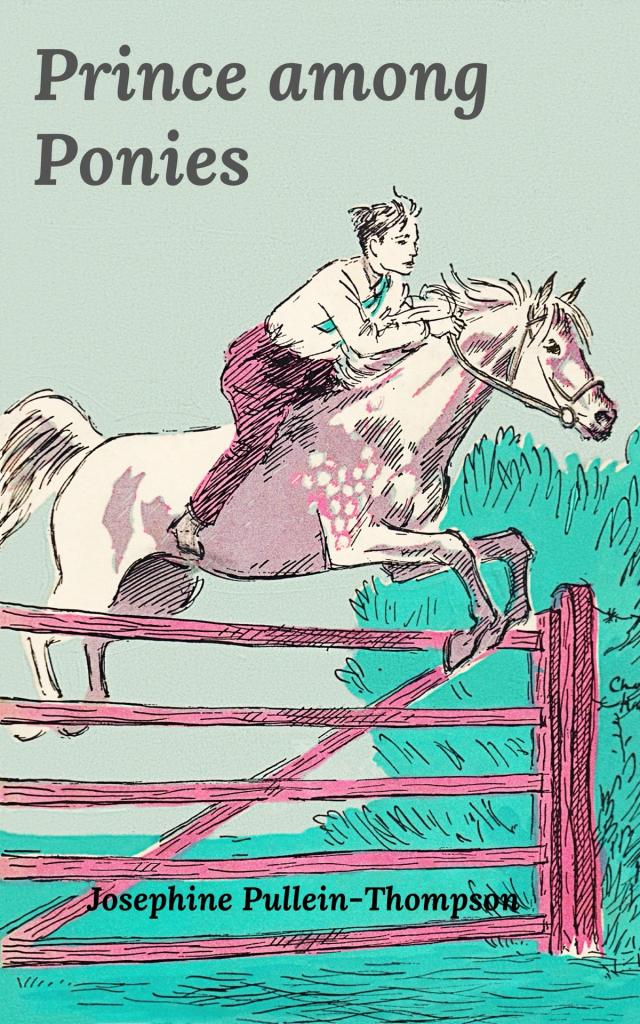
Prince among ponies, p.16
Prince among Ponies,
p.16


Mr. Merriman came bustling up. “Come on,” he said. “Don’t loiter about. I want you all home before dark.”
The Merrimans watered their ponies and put on their coats. Mummy and Mrs. Merriman handed round biscuits and cake. Michael asked Patrick to ride Thunder home and said that he would ride Druid as he was the heaviest and she, besides being the biggest, had done the least work. Mr. Merriman began to hurry us again so we all mounted and set off for home.
“Gosh, we’ve done well today,” said Jane as we left the showground. “Honestly I never expected us to.”
“No,” agreed Michael. “Many’s the time we’ve ridden home from this show completely rosette-less.”
“We must have improved,” said Jane.
“I shouldn’t think so. I expect that the standard was lower this year,” said Michael in level and unconcerned tones. Out on the road Adonis announced that he had been hanging about the showground much too long and that now he was going to gallop home to tea. When I restrained him, he bucked and careered about in the middle of the road kicking at cars. Motorists jammed on their brakes, pedestrians sought the safety of gateways and my hat fell over my eyes.
“We’ll have to trot until he settles,” shouted Patrick. “Go on, Sara.”
As soon as I told Adonis that he might trot, he began to canter. But after I had brought him back to a trot several times he realised that I meant it and then he flew along at his best extended trot. None of the other horses could keep up with him and soon the Merrimans began to shout, “’Ammer, ’ammer, ’ammer,” at me.
When I reached the traffic lights I had to stop for they were red but, mercifully, Adonis behaved quite well and didn’t kick the cars which were all around him.
I was very thankful when at last we left Barnstairs. Riding along the country roads, Adonis became sensible and I was able to converse with the others. At first we talked about the show. We described our feelings and the wonderful behaviour of our mounts, we repeated the judges’ remarks, we discussed the other competitors and the reasons why we had lost or won. Then Patrick and I found ourselves riding beside Jane, and he said, “You’ll keep Adonis now, won’t you, Jane?” in pleading accents.
“No fear,” answered Jane. “What’s the good of me keeping him? I’m not allowed to ride him.”
“There are three people coming to try him on Monday,” Patrick said, “but it seems silly to sell such a lovely pony. Surely your father would let you ride him again now if you asked?”
“I don’t know that I want to.” Jane spoke off-handedly. “I like Starry better.”
“But think of riding at Richmond,” I said.
“Ugh, I hate showing classes. You have to wear gloves and keep your heels down.”
“You can jump at Richmond,” Patrick pointed out, “and he really has got a lovely jump. You ought to try him again, Jane, for he really is super.”
“Especially when he’s trying to kick cars,” said Jane sarcastically.
“But he hardly ever does that now,” I told her.
“When I ride him he does it the whole time,” said Jane, “and he runs away with me.”
“Oh dear, he’ll probably get an awful home with some beastly show-jumping person who raps him,” I said drearily.
Patrick sighed and said nothing. Jane looked at our depressed faces.
“Daddy won’t sell him to anyone beastly,” she said.
With that we had to be satisfied for we were more than half-way home and the other Merrimans were clamouring for a song. Patrick and I sang with heavy hearts. We felt far from merry and yet it seemed terribly ungrateful of us when so many of our dreams had come true. We had one horsy parent anyway and we were going to have riding lessons again, we had ridden in shows and we had each won a first; surely we ought to be contented. I tried to be cheerful and sing as loudly as the Merrimans but the words stuck in my throat. When one loves, one loves, I thought, and nothing much can be done about it; I suppose in time one forgets.
Patrick knew what I was thinking. “It won’t be so bad if he goes to a nice home,” he said.
“If he does,” I muttered gloomily. I looked at the long supple neck in front of me, at the six white plaits and the little curved ears. “I shall never want another pony as I want him,” I said.
“No, neither shall I,” agreed Patrick.
It took us much longer than usual to turn the horses out that evening for we had plaits to cut out and everything was in a muddle and no one could find his head collar. But when at last we hastened into dinner we found that the grown-ups had waited for us. They were drinking sherry and seemed very lively.
“There’s a letter for you, Celia,” said Mrs. Merriman. Mummy turned to Jane and said, “I found a cable waiting for me when I got home and everything’s all right if you haven’t changed your mind.”
“No, I haven’t,” said Jane. “But Patrick and Sara have been trying to make me the whole way home.”
We were completely mystified by this conversation and Jane just stood looking embarrassed.
“Patrick and Sara, Jane has something to tell you,” announced Mr. Merriman.
“Go on, Jane,” encouraged the rest of the family.
We looked at her stupidly and waited. Suddenly she began with a rush. “I’m going to give you Adonis,” she said, “because I don’t want him and because even though he’s so jolly silly, I don’t want him to be sold to some beastly person.”
We gaped at her with our mouths open and then we looked at each other.
At last Patrick found his voice. “You don’t mean it,” he said. “You can’t possibly mean it.”
“Of course I mean it,” said Jane.
I looked at Mummy. “It’s quite all right,” she said, interpreting my look. “We were waiting for Daddy’s cable before we told you.”
“Oh thank you, Jane. Thanks awfully,” I said. “I never imagined anyone was given a pony in real life.”
The whole day had had a dreamlike quality and I felt suspicious. Soon, I thought, I shall wake up and have a dreadful disappointment. Patrick, too, was quite unable to accept his good fortune.
“But you can’t just give him to us like that,” he said, going very red in the face. “I mean he’s worth about two hundred pounds and what about the people who are coming on Monday?”
“He’s not worth that to us,” answered Mr. Merriman. “I’ve had all this out with your mother. When you came to stay he was a liability, eating his head off out in that field. If he’s now worth two hundred pounds—which I doubt—that’s entirely due to your schooling and I’m certainly not going to make money out of my guests. As for the prospective buyers, I explained the position to them. I shall merely give them a ring and say that your father has consented.”
Mummy made a helpless gesture. “You can’t argue with him, Patrick, I’ve tried,” she said. “But it’s certainly the loveliest present you’ve ever had.”
“By miles and miles,” I agreed.
“Are you quite sure, Jane?” asked Patrick. “Are you certain that you don’t want him?”
“I don’t believe Patrick wants him,” said Mrs. Merriman.
“Oh I do. You know I do,” protested Patrick indignantly. “It’s just that it seems such an awfully big present that I can’t really believe it’s true.”
“Here’s Daddy’s cable to convince you,” Mummy said handing it to Patrick.
I read it over his shoulder:
Accept pony by all means. But insist stabled at Stefinski’s owing to preference for rockery.
“You’re not going to have your portable loose box and paddock,” I told Patrick.
And Mummy said, “No, and of course Daddy’s quite right. There isn’t room in the garden and Adonis will need exercising while you’re at school. Captain Stefinski will see to that. And we want him to go on teaching you.”
Somehow the thought of Adonis at Captain Stefinski’s made everything seem real at last.
Patrick and I thanked Jane properly. Just as the excitement over Adonis was dying down Celia announced that her letter said that she had passed her ballet exam with honours. We all said, “Jolly good,” and “Hurray,” even Patrick and I who were so selfishly wrapped up in our own good fortune that we scarcely heard her.
“We’ve got a lot to celebrate tonight,” said Mr. Merriman.
“One ballet exam, three first prizes, the Huntingdons being given a two hundred pound pony and the Merrimans being rid of a rogue. I think I’ll see what we have in the cellar.”
“Champagne,” said Celia.
And Michael said, “Really Celia, what taste; where’s your palate?”
We had a very rowdy dinner that night. Patrick and I felt really happy for the first time for days and the Merrimans went quite wild. But afterwards all the Merriman children felt exhausted and they soon retired to bed. Patrick and I, much too excited to sleep, sat on the attic stairs and planned. We didn’t mind going home to Marston now that Adonis was going with us. We imagined travelling with him in the horsebox; we saw him looking over one of Captain Stefinski’s loose box doors.
“We’ll join the Pony Club,” said Patrick.
“We’ll buy him an elegant rug with H for Huntingdon in the corner,” I said.
“We’ll go to Richmond.”
“We might even ride at the White City.”
“We might be able to hunt him one day.”
Then Macgregor appeared, grinning slightly at finding us sitting in such an odd place. We told him of our good fortune and we promised him that he should come with us whenever we went, one riding and one walking, across Marston Common.
* * *
THE END
Show Jumping Faults
If you’ve watched a show jumping event this century, you’ll know that the faults given when a horse knocks down a fence or refuses are very different to the way they’re portrayed in this book.
When show jumping began as a sport in the 19th century, there were no rules to speak of. If you entered a competition, you might go on until you were the last rider standing, or you might be judged on how well you’d jumped a fence. In 1868, competitors in the ‘high leap’ at the Royal Dublin Society show just had to clear the fence ‘to the satisfaction of the judges’.
Attempts were made to standardise fault systems, but there was no standardisation across countries. When the British Show Jumping Association was set up in 1925, the system below was included in its rule book, and it is this one that is used in this book.
* * *
Refusing or bolting at any one fence
1st fence: 2 faults
2nd fence: 3 faults
3rd fence: eliminated
* * *
Fall of horse and/or rider: 4 faults
Horse touches fence (no knockdown): ½ fault
Horse knocks down fence with fore limbs: 4 faults
Horse knocks down fence with hind limbs: 2 faults
Water jump, fore leg in: 2 faults
Water jump, hind leg in: 1 fault
Upsetting or removing water fence: ½ fault
* * *
The fault system reflected the realities of riding in the hunting field. If your horse hit a fence with its forelimbs, it was much more likely to fall, with possibly fatal results for both horse and rider.
Also by Josephine Pullein-Thompson
Six Ponies
First in the Noel and Henry series, this book was drastically cut in the paperback editions. This edition has the full first edition text, so you won’t miss a word of the first of the Pony Club’s adventures.
Available in eBook and paperback
Jane Badger Books
Jane Badger Books is dedicated to bringing back classic pony fiction, some of which has been out of print for over 50 years. Authors available, and available soon, include:
Caroline Akrill
Joanna Cannan
Victoria Eveleigh
Ruby Ferguson
Patricia Leitch
Patience McElwee
Marjorie Mary Oliver & Eva Ducat
Hazel M Peel
Christine Pullein-Thompson
Diana Pullein-Thompson
Josephine Pullein-Thompson
www.janebadgerbooks.co.uk
Published by Jane Badger Books 2020
First published by Collins, London, 1952
© The estate of Josephine Pullein-Thompson
Cover image © Charlotte Hough
The moral right of Josephine Pullein-Thompson to be identified as the author of this book has been asserted by her estate in accordance with the Copyright, Designs and Patents Act 1988.
* * *
All rights reserved.
* * *
Without limiting the rights under copyright reserved above, no part of this publication may be reproduced, stored in or introduced into a retrieval system, or transmitted, in any form or by any means (electronic, mechanical, photocopying, recording or otherwise), without the prior written permission of the above copyright owners and the above publisher of this book.
* * *
Without limiting the authors' and publisher's exclusive rights, no part of this book may be used or reproduced in any manner to train generative artificial intelligence (AI) technologies or systems. Under Article 4(3) of the Digital Single Market Directive 2019/790 Jane Badger Books expressly reserve this work from the text and data mining exception.
* * *
Neither the author nor contributor has any responsibility for the continuing accuracy of URLs for external or third-party websites referred to in this book, nor do they guarantee that any content on such websites is, or will remain, accurate or appropriate.
Josephine Pullein-Thompson, Prince among Ponies