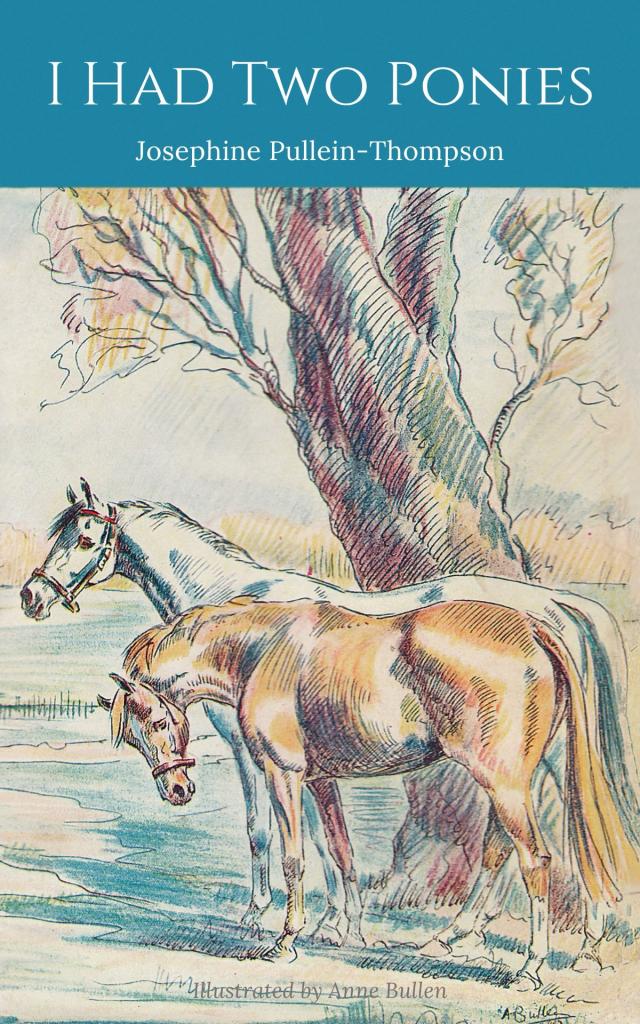
I had two ponies, p.6
I Had Two Ponies,
p.6


“Jolly good, Lucy,” said Adrian.
“You rode her marvellously,” said Gay.
“She was lovely,” said Lucy leaping off. “I didn’t do a thing.” And they all stuffed Wisdom with oats.
“You’ve done much the best round so far,” I said to Lucy.
“Yes,” she replied, “but there are dozens of good people to go yet.”
But only two of the remaining competitors jumped decent rounds: Richard Stockes, a smartly dressed boy on a blood pony and Elizabeth Cleaver; however, neither of their rounds were as good as Lucy’s so we knew that she must have won. Soon the judges called them in: Lucy first, Elizabeth Cleaver second, the superior Heather Cotton third and Richard Stokes reserve. Now Adrian was the only Westlake without a prize.
“Adrian,” said Simon, “would you like Dauntless for the consolation jumping?”
“No, thanks awfully,” said Adrian, “it was my fault Shadow knocked down the stile and in and out; I took him too fast. I think we shall do them all right this time.”
“O.K.,” said Simon, “I just wondered. Dauntless is bigger and speed’s an advantage, but you haven’t practised her, so perhaps it wouldn’t be much of a gain.”
“Come on,” said Gay, “let’s give the ponies their lunches. I think that the water trough is by the entrance gate.”
While Simon fetched the oats, the rest of us watered the ponies and then, when we had fed them, we hurried to the car where the Westlake parents had already unpacked the lunch. When they had congratulated their children, we ate. It was a very good lunch and Adrian was delighted to find that Cook had made some treacle tarts after all. I must say one thing about staying with the Westlakes was that one always had decent food and never beastly things which were good for one, like tapioca pudding.
After lunch we sat in the car and talked, for it was frightfully cold and the pair class didn’t start until two o’clock. At a quarter to two we bridled Dauntless and Wisdom, and Simon and Gay walked them about until class three was called into the collecting ring. In the pairs class, as in the children’s, the competitors had to jump the hurdles instead of the drop fence, which was too narrow for two people to go over at once. The in and out and the stile both had to be jumped in single file, but the pair was supposed to be together again when they reached the next jump, number seven, the uphill hedge. The event was being judged, the collecting steward told us, on the combined faults of the pair, marks for keeping together and style. There were about a dozen pairs in all. Quite a lot of people were riding with a brother or sister and some of them were extremely bad at keeping together, considering the opportunities they must have had for practising.
The Fleckers made two pairs: Carola and Clare went together and Cyril and Cynthia, but none of them did very well and they all argued in the most unpleasant way, about whose fault it was, afterwards. Major Carwent was cross too, for Anne was again unable to persuade her pony, Tiptree, to jump the second jump. After shouting a lot of instructions at Anne, in a very loud impatient voice, the Major went on round the course, leaving her behind. We were very glad when his horse appeared riderless and we saw him toiling up the hill, his elegant cream breeches covered in mud. Antonia and Olivia Stevens, who followed the Carwents, jumped a much better round than anyone had expected. I think that their horses were very nappy and jumped better in company. Over the first two or three fences they made no attempt to keep together, Marshmallow jumped first to give Ragged Robin a lead. Mrs. Frankthorpe, on the fat cob, was accompanied by Brian on what everyone supposed to be a borrowed pony. The cob jumped the first jump beautifully, but Brian’s pony wouldn’t follow and, even when Mrs. Frankthorpe jumped back again to give him a lead he still refused. At last they were disqualified and the Bridgebecks rode to the start. They jumped the first fence quite successfully, but one of them, I think it was Shirley, fell off over the second and, by the time that her pony had been caught, the time limit had expired. Mrs. Bransome and Mrs. FitzGerald-Brown were rather a noisy pair. They both refused every jump and then, as neither would accept the other’s lead, they became horribly tangled up and shouted insults at each other, which greatly amused the spectators. The time limit expired while they were refusing the ninth jump—the second stone wall—and they were apparently not on speaking terms as they rode off the course.
During all this refusing and falling off, Lucy’s and Adrian’s hopes had been rising; they said that they felt sure that Gay and Simon could do better than anyone had so far and they were right. Dauntless and Wisdom made an excellent pair; they kept together marvellously and for all Dauntless’s extra two inches in height, her stride seemed no longer than Wisdom’s. But more important still was the fact that they both took off the correct distance away from the jumps, so that they were together even in the air. It was far and away the best performance we had seen. They took the last three jumps fast but their timing was perfect and there was quite a roar of applause as they galloped past the finishing post.
Adrian hurried across to find out whether they had had any faults over the jumps in the valley and when Simon and Gay said not as far as they knew, our hopes soared higher than ever. But they were soon dashed when Robin and Elizabeth Cleaver also did a clear round, though, personally, I thought they hadn’t kept together so well, or been so fast, as Gay and Simon. The Cleavers were followed by Jane Stevens and a girl called Joan Meade, who had refused three times in the children’s class. Even with Jane to give her a lead she refused each jump at least once; however this gave Jane all the more time to adjust her stirrups and spectacles. We all got so bored with them that we were quite glad when the time limit expired, just as Joan refused the eighth jump. Now there were only two pairs left: Heather Cotton and a boy called Christopher Symington-Jones, who had apparently ridden in the children’s class, though I must confess I hadn’t noticed him, and Pat McBain and John Whitaker. Lucy was furious that Pat should have had John Whitaker for her partner after the way he had ridden in the first class; she said that no one who liked horses should have spoken to him, much less ridden with him. But John had evidently benefited from the judges’ lecture for he didn’t hit Nobby, the cob, once, with the result that she only knocked down two fences with her forelegs, though she still went rather fast, much too fast for Pat McBain and Twinkle, who seemed unable to go at any pace but a collected canter. Both competitors’ finished the course, but by no means as a pair. I felt sure that Simon and Gay had won, but when I said so I was told to shut up, not to be so jolly optimistic and not to count my chickens before they were hatched. However I was right. The numbers were called out: first Simon and Gay, second Elizabeth and Robin, third the Stevens, and reserve, much to Lucy’s disgust, Pat McBain and John Whitaker.
“Oh, dear,” said Lucy, as the ponies came out with their rosettes, “the Hunter Trials are nearly over. There’s only the consolation class left.”
“Gosh, doesn’t Wisdom look smart?” I said, “two reds and a blue.”
“Shadow must win something,” said Adrian. “He’s the only one without a rosette.”
We listened carefully as the steward told us about the consolation class. The grown-ups and children were to ride round the same course, jumping the hurdles instead of the drop fence and two prizes were being given: one for the best round done by a child and the other for the best grown-up.
“Oh, gosh,” said Adrian, when he heard this. “Shadow and I haven’t a chance.”
“Of course you have,” said Simon, “remember that no one who has won anything is allowed to enter and I should think that you were about fifth in the children’s. Brian Frankthorpe wasted hours falling off, besides trotting between the jumps; Jane Stevens was frightfully slow and John Tweed and Christopher Symington-Jones both had far more faults than you, and I should think that was about everybody who got round.”
“They’ll all be better this time,” said Adrian gloomily.
“Well, so will you,” said Gay.
“Is this everyone for class four?” shouted the collecting steward impatiently.
“Oh, gosh,” said Adrian trotting off on Shadow.
“Good luck,” we shouted after him.
I won’t bore you with a long account of the consolation class, for such events are generally rather dull: all the people who had refused before, refused again and the already battered jumps were reduced to pulp. To our delight, Adrian won the children’s prize, beating Brian Frankthorpe on speed, for they had both jumped clear rounds. But the fat cob won the other prize with Mrs. Frankthorpe, who was the only grown-up to make a faultless round. The Westlakes’ ponies looked very superior, each wearing a red rosette and I felt very proud to belong to them. How wrong I had been at the beginning of the Hunter Trials, in imagining that Major Carwent and Mrs. FitzGerald-Brown would carry off the prizes; it just showed that appearances counted for nothing, I decided, and I would never be taken in by them again.
At the prize giving the Westlakes were loudly cheered and I am afraid that I felt very envious—this was the sort of triumph I had always imagined for myself, but now—how could it ever be mine? I began to regret having parted with my ponies more deeply than ever before. Daddy had bought Daydream with an excellent reputation as a jumper. If only I had been more sensible how differently everything might have turned out. I saw myself collecting numerous rosettes and prizes amid terrific applause; Olympia, always the climax of pony books, rose before my eyes. But in my heart I knew that it could never have been; even if I hadn’t lost my ponies, I should still have been a shocking rider and knowing myself for the miserable coward I was, would have flustered Daydream into refusing three times at the first jump. Suddenly I wished above all things that I was tall, slim and dark with a reputation for recklessness, a scornful expression and the immeasurable gift of looking dashing in the most disreputable jodhs.
5
We went to bed much later than usual on the night of the Hunter Trials, partly because we had to celebrate the ponies’ success, partly because it was Mr. Westlake’s last night at home for several weeks, but mainly because at Underwood Farm no one was expected to go to bed if they didn’t feel like it, and certainly none of us did.
After dinner, which was even larger than usual owing to us having had a picnic lunch, we had a concert. I played the gramophone, Simon his mouth organ and everyone else sang. Mr. Westlake was the only person who could keep in tune so he had to sing the solos, but the rest of us made a great, though rather unmusical noise when we joined in the choruses. After we had exhausted all the songs we knew, Gay suggested a poetry reading. The others agreed and so we all seized several poetry books, of which there were a great many, and each read a poem in turn. You may think, as I did, that this was a very strange way to spend an evening, especially if you don’t like poetry and I didn’t at that time. Actually, at school, which was the only place where I had read poetry, it does seem dull. People who have learned lovely poems gabble them off and then return to their places with self-satisfied expressions because they haven’t missed out a single word, but they don’t realise that they have missed absolutely everything else out and what the poor poet would say if he heard his life’s effort mutilated like this I can’t imagine. I should think that dead poets must turn in their graves and long to rise and haunt people. I do wish a ghost would haunt Bramblewick Hall. It would be great fun and one would soon see who was really brave.
But to get back to the poetry reading; I was very surprised to hear how marvellous some poems, which I knew quite well, sounded when they were properly read. Of course, being an actor, Mr. Westlake read awfully well, but so did all the rest of the family. I only dared to read the shortest poems and even then I stumbled over the long words, forgot the punctuation and felt that I was setting everyone’s teeth on edge. All the same I enjoyed that evening and I was very sorry when, at half-past eleven, Mrs. Westlake said that we really must go to bed.
For some strange reason I wakened very early on the morning after the Hunter Trials and, sitting up in bed, I finished reading my book on riding. Then I dressed, without waking Lucy, and went out into the garden. It was a lovely clear morning but rather cold. I wandered round the garden and took a look at the ponies, which were grazing peacefully in the flat field with the clump of chestnut trees behind the house. I thought of going across to speak to them, but the long wet grass didn’t look very inviting, so I wandered into the farmyard instead. The cows were standing in the long byre and Harry was singing to Peace as he milked her. I knew that it was Peace because they all had notices in their stalls with their names on. “Want to try?” he asked, looking up, after I had stood watching him for a moment or two. “Ugh, no thank you,” I said, thinking what a horrible job it looked. “I don’t like cows.” A disapproving silence fell so, after a few more moments, I walked across the farmyard to the stables. George was whistling as he groomed Midnight, one of the carthorses, but I knew that he would only disapprove of me too, so I didn’t stay to watch him, I went into the saddle room.
There the most frightful confusion reigned; it looked more as though there had been an earthquake than three ponies got ready for some hunter trials. Rugs, tail bandages, rubbers, needles and thread, scissors and wet bath towels lay on the floor, a packet of soapflakes had been upset and all the tack was dirty. I looked at the mess for a few minutes and then an idea came to me; I would give the Westlakes a surprise by tidying it up. Feverishly I set to work. I knew where most of the things lived: brushes in the cupboard, rugs in the big chest, tack cleaning things in one drawer, plaiting things in another. I scraped up the spilt soapflakes and put them back in their packet; I hung the wet bath towels on the farmyard wall, then, seizing the broom I swept the saddle room out. I was pleased with my handiwork, but there was still half an hour to breakfast and no sign of the Westlakes. I looked at the saddle room for a bit and then I decided that its appearance was slightly spoiled by the dirty tack.
Suddenly it occurred to me to improve the surprise by cleaning the tack too. I had never cleaned any before, but I had seen the Westlakes and Small doing it and I felt sure that I could do whatever Adrian and Lucy could. Opening the tack drawer, I chose a few clean-looking dusters and found the saddle soap; then I fetched a bucket of water; it was cold but I didn’t want to go into the house for hot because I knew that someone would ask questions and spoil my surprise. I sloshed a good deal of water over the three saddles and soon got all the mud off them, but, to my horror, they all turned an awful pale grey colour. I seized the saddle soap and started to rub it in hastily, but it went frothy and the saddles looked as though I had used soapflakes. I looked in the drawer again and found a can of neatsfoot oil, which said that it was good for all leather. I put a good deal of it on my duster and rubbed that in—it smelled disgusting and both the saddles and my hands were now revoltingly sticky.
In despair I decided to clean the stirrups and then see if the saddles looked more normal when the oil had soaked in. I found the metal polish and soon had the stirrups shining beautifully, but the saddles still looked frightful. I gave them another rub with the duster before I remembered that I had used it for metal polish and naturally this made them look worse still. I began to be worried; there were only ten minutes to breakfast time and what would the Westlakes say if they found their saddles in this state? Feverishly I searched in the drawer for a remedy and suddenly I came upon a tin of shoe polish. Oh, hurray, I thought, I’m all right now. This will make them look grand in no time. Seizing another duster I began to rub the polish in. When I had done all the saddles and polished them with the stable rubber they really did look lovely; the Westlakes hadn’t got them nearly so shiny for the Hunter Trials. I looked at them proudly and decided that I had discovered a new way of cleaning tack and that the horsy world would be eternally grateful to me. Stuffing the now dirty dusters in the drawer, I washed my hands in the bucket of water and rushed in to breakfast.
There was kedgeree and Lucy and Adrian were arguing. Lucy said that Adrian was a greedy beast and had taken more than his share of the hard-boiled egg and Adrian said that he hadn’t and that Lucy was a socialist. Mr. Westlake told them to shut up and Mrs. Westlake said that if they were going to be bad tempered after hunter trials she wouldn’t let them enter for any more. This threat stopped them but they glowered across the table at each other for ages afterwards. Simon and Gay were both late for breakfast and they didn’t seem to be in very good tempers either. Simon accused Adrian of borrowing his toothbrush and told Lucy that she was clumsy and uncivilised when she upset her coffee over him. Gay said that there was no water in the dogs’ bowl again and that she didn’t see why she should always have to fill it up. She thought that one of the others might do it occasionally. Of course the others said that she didn’t always fill it up and started to point out how often they had done it in the last week, which led to a good deal more argument. At last their father told them to shut up and then none of them spoke, except to ask for the marmalade or toast.