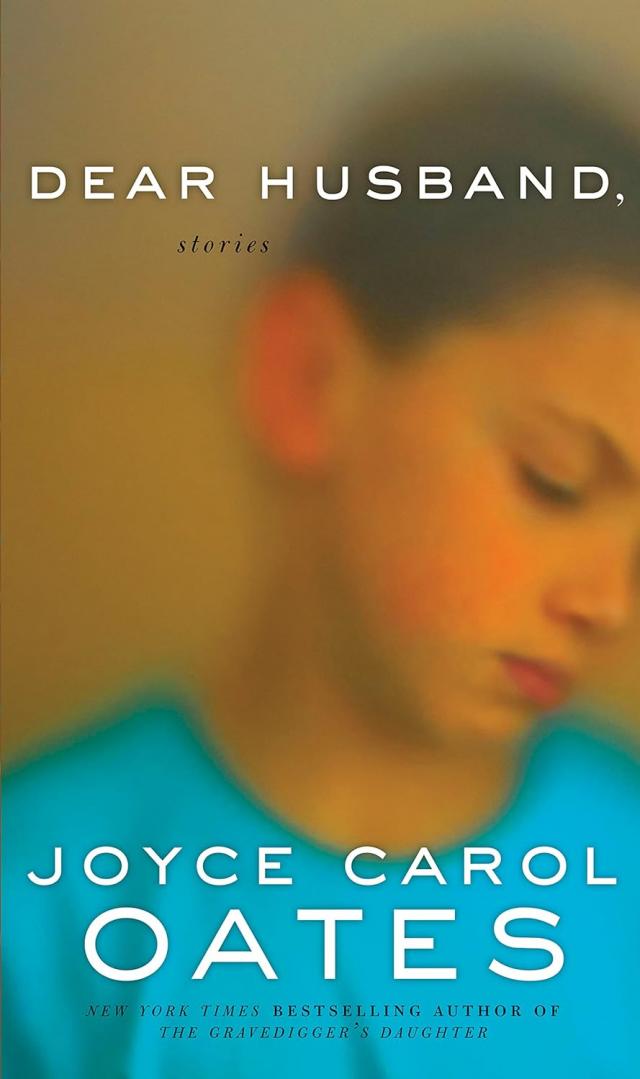
Dear husband stories, p.14
Dear Husband: Stories,
p.14


Here was another high-ceilinged room with a ten-foot window overlooking rooftops and in the near distance the river refl ecting an overcast March sky. On the table was a black lacquered box with what appeared to be Japanese characters on its cover, in gilt. “You don’t have to open this box, Kit. If you don’t want to. There is something inside crucial for you to know but if you don’t want to know it, you don’t have to. We don’t even need to discuss it afterward. I’m going out now because it’s too hard for me to remain in the loft while you’re here. I’ll be back in about an hour and we can discuss this if you want to—what you’ve discovered inside the box—but if you don’t want to, darling, whether you’ve opened the box or not—you don’t have to, of course.” Kit’s mother spoke rapidly and breathlessly and seemed confused, unsure what she meant to say. Nor did Kit follow all that she’d said. Lightly she touched Kit’s wrist. A faint stale smell of perfume hung in the air. “I—I hope that you will be waiting for me, Kit. When I return. That’s all I ask.”
She left. Kit was alone. Kit’s heart had begun to pump harder.
How like his mother to dramatize a situation, he thought. Probably this was some elaborate joke, a part of Kit’s birthday surprise but she’d made him uneasy, and he resented it. Those eve nings when he and his father had waited for his mother to return, and at 11 p.m. a call might come, or might not. Kit forced himself to sit at the table. If this was a game, Kit Smartt liked games. He drew his fingers over the black-lacquered box, that had to be an expensive object. Maybe it was an antique. Maybe Quincy Smartt had smug-gled it back from Japan. On the table lay a number of ballpoint pens, pencils. To Kit’s left, a laptop computer, its lid closed. On a just-perceptibly grimy window sill in front of the table were small framed photographs of glamorous Quincy Smartt alone and with individuals whom Kit didn’t recognize. And there, framed in Cutty Sark * 127
mother-of-pearl, was Quincy Smartt as a happily smiling young mother with her son Kit at about age nine, youthful mother and dimple-faced child smiling into the camera from out of a sunny patch of what appeared to be a sandy beach, in a long-ago time on—Nantucket?—at Kit’s grandparents’ house on the water?—Kit could not recall.
If this was a game, what was inside the black-lacquered box?
Photographs? Documents? Blood pounded in Kit’s temples but he wasn’t going to become frightened. His birth certifi cate was inside—was that it? For seventeen years it had been kept secret from him, he wasn’t Quincy Smartt’s son, nor was he Lloyd Smartt’s son, but an adopted child. Was that it? Kit thought I don’t need to open this. I don’t need to look. But already his fingers were prying the lid open.
He thought It will be something terrible. Nothing in my life will be the same again.
Was his mother gone? Could you trust Quincy Smartt, to have actually gone away at such a time? Kit listened, the loft was silent.
Seven floors down on Greenwich Street was a hurtling vehicle, fl ashing lights and a wailing siren. The shrill combative sound of the city was consoling to certain of its inhabitants, signaling danger elsewhere, serious injury and harm elsewhere. In this chic furnished loft there could be no danger. Kit was seventeen, he’d led a ridiculously sheltered life. He knew this, he was a rich doctor’s son.
He scored high on tests, he was of a generation geared to take and to excel at tests. He could not be hurt, really. He was untouched by the emotion that swept over others with the power to destroy, something in his soul was mineral-hard and unyielding, even the woman could not touch it.
Inside the lacquered box was a stack of pages: a manuscript.
A manuscript! A manuscript could not hurt him.
Aloud Kit said, sneering: “I don’t have to read this.”
He read the title page: Memoir of a Lost Time by Quincy Smartt.
He said, “I don’t have to read more. This is bullshit.” He turned to the Prologue. He read:
128 * joyce carol oates
When I was fifteen and my parents were divorcing I set out to seduce and corrupt my twelve-year- old brother who was their favorite because he was “high-strung”—“sensitive.” This is my story of how I succeeded and how when he was seventeen and a high school dropout my brother committed suicide and all these years I have borne the secret guilt . . .
Kit let the pages fall. Kit shut the black-lacquered box.
By the time Quincy Smartt was scheduled to return to the loft, Kit was gone. He’d reopened the lacquered box and dumped out the manuscript of 212 neatly typed pages and with a ten-inch steak knife from the kitchen he’d cut and slashed many of the pages and others he’d kicked and torn underfoot. He’d smashed the lacquered box. He’d yanked the laptop out of its several sockets and smashed it on the floor. The framed photographs of smiling people he’d swept off the windowsill. The work-table he’d overturned.
With the knife he’d cut and slashed those clothes in his mother’s bedroom closet he could reach easily and in the front room he cracked a mirror with his fist, overturned and smashed the precious bottles of whiskey, vodka and gin on the sideboard and he ran from the loft leaving the heavy door swinging open behind him.
2.
“Kit? Give me a hug.”
He would not. At the foot of the stairs he made no move toward her. Regarding her as if without recognition and after a moment’s hesitation she came to him, and laid her gloved hand tentatively on his arm. “Well! If you won’t, I will.”
Her arms closed around him. Her arms were unexpectedly strong. He held himself stiff, resistant. He held his breath against her cloying perfume, that made his nostrils contract. Female animals release such smells, to attract males. But there were smells that repelled, too.
That morning she’d called him at his residence hall and left Cutty Sark * 129
three messages and he had not replied and yet, here she was.
Through the day he’d been distracted and anxious in his classes, aware that Quincy Smartt had checked into the New London Inn which was less than two miles from campus and it was her plan to arrive on campus in the late afternoon, to seek him out. He’d thought of running away. He’d thought of hiking out into the birch woods beyond the playing fields and returning late that night when his mother would have to be gone but how ridiculous that would be, how Kit’s classmates would laugh at him, a seventeen-year- old frightened of his own mother! Kit could not bear the thought of Gervais laughing at him . . . And so she’d arrived at Kit’s residence hall at 4 p.m., and she’d asked for him. And he’d descended the stairs unsmiling. He hadn’t shaved. He hadn’t showered in two days. He’d pulled on his maroon lacrosse jersey sweat-darkened beneath the arms and he was carrying his grungy down jacket.
“Kit, darling! You look gaunt. You’ve lost weight, I can see.”
With a show of motherly anxiety she framed his face in her hands. It was a gesture meant to inspire Kit to bend to her, to accept her kiss like a supplicant, a smear of dark-maroon lipstick on his cheek she’d have to rub away, but Kit did not bend.
They went out. He was going with her. For she would make a scene otherwise, her arrival on the school campus would become an Event. And he, Kit Smartt, would become a participant in the Event, and would be subsequently defined by the Event, through the remainder of his time at the New London Academy. And so he went with her, and he was being seen with her and there would be witnesses This woman Kit Smartt was with, had to be his mother. In high-heeled black leather boots she was nearly Kit’s height. She leaned on his arm, she was laughing nervously. The long straight silver hair spilling past her shoulders. The ivory-white face, heavily made up as a geisha’s. Her coat was black sable, her eyes outlined in black.
There was something frantic in her eyes, that wistful yearning Kit hated. He felt a revulsion for the woman that was purely physical.
It was the first time he’d seen Quincy Smartt in person, since 130 * joyce carol oates
his birthday. That windy March day, the loft on Greenwich Street.
Kit could not recall precisely what he’d done that day after skimming the pages of Memoir of a Lost Time and she had never accused him of trashing her things and had not reported him to his father so far as Kit knew, for which Kit felt not the slightest gratitude but despised her all the more.
Outside in the chill November air she continued to chatter in her bright brittle way as he’d heard her speak in television interviews. She was asking Kit about the school, in which buildings were his classes held, what was he studying? In the distance Kit could make out running figures on the lacrosse field, too far away for Kit to be glimpsed by any of his teammates should he have lifted a hand to wave to them. Bitterly he resented this glamorous perfumy woman, he’d had to miss practice that afternoon.
Coach had asked Kit if it was a family emergency? Seeing the look in Kit’s face.
Quickly Kit said no. Not an emergency. But it was family, he could not avoid.
“ ‘Josiah Cobb.’ I’ve been reading about him—your ‘Founder.’ ”
Quincy had stopped Kit in front of the quaint old red-brick chapel. Asking him about the school’s founder—she’d been reading in a school brochure—who the hell Josiah Cobb was, Kit had no idea. Old railroad billionaire who’d donated land and money to establish the New London Academy for Boys with the provision that his gravesite would be on campus, beside the chapel and facing the green; Kit was being made to look at the raised grave now, that was made of hoary old weather-worn granite topped by a rugged cross and of about the size of a barnyard trough. “So he wouldn’t be lonely! The old man must have loved young boys, to want to spend eternity among them.” Quincy laughed, you couldn’t have gauged whether in sympathy, or scorn.
Please would Kit come to her hotel room, she was saying. She hadn’t eaten since early that morning in Boston and she was light-headed with hunger and could Kit have an early dinner with her, a meal at the Inn, in private. She wanted to speak with him in Cutty Sark * 131
private. She’d taken a suite at the Inn, overlooking the river. She was chattering nervously, brightly. Kit did not intend to have a meal with his mother but with his lacrosse teammates in the dining hall at their usual table, maybe they would ask him about who’d come to visit him that afternoon but maybe not. Maybe no one would ask. Kit must’ve given in, climbed into Quincy’s car and she drove to the Inn in a state of fevered excitement so he had to wonder if she’d been drinking before she’d come to get him, beneath the flowery scent of her perfume was a sharper smell of alcohol.
She was telling him about her car which Kit had had to admire, a bottle-green Jaguar XJ she didn’t own but was leasing by the month and naturally a seventeen-year- old kid would be intrigued by the luxury car, a thrill in the gut just to climb into such a vehicle and to feel the power of the near-inaudible engine and to wish—for just this fleeting moment—that some of the guys on the team had seen him get into the car and drive off campus. And this thrill in the gut seemed ignoble to him, contemptible. Quincy was asking if he had a learner’s permit to drive yet and when Kit mumbled no she said, “Well, too bad! You could try out this amazing car,” and a moment later, glancing at him sidelong with her wistful dark gaze,
“—maybe next time.”
At the Inn, they entered from the rear parking lot. The single time Dr. Smartt had driven to New London to visit with Kit and to stay overnight they’d had dinner in the Yankee Doodle Tap Room seated in a wood-plank booth of the size and proportions of Josiah Cobb’s gravesite. But Kit’s mother took him directly to her suite on the fourth floor of the Inn where as soon as she shed the soft-shimmering black sable coat and, with a grunt of relief, her tight-fitting high-heeled boots she placed an order with room service: Cutty Sark, imported Belgian beer, club soda with lemon, a platter of Room Service Deluxe sandwiches. In a vehement-bemused voice she was telling Kit about a “mistake” she’d made recently, becoming “too deeply involved” with an individual, a man whose name Kit wouldn’t know; she’d met this individual on her book tour to California, she’d allowed this individual to “exploit” her 132 * joyce carol oates
mentally and physically but finally she’d had enough, she’d called Malibu police to “report an assault” and the man had been arrested and she was not going to drop charges; the incident had been picked up on cable news and “wildly distorted” but she didn’t regret any of it for from now on, Quincy Smartt intended to reclaim her rights as a woman. “And that’s why I am here, with you, Kit: to reclaim my rights as a mother.” To this torrent of words Kit listened dazed and distracted. He was staring at his mother’s unexpectedly fl eshy legs, her somewhat thick ankles, her small pudgy feet in sheer stockings the shade of smoke, her toes inside the smoke-hued fabric that wriggled with the vehemence of her voice. Initially, Kit was drinking club soda. So thirsty!—his mouth felt parched. He’d been diagnosed with a “sleep disorder” which was why he was prescribed to take medication but medication made him sleep so heavily, in that exhausting stupor-sleep he hated, when he woke his mouth was dry from having been open during the night and that morning early in the dark, Kit was remembering now, his roommate Gervais had nudged his shoulder saying for Christ’s sake Kit was grinding his teeth so, moaning in his sleep, must’ve been having a nightmare . . . Kit shook his head clear seeing that that time was past now, had to be later in the day though twilight outside the windows of his mother’s suite in the New London Inn. Why he’d come here with his mother, when he’d vowed he would not, Kit could not have explained. His mother had pushed one of the sandwiches in Kit’s direction urging him to eat but Kit refused. Kit ate with his friends in the dining hall, at the table reserved for the lacrosse team. That was where Kit Smartt ate dinner unless there wasn’t a chair for him, but if Kit got there early enough, or if Kit came with Gervais, there was always room for him yet still Kit felt a clench of apprehension, anxiety in the pit of his stomach and so he had no appetite for food here, now. “You look so gaunt, Kit! I hate the idea of something ‘eating’ at you—your father refuses to take responsibility.” They were sitting together on a sofa, closer than Kit would have liked. Quincy’s perfume filled his nostrils but also the rich warm amber smell of Cutty Sark. In her wistful-girlish Cutty Sark * 133
voice Quincy was saying that she understood and respected Kit’s wish to “distance yourself emotionally” from her but she hoped that he would see how “unnatural and self-destructive” that was.
Did Kit know, the river outside was the Quinebaug River?—had to be an Indian name, she’d never heard before. Kit could stay the night and in the morning they could drive up along the river and
“explore.” A quick call to the school, and arrangements could be made, a drive up along the river to—where?—it was a scenic countryside of many waterways and small lakes.
To this, Kit mumbled “Yes ma’am”—“No ma’am”—in robot politeness. Knowing that nothing so annoys a glamorous woman than to be called “ma’am.” Kit’s mouth still felt parched, he’d begun drinking the Belgian beer. And Quincy had urged a sandwich upon him, moist ham, Swiss cheese, a crusty baguette he’d begun to eat though he would have said he wasn’t hungry, yet he took a tentative bite, and then an enormous bite, and ate. Kit disliked the taste of beer, disliked even the smell of beer, he’d had beer a few times at parties and he’d gotten a buzz from it but hadn’t liked the taste, for it was an acquired taste, as people said. Seeing at such close range that Quincy Smartt was not a beautiful woman truly but so carried herself, so meticulously made herself up, and lavished such attention upon herself, you were led to acquiesce, you would see her as beautiful, desirable. The ivory-white skin in which thin white lines were just perceptible at the corners of her mouth and eyes, and a tiredness beneath the eyes, and in the fl eshy throat, yet you were distracted by her animation, her daring. Here was a woman utterly open and frank and vulnerable. And willing to ignore her adolescent son’s rudeness. Though in fact rudeness excited her, male cruelty excited her. Female masochism, male cruelty were Quincy Smartt’s usual subjects. A female is a sort of receptacle into which the male discharges himself. In interviews Quincy Smartt had said. You can access these interviews on the Internet but Kit Smartt would not, no longer. To provoke she’d said a woman has only her will, her “cunt-cunning.” A man has strength.
A man desires through the eyes. The primary male sex organ is the 134 * joyce carol oates
eyes. A woman must be sexually attractive or she is nothing. In her beautifully modulated girlish voice Quincy Smartt made such pronouncements meant to enrage, and attract. And arouse. And bring hundreds of thousands of readers to her books. For Quincy Smartt could be relied upon to speak frankly of intimate things others would not speak of, out of hypocrisy. Yet she was a charm-ing woman, soft-voiced and seductive. See how Quincy Smartt shrewdly ignores her son’s hostility! Her son’s obstinate silence. No prig like an adolescent boy incensed over his mother’s sexual life, that was the key. Why the many e-mail messages she’d sent to him he had deleted without reading. (How did Quincy know this?
Quincy knew.) Phone and text messages she’d left for him he had not answered. On the very BlackBerry Pearl she’d given him, her son had snubbed her. But she forgave him, he had to know.
Now she was asking him about “your father” as you might ask after an invalid for whom you felt pity but hoped never to see again. “Your father should remarry, Kit! There must be many women on the Upper East Side who’d adore to be the new Mrs.
Lloyd Smartt. Is he seeing anyone?”—a way of asking Is your father sleeping with anyone? and Kit irritably shrugged no, how’d he know.
Nothing so offended him as Quincy asking about his father in that smug-solicitous way of hers for it was shameful to Kit, the thought that his father still loved Quincy who’d betrayed him and made a fool of him and had even written about him obliquely, in unkind ways.
“Kit, why are you looking at me like that? You make me uncomfortable.”
“I don’t want to talk about Dad with you, O.K.?”