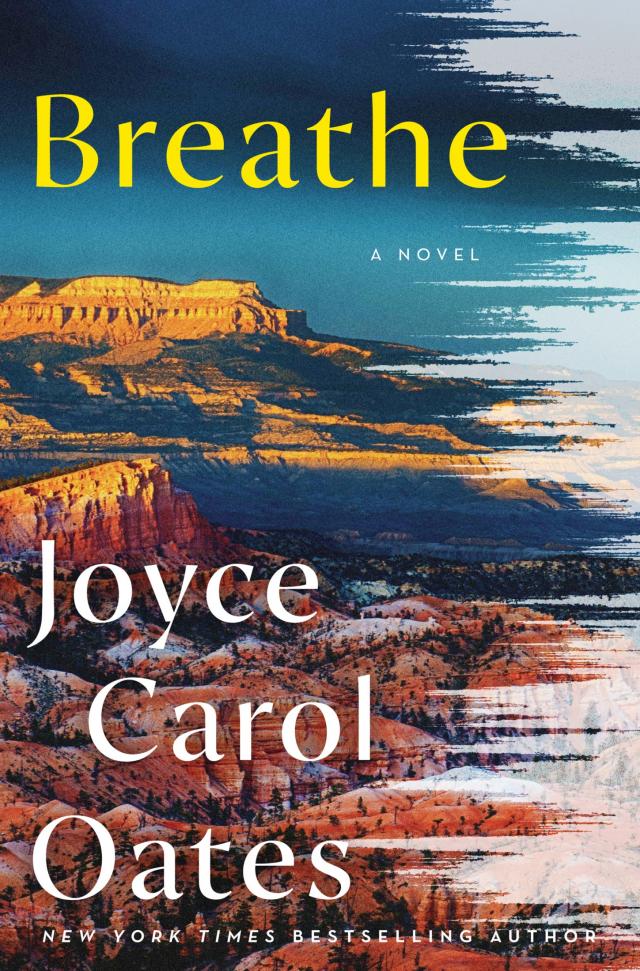
Breathe, p.27
Breathe,
p.27


Pause to push several bills into an urn for donations to the Mission—five-dollar bills, a ten-dollar bill. Your penance.
In the gift shop pretend to be interested in purchasing something. Pretend that you are a typical tourist. Not shaking, trembling, forehead oozing sweat, as the adrenaline rush subsides suddenly very tired, weak-kneed. Instead stare at the merchandise. Hand-tooled leather goods, silver and turquoise jewelry, prayer cards picturing a young dark-eyed Saint Gabriel. Miniature adobe replicas of the Mission San Gabriel de Isleta. Postcards, brochures, maps. T-shirts, caps. Sierra Club books, Audubon Society books, Spanish Missions of the Southwest: A Pictorial History. Children’s books, cartoon book titled A History of the Latino Holocaust.
Step out into the bright gusty air. You wonder if the guard is reporting you—to whom? And why?
But he doesn’t know your name. No one knows your name. No one knows where you are. In all of the world there is no one (now) who knows where you are or has the slightest interest in where you are.
No purpose to your life. No compass.
59
Rio de Piedras
But of course there is a purpose: you know what that purpose is.
The trailhead at Rio de Piedras is three miles away. Drive there directly, no need to seek a sign from Gerard.
ARRIVE AT COLD SPRING CANYON State Park suffused with hope, yearning.
Because the other places have been absent of him. Of those places marked in the guidebook with an asterisk, only the trail at the river remains.
Because it is time, you are certain. The crossing-over time.
Less than twenty hours before your flight to Boston from Albuquerque. And so, what will happen must happen, now.
As if you’d known beforehand, you are dressed for hiking. Though you are not wearing hiking boots (as Gerard would have insisted) you are wearing running shoes and cotton socks.
Khaki shorts, one of Gerard’s white T-shirts loose-fitting on you. On your head, a hat with a brim to protect your eyes from the sun.
White-hot sunshine, in the canyon! Though the sky is beginning to be mottled with clouds, not so glaring a blue as it had appeared from the bell tower in Mission San Gabriel.
Hikers are assembling at the trailhead a quarter mile from the glittering Rio de Piedras, just visible in the distance. A loose confederation of (White?) individuals led by a swaggering-macho Native American guide whose straight black hair falls to his muscular shoulders, held in place by a red headband.
In all the visual field, nothing so vivid as the red headband.
At first, the guide appears to be young, in his mid-twenties. When you look more closely, however, you can see that he is middle-aged, at least forty, with a thickened face, hard-muscled neck, legs. His manner is aggressively friendly, his eyes shine with a teasing sort of merriment gliding over the hikers, and over you, as if counting, assessing.
“Hello! Can you all hear me? My name is—”
Harsh brusque sound resembling Kwer-vo. A bird’s cry.
“—your guide today for our climb into the canyon and to the Pueblo burial site . . .”
As you recall Gerard had particularly wanted to see the Pueblo burial site which is, according to the guidebook, accessible only from the five-mile canyon trail.
You are feeling anxious, excited. Faint with anticipation. It is evident to you, Gerard is here somewhere.
Fact is, if Gerard is anywhere, Gerard is here.
(Not among the hikers, however. Not likely. He will be waiting for you on the trail.)
The swaggering-macho guide with the name harsh as a bird’s cry is giving instructions in hiking protocol to the assembled hikers: never wander off alone in the canyon for you can become lost within minutes, make sure that you have a full bottle of water when you set out, if you begin to feel heated or light-headed on the trail do not continue, in the event of sudden rainfall do not continue . . .
Always in these steep-walled canyons there is a danger of flash floods from sudden heavy rain. But, as Kwer-vo announces, the weather report for this day is “clear”—“safe.”
In fact, the sky is not so clear, entirely. Ribbed clouds above the mountains, glinting-gray like mineral. Still the sun shines unimpeded.
He will be leading them into the canyon in seven minutes sharp, the guide warns. Hikers should use restrooms while they can, stock up on supplies.
In the Canyon Lodge hurriedly you purchase a bottle of Evian water and a package of trail mix—nuts, raisins. Can’t recall when you’ve eaten last. You are feeling light-headed but with anticipation, hope.
The lodge is air-conditioned yet heat seems to be radiating from your body. Beneath your hair the nape of your neck is slick with sweat. Do you have a (mild) fever? Grief has so settled in your bones, you cannot recall a time when you were not burning with it. A fever is the frantic effort of expelling the enemy from your bloodstream.
No one to oversee your health, well-being any longer. No one who gives a damn about you.
Fact is, you are angry at Gerard for abandoning you. You have not abandoned him.
In a women’s restroom press paper towels soaked in cold water against your face.
Except the water out of the faucet is lukewarm not cold. Cheap paper towels soak through and dissolve within seconds.
Terrible loneliness. Your bitter heart.
Cannot make your way alone on the trail . . .
“Ma’am? Is something wrong?”—a presence has appeared beside you, with a concerned female voice.
Evidently you have been behaving strangely—possibly, swaying on your feet.
Yes just slightly light-headed. Flushed with fever.
Quickly assure the solicitous woman that you are fine. Embarrassed but yes, fine.
Avoid her eyes. Avoid pity. Especially, self-pity.
In a sharp voice insisting—“Yes. I am all right.”
You hurry to join the hikers. You will keep the red headband in sight.
Uneasily you have been wondering if Gerard knows that you are scheduled to leave New Mexico in the morning. If Gerard understands that this is your final chance for the crossing-over.
A curious fact: you believe with a part of your mind that (probably, almost certainly) Gerard is waiting for you somewhere along the canyon trail while at the same time you understand that Gerard is dead, Gerard has become (mere) ashes already packed in one of the larger suitcases and tenderly protected from spilling by having been wrapped in Gerard’s terry cloth bathrobe by your hands.
Yet, the logic is unassailable: if Gerard is anywhere, Gerard is here.
It seems likely too, the guide with the name harsh as a bird’s cry will have something to do with the crossing-over.
The guide’s straight black hair and defiant swagger remind you of the Scavenger God Ishtikini.
You begin to wonder if the guide is Ishtikini.
Deftly you make your way along the trail bypassing slower hikers. At the outset, the Canyon Trail is not challenging: flat, at least ten feet wide, with just a scattering of small boulders, a clear path. Keeping a steady pace you pass couples, families with children . . . You wonder at the wisdom of parents who bring small children onto this rocky trail which will soon turn arduous.
Sacrifices for Ishtikini, is that what we are?
Smile to think so. Grim logic.
You are an experienced hiker, but only to a degree. You have never backpacked. You have camped out only as a girl, in summer camp. Never have you hiked a really long and challenging trail—seven miles was your limit, long ago in the Adirondacks. Nine, twelve miles through labyrinthine trails in the San Mateo Mountains would be impossible for you.
In his youth Gerard had backpacked in Yosemite, Yellowstone, Bryce Canyon. But not in recent years. Not since knowing you.
You are feeling very fit! In the restroom mirror before the intrusive stranger interrupted your reverie a feverish-radiant face had floated, a surprisingly youthful face, the face of a woman not (obviously) stricken with grief though somewhat thin, malnourished.
A face radiant with hope. A face ravenous with hope.
Would Gerard recognize you after so many weeks?—almost shyly you wonder.
There is something of the bride about you, you realize. A virginal bride. So many weeks, months since you have lain in your husband’s arms. So many weeks, months since your husband has entered your body in love, penetrated your soul.
What marriage is, this penetration of the soul by the soul of another in which bodies are but the medium. You can recall now only dimly such lovemaking as if it had taken place in a previous lifetime.
Make your way along the trail at a steady pace. While the trail is still wide enough, pass slower hikers. (It is always a joy to pass slower hikers!)
Kwer-vo will always be ahead of you, you cannot catch up with him, no one can catch up with Kwer-vo who leads you and the other (White, Caucasian?) hikers deeper into the canyon. Kwer-vo with his broad muscular back, legs so hard-muscled as to be almost deformed, glaring-red headband amid the sere and muted colors of the canyon.
Do not glance sidelong at hikers when you pass them. Your impression is, their faces are blurred, indistinct as faces glimpsed through wavy glass. If they speak to you, their words are blurred. Ignore them.
Keep the guide in sight. He will lead you to Gerard, that is all that matters.
Hot gusts of wind at your back.
AN HOUR INTO THE CANYON is the first stop: the Pueblo Abode of the Dead.
By this time the trail has descended into a maze of boulders, stunted mesquite. Steep canyon walls blocking sunlight. A harsh mineral smell. Weaker hikers have turned back, only a few hardy hikers remain.
Stunning now to come upon a sudden declivity in the trail dropping some fifty feet to an open area like an amphitheater. Kwer-vo identifies the site of an ancient Pueblo “sacrificial altar” and “burial catacombs” predating even the Spanish invasion in 1540 and long-abandoned by the time of English settlers in the region in the late nineteenth century.
Try to imagine seeing this extraordinary sight for the first time. As the original Pueblos must have done. Making their tortuous way through the canyon, turning a corner and coming upon what looks like a gigantic gouging in the earth for—what purpose?
Has to be a purpose.
To the primitive mind, no accidents.
“To give you a sense of scale,” Kwer-vo says, “—remember that New Mexico wasn’t admitted into the Union until 1912. This Pueblo burial site dates back to 1512.”
Murmurs, exclamations. Nervous (White) laughter. Hairs stir at the nape of your neck.
Present-day Pueblos living at Taos (or elsewhere) do not descend from the Pueblos who’d once lived in this region, Kwer-vo says. There are more than one dozen Pueblo Indian tribes in New Mexico and each speaks a language that differs significantly from the others though there is a common (extinct) root.
“Yes, I am a Pueblo Indian—but I am of the Kawa tribe.”
Kiwaan. The “endangered” language in which Gerard was interested.
You wonder if Kwer-vo wants to distance himself from the ancient Pueblos who’d practiced human sacrifice. If he wants gringos to know that they were not his ancestors and he doesn’t speak their language.
Kwer-vo laughs often as he addresses his listeners. But when you glance at him you see that there is little mirth in the man’s face.
He has been wounded, perhaps he is a U.S. military veteran. His hard-chiseled face is scarred, his (hairless) jaws appear battered. You see that he is missing part of his left ear which has been inexpertly repaired, replaced with a synthetic flesh-colored material that fails to blend convincingly with his own skin.
You allow other hikers to descend into the burial site before you follow, cautiously. In such circumstances Gerard would urge caution. The sun is beating on your head, it would be easy to slip on loose rocks. You have not slept well the previous night, your vision is softening at the edges. A turn of your ankle, a fall that sprains a wrist, cracks a skull—No.
You are relieved to see that most of the Pueblo site is off-limits to hikers, protected by fences. But how annoying that hikers are swarming daringly close to the ruins, taking pictures with cameras and cell phones.
Selfies! A Pueblo sacrificial altar behind a fatuous grinning face.
Uneasily, you have been aware of Kwer-vo watching you. When he isn’t addressing the hikers his scarred face settles into an expression of affable aloofness, disdain.
One of the hikers asks Kwer-vo if stains on the altar are human blood and Kwer-vo retorts—“No. The last sacrifice was hundreds of years ago.”
Still, stains are visible. Pictures are taken.
Again, you see Kwer-vo watching you. Aware of you.
Because you are the lone single woman remaining on the trail? Or—because you are known to him?
You don’t want to think that the Indian guide has a particular interest in you, a sexual interest. That he is curious about you.
A faint stirring in the pit of your belly, not sexual desire so much as the nostalgia of such desire, its loss.
But I am not a woman any longer. I am a widow.
You have a fear of humiliating yourself, a woman without a husband, an abandoned woman. A woman seeking male interest from any quarter.
Through rocks encrusted with thick layers of sand there emerge here and there totems of the dead. Some are abstract shapes and some resemble humanoid figures. Or, the abstract, weathered shapes are all that remain of the human shapes after centuries.
In the hill beyond, you see the faint outlines of cell-like hollows in rock, as in a gigantic hive. Hundreds, thousands of these hollows. Was this a primitive pueblo dwelling, or was it an extension of the catacomb?
The living, the dead. At the crossing-over, each is indistinguishable from the other.
The ghastly fact overwhelms you, like filthy water rising to cover your mouth. The burial site is all of the earth, wherever you step there is Death.
Heat-lightning in the sky. Without anyone seeming to have noticed the sky has become mottled with rain clouds.
Still, sunshine prevails. Shafts of sunshine, illuminating patches of the ruined altar.
One of the hikers remarks ruefully to the guide that the Cold Spring Canyon hike is “damned more strenuous” than the guidebook had promised. He isn’t sure if he can complete the five-mile trail, might have to turn back soon . . . Good thing that all the women and kids turned back by now.
All of the women? You wait for Kwer-vo to point you out, the exception.
Another hiker jokes that it’s just as well the children have turned back, if there’s child sacrifice here.
A glimmer of a frown passes over Kwer-vo’s face for (of course) this chatter annoys him but (of course) he is a salaried guide, he is obliged to consider inane remarks seriously.
Kwer-vo replies that it isn’t “one hundred percent clear” just who was sacrificed at this site. Mostly, sacrifices were believed to be animals. And “captives”—“enemies.”
Is this true?—you wonder. In the Arriba County Museum you’d learned that Pueblo children as young as infants were occasionally sacrificed to Ishtikini and other gods. For what would be the point of sacrificing anyone but the most precious beings to your most precious god? Would a god settle for anything less?
But you are not going to contradict Kwer-vo, who speaks with such authority.
Also, Kwer-vo points out, marriage ceremonies took place here as well. Funeral ceremonies. Baptisms. Not just sacrifices.
Marriage! You hear this with great interest.
You drink from the Evian bottle, that trembles in your hand. Water no longer chilled but unpleasantly warm, water you envision seething with microbes, bacteria. The interior of your mouth is coated with a fine film of dust that extends into your throat, lungs.
Is that the plan? Marriage. Then—the crossing-over . . .
For you have been seeing Gerard. Without wishing to acknowledge that you have been seeing him.
What had Gerard called it—blindsight. The brain sees what the eyes register. Though the brain cannot always name what it is that the eyes (blindly) register.
You have not wanted to look closely at your fellow hikers. Sidelong glances, no more. At the Arriba Museum you’d noticed also—the faces of people around you had become blurred, imprecise. And now at the burial site, you are experiencing a kind of tunnel vision, you can see only straight ahead, fixedly; your peripheral vision has vanished.
Staring at one of the hikers, his face in profile, vivid and unmistakable: Gerard.
You are stunned, in that instant unable to move. A white-hot sensation passes over you leaving you feeling faint. The hiker who has kept closest to Kwer-vo since the start of the hike, whom you have not attempted to pass, is Gerard—until now you have only seen his back.
But of course, now it seems obvious: Gerard.
Vaguely you’d expected that your husband would be waiting for you on the trail somewhere ahead. Or at the burial site.
And so here you are, at the burial site. But Gerard has been one of the hikers all along, and you had not realized.
Of course, Gerard is altered since his long hospitalization. He is not so tall as he’d been—though he is still tall—and though he has maintained a steady pace on the trail he appears to be walking with a slight limp; you are made to recall how in the hospital that he’d been walking, when he was still able to walk, in the corridor on the seventh floor, with a slight limp, and you’d laughed in astonishment for in those (early) days you’d been often astonished, surprised, disbelieving; and such responses often provoke laughter, sharp laughter, startled laughter, frightened laughter, and you’d heard yourself ask your husband why, why on earth was he limping, since when had he begun limping, oh God—what was this limping—and Gerard had said, wounded, as if your careless remark had indeed stung him, that he had always had a slight limp, his right knee had been injured decades ago, but you’d never seemed to notice before because he tried to disguise it, and because you had not been “prepared” to see him limping.