The isle of skiy, p.1
The Isle of Skiy,
p.1
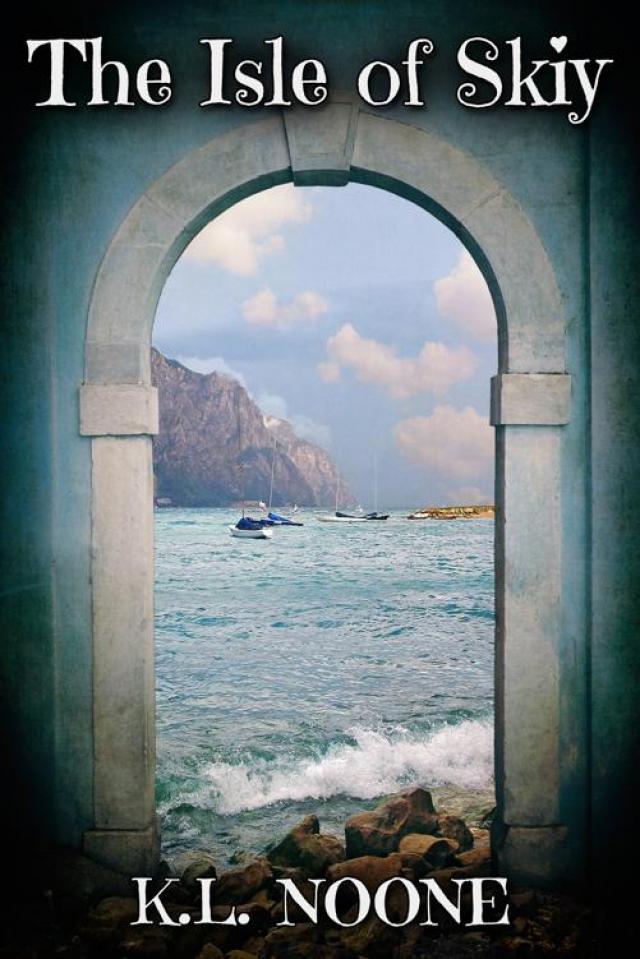


The Isle of Skiy
By K.L. Noone
Published by JMS Books LLC
Visit jms-books.com for more information.
Copyright 2024 K.L. Noone
ISBN 9781685507831
Cover Design: Written Ink Designs | written-ink.com
Image(s) used under a Standard Royalty-Free License.
All rights reserved.
WARNING: This book is not transferable. It is for your own personal use. If it is sold, shared, or given away, it is an infringement of the copyright of this work and violators will be prosecuted to the fullest extent of the law.
No portion of this book may be transmitted or reproduced in any form, or by any means, without permission in writing from the publisher, with the exception of brief excerpts used for the purposes of review. This book is for ADULT AUDIENCES ONLY. It may contain sexually explicit scenes and graphic language which might be considered offensive by some readers. Please store your files where they cannot be accessed by minors.
This is a work of fiction. Names, characters, places, and incidents are solely the product of the author’s imagination and/or are used fictitiously, though reference may be made to actual historical events or existing locations. Any resemblance to actual persons, living or dead, is entirely coincidental.
Published in the United States of America.
* * * *
This one’s for J.M., for encouraging me to dust this one off and send it in, and for giving it a home!
* * * *
The Isle of Skiy
By K.L. Noone
The isle of Skiy, as the tale goes—this tale, the one I will tell you now—was a lovely land, a rich and fertile land. It glowed with good health like an emerald dropped into the glittering sapphire of the sea. But it was an emerald that lay alone.
No one came or went from Skiy, not in those days. But that was before the world changed; before the eightieth Lord of Skiy, and the man who would become his Consort, brought that change to the world.
Of course, they’ve always said they aren’t heroes. They would say so to me now, if they were here in this tavern: Lyrho, we didn’t set out to be heroes. And perhaps they’re not. But that’s getting ahead of the story.
The people of Skiy, the histories tell us, had been contented with this isolated state of affairs. The sea was bountiful, the land fertile; the children of Skiy, all agreed, were born with an extraordinary beauty that bordered on the magical. No one ever left the island; why should they, when nowhere else was Skiy? Neither did it trouble the inhabitants that no one came to visit them from foreign places, bringing news of strange and exotic lands and the scents of distant spices and silks. The people of Skiy had always scoffed at such notions when the youngest children, who knew no better, brought up such questions. Skiy needed nothing beyond itself; and, indeed, that appeared to be true.
No one grew old on Skiy, only older. Disease and ill health were unknown on the island, and it was not uncommon for a man to see his third century before his calling into the deep. Such passings were always peaceful, never unpleasant, as if the person had merely decided that it was time to go. Deaths were, in fact, relatively well attended, as they were something of a novelty on the island.
Funerals, however, were something else again; and that was one of the best-kept secrets of Skiy.
The eightieth Lord of Skiy was a young man, whose father had died unexpectedly the year before. Like many of the past rulers of Skiy, he was handsome, and charming, and took care of his people with a kind hand, if a slightly inexperienced one. Unlike many of the past rulers of Skiy, he was also a curious man, and his father’s sudden passing had struck him hard. Kevane’s father had been only ninety-eight, and no one had quite been able to explain why his heart should have given out so abruptly.
Such an event was not unknown in history, but it had not happened for over four hundred years, and never before to a ruling Lord of Skiy. Kevane had never expected to inherit so soon, and would have been surprised to hear, after the first year of feeling as though he were floundering in water over his head, that his people spoke his name with approving nods in taverns and tea-rooms all across the island.
He asked his household minister one day, a month past the first anniversary of his ascension to the throne, the question that had been troubling him since they’d carried his father’s corpse down to the crashing shores that heavy twilight. It was the same question that had left him no peace for over a year now, since Kevane had evaded his solicitous courtiers on the day after the burial to stare at the empty sand and wonder where the bodies of the dead were taken, after they’d been left on the shore with all appropriate ritual and circumstance.
He finally asked that question on an unusually gloomy day on the island of Skiy; they’d been sitting in Kev’s expansive study, going over expenses and production, crops and sea-yields and stone-quarries and fields, for the last quarter. Grey lowering skies promised future wetness, though the rain had not yet burst into being.
The edges of branches scraped at the windows of Kevane’s office like bones; he’d not had time to ask anyone to trim them. Perhaps that had been the impetus, he thought, for the sudden query.
Rill looked up, light glinting from his spectacles; he gazed at Kevane severely. “That,” he said, “is a dangerous thing to ask.”
“I know,” Kev said, defeated by the stern glare. “I only meant—never mind.”
Rill sighed. He was only two years older than Kev, tidy and dark and scholarly, with temptingly graceful fingers and wrists: a contrast to Kev’s indeterminate blond-brown often-windblown hair and broad hands and height. Kev had been interested, in an unfocused on-and-off way, long before the desperate flailing of this past year; he’d never got round to doing anything about it, in part because he had a hazy sense that it’d be awkward to flirt with his father’s newly appointed household minister and in part because Rill was precise and orderly and meticulous to an extent that always felt vaguely like a critique. His family had been in service to the rulers of the island for generations; he’d taken on the position as Kev’s father’s household minister only five years before, stepping into the same role his grandfather and great-grandmother had previously filled in their turns. Kev sometimes suspected that the Sapphire Palace, seat of the Lords of Skiy for eons, would fall apart if Rill’s family ever retired from it.
“You must know,” Rill said now, “that it would be a blasphemy for you to investigate the subject. Even to think of it.”
“I know.”
“It is what we do.” Rill pushed up his spectacles. His eyes were dark as well, ink-pools that gave nothing away. “We give our dead, when they pass from us, to the lords of the sea. We do not ask questions. We do not venture into their realm. We remain safely on our land. And in exchange they allow our island to prosper. You vowed at your coronation to respect that bargain. Your ancestors have always respected it.”
“I’m not a schoolchild,” Kevane snapped. “I know. Just—forget that I asked.” He looked back down at the scattered farmland reports and wheat production estimates, wondering what he had expected. Wondering why he could not let the question go.
“But I cannot,” Rill said, after a moment. His voice was very quiet, and carefully steady in the way of a man venturing out across creaking ice, where one overly emotional step might fracture the world.
Kev looked up, astonished.
“My grandfather,” Rill said, “is dying.” This time he took off his spectacles, ran his hands across his face, through his hair. Black strands stood out in the wake of the motion, tugged free from smoothness. “He will not have long. Through his own choice. He does not eat, or speak, or leave his bed. I believe that, when he became finally too fragile to serve Skiy as he always had, he no longer wished to go on. And I believe that he desires this. But I…” He stopped, glanced down, searched for words amid grammar-school construction and bridge-repair expenditures. “I have never known anyone in my family to die before. And I have found that I…I do not want to lose the person who taught me to play hunting-stones and the exact length of time to brew the perfect pot of hibiscus tea. And if I must, if it’s happening, I want to know where they’ll take him.”
In all the years they had grown up near each other, and learned their respective duties in their respective family’s orbits, and now worked together in the halls of the Palace, Kev had never heard Rill speak of anything so personal. He had not known his flawlessly organized household minister had been hiding hurt, or grief, or anguished heretical ideas.
He managed to say, “I’m sorry,” and meant it. He knew about loss. He knew about grief. He remained astounded at the presence of the words, spoken aloud: I want to know.
He thought, then: at least mine was a surprise. My father. Here and gone, not lingering.
He could not imagine what Rill felt, knowing, watching, day by day. Asking the same question Kev himself had, night after night.
“Yes.” Rill took a breath, let it go. “Thank you.”
“I mean it.”
“I know you do.” Their eyes met, for a moment. The rain began, soft as a fallen mourning-veil.
“Is there anything I can—”
“Yes,” Rill said. “You can never speak of this conversation again.”
“But—”
“If it were my choice, I would stand on the shore and hold him back,” Rill said. “I would ask questions. I would follow, rather than leave him alone on a beach for the sea-lords to take. I would at least know where he goes, and whether
he will be honored there. I’ll listen to you, if you ask the same questions. But those are words we will not say outside this room.”
“If we both ask—if we don’t know what might happen, if we could at least try—”
“No.” Rill had his spectacles back on, glass hiding his naked eyes. “I said that I would. I will not be responsible for the breaking of the compact between the sea and Skiy. I will not be the person selfish enough to stay behind, to witness the sea-lords setting foot on earth, to decide that my pain is worth more than our island’s prosperity. I can choose to do what we have done for ages without question. And I will choose that, rather than face the prospect of destroying our world. Do you understand?”
Kevane hesitated.
“I know,” Rill said, “I know. Believe me—I know. If I could choose otherwise—but I can’t. Neither can you. As our Lord…make the right choice. Not for yourself. For the people of Skiy.”
Kev turned from the desk. Away from the kindness and despair in his young household minister’s face and voice and lovely elegant fingers, lying still beside a pen. Toward the rain, which whispered sadly back.
He nodded, because he had to.
But as he did, he felt a heaviness settle into his chest, a stone sitting atop his heart.
And he caught himself wondering what would happen if he did not, in the end, keep his promise.
* * * *
He rode out to visit his mother early the next week, as had become habit over the last year. She had removed herself to the Little Palace, where generations of retired rulers of Skiy had previously sat among the wild daffodils and gazed out over the hills and valleys, only a few short weeks after Kev’s father had died.
He suspected that it had been too painful for her to remain in the Sapphire Palace, where every room and hall and echo whispered his father’s name back to her. They whispered to him as well.
The Little Palace, though perched on a lovely low rise overlooking much of the island, had no windows facing the sea. Kev had guessed, though he had not asked, that the architecture reflected the unwillingness of past rulers to witness any reminders of death. The house, and the land, were private property, not belonging to the throne; they had belonged to the Idyia family for a very long time. A refuge, of sorts. A retreat, he thought now.
He followed the curve of trail up the hill, toward the pale creamy stone of the house. The sun had come out, though the wind bit at his coat.
He’d been among the bearers of his father’s body, of course: custom and love, entwined. They’d brought his father down to the shore for the passing into the deep, and left the body, as tradition required. He’d listened to the waves, the rhythm, then.
He thought that his mother might prefer to be here, where she could not see the shore. Kevane himself had always liked the sea, just as he liked mysteries and puzzles and things kept secret.
He’d wondered about the sea-lords even as a boy: how they breathed, what they did, the terms of their bargain with Skiy. He’d been taught not to ask. No one asked.
Today he brought his mother flowers, which he’d collected from the Sapphire Palace’s gardens—he’d asked a gardener, because he hadn’t wanted to upset their hard work, but he’d done the actual choosing himself, liking the reality of their presence and scent in his hands—and their bright pinks and oranges bloomed too brightly against the pale beiges and creams of his mother’s decorations. The colors stampeded through the sitting room, making papered walls seem dull and faded, though Kev was sure that the palace staff would never allow such a thing. But even the light spilling through lacy curtains shivered tired and wan.
He and his mother exchanged light conversation, as they did each week, about inconsequential topics: her cook’s new baby or the unusually bountiful pumpkin harvest from the North Slope farms this year. They nibbled airy weightless crumpets and jam; his mother did not offer him any advice, even when he asked what she thought of perhaps constructing a new public library. She simply smiled and told him to do what his father would’ve done.
Kev poured tea—not hibiscus, but a delicate light grassy blend—and thought fleetingly of Rill, and weary beautiful dark eyes behind glass, and a moment of open honesty. He swallowed, hard, and tried not to think of his minister’s disapproval.
He also began to think that his mother was pausing a long time between replies to him, as if having to recall her mind to the present. And though there was animation in her voice, it did not reach her eyes.
He asked suddenly, impulsively, “Are you all right?”
Irene smiled, a thin sweet line of a smile like the curve of antique wood. “Of course, dear. It’s just that I miss him so, I suppose. It’s nothing at all; no need to worry.” Her hands shifted like small restless animals in their lace mittens, and she watched them as if they might do something surprising of their own accord.
“Mother,” Kev said, “do you ever think about that bargain? About what happens, I mean. After we leave them on the shore, after we go back home…”
“Kevane,” his mother interrupted, in the exact same tone he’d heard countless times as a curious child, “those are answers we are not meant to know.”
“But something happens,” Kev said. He couldn’t not. He had to. “The passing into the deep. We never find bodies returned to us. And why would they do it? What do they get from this? And what about the rest of the world—we know there’s more, we know there are places beyond Skiy, there must be—in the oldest books—”
“There will be no blasphemy in our family,” Irene said sharply, and for a moment she was every inch the steel-backed Consort who had protected her people at her husband’s side. “You are the Lord of Skiy, now. You will respect the world of the dead. Your father would never have presumed to wonder about such things.”
“I know,” Kev said. “I know he wouldn’t. I’m sorry.”
He looked at his mother as she sat among her cushions and silks, pale and wispy as dandelion fluff. Tiny lines framed her eyes, and he wondered when they had appeared, or if he’d simply never seen them before.
She looked, he thought, older.
Though he smiled and changed the subject, talking to her of new gardens and a possible greenhouse—the gardeners wanted it, and Kev liked the exploration of it, the science of growing things and seeing what emerged—that look haunted him for the rest of the afternoon.
Little autumn tufts of fallen leaves chased him homeward, as he left. He wondered whether they could lie still again after he’d gone, or whether they’d stay in motion, tugged by the wind.
* * * *
Rill’s grandfather died the following week, in his sleep, smiling quietly as he passed. When Rill’s mother realized that he would not wake, she sent messages to the family; the notes came drifting across the town and the shepherd’s hills and the thin autumn trees in the late afternoon, as the sun slanted gold across the sky.
Kevane had been holding open audiences that day in the receiving hall; his head ached, and the beautifully carved sandstone of the throne was not terrifically comfortable. He’d been wondering how his father and grandmother had managed, and whether a cushion would be acceptable, or whether he should simply resign himself to his backside going numb in sacrifice to royal poise.
He finished listening conscientiously to one final dispute over farming property boundaries and sent the bickering claimants off with a palace secretary to look through the historical records of land grants, and then looked up at his household minister. “Please tell me there’s not a problem with the Artificer’s Guild dinner next week.”
“As if there would be. I’ve taken care of all of that already. Menus, table linens, seating arrangements, orders of seniority.” Rill paused. A flutter of white showed in one hand; his fingers were tight around it. “May I speak to you for a moment?”
“Of course.” Kev got up with a certain amount of relief, and did not rub his backside, tempting though that was. He waved at the door to the hall. “In the study?”
Rill, falling into step with him, observed, “Your grandmother preferred a cushion, I believe. And a footstool, padded, with golden tassels. I could see about reinstating all of those if you’d like.”
“How’d you—”
Rill eyed him. “Your face is hardly subtle.”