Hurleys heroes collectio.., p.1
Hurley's Heroes Collection Volume 6,
p.1
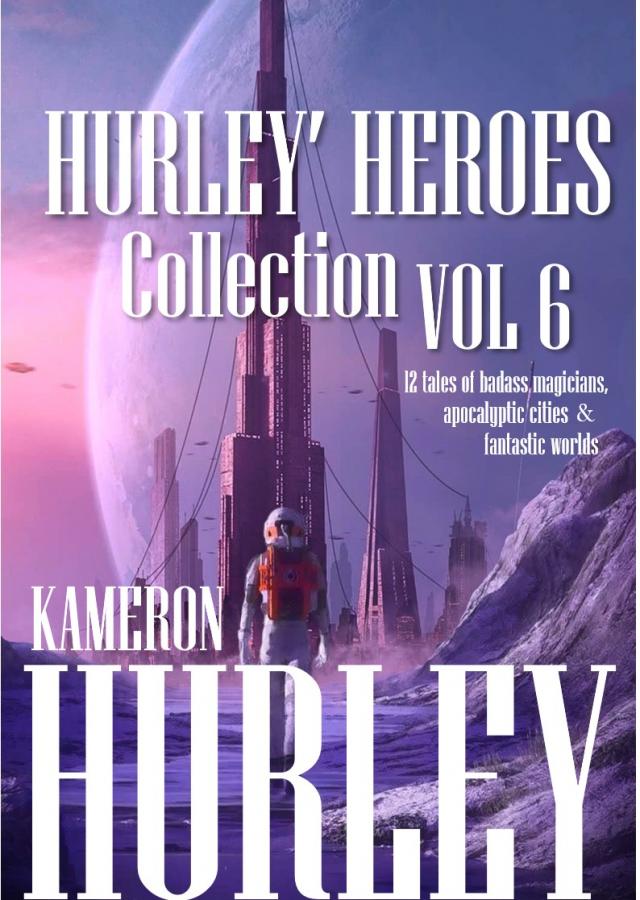


HURLEY'S HEROES COLLECTION 2021
KAMERON HURLEY
TABLE OF CONTENTS
VESSELBORNE
THE BURNING FIELDS
DIRGE
AN INDECENT CITY
RETHNAAA, SINGS
THE WIZARD IN THE TOWER
THE WOOD OF WICKED CHOICES
JUDGED
THE UNRAVELING
REGOLITH
BEHOLD THE STORM
OH, SING OF THE WRETCHED CITY
VESSELBORNE
I.
Every child in Shinshasa dreamed of becoming a sacrifice.
The elders dreamed of whom they would choose for that honor. They squabbled and nagged and wheedled and connived. Such choices were said to benefit the child, to deliver unto them the immortality inherent in becoming Chosen.
To have one’s child chosen for this sacrifice was a great boon for those that survived them; for their families. They gained a lifetime free from labor, donations of all the food they could fill their bellies with, and a warm home with a solid roof.
The families would never say aloud: the sacrifice was worth it. The sacrifice uplifted them. The sacrifice maintained the balance. The sacrifice ensured the life spring of magic that seeped from the ground all around them was released back into the world. The sun came up. The ground bore fruit.
Because of the sacrifice.
They believed this because to believe anything else would unmake them.
And still, the children dreamed.
II.
He was the chosen vessel for the old, deep magic, which the elders drew from the center of the world and deposited daily into fleshy tubers and spongy mushrooms. One child, each generation, became like those tubers and mushrooms: a container. A vessel meant for transit, and breaking. A vessel to sop up the magic that would otherwise wash over them like a tide, erasing all they were. All they ever would be.
What he was called was important to him; he believed his name would live forever. That’s what the elders said. To be a sacrifice meant a life of cheerful hedonism and gluttony, until he came of age. At fifteen the elders guided him to the wellspring from which the world’s magic flowed. He bowed before it, expecting pleasure in its many forms, and found that drinking from the well of magic was sweeter than any ambrosia he had yet tasted.
Drunk on the magic he had been promised since he choosing, he followed the elders happily to the edge of the village, where he was to gaze upon the verdant valley below that hugged the great, lazy river that gave them life. He prepared for perfection. For the pinnacle of a life that meant more than any other of his generation.
III.
“What’s it like, to be no one?” he once asked his sister, and she did not reply because she was pulling the legs off fat grasshoppers and throwing them into hot oil.
“I can tell you,” he said, “because before I was ten, I was nobody, too. But now I’m going to be the vessel. Carrying magic that will destroy our enemies. I’ll save you all.”
“I’m not sure we need saving,” his sister said, and tossed another handful of grasshoppers into the pot. The oil spit and roiled. “Or that we should be saved.”
“Everyone needs saving.”
“Maybe we should leave this valley,” she said, “if our enemies demand a sacrifice each year. If only the death of one of us will stop it.”
“It’s a small price,” he said. “One life.”
“It’s your life.”
“I will live on.”
His sister shook the pan of sizzling grasshoppers, and closed her mouth.
She was to inherit the boon of his death. She would wont for nothing.
But she would lose a brother.
IV.
Her words sowed doubt.
He suspected that was her purpose. That she was jealous. Everyone was jealous of the vessel.
Filled to bursting with the magic from the belly of the world, he gazed out across the valley, and even in his stupor, could not help but gasp.
Swarms of black, serrated monsters with gaping mandibles and multi-faceted eyes poured down from the mountains, so many he could not count them. He could not even name them. He had seen nothing like them in his life.
For the first time, he hesitated.
The head elder put her wizened hand against his bare back. Her touch was cool, startling. It cut through his ambrosia-haze. Suddenly, he wanted to bolt. He felt he was once of those grasshoppers, now, the elders ready to pull of his legs and toss him into oil.
“Wait,” he said.
“There will be no pain,” she said.
“Wait,” he said. “Take someone else.”
“You have been chosen,” she said. “This is what it is, to be the chosen one. Do you understand, now?”
V.
How he longed to be virtuous. To be brave. To be remembered.
How they all longed for the promise of life beyond death; immortality through story, even those who had hardly experienced living.
Such was the power of story.
A touch, light as a feather, and he fell, he fell toward the valley and for one long, long moment as he fell, he realized his hubris.
He, the vessel, burst apart.
It became a searing ball of light; annihilation.
Below him, the seething tide of snapping, spitting, chittering monsters turned instantly to cinders.
He would never know this.
Never see this.
Never experience a single breath, a look, a touch, ever again.
He lived only long enough to sacrifice.
When the light blazed out, and the cinders cooled, the people of the community descended into the valley and collected the ashes of the monsters into great urns. Somberly, dressed all in violet and crimson lace, they walked back up the mountain from whence the creatures had come, and stored the cinders in the back of a deep, warm cave. Inside the urns, the seed heads that had marbled the surface of the monsters lay dreaming and dividing, their germination triggered by the fire.
As the people sealed the cave once more with wax and stone, the head elder raised her gnarled hands and said a prayer of thanks to their sacrifice.
“You live on,” she said. “You live forever. As do we. Because of you.”
Together, they wended their way back down the mountain, the head elder a little slower in step, voice hoarse. Beside her, another elder, newly raised, said softly, “Another generation, and they will rise again. The monsters.”
“That is the way of it.”
“Surely we could end it. Pour out the cinders, drown them, annihilate them –“
The head elder paused. Placed her hand on his cheek. “Oh, child,” she said, “if we were to destroy the creatures, what would we do each year with the sacrifice? Without the creatures, the sacrifice has no meaning.”
“And without the sacrifice?”
She removed her hand, and continued down the narrow, well-worn path. “There will always be a sacrifice,” she said. “Our duty is to give it meaning.”
Behind her, the wind wailed through the craggy mountains. Ahead of her, the villagers burst into song.
THE BURNING FIELDS
Let me tell you about the cane rats. No. Let me tell you about the cane fields. The cane fields are the world. They cover the whole of the land in all directions. The cane fields are the world. I have grown up alongside them - them and the rats.
Cane rats aren’t like the ones you keep in glass cages. They aren’t the ones that you can teach to sit on your shoulder and groom you to keep your hair free of pests. Cane rats are as big as cats. They have fleas on them the size of rice grains. They rule the cane fields. The cane fields rule the world.
We just live there.
We can get into our skiffs and buzz over the fields, and when we do, the rats scatter like swarms of beetles, racing through the canes, making the stalks whisper and then roar like a swell of white water tumbling from a cliff.
I hear that sound, in dreams. We all do. Sleeping and waking, the lullaby that sooths us and frightens us in equal measure.
Because while the rats we startle may swarm and break during the spring and low summer, high summer is another matter. In high summer, when the rats swarm, it is because of the burning.
Each year we burn the cane fields before harvest. It reduces what we must transport to the vehicles for processing. What remains, they take across the world to some other people, and they break it down and create the rations we eat, and the extra ones that power the grid that keeps us safe from the wider world outside ours.
At night I can watch the hungry, would-be invaders pinging the shield over our world with their bursts and bombs and bodies. We don’t know what’s happening out there that’s made them so desperate, but we don’t want to find out.
We are the fields.
The rats and the fields.
The cycle of growth and burning and rebirth.
That is what we know. All we care to know.
When we burn the fields, that’s when the rats swarm.
Rats pour of the fields. They crawl into our houses. They tunnel into our cellars. They shimmy up the posts of our raised beds and cribs. They gnaw at unprotected toes. They have taken the soft noses and fingers and toes from our babies.
I had my own little toes nipped off, when I was very young. I don’t remember it, but whenever I look at
my toes, I think of the rats. They could have swallowed me whole. They didn’t, though, not like they do to some others.
The rats rule the world.
I don’t know when this started. Maybe it’s been that way since the beginning of the world. But they decide who lives, who dies, when the fields burn.
It’s my job to patrol the community on my skiff, now that I’m tall enough to reach all the gears. It’s a job I like. It’s important. I’m not allowed to hurt the rats, of course, but we can try and herd them away, dissuade them. Mostly, I spend my time repairing any barriers or nets that they destroy, and there’s a good many that are destroyed. They usually aren’t hungry enough to attack me.
Usually.
But if they did, I’m supposed to feel all right about it.
I don’t, though. Mostly.
I once asked my mother if the world was evil, back when I was little, and didn’t know anything.
“Our world is just dirt and rocks,” my mother says. “If there is evil here, that evil is in someone’s heart.”
“Someone?” I said, because I heard the distinction even then. “Not… something?”
“Someone,” she said, and she shushed me, and my other mother, mama, came in, and they sang me to sleep, a lullaby that that I could sing along to the sound of the rats in the fields.
There are many people in our community. Tending the cane fields, and managing the rats, takes a lot of people. There are some others that make sure we are all content and fed, and that we are well enough to work. We call them Friends. Or maybe that’s what they call themselves. No matter.
Our Friends are always looking out for us. They mended my toes. Made sure there was no infection. When I had a bad lung infection, they took me into one of their vehicles and brought me to a field hospital a long ways away. They didn’t have to do that, as my mama told me.
But they did.
And so I could work again.
It’s why I don’t understand what I did.
Maybe mama would.
One night in high summer I was patrolling on my skiff. The sky was burnt-orange-and-black, and the smell of burning fields filled my nose. I followed the humped forms of the rats as they peeled around the defenses of our community and raced on, toward the not-yet-burning fields. They would continue on for some time. I had never seen the end of the cane fields.
It was the sursurrus that caught my attention; that whispering keen. Hundreds of rats had broken the barrier of the community just to the north, where we kept tall stalks of corn for our own consumption.
I turned my skiff toward the breach and buzzed up over our defenses and into the corn field. My first instinct was to burn it, but that result would be no better than letting them eat it. Instead, I called out over the radio, letting the community know the defenses had been breached. The rounded windows of our squat dwellings lit up, and elders poured out, carrying their nets and sticks.
I let out my breath, relieved that they were there to help.
But as I turned my skiff, a giant rat latched itself onto my leg and bit down hard. I kicked it away, squealing. “Help!” I called, as another grabbed my thigh. They began crawling up one another’s bodies, streaming up my leg. I tried to power away, sending the skiff up and up, but the rats made a long chain from my leg to the ground. I watched them tear hunks of flesh from my thigh.
I screamed.
I don’t know what came over me.
I pulled the utility knife from my hip and I stabbed them in their squirming little faces. I stabbed and stabbed. They began to fall away.
And when I was free, the blood streaming down my leg, I zoomed back down to the corn fields, and turning my skiff around to aim its exhaust into the brittle corn husks, I set them on fire.
The rats screamed. They tried to flee, but they were caught against the defenses of our community, and the walls of our houses. Some of them purled up over the top of the houses, or climbed up one another’s bodies so they could get over the defenses. But most of them burned.
And burned.
They burned.
As they burned, I repaired our outer defenses. I knew we had lost the corn, but with most of the rats dead, we would not lose any children that night, or any of their toes.
I had lost a good deal of meat on my thigh, but I was beefy. I had some to spare. It was the first time I wondered if that was by design; if we all kept just enough flesh on our bones to sustain the rats.
I wondered if the world belonged to us, or the rats, or the canes.
When the suns rose, I still worked outside, gathering up the bodies of the rats and burying them in the fields. Blood and bone and flesh make good fertilizer.
I did not think the Friends would react so quickly, even knowing I had seen them angry before.
My mother and my mama found me, and they worried over my wounds, but they knew and I knew that the wounds were not the trouble.
The trouble was the rats.
The Friends alighted from a large vehicle. They were taller than us, thin and waspish, and they surveyed the burned corn and the dead rats and shook their heads.
“This is a terrible waste,” one of them said. “Have you done this?”
“Yes,” I said, “I needed to save the community. To save the babies.”
“There are plenty of babies.”
“There are plenty of rats,” I countered.
“We value the rats more,” they both said, in unison, as if they had planned it.
My mama began to keen. My mother grabbed me close, but I pushed her away. I was old enough to work the skiff. I wasn’t a baby, myself.
“What happens now?” I said.
“Now you run with the rats,” they said.
And so I did.
I was banished from the community, and let out among the cane fields. I am marked, now, a great red stain on my face that says I am an outcast, that says I am to live off the cane sugars and the pests as the rats do. And when we burn the fields, all across this part of the world, I run with them. I run with the rats. Sometimes they take pieces of me. Sometimes I take pieces of them.
We run.
Always ahead of the fire.
We run.
Someday I hope to find the end of the fields. Because I know, at the end of the fields, I will find the other piece to my community’s existence, the answer to the puzzle that keeps us in thrall to the rats, and the Friends, and the fields.
And on that day, I will know how to change it all.
DIRGE
They played songs for the dead and the living and the yet to be; beginning at the end and ending at the beginning; a cycle of new faces that were the same as the old, as they were renewed, reborn, dispersed like pollen on the wind.
Night moved on, soaking the radiance from the swollen sun. The mourners, the revelers, had to be out of the wood before the stars fell, because singing a dirge in a public wood was something best done at night, before the smoke cleared, and the fog lifted.
Around and around, back to the beginning.
#
Shay woke to a gray dawn with mud still clinging to her feet. Her hangover from the night of mourning was pronounced; her head felt stuffed with cotton. She had the gray, drawn look of the dawn, like a body long bereft of blood.
She drew herself up and crunched across the floor, scattering glittering patterns of roaches that fled or died beneath her bare feet. She shrugged into a long coat and passed through the filmy haze of the door. The film ate what remained of the mud and dead roaches from her feet, ate the dust from her hair.
Nearby, a bomb exploded. The house shook. The bugs in the walls hissed, and Shay wished she had invested in more cats for this boarding house. Perhaps there would be more cats, tonight, when the world was reborn and refreshed anew.
She heard a scream below. Saw smoke rising from the fountain of the stairwell. Perhaps the blast had upset something in the guts of the house.
Her neighbor, Raj, popped through the film of his door and peered after her with eyes the color of burnt toast.
“Not a good day for going out,” Raj said.
“Wouldn’t be the first time,” Shay said. “But that is the cycle, is it not?”
She pushed downstairs where the house was already beginning to mend itself of the bomb blast; through the hole in its flesh she could see the explosion had hit the neighboring house, causing it to leak gooey, vital fluid all over the street. Roaches seethed over the shattered walls, their bodies forming temporary support for the boarding house as their brethren patched together the spongy tissues and fibrous synthetic wood that made up the house.