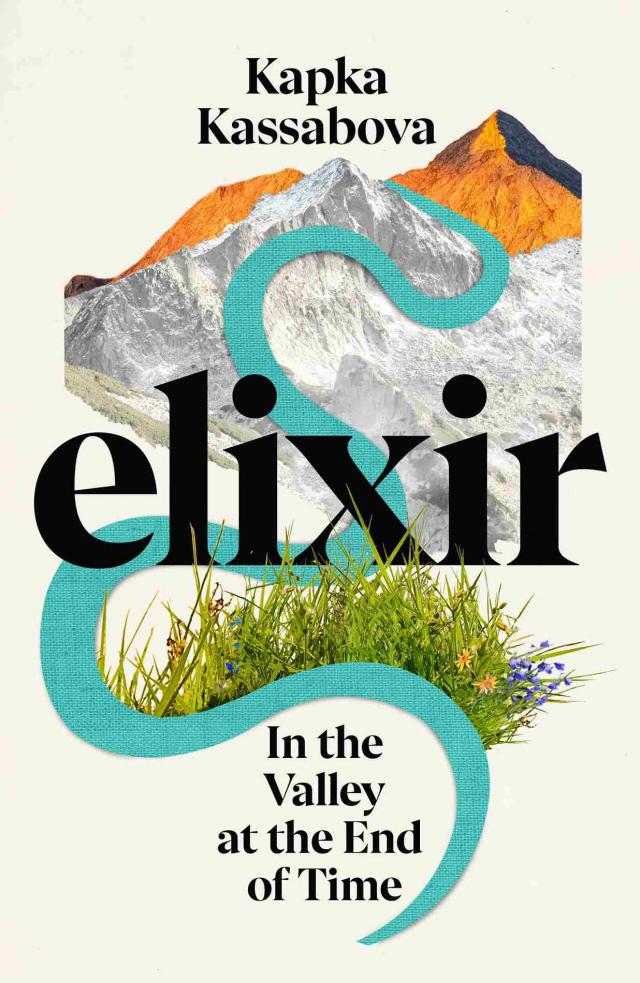
Elixir, p.1
Elixir,
p.1


About the Author
Kapka Kassabova is a writer of narrative non-fiction, poetry, and fiction. She grew up in Sofia, Bulgaria, was university educated in New Zealand, and since 2005 has lived in Scotland. In Border (2017) and To The Lake (2020) she explored the human geography of the southern Balkans. Border won the 2018 British Academy Prize for Global Cultural Understanding, the Edward Stanford Dolman Book of the Year, the 2017 Saltire Society Book of the Year, the 2018 Highland Book Prize, and a number of European awards. To the Lake was awarded France’s Best Foreign Book of Non-Fiction in 2021, and her work is translated into twenty languages. Her earlier books of non-fiction are the tango memoir Twelve Minutes of Love (2011) and the childhood memoir Street Without a Name (2008).
Also by Kapka Kassabova
Street without a Name
Twelve Minutes of Love: A Tango Story
Border: A Journey to the Edge of Europe
To the Lake: A Journey of War and Peace
Kapka Kassabova
* * *
ELIXIR
In the Valley at the End of Time
Contents
Map
Valley at the End of Time
OLD WOODS – FIRE Bone of dandelion
Empty Village, Full Village
Brightness of the mountain
Blueberry Blood
Botani
Rocky the Enchanter
Elixir
The Passage
THE BIRCHES – EARTH Birch, Birches
Shepherd’s superfood
By Fatmé’s Fountain
Morning tonic
Us and the Ancient Darkness
Stone flower
Gyulten and the Poison
Snake-spindle cocktail
I Sever to Sever
Seventy-seven-and-a-half
Maiden Gorge
Vortex
SOURCE – WATER Honey Sellers
Pine syrup
Black Mesta, White Mesta
Mycelium
Alish
Silent weave
Contact
Immortal flower
In the Ladies’ Pool
PIRIN – AIR Meadows of Asphodel
Anima mundi
Pilgrims
Merciful herb
The Horse Whisperer
Iris
Acknowledgements and References
Dedicated to healers, living and dead.
And in memory of my grandmother, the forager, and my great-aunt, the gardener, who first showed me the green way.
The planet does not need more successful people. But it does desperately need more peacemakers, healers, restorers, storytellers, and lovers of every kind. It needs people who live well in their places, people of moral courage willing to join the fight to make the world habitable and humane. And this has little to do with success as we have defined it.
David Orr, ecologist
We need a revolution. It begins with falling in love with the Earth again. There is no difference between healing the Earth and healing ourselves.
Thich Nhat Hanh, Love Letter to the Earth
elixir: from the Arabic ‘al-iksir’, miraculous substance
eco: from the Greek ‘oikos’, dwelling place
Some people appear with pseudonyms. Some circumstantial details have been merged. No mind-altering plants were used in the making of this book, only a sense of wonder.
Valley at the End of Time
The sun was setting on the valley, giving everything a gilded edge. The great mountains to the west and east, the scorched fields studded with human-sized thistle where a mare and her foal lifted their heads from grazing as if hearing a distant sound, even the potholed road shimmered with golden heat. The silence was that of humanity gone for a long nap. Crickets tuned their scrapers for the evening concert.
In the river plains a Roman city lay in ruins. Invaders, plagues, recyclers, nature and neglect had left their mark. The interpretative boards in three languages and with the EU flag were so bleached by the sun that no interpretation remained. Cherry trees thrived in the tepidarium, snakes mated in the banquet hall and the girl in the reception kiosk was asleep with her head on the desk where the ceremonial entrance had been, and where the children of grandees had walked their lion-cub pets on chains.
The villages of Thunder and Fire were deserted with heat, as after an exodus. The road was nibbled by high grasses. Then – an unharvested field of sunflowers black with seeds, all heads turned to the sun. I abandoned the car and entered the sunflowers.
Blue-faced ranges on all sides. And on all sides – out of view and out of earshot – the rivers that made up the big Mesta River. I sensed their smiling gallop downhill. Men had spent their best years waist-high in these rivers, moving logs downstream. Women had beaten their laundry and anger into the waters, children spent endless summers catching fish with their hands, vast herds of buffalo and horses drank, bird colonies nested. The land is fat and the mountains bathed by Mediterranean currents, an ideal climate that blends seasons like nectar in the cup of the valley. Once, the valley held one of the largest fairs on the continent – merchants and craftsmen, weavers and matchmakers, cattle and horse breeders, fortune-tellers and shepherds, speaking a Babel of languages and wearing all manner of fur hats and turbans, capes and aprons in linen and wool. Houses were built in stone above the valley, with grey schist-slated roofs, orchards planted. Many seasons passed. Then, in the last century of the last millennium, people began to leave and with them the animals too. The river flats where golden apples ripened were dug up.
It was August. I’d been in the mountains and news reached me that Siberia’s forests were on fire and Arctic peat smouldered. A virus whose biological form already seethed was still in the future, but it was also in the past. I was inside some interregnum of sunflowers. Calendar time released its grip and I was free to roam Earth’s broad valley.
I plucked a seed from a sunflower head and cracked it open with my teeth. It was warm. Drunk on sunset, I pushed through the sunflowers. Beyond the plantation – a scorched pasture. Goats and sheep were scattered on it, and a skinny boy in a white singlet with sun-bleached hair and a shepherd’s crook. Shafts of light poured through cloud, making him look like a golden child with his unearthly flock. Inside that funnel of light, the boy rested on his crook.
Until a hundred years ago, travel was slow in the valley – cartslow, chariotslow, horseback and muleslow, buffalo and footslow. At the end of the day, the boy walked the animals past the recent ruins, the older ruins and the ancient ones – though to him unfinished new builds, communist, post-communist, Ottoman, Roman and Thracian ruins meant the same thing. Across the floor of the valley, past the village of Fire so named because of the year-long sunshine and the hot springs where humans have sat throughout the centuries, sat with psoriasis and ulcers, cramps and battle wounds, melancholia and gout. Back to his village of Thunder so named because of the thunderstorms that roll in like an army from the north.
Like the boy, I would rejoin the road. Past the spring vapours. Past the hotels shaped like turreted faux-castles in gangster-baroque style, where the new rich arrive in cars like armoured vehicles, their listless children playing games on tablets. Past the Roma slum where laundry hangs over open dumps and a man leads a horse on a rope with small children bestride, no saddle. Garbage lines the riverbank. Past the 600-year-old sycamores, past the mansions built with public funds and pretending to be guesthouses, past a drinking fountain with a broken spout, the cement still bearing a hammer and sickle and ‘BUILT BY A STAR BRIGADE OF THE NATIONAL FRONT’.
What is this strange place? This is Europe in the new millennium.
Above the slum I’d follow a steep road that fills you with awe at how people built dwellings so high up, but you got why they did it – to avoid the fate of low-lying districts in the hands of brigands, floods and pandemics. I’d pass a single soul – a handsome man in rags with copper skin and ash hair, with a cloth sack full of something, who for a moment looked like an extra in a film of the ancient world, like Spartacus. I’d offer him a lift and he would smile shyly, revealing an old man’s mouth with rotten teeth, saying he’d been picking mushrooms and preferred to walk. His smile touched a nerve. It was like the valley. I’d reach a village where only one house is inhabited full-time, and in this empty village I’d rent a house. The next year, I’d do it again. I would fall under the spell of the valley.
For the past ten years, I have lived by a river called Beauly in the Highlands of Scotland. Until this move to the rural north of Scotland, I had defined myself as an urbanite, yet I never missed city life. Every day, I felt joy for no reason. Before, I’d needed a reason. Daily contact with the river and the woods changed my life, as if a door opened and I stepped into a place where everything was clearer.
That place was not new – it was remembered from my Bulgarian childhood. That place was in the wild strawberry woods of the mountains and in the foraging expeditions with my paternal grandmother in the pre-Danubian countryside. Her family were prominent vintners in that wine-growing region who lost everything during collectivisation. But even if she was dispossessed, grape juice ran in her blood. We would leave the house in the morning with shoulder bags and spend the day foraging for nettles which she rubbed into her fingers for arthritic relief, then made into fritters, eating mulberries and sour cherries off the trees that stained our clothes, collecting lime blossoms and elderflower which made me sneeze, and she would sit knitting shapeless doilies in a pine forest while I picked last season’s ac
orns to glue together into shapeless figurines. There was a bed in her house where herbs dried on newspaper and she was always chewing something just-pulled from the ground.
My great-aunt nearby had an edible garden under the grapevine that shaded the courtyard, and chickens and goats in the barn. The morning thrill of finding eggs in hidden places, the smell of barn and roses! There was a room in her house where food was stored and processed. Yogurt jars fermented overnight, wrapped in newspapers, fresh cheese dripped in cloths, crates of apples rested for winter, bottles of elder cordial fizzed and honeycombs dripped into trays. She was always next to a bubbling pot or work bench where she rolled out pastry, beat up mayonnaise with warm eggs and peeled still-muddy vegetables for an oven roast. We watched transfixed at how she turned the unshapely stuff pulled from the ground into something else, like a scientist in her lab. Things had to be constantly sampled, of course. And then there was the Making of the Jars in early autumn, a seasonal rite, when she sat regally on a creaky chair by a cauldron, boiling jars of goodies to seal them. She was an accountant during the week, mistress of the land on weekends. Nourishment was her talent and although she didn’t have children of her own, she was everybody’s favourite mother.
This is how I became enchanted by the edible Earth. Thirty years later, in a northern country, I drove away from my urban life and put on my wellies with glee as if I had seen off the last day of school. I was finally deinstitutionalised. Now, the river textured the days with its soundtrack. Its wooded paths became an extension of my feet. I dreamt of the river rising and falling. When I visited towns heaving with people, I felt in transit. Then I’d stand still with my feet planted on the ground and water would flow through me. I stood in the river. The river was there even when it was out of view. At sad times, I’d sit where the flow is fast and watch the water rush to the sea until I was smoothed, pebble-like. All is change. In happy times, I’d sit by the same bend and relish the rush of water. All is joy. Before the hydroelectric era, there had been a waterfall and I see the ghost of the cascades inside the dam wall.
The river is flanked by a mixed forest but next to the river, a gravel quarry had taken root and next to the quarry, Scotland’s largest power substation, and one day, a column of new mega-pylons appeared, trampling forests and overstepping river and hills. Wires buzzed in the moist air. The quarry and the substation were separately owned but moved in the same direction – expansion. Another day, a large new swathe of forest was cut down. The stumps still bled resin when I went for a walk and discovered that the walk was no more. The quarry men finished off the smaller trees with chainsaws. The sight nearly cut me off at the knees. The quarry had cut so close to the nearest mega-pylon that the pylon stood on the edge of the quarry now. Like a man sawing off his own legs.
Pictish cairns with cysts and carved stones had been dug up. This had been a sacred place for the last two thousand years. Within a week there was a new thundering hole with barbed wire. Within two years, the forest floor was exhausted. Murky water sat at the bottom. Next to the quarry was the logging station. It used to be small, but like the quarry it grew, and its sawing became constant. An angry man operated the logging truck – once a small-scale woodcutter, now his van said ‘Contracting services’. His expansion was bolstered by the quarry for which he used to work. He was riding the wave of earth-flattening. In the first spring of the pandemic, while birds nested and the world was in lockdown, the multi-million pound quarry company felled another large chunk of forest and sold it as pulp. The nightmare was recurring. Gone again were the trees, the paths, the blueberries, the mushrooms, the birds’ nests, the beds of animals. Deer ran across the narrow rural roads and were hit by lorries that had also grown too big for the place. I wandered the battlefield in shock. Metal was replacing wood wholesale.
When you live with it, this mass assault on the land produces a sensation in your own body, a sensation of pain caused by a blow with a metallic object. It is truly psychosomatic: psyche is soul, soma is body. I could not work for the crashing noise of the quarry. In my dreams, I visited a wasteland with furrows like open graves. The ground literally shifted under my feet. The people and animals of the woods were running out of dwelling places but there would be a lot of gravel to build wider, longer roads, ultimately going nowhere.
The local has become inseparable from the global and our shared condition travels across borders freely, even when people don’t. How does illness begin? I stood on the edge of the quarry abyss. It was a war trench. A pointless health-and-safety sign was stuck next to it. The river glinted through the remaining trees.
How does health begin? For years, I’d received treatment from a medical herbalist in Scotland. I became curious about the plants that went into the potent tinctures that changed my life for the better. At the same time, I discovered the benefits of Traditional Chinese Medicine (TCM) and its companion practice QiGong. It gave me relief and new tools to understand the energy that flows through all living things. I now understood why I felt unstoppable every spring: because energy rises in the human body when it rises in plants.
In the Daoist view, each person’s constitutional personality is a microcosm of the Earth’s ecosystems. Each individual has a blend of five elements: wood, fire, earth, metal and water. So there are wood people, earth people, metal people, though most of us have two to three dominant elements. Spring is the season of wood – the creation season. My trees whispered of other woods even as they were felled by metal and I had to follow the trail. Then summer – the season of generative fire, which adds fuel to the wood. Come May – June, the open road surged through me like a dragon awakening. I couldn’t sit at my desk. I’d roam the forests, pick raspberries and startle the deer. My blood sloshed like a river jumping its banks. The hunter-gatherer in me was awake and yearned to meet new faces and places. I’d leave home with a pack, braced for the unknown, trying not to look back to the one I loved because then I’d stay. He was a gardener, I was a forager. He would see the two sunflowers he planted in spring grow human-sized with heads like lions, then fall to the ground when I came home in autumn, as if shot.
And here I am in this unknown valley. From the north-westernmost to the south-easternmost highlands of Europe, from one river to another, I’ve come to seek connections across borders and seas, human and vegetal, physical and metaphysical. I lie on the floor of the veranda, cracking sunflower seeds with my teeth and the thunderstorm crashes into the valley like cannon firing. Warm rain pounds the slate roofs built without nails in a masonic tradition meant to last forever and bunches of staggering light pierce the cloud like a prophecy. But there’s no telling how this prophecy works – forwards or backwards – and whether this is the key moment or a rehearsal. One afternoon, a lightning bolt struck the elder tree by the veranda where I stood. I staggered back but an aftershock ran through me and in this coup de foudre, I saw why I had come here on nothing but a hunch.
This valley was suspended in an exquisite web of earth, water, fire and air, and inside the web was some trail I had to find. Something was forgotten that I had to remember. It had called me and I had come. Apart from the language, I was a stranger. I didn’t know a soul. And I didn’t bring personal pain this time, I brought the pain of my Scottish river and woods.
People in the Mesta basin knew suffering, but they had something precious – the forest. Everything was still connected – peaks, people, plants. This place still had something of the old, wild kind – medicine, meaning, magic. Bulgaria, I discovered, is a leading exporter of medicinal and culinary plants. Many of them are still gathered in the wild and the Mesta basin is a hub because of its ecological wealth: three mountains, layered climate zones, virtually untouched by industry and, until the 1950s, unspoiled by mechanisation or modernity altogether. The communist state exploited the valley to the full – here were plantations of the world’s most aromatic tobacco, the Basma Oriental leaf and millions of tonnes of fruit were harvested each year in the valley. Those mega crops were gone, but something else survived: a cultural ecosystem.