Golden ticket, p.2
Golden Ticket,
p.2
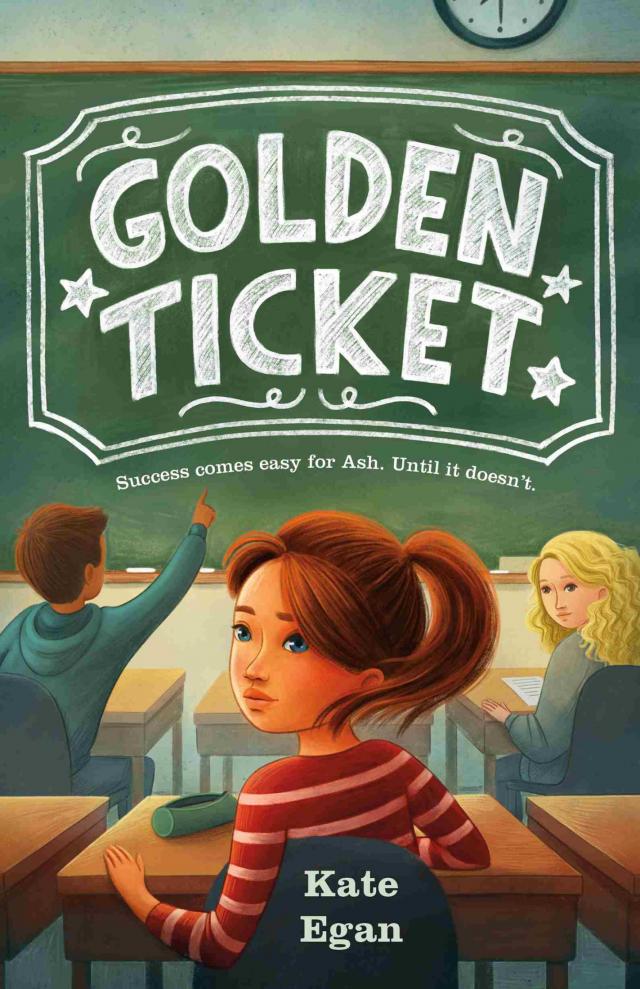


The music room was right next door, a tangle of black music stands. “Fifth graders can play an instrument,” Ash told her. “We have band twice a week, and there’s a concert in June.” She remembered this because it was always on her birthday.
Tilly started to emerge from her sweatshirt, like a turtle coming out of its shell. Her neck stretched, and she swept the hood off to reveal a blond mop. “You think I can join in the middle of the year?” she asked. “I’d love to play the clarinet.”
Ash didn’t know. They’d been working on their songs since September. Would Tilly be able to catch up? Being a new kid meant being out of step with the rhythm of the school, like when the drums came in at the wrong time on a song. It was going to take some time and practice before she got in sync with everyone else.
Ash was wondering if she should show her the playground when Mrs. Shepard appeared again. “I’m sorry, girls,” she said. “Never a dull moment. Thank you for taking matters into your own hands.” She turned to Tilly and said, “It’s better to see Quigley through a student’s eyes, anyway.” Mrs. Shepard grinned. “Ash is one of our very best.”
Ash wished she wouldn’t say that.
And maybe it was her imagination, but Tilly’s posture seemed to change, like she just remembered Ash had the flu and she didn’t want to catch it.
“Why don’t we head for your classroom?” Mrs. Shepard said to Tilly. “Get you settled in before … language arts? That’s what fifth grade has first, Ash, correct?”
She nodded. “Who’s your teacher, Tilly?” Ash asked, to signal that she was still friendly.
“Ms. Cooper,” Tilly said.
Ash beamed. “I have her, too!” she said with pretend enthusiasm. Inside, she was cringing. Ash was the only person Tilly knew in the whole school, and she would be leaving as soon as they got back to their classroom, because Mr. Lopez was expecting her.
Tilly and Ash followed Mrs. Shepard upstairs and all the way back to Ms. Cooper’s room. Mrs. Shepard took over the tour now, telling Tilly the kinds of things she might tell to adults. Stuff about student-teacher ratios, and after-school programs, and the coming transition to junior high. “As I was telling your mother…,” Mrs. Shepard said. Ash wondered where she was.
“We don’t teach to the test here, of course,” Mrs. Shepard promised. “But we use standardized test scores to make sure that all the students are challenged appropriately. Children who need extra help meeting the goals will have assistance. And children who have surpassed the goals will have accelerated work.”
Tilly didn’t ask any questions, but Ash wondered if she understood this lingo. She also wondered if Tilly’s family picked this town because of its nice school. That was the whole idea when it was built, Ash knew. This town didn’t have the most jobs or the biggest houses, but it had one of the best schools around. That was why her family lived here, for sure.
“Here we are!” said Mrs. Shepard. She knocked briskly on Ms. Cooper’s door, and Ash led the way in. Caden was sharpening a pencil over her desk, and the shavings were in a filthy heap on her chair. Ash squinted at him: gotcha! He shrugged as if the pencil were out of his control.
For Tilly’s sake, Ash hoped her desk would be far away from his. To her horror, Ms. Cooper had another plan.
She turned away from the board, where she’d been writing. “We are so happy to meet you, Tilly,” Ms. Cooper said. “I think you’ll feel right at home in our room. There’s only one problem…”
Somehow, although Ms. Cooper had all Tilly’s records from her old school, a thick file full of information, she had not been able to get anyone to bring in an extra desk. “We will get that resolved today,” Ms. Cooper promised her new student. “For the time being, though, you can sit in Ash’s place. I see you two already know each other.”
Caden swept the shavings away, and his fingers turned black. Now there were pencil streaks on the chair and a little pile of sawdust on the floor beneath it. Tilly looked confused. Why did she get the desk that was trashed? “But where is Ash going to sit?” she asked.
Caden explained, “Ash is going to her other class, where the smart kids are. You won’t see her for a while.”
So now Tilly had a dirty desk to sit at, in a room full of strangers, and a sudden understanding. This school had lots of bells and whistles, but not all of them were for her. She shrank back into her hood. Ash hated that moment, when other people saw that she had something they might like to have.
Too bad Tilly didn’t know the whole story.
Ash fled before the new girl was fully settled, but by the time she got to language arts, she was late. There was no sneaking past the GT kids: Five heads turned as soon as Ash opened the door.
“Sorry…,” she said. “Mrs. Shepard asked me to give someone a tour.”
Ash’s best friend, Jane, raised an eyebrow high enough to clear the frame of her red glasses. Her mother might be a lawyer, but Ash thought Jane could probably be a detective when she grew up. She knew Jane would want to know every detail: who needed the tour and why.
Mr. Lopez nodded, his shaved head catching the light. “Glad you could join us,” he said.
Tilly would have been surprised if she’d seen this room. Rumor had it there had been a mistake during construction of the new school, and one classroom never got built. Instead, the builders put up a wall to divide a room they’d already made, creating two tiny spaces. Mr. Lopez had one, and the school nurse had the other, which meant that sometimes his class heard people throwing up next door.
It was a little crowded in Mr. Lopez’s room, but no one was complaining. Instead of a tile floor, there was a bright rug that was supposed to absorb sound. Instead of desks, the kids all sat around a big table. Mr. Lopez was at the head, with a stack of papers where a plate would be if they were having a meal.
“We were just reviewing our figures of speech,” he told Ash. “Remember, they help us spice up our writing.” The rest of the fifth grade was still on nouns and verbs, as far as she knew.
Ash relaxed. She loved reviews.
Mr. Lopez said the figures of speech, and everyone gave examples in a quick call-and-response.
“Alliteration?” he ventured. That was the easiest one. Matching sounds at the beginning of every word.
“The big bad bear bounced,” said Lane.
Mr. Lopez nodded and moved on. “Assonance?”
It was Sebastian’s turn. “Sweet cream. Space age.” He explained why these words were good examples. “They don’t rhyme, and the spelling isn’t the same. But the vowel sounds repeat.”
“Onomatopoeia?” These were words that sounded like what they were describing—they were everybody’s favorite.
“Whoosh!” Olivia called out.
“Splat,” said Jane.
“Mooooooo,” added Lane. He made a convincing cow, and they all laughed. Even a class of five could have a clown.
Ash’s turn came on oxymoron. In her other class, you could bet a billion dollars that someone would make fun of the word. Someone who couldn’t get past the moron. No one commented on it here.
“Oxymorons are two words that seem to contradict each other,” she said. “Like old news, for instance. Open secret. Pretty ugly.”
Mr. Lopez smiled. He was happy so far. “Okay, guys,” he said. “I think we’ve got the hang of these. How about we see what they look like in their natural habitat?”
He waited expectantly. The moment lasted long enough for Ash to worry if she’d missed something again. She opened her folder just as Sebastian’s hand shot into the air. “Yes?” said Mr. Lopez.
“Metaphor!” Sebastian said triumphantly. “‘Natural habitat’ is a metaphor. Mr. Lopez is comparing words to plants or animals.”
Ash met Jane’s glance. Know-it-all, her eyes said. A little admiring, a little jealous.
Sebastian always seemed to be a step ahead.
And these days Ash was always a step behind.
She kept her eyes on her folder and her hands very still. She knew where this lesson was going.
A metaphor was a figure of speech, like its cousin the simile. In similes, the writer used the word like or as, which made them easy to spot. “As cold as ice” was a simile. So was “In like a lion, out like a lamb.” But a metaphor was a comparison without any warning.
When Mr. Lopez talked about words in their natural habitat, Ash knew what he meant—words in a real piece of writing—without ever noticing that he was using a metaphor. Unless you were really paying attention, metaphors would sneak up on you like that. Ash could tell you what they were, no problem. But finding them by herself was like finding a needle in a haystack. Even though that phrase was a cliché.
Mr. Lopez peeled sheets off his stack of paper and handed them around. Each student had a different poem to read, he explained, and each poem contained many figures of speech, particularly metaphors. Today’s work was to find as many as they could.
Ash frowned, and Mr. Lopez noticed. “Soon we will be writing poems of our own,” he added, like that would be a treat. Ash wasn’t thrilled about that, either. She was better at things that had answers.
Then a little bit of good luck came her way. Mr. Lopez wanted his students to work alone for a while. At least Ash wouldn’t have to partner with Jane or Sebastian. No one would see her floundering.
Ash was at the foot of the table, with Lane on one side and Olivia on the other. She kept her eyes on her poem, scanning for alliteration or anything else, but she was distracted by the sound of their pencils, so smooth and so sure of themselves.
This metaphor hunt is like Animal Farm all over again, Ash thought.
Before they started reading it, Ash had thought that Animal Farm might be a book for preschoolers, with tabs that lifted up to show baby goats and friendly mice. Turned out it was a book for high schoolers, only Mr. Lopez was teaching it in fifth grade. And somehow Ash had missed the most important thing about it: The whole book was a metaphor.
What she’d thought was a story about two pigs making mischief in the barn—a little bit Charlotte’s Web, a little bit Click, Clack, Moo—was actually a story about the leaders of a real country called the Soviet Union. Which didn’t even exist anymore.
Mr. Lopez explained that the pigs Snowball and Napoleon were modeled after Soviet leaders named Trotsky and Stalin. They started out with grand plans for building a new government there, but it ended up worse than the government it replaced.
“Trotsky?” Lane asked. “Why didn’t the author make him a horse?” Ash laughed along with the other kids, but that wasn’t the only thing she didn’t understand. If the author had wanted to write about Trotsky and Stalin, why did he write about animals? she wondered. And couldn’t they just enjoy the story about the pigs without getting into politics?
Mr. Lopez gave the class a long list of new words and a crash course in history to go with Animal Farm. It was easy to memorize the words and the important dates, but Ash ran into trouble when she had to write an essay. Getting her first low grade—a Needs Improvement—was hard enough. But then she saw what Mr. Lopez wrote in his weekly report to Ms. Cooper: “Ash is having trouble with the abstract thinking required in our novel unit.” That was when Ash realized she had a problem.
Because, if she was honest, the Animal Farm essay wasn’t the only assignment she’d struggled with.
The geometry unit had been fine … until they got to theorems. Which were basically sentences, and Ash wasn’t sure why they were part of math class. She still didn’t know how or when to use them. And one of these days she had to get serious about the Island Project.
It was only a matter of time before Ash would have to talk to someone about her progress—or lack of progress—in Mr. Lopez’s room. It was only a matter of time before she would have to get her report card, currently under a pile of stuffed animals, signed by a parent and returned to school. And, okay—the report card wasn’t that bad. But it was way below Ash’s usual standard, and that was bad enough. Maybe there would never be a meeting in the principal’s office, but Ash wasn’t sure. Did anyone know what happened when talent failed to develop?
Mrs. Shepard had told Tilly she was a fifth-grade leader. Caden thought she was a genius. Only Ash knew the truth: She was on the verge of trouble.
She was bad at abstract thinking—and she didn’t even know what that was.
She was losing confidence day by day.
She was the slowest kid in the GT class, and getting slower.
If she couldn’t keep up now, she might not be able to keep up when she went to junior high.
She might not be in the GT class at all.
And then where would she be?
No one would be handpicking her to give tours, or to help make a new kid feel at home, if that happened. No one would be saying she was the best. She’d be just like everyone else—and, even worse, the whole world would know what she’d lost. What would Mrs. Silver say? she wondered. Something like, All that special treatment, wasted. A little fake sympathy, then an all-out campaign to move Sammy into her spot at the top.
Quigley Elementary had experts who would help you catch up in math and reading. It had a speech therapist and a behavioral specialist. There were two guidance counselors and, as Mrs. Shepard would tell you, a top-notch group of teachers. But no one at Quigley could fix Ash’s problem. The minute she asked for help, they’d know she wasn’t gifted. She’d be out of the program before she could prove that she still belonged.
Luckily, Ash had a plan.
This Friday, she hoped, the Quiz Bowl was going to fix everything. For the second year in a row, she’d take home the grand prize!
More importantly, though, she’d send a message with every right answer in the Quiz Bowl. She was still smart, and she was still special.
After her triumph, her parents would be a little less likely to use words like let down when they saw the report card.
After her triumph, Ash could stop making excuses, regain her pride, and somehow get herself back on track.
Ash looked up from her poem. Sitting around the table, the other kids looked almost like they were eating dinner at home. She’d known them for so long they were like brothers and sisters. You need to get it together, she told herself. You can’t be the black sheep of this family.
She had just noticed that black sheep was a metaphor when she heard Mr. Lopez beside her. He said, “Ash, can you step outside to talk?”
Chapter Three
The Talent Development room didn’t have any extra space, so Mr. Lopez liked to have important conversations in the hallway. Sometimes he wanted to know if the homework load was too heavy or help iron out problems between kids in the class. There was nothing unusual about Mr. Lopez closing the door behind them, but Ash wished that someone would come down the hallway with, say, a motorcycle. Something loud enough to drown out the sound of her beating heart. What did they need to discuss?
Mr. Lopez adjusted his tie. He always wore a tie. “I just wanted to touch base with you, Ash,” he said. “Everything good?”
“Um … yeah…” Ash stammered, staring at the floor.
Mr. Lopez seemed nervous, too. He rubbed his bald head like a magic lamp, then said, “Look, I know you weren’t happy when I returned the Animal Farm essays. I was thinking it over later—pondering, you might say—and then I had an epiphany. That is, a great idea.”
Ash could still remember how she felt when she saw that Needs Improvement. Just like the essay, Ash herself needed improvement, she’d realized. Why hadn’t she seen it before?
“I thought you might like to do a rewrite,” Mr. Lopez continued. “Give it another try. With the feedback I gave you, I know you can get it into better shape. Spruce it up, right?”
Kids in Ms. Cooper’s class did rewrites all the time, but Mr. Lopez never offered that option. His students got things right the first time around, Ash thought.
“Oh,” she said, blinking. “Thanks! I mean … I’m not sure what to say…”
She really just wanted to forget the essay had ever happened. Once she won the Quiz Bowl, would it even matter?
“You’ll have a road map if you read my comments,” Mr. Lopez said. “Or we can do some brainstorming together. Whatever it takes. I just want to see you grasp the ideas, you know?” He pretended to grasp an idea out of the air.
Mr. Lopez paused to let Ash speak, then covered over her silence with more words. “You can think it over. But it might be helpful. Everyone needs a second chance sometimes.”
“Speaking of second chances … or maybe third…,” Ash said, changing the subject abruptly, “I can’t believe I forgot my report card again. I’ll bring it in tomorrow, okay?”
She hated the feeling of telling this lie. When Caden forgot to bring in his signed report card for Ms. Cooper, he’d had to have an inside recess, but GT kids got a little extra leeway like that. She had to bluff only a little longer now. Once the Quiz Bowl was over, she could hold her head high.
Mr. Lopez had no reason not to believe her. “I know, I know,” he said, waving it off. “Don’t worry about it. Just get it to me when you can.”
Now Ash did some quick calculations in her head. The Needs Improvement had been folded into the B minus she got on her report card. Rewriting wouldn’t get her back on the honor roll. But she could stay on Mr. Lopez’s good side …
“Can I get back to you on the rewrite?” Ash asked.
“Great!” said Mr. Lopez. “Just know I’m here for you. Truly. I want to see you do your best work, Ash.” He high-fived her and opened the door to the classroom again. It was silent except for the sound of someone blowing their nose on the nurse’s side of the wall.
His offer stayed in the back of Ash’s mind as she finished reading her poem. Was it okay to take a second chance? she wondered. She could never erase the mistakes she’d made the first time—Mr. Lopez would always know what she didn’t know. Teachers were always saying that students needed a “growth mindset,” that they needed to accept they wouldn’t get everything on the first try. That was all okay, Ash thought, but why did it seem like she was the only GT student who needed a redo? Sebastian got extra coaching for social skills, but he got answers—and digested ideas—faster than a computer.