Birdies bargain, p.2
Birdie's Bargain,
p.2
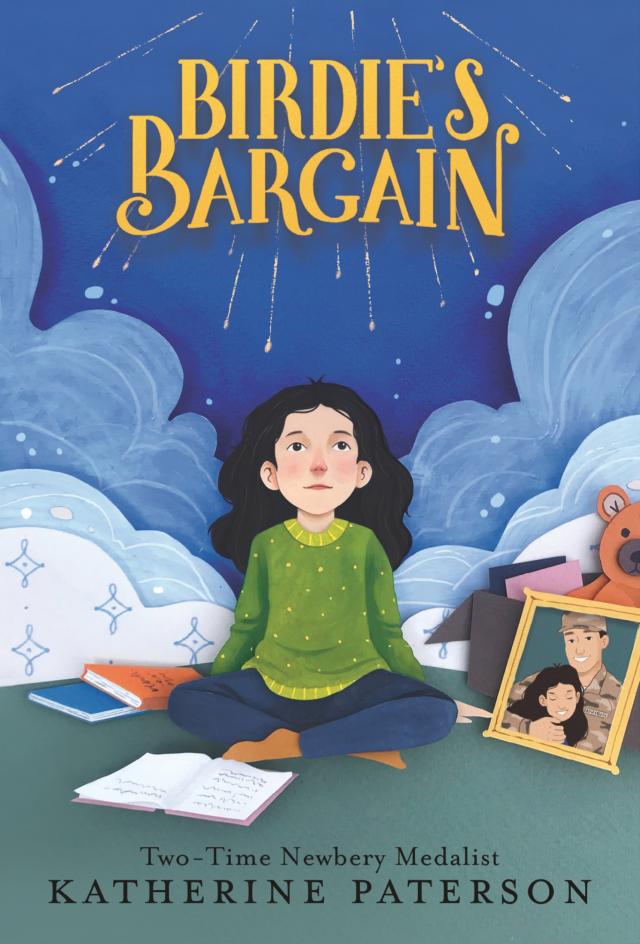


“It’s awfully icy out there.”
“I’ll be careful.”
She had hardly walked a block when she realized that walking in this weather was crazy. It was well below freezing, and even with her hood up and her warmest mittens, the January wind bit into her face and hands. But she didn’t turn back. And there, just ahead, she saw another sign.
Birdie gasped. It was a tree encased in ice. And even though the morning sun added no warmth to the day, it lit up the giant branches. They gleamed and sparkled. The thought came to her that the tree was singing, singing a hymn to the sun. She stood there looking at the great old fir, silvered and dancing, light sparkling from every branch. She caught herself listening for its song. As cold as she was, and as anxious as she was, it was another message from God. She was sure of it.
Her grandmother heard the front door close and called out to her. “Ready for that hot chocolate now, Elizabeth?”
“Yes,” Birdie said. “Thank you.”
If Birdie had turned right at the corner instead of left, everything would have been different. Why had God let her do it? They had been getting along so well. He could have given her a little nudge when she got to the corner, but He hadn’t. As it was, the first person she met that Saturday afternoon was Alice Suggs—or Alicia Marie Suggs, as she preferred to be known.
Birdie knew now that Daddy was really on the way to Iraq. Even with the bargain, though, it was too terrible to bear. She was trying not to cry. But when you’re homesick and scared, it’s hard not to. By the time she’d turned the corner and gone halfway down the next block, tears were freezing on her face. She rooted in her jacket pocket for a tissue and ended up wiping her eyes and nose, too, on the back of her mitten.
“What’s the matter?”
Birdie jumped. The girl was sitting on the steps of a once-brown house, now badly in need of paint. “I said, what’s the matter? Somebody die?”
“No!”
“You don’t need to be so touchy. I saw you crying and I wanted to help. I’m often told I have a gift for helping people in trouble.”
Birdie stared at the girl. She was wearing a neon-pink jacket trimmed with grayish fake fur. Despite the cold, her knees were sticking out from under a flowered cotton skirt, and she was wearing badly scuffed high-heeled blue boots that came halfway up her legs. After a few moments filled with nothing but Birdie’s open-mouthed stare, the girl tossed the hood off her head and came down the short walk to where Birdie stood.
The girl’s hair was what Birdie’d heard someone call dishwater blond, and it hung lifelessly down the sides of her narrow face. Her eyes were sort of blue, maybe more of a mixture that you’d think of as hazel. They were a little too close together and gave her the look of an irritated chicken.
“I said, what’s eating you?”
“Uh … nothing,” said Birdie.
The girl put her arm through Birdie’s and smiled, revealing a mouthful of small, sharp teeth. If she could have, Birdie would have drawn back and gotten out of the girl’s grasp, but she didn’t know how to extricate herself in any way that wouldn’t seem rude.
“I know who you are now,” said the girl. “You’re the one that’s come to stay at Old Lady Cunningham’s, right?”
“She’s my grandmother,” Birdie said stiffly.
“Oh. Right.”
“It’s just temporary—while my dad’s overseas.”
“No kidding! What a coincidence. My dad’s overseas, too. What’s your dad’s rank?”
“I don’t know. Corporal, maybe.” Birdie had a vague memory of a promotion, but she wasn’t sure to what.
“Oh. An enlisted man.”
“He’s in the Vermont guards.”
“My dad—” The girl stopped a moment and examined her nails. She wasn’t wearing gloves, and Birdie saw that the bright purple polish was chipped and peeling. “My dad,” the girl continued, “is a full colonel—in—in the regular air force. You ought to see his medals. When I was little, I used to put them on—for dress-up, you know.” She gave a little laugh as if dismissing her play as a child.
How old was this girl? Although she was a head taller than Birdie, she didn’t have breasts yet, so she couldn’t be much older than Birdie.
“You haven’t started school here, have you?”
“No. No. Not yet. We just got here and my dad was leaving and it was the end of the semester and my—”
“What grade?”
“Huh? Oh. Uh. Fifth.”
“What a coincidence! I’m in fifth, too.” She gave Birdie an appraising look. “I figured you for younger. But, jeez, that’s good. Maybe we’ll be in the same class.”
Birdie fervently hoped not, but she gave a weak smile. Screebies. It would be just her luck. She wriggled her arm but failed to loosen the girl’s grasp. “I gotta go,” she said.
“Not yet.” The girl squeezed even tighter. “You haven’t even told me your name.”
“Elizabeth,” Birdie muttered.
“Do you prefer Bets or Lizzie?”
Yipes. Would this strange girl try to name her as well? “Most people call me Birdie.”
“Birdie? That’s cute,” the girl said. “A little too old-fashioned and babyish for my taste, but then … I’m Alicia Marie Suggs, by the way. Of course, that’s not my stage name.” She laughed, a high prissy little laugh. “Only one of those country western stars would go by a name like Suggs.”
“Stage name?”
“I’ll tell you more about it when you aren’t in such a gosh-awful hurry. Are you Cunningham, too?”
“Yeah.” Birdie tugged again, but though Alicia Marie had the face of a chicken, she had the grip of a hawk. “Excuse me, but …”
“You don’t have to be shy with me. We’re going to be best friends, I can tell. People often say I have a special gift for friendship.”
Birdie didn’t ask what people, though she was surely tempted to. “I really got to go.”
Alicia set her free with a final little pat. “Best friends, little Birdie!” She gave a wink. “I’m sure of it.”
Birdie tried not to run, since the sidewalk plow had missed a lot of the icy spots, but somehow she had to get away from the strange girl—the girl who was so sure that they were going to be best friends. Birdie had friends in Brattleboro, but she’d never had anyone she thought of as her best friend.
She and Heather and Jamie and Melanie had kind of hung around together since kindergarten. She liked them, but none of them had cried when she told them she would be gone for at least a year. None of them had begged her to keep in touch. It would be hard to anyhow. She didn’t have a computer, much less a cell phone, and the only letters she’d ever written were the thank-you notes Mom made her write to Gran for Christmas and birthday presents. Even if Birdie wrote one of them a letter, she might not answer, and how awful would that feel? No. They’d be busy with their own lives. They might even forget all about her. It happened. She was sure of that. She snuffled. She was not going to cry again.
And she didn’t. Because things were different now, weren’t they? She stepped carefully around a little patch of ice. Yes, everything was different. She and God had an agreement, a bargain—what did Reverend Colston call it?—a covenant. Yes, that was what God called bargains.
On Monday morning Birdie got up, put on her I ❤ JESUS T-shirt, her best jeans, and the new green sweater Gran gave her for Christmas, and came to breakfast.
“You’re up.” Her mother put down her coffee cup and smiled.
“I thought I’d start school,” she said.
“I have to go to my orientation at the store this morning.”
“I know. I thought Gran could take me. It might help if they know I’m her granddaughter.”
Gran laughed. “Or maybe not. Most of my old students thought I was a pretty mean teacher.”
“You always secretly like the ones who make you work hard,” Mom said.
Her grandmother laughed again. “That’s a nice thought, Susan. Let’s hold on to that, shall we, Elizabeth?” Then she got up from the table and took one of those variety packages of little boxes of cereal from a cabinet. “Take your pick, love.” She put the box on the table and went to the stove to heat milk for hot chocolate.
Birdie tore off the plastic wrap. Her hand hovered over the assortment. How could she choose from among the dozen little boxes? Mom had a funny kind of smile fixed on her face. She never bought variety packs. They were more expensive than the big boxes. She even bought generic cornflakes and wheat puffs. Never anything sugared or frosted.
It was as though Gran with her back to them could read their minds as well as see what was happening. “Don’t worry. It’s just a first-day-of-school treat. I won’t make it a habit. When that batch is gone, it’s back to oatmeal.”
Gran loaded Billy into the stroller, and they walked through the cold and icy street to the school. It was old and had lots of steps up to the door. Gran had to pick up Billy and carry him up the long flight and into the office.
Mom had been right. The secretary at the elementary school nearly fell over herself when she saw Gran, and she gushed over darling Billy and even smiled at Birdie.
“Mr. Taylor is on the phone right now. Can’t I get you something while you wait? Coffee? Tea? Juice?”
“Just a chair, please, Crystal,” Gran said. “This boy is heavier than he looks.”
The secretary rushed to get a chair from behind the counter and pushed it close for Gran to sit in.
“I don’t know why this call is taking so long,” Crystal said more than once while they waited. Finally, Birdie heard the principal say a formal sort of goodbye and hang up the phone.
“Nancy Cunningham!” He jumped to his feet when Crystal ushered them into his office. “It’s always such a joy to see you! And with not one but two lovely grandchildren!”
Why did grown-ups, even school principals, lie? People always thought Billy was cute when he wasn’t bawling, which, thank goodness, he wasn’t at the moment, but no one except Gran thought she was “lovely.”
“Sit down, sit down. I am so glad to see you.”
“Even if … ?”
“Yes, despite the grade on my senior paper.” He chuckled. “Forgiven but not forgotten.”
Mr. Taylor then spent time fiddling at his computer to determine which section of fifth grade Birdie should go into. “All three of our fifth-grade educators are new to the area, so they wouldn’t have known you at the high school.”
“That’s probably just as well,” said Gran.
“No,” he protested. “Their loss.”
Gran gave Birdie a wry smile and said to her, rather than to the principal, “I gave a lot of less than flattering comments on papers. No one in town seems to have forgotten.”
“Merv Goldberg,” he said finally. “He’s your kind of teacher, Nancy. I think Elizabeth will fit in well there.” He stood up again. “Crystal will have some forms for you to fill out. Do come back soon. It’s always so good to see you.”
Gran said goodbye to the principal and stood up, shifting Billy to her other arm. When they were in the outer office, she said, “Birdie, would you sit down and hold him while I sign you up? I don’t think I can manage both Billy and a pen at the same time.”
Birdie sat down and, reluctantly, took the heavy baby from Gran. Don’t cry! Please.
Please. Billy always cried when she was asked to hold him. This time, though, he looked up at Birdie wide-eyed, as though he was too surprised to cry.
Gran filled out what felt like endless forms. When Crystal asked about the records from Brattleboro, Gran dug around in her huge shoulder bag and retrieved Birdie’s health certificate and report cards for placement in what Crystal was calling her new “permanent records.”
Why would you call them permanent if they changed when you moved? That was the trouble with permanent. Nothing in this world was permanent—not friends, not jobs, not schools, not homes …
She tried to stop feeling sorry for herself, after all, but leaving Gran and Billy behind on the first floor and following the secretary up the wide staircase to the third floor, she couldn’t help it. What a baby she was! Daddy was off to war. All she had to face was a new school.
Fear not! That was always God’s message in the Bible.
The staircase was stained and worn, and the stairwell needed a new coat of paint. The old paint was as gray as the stuff that pooches out of the neck of the vacuum cleaner bag. Why couldn’t they paint the walls a bright yellow like a sunny day? Wouldn’t everyone like school better if the walls weren’t so goldurn ugly?
They finally stopped climbing. The secretary pulled open the heavy fire door at the top of the stairs and motioned for Birdie to go through. The hall was dimmer than the staircase as there were no windows. She waited and followed the secretary down almost to the last door.
“This is Mr. Goldberg’s room,” she said. “I called ahead. He’s expecting you.” The secretary smiled.
“Good luck.” She turned to go.
So—she was supposed to take the last few steps completely alone, it seemed. Birdie pulled the door open and the light and warmth from the classroom engulfed her.
Okay, God. Here goes. She took a deep breath and walked in.
It was a large room with windows all across one side. The February sun was filling the room with light. There were no desks in straight rows, but round tables. The class was not as large as the one at home—twenty, more or less. She would count later. Mostly boys, though, drat it. Out of the corner of her eye, she caught Alicia Suggs grinning like a commercial for false teeth and waving from a table in the back. Birdie pretended not to see.
The teacher was a man! Well, of course. Crystal had said Mr. Goldberg.
Pay attention, dummy.
“Why don’t you sit here, Elizabeth?” he said, pulling out a chair from a table near the window. Mr. Goldberg looked to be about Daddy’s age. He had a nice smile and a lovely voice. It was like music, soft and warm without any phony gush. After Birdie sat down, Mr. Goldberg put his hand gently on her shoulder. “This is Elizabeth Cunningham, class. She won’t remember everybody’s name right away, so please introduce yourselves to her and make sure she feels at home with us.”
There were four other people at the table. Three boys and one other girl. The girl, who was next to her, leaned toward her. “I’m Christine, but everyone calls me Christie,” she said. “And that’s Devon, Mark, and Wayne the Weird, but you can ignore them. I do.”
Birdie smiled weakly.
“Do you have a nickname?”
“Birdie.” She spoke in a whisper.
“Birdie?” Christie asked.
“You know, Chris, like in tweet, tweet,” the one Christie had called Devon said in a raspy whisper. The other boys snickered. Birdie was blushing; she could feel it.
“Is there a problem, gentlemen?” Mr. Goldberg was back in front of his own desk.
The boys ducked their heads and grinned behind their books.
Ignore them. Christie mouthed the words.
Birdie was going to like Christie. She was really nice and pretty, really pretty. She had dark curly hair and brown eyes and didn’t seem at all stuck-up. Maybe she’d become a friend.
But it all fell apart at lunchtime. Christie had brought her lunch and went to sit at a table with other girls from the class. As Birdie stood still, looking to see where the line to buy lunch began, she was grabbed from behind. “Over here, Birdie. I’m buying, too. We can eat together.” And Birdie was trapped. She couldn’t say to Alicia that she’d promised Christie to eat with her. She hadn’t. And Christie hadn’t really invited her to join her table when she’d found out Birdie was buying her lunch. So Birdie let Alicia drag her over to the line and stood there not really listening as Alicia prattled on about something. She couldn’t help but notice that Christie and the other girls looked over from time to time to where she and Alicia were sitting, but no one came over to say hi or to introduce themselves.
“You haven’t listened to a word I said!”
“What?”
“See? You’re doing it again.”
“Sorry. I guess I …”
“Just don’t do it again, hear?”
Do what again? How could Birdie not do it again when she had no idea what “it” was?
She tried to listen to what Alicia was saying, but all the time she could feel the stares from Christie’s table.
After lunch, Alicia showed her where to take her tray back, and then she linked her arm through Birdie’s and walked her back up to the classroom. She didn’t let go even at the door.
Birdie saw Christie look up and then quickly down. Birdie slid into her seat. “I see you and Alice Suggs are friends,” Christie said.
She wanted to say something to Christie about not being actual friends with Alicia Suggs, in fact, hardly knowing her at all, but she didn’t know how. “Not really. I just …”
“Well, I guess you get to choose,” Christie said. “It’s a free country.”
But I didn’t get to choose. I wanted you to be my friend, not her. But she couldn’t say that. She couldn’t say anything at all because Alicia had come over to the table.
“It’s great you can come over to my house after school. I can catch you up on all the stuff you’re behind in.”
Had she told Alicia that she would come to her house after school? She couldn’t remember saying anything of the sort. She started to protest, but the teacher was speaking.
“Alice, would you take your seat, please?”
“Alicia Marie,” Alicia mumbled, but she headed back for her own table.
When the bell for the bus rang, everyone from Birdie’s table got up and left. Indeed, most of the class left. Alicia wriggled her fingers at Birdie from across the room. As soon as the second bell rang, she came right to Birdie’s table.
“C’mon. Let’s break outta here.”
She followed Birdie to her cubby and waited while Birdie fumbled to get the books she had been given into her backpack.