Death du jour needs rep.., p.1
Death Du Jour # Needs Replacing,
p.1



Death Du Jour
Temperance Brennan [2]
Kathy Reichs
Simon and Schuster (2009)
Tags: Mystery & Crime
* * *
SUMMARY:
Dr. Temperance Brennan, forensic anthropologist for Quebec, digs for a corpse where Sister Elizabeth Nicolet, dead for over a century and now a candidate for sainthood, should be lying in her grave. The puzzle surrounding Sister Nicolet's life and death provides a welcome contrast to discoveries at a burning chalet, where scorched bodies are found.
"Completely engrossing… Read this and you'll know why the word "chiller" was invented'
Frances Fyfield, Express
"Another day. Another death. Death du Jour. My God, how many such days would there be?"
"A gripping read'
Daily Mail
"This novel truly deserves the publishing cliche "unquestionable"… The addictive winning formula created by Ms Reichs… is a believable and likeable central character in forensic expert Dr. Temperance Brennan, a cracking plot, and, naturally, utterly convincing technical details'
Ms London
"Reichs's first novel, which won the Arthur Ellis Award for Best First Novel of 1997, was compared justifiably to the Kay Scarpetta novels of Patricia Cornwell. Soon, Cornwell's novels may be compared to Reichs's' Publishers Weekly
"This impressive thriller offers an illuminating account of the psychology of cults and their terrifying influences'
Good Housekeeping
"A nail-biter, along the lines of Patricia Cornwell, only much better. Kathy Reichs has perfected the art of the page-turner novel; at the end of every chapter is a hook you can't ignore. You have to keep on reading'
Choice
"A gripping read'
Daily Mail
"A real gift for the page-turning nail-biter of a thriller'
Manchester Evening News
"Compelling and dramatic… a thriller of real quality'
Yorkshire Evening Post
Kathy Reichs is forensic anthropologist for the Office of the Chief Medical Examiner, State of North Carolina, and for the Laboratoire de Sciences Judiciaires et de Medecine Legale for the province of Quebec. She is one of only 50 forensic anthropologists certified by the American Board of Forensic Anthropology and is on the board of the directors of the American Academy of Forensic Sciences. A professor of anthropology at The University of North Carolina at Charlotte, Dr. Reichs is a native of Chicago, where she received her Ph.D. at Northwestern. She now divides her time between Charlotte and Montreal and is a frequent expert witness in criminal trials.
Deja Dead, her- first novel, shot straight to number one of the Sunday Times bestseller list and won the 1997 Ellis Award for Best First Novel. It became an international bestseller, as did its successors Death du Jour and Deadly Decisions, Fatal Voyage, the next Kathy Reichs novel featuring Temperance Brennan is published in Arrow paperback in Spring 2002.
Also by Kathy Reichs
Deja Dead
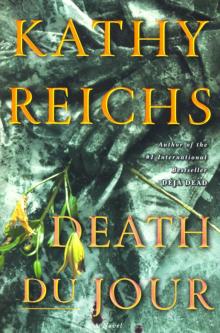
Death du Jour
Deadly Decisions
Fatal Voyage
KATHY REICHS
Death du Jour
Published in the United Kingdom in 2000 by Arrow Books
7 9 10 8 6 Copyright Kathleen J. Reichs 1999
Published by arrangement with the original publisher, Scribner, an imprint of Simon & Schuster Inc.
The right of Kathleen J. Reichs to be identified as the author of this work has been asserted by her in accordance with the
Copyright, Designs and Patents Act, 1988
This book is sold subject to the condition that it shall not, by way of trade or otherwise, be lent, resold, hired out, or otherwise circulated without the publisher's prior consent in any form of binding or cover other than that in which it is published and without a similar condition including this condition being imposed on the subsequent purchaser
First published in the United Kingdom in 1999 by William Heinemann
Arrow Books Group
The Random House Group Limited
20 Vauxhall Bridge Road, London, SW1V 2SA
Random House Australia (Pry) Limited
20 Alfred Street, Milsons Point, Sydney,
New South Wales 2061, Australia
Random House New Zealand Limited 18 Poland Road, Glenfield Auckland 10, New Zealand
Random House (Pty) Limited Endulini, 5a Jubilee Road, Parktown, 2193, South Africa
The Random House Group Limited Reg. No. 954009 www.randomhouse.co.uk
A CIP catalogue record for this book is available from the British Library
Papers used by Random House are natural, recyclable products made from wood grown in sustainable forests.
The manufacturing processes conform to the environmental regulations of the country of origin
Typeset by Deltatype Ltd, Birkenhead, Merseyside Printed and bound in Germany by Elsnerdruck, Berlin
ISBN 0 09 925519 7
To all who survived the Great Quebec Ice Storm of 1998.
Nous nous souvenons.
The characters and events in this book are fictional and created out of the imagination of the author. The setting is in Montreal, Canada; Charlotte, North Carolina; and other locations. Certain real locations and institutions are mentioned, but the characters and events depicted are entirely fictional.
Acknowledgements
Gratefril thanks are extended to Dr. Ronald Coulombe, specialiste en incendies; to Ms. Carole Peclet, specialiste en chimie; and to Dr. Robert Dorion, Responsable d'Odontologie, Laboratoire de Sciences Judiciaires et de Medecine Legale; and to Mr. Louis Metivier, Bureau du Coroner de la Province de Quebec, for sharing their knowledge with me.
Dr. Walter Birkby, forensic anthropologist for the Office of the Medical Examiner of Pima County, Arizona, provided information on the recovery of burned remains. Dr. Robert Brouillette, Head of the Divisions of Newborn Medicine and of Respiratory Medicine at the Montreal Children's Hospital helped with data on infant growth.
Mr. Curt Copeland, the Beaufort County coroner; Mr. Carl McCleod, the Beaufort County sheriff; and Detective Neal Player of the Beaufort County sheriffs department were most helpful. Detective Mike Marmix of the Illinois State Police also answered many questions pertaining to the investigation of a homicide. Dr. James Tabor, Professor of Religious Studies at the University of North Carolina at Charlotte, supplied information on cults and religious movements.
Mr. Leon Simon and Mr. Paul Reichs provided information on Charlotte and its history. I am also indebted to the latter for his comments on the manuscript. Dr. James Woodward, chancellor at the University of North Carolina at Charlotte, supported me unquestioningly throughout the writing of this book.
Special thanks must go to three individuals. Dr. David Taub, mayor of Beaufort and primatologist extraordinaire, was steadfastly helpful despite the barrage of questions I sent his way. Dr. Lee Goff, Professor of Entomology at the University of Hawaii at Manoa, did not abandon me as I pestered him endlessly for advice on bugs. Dr. Michael Bisson, Professor of Anthropology at McGill University, was a resource on McGill University, on Montreal, and on basically anything I needed to know.
Two books were particularly useful in the writing of this story. Plague: A Story of Smallpox in Montreal (1991), by Michael Bliss, Harper Collins, Toronto; and Cults in Our Midst: The Hidden Menace in Our Everyday Lives (1995), by Margaret Thaler Singer with Janja Lalich, Jossey-Bass Publishers, San Francisco.
I am grateful for the loving care of my agent, Jennifer Rudolph Walsh, and my editors Susanne Kirk and Maria Rejt. Without them Tempe could not tell the stories that she does.
One
If the bodies were there, I couldn't find them.
Outside, the wind howled. Inside the old church, just the scrape of my trowel and the hum of a portable generator and heater echoed eerily in the huge space. High above, branches scratched against boarded windows, gnarled fingers on plywood blackboards.
The group stood behind me, huddled but not touching, fingers curled tightly in pockets. I could hear the shifting from side to side, the lifting of one foot, then the other. Boots made a crunching sound on the frozen ground. No one spoke. The cold had numbed us into silence.
I watched a cone of earth disappear through quarter-inch mesh as I spread it gently with my trowel. The granular subsoil had been a pleasant surprise. Given the surface, I had expected permafrost the entire depth of the excavation. The last two weeks had been unseasonably warm in Quebec, however, allowing snow to melt and ground to thaw. Typical Tempe luck. Though the tickle of spring had been blown away by another arctic blast, the mild spell had left the dirt soft and easy to dig. Good. Last night the temperature had dropped to seven degrees Fahrenheit. Not good. While the ground had not refrozen, the air was frigid. My fingers were so cold I could hardly bend them.
We were digging our second trench. Still nothing but pebbles and rock fragments in the screen. I didn't anticipate much at this depth, but you could never tell. I'd yet to do an exhumation that had gone as planned.
I turned to a man in a black parka and a tuque on his head. He wore leather boots laced to the knee, two pairs of socks rolled over the tops. His face was the color of tomato soup.
"Just a few more inches." I gave a palm-down gesture, like stroking a cat. Slowly. Go slowly.
The man nodded, then thrust his long-handled spade into the shallow trench, grunting like Monica Seles on a first serve.
"Par pouce
s I yelped, grabbing the shovel. By inches! I repeated the slicing motion I'd been showing him all morning. "We want to take it down in thin layers." I said it again, in slow, careful French.
The man clearly did not share my sentiment. Maybe it was the tediousness of the task, maybe the thought of unearthing the dead. Tomato soup just wanted to be done and gone.
"Please, Guy, try again?" said a male voice behind me.
"Yes, Father." Mumbled.
Guy resumed, shaking his head, but skimming the soil as I'd shown him, then tossing it into the screen. I shifted my gaze from the black dirt to the pit itself, watching for signs that we were nearing a burial.
We'd been at it for hours, and I could sense tension behind me. The nuns' rocking had increased in tempo. I turned to give the group what I hoped was a reassuring look. My lips were so stiff it was hard to tell.
Six faces looked back at me, pinched from cold and anxiousness. A small cloud of vapor appeared and dissolved in front of each. Six smiles in my direction. I could sense a lot of praying going on.
Ninety minutes later we were five feet down. Like the first, this pit had produced only soil. I was certain I had frostbite in every toe, and Guy was ready to bring in a backhoe. Time to regroup.
"Father, I think we need to check the burial records again."
He hesitated a moment. Then, "Yes. Of course. Of course. And we could all use coffee and a sandwich."
The priest started toward a set of wooden doors at the far end of the abandoned church and the nuns followed, heads down, gingerly navigating the lumpy ground. Their white veils spread in identical arcs across the backs of their black wool coats. Penguins. Who'd said that? The Blues Brothers.
I turned off the mobile spotlights and fell in step, eyes to the ground, amazed at the fragments of bone embedded in the dirt floor. Great. We'd dug in the one spot in the entire church that didn't contain burials.
Father Menard pushed open one of the doors and, single file, we exited to daylight. Our eyes needed little adjustment. The sky was leaden and seemed to hug the spires and towers of all the buildings in the convent's compound. A raw wind blew off the Laurentians, flapping collars and veils.
Our little group bent against the wind and crossed to an adjacent building, gray stone like the church, but smaller. We climbed steps to an ornately carved wooden porch and entered through a side door.
Inside, the air was warm and dry, pleasant after the bitter cold. I smelled tea and mothballs and years of fried food.
Wordlessly, the women removed their boots, smiled at me one by one, and disappeared through a doorway to the right just as a tiny nun in an enormous ski sweater shuffled into the foyer. Fuzzy brown reindeer leaped across her chest and disappeared beneath her veil. She blinked at me through thick lenses and reached for my parka. I hesitated, afraid its weight would tip her off balance and send her crashing to the tile. She nodded sharply and urged me with upturned fingertips, so I slipped the jacket off, laid it across her arms, and added cap and gloves. She was the oldest woman that I had ever seen still breathing.
I followed Father Menard down a long, poorly lit hallway into a small study. Here the air smelled of old paper and schoolhouse paste. A crucifix loomed over a desk so large I wondered how they'd gotten it through the door. Dark oak paneling rose almost to the ceiling. Statues stared down from the room's upper edge, faces somber as the figure on the crucifix.
Father Menard took one of two wooden chairs facing the desk, gestured me to the other. The swish of his cassock. The click of his beads. For a moment I was back at St. Barnabas. In Father's office. In trouble again. Stop it, Brennan. You're over forty, a professional. A forensic anthropologist. These people called you because they need your expertise.
The priest retrieved a leather-bound volume from the desktop, opened it to a page with a green ribbon marker, and positioned the book between us. He took a deep breath, pursed his lips, and exhaled through his nose.
I was familiar with the diagram. A grid with rows divided into rectangular plots, some with numbers, some with names. We'd spent hours poring over it the day before, comparing the descriptions and records for the graves with their positions on the grid. Then we'd paced it all off, marking exact locations.
Sister Elisabeth Nicolet was supposed to be in the second row from the church's north wall, third plot from the west end. Right next to Mother Aurelie. But she wasn't. Nor was Aurelie where she should have been.
I pointed to a grave in the same quadrant, but several rows down and to the right. "O.K. Raphael seems to be there." Then down the row. "And Agathe, Veronique, Clement, Marthe, and Eleonore. Those are the burials from the 1840s, right?"
"C'est ca."
I moved my finger to the portion of the diagram corresponding to the southwest corner of the church. "And these are the most recent graves. The markers we found are consistent with your records."
"Yes. Those were the last, just before the church was abandoned."
"It was closed in 1914."
"Nineteen fourteen. Yes, 1914." He had an odd way of repeating words and phrases.
"Elisabeth died in 1888?"
"C'est fa, 1888. Mere Aurelie in 1894."
It didn't make sense. Evidence of the graves should be there. It was clear that artifacts from the 1840 burials remained. A test in that area had produced wood fragments and bits of coffin hardware. In the protected environment inside the church, with that type of soil, I thought the skeletons should be in pretty good shape. So where were Elisabeth and Aurelie?
The old nun shuffled in with a tray of coffee and sandwiches. Steam from the mugs had fogged her glasses, so she moved with short, jerky steps, never lifting her feet from the floor. Father Menard rose to take the tray.
"Merci, Sister Bernard. This is very kind. Very kind."
The nun nodded and shuffled out, not bothering to clear her lenses. I watched her as I helped myself to coffee. Her shoulders were about as broad as my wrist.
"How old is Sister Bernard?" I asked, reaching for a croissant. Salmon salad and wilted lettuce.
"We're not exactly sure. She was at the convent when I first started coming here as a child, before the war. World War II, that is. Then she went to teach in the foreign missions. She was in Japan for a long time, then Cameroon. We think she's in her nineties." He sipped his coffee. A sharper.
"She was born in a small village in the Saguenay, says she joined the order when she was twelve." Slurp. "Twelve. Records weren't so good in those days in rural Quebec. Not so good."
I took a bite of sandwich then rewrapped my fingers around the coffee mug. Delicious warmth.
"Father, are there any other records? Old letters, documents, anything we haven't looked at?" I wriggled my toes. No sensation.
He gestured to the papers littering the desk, shrugged. "This is everything Sister Julienne gave me. She is the convent archivist, you know."
"Yes."
Sister Julienne and I had spoken and corresponded at length. It was she who had initially contacted me about the project. I was intrigued from the outset. This case was very different from my usual forensic work involving the recently dead who end up with the coroner. The archdiocese wanted me to exhume and analyze the remains of a saint. Well, she wasn't really a saint. But that was the point. Elisabeth Nicolet had been proposed for beatification. I was to find her grave and verify that the bones were hers. The saint part was up to the Vatican.
Sister Julienne had assured me that there were good records. All graves in the old church were cataloged and mapped. The last burial had taken place in 1911. The church was abandoned and sealed in 1914 following a fire. A larger one was built to replace it, and the old building was never used again. Closed site. Good documentation. Piece of cake.
So where was Elisabeth Nicolet?
"It might not hurt to ask. Perhaps there's something Sister Julienne didn't give you because she thought it unimportant."
He started to say something, changed his mind. "I'm quite sure she's given me everything, but I'll ask. Sister Julienne has spent a great deal of time researching this. A great deal."
I watched him out the door, finished my croissant, then another. I crossed my legs, tucked my feet under me, and rubbed my toes. Good. Feeling was returning. Sipping my coffee, I lifted a letter from the desk.