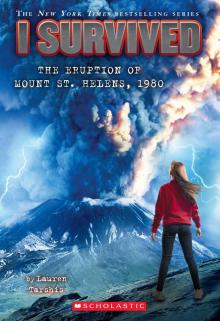
I survived the eruption.., p.5
I Survived the Eruption of Mount St. Helens, 1980,
p.5


It was a long time before they let each other go.
I have featured some amazing girls in many of my I Survived books, like Zena, who helped her brother, Max, escape from the Nazis, and Jennie, who led Oscar and her brother, Bruno, through the blazing streets of Chicago during the Great Fire of 1871. But I had never put a girl on the cover. I always told the stories through the eyes of a boy.
The reason for this is that I have three boys of my own (Leo, Jeremy, and Dylan). And none of them liked to read. It was very hard for them to find books that they really loved. I could rarely convince them to read a book that had a girl main character.
And so about six years ago, I decided to write a few books that I thought my own boys would really like. I thought of the title I Survived, and imagined a series of four books featuring boys going through disasters from history.
I had already written two other books, both about a girl named Emma-Jean Lazarus. I thought the whole I Survived project would take about a year, and then I’d get back to my beloved Emma-Jean.
But four I Survived books turned into six, which became eight, then twelve, and on and on. It so happened that not only boys liked the books, but girls, too. This made me very happy. And then some of those girls started to write to me.
Girls like Amelia: “Mrs. Tarshis, why are there no girls on your covers?” And Chloe: “I don’t understand why there aren’t any girl main characters.” And Maya, and Charlotte, and Mariella … and hundreds of others.
I would write back to each of them to explain about my boys. I told them that it always seemed to me that there were more books for girls like my own daughter, Valerie, than for boys like my sons. I told them about the thousands of boys (and their teachers and parents) who have written to me to say that they never liked to read, and that the I Survived books inspired them to become readers.
But the girls kept writing to me, too, and some emails were a little angry.
“Don’t you think girls are strong, too?” wrote Matty.
“What about us?” wrote Ali and Elena.
So after long talks with my editor, Nan, I decided that it really didn’t matter if my character was a boy or a girl. I decided that those devoted boy readers of I Survived probably wouldn’t care if the main character was a girl or a boy — as long as the books were exciting and interesting.
And guess what? The writing experience for this book was no different from the others. My I Survived books are so hard to write! Creating Jess was just as difficult for me as creating Max and Oscar and the other boys of I Survived. I love her just as much.
And really, my books are not about boys or girls, are they? They’re about young people who go through difficult and frightening experiences and discover their inner strength. They’re about how people can find inspiration and comfort from their family and friends and their faith. The I Survived books are not boy books or girl books. They are, I hope, human books.
And to Amelia, Chloe, Maya, Charlotte, Mariella, Matty, Ali, Elena, and the many hundreds of girls who have written to me, I am truly sorry it took me so long!
Why did I write about the eruption of Mount St. Helens?
The eruption of Mount St. Helens in 1980 was one of the most environmentally destructive in world history. It was the most powerful natural disaster ever recorded in America, more powerful than Hurricane Katrina in 2005 or the San Francisco Earthquake of 1906.
And yet many people under the age of thirty have barely even heard of it. How can that be?
We tend to remember disasters that result in large numbers of human deaths. The St. Helens eruption destroyed 230 miles of wilderness. But because the mountain was surrounded mostly by forests, it claimed far fewer lives than many other destructive volcanoes. Fifty-seven people died in St. Helens. More “famous” volcanoes like Vesuvius and Krakatoa killed tens of thousands.
But the eruption of St. Helens was very important, and not just because it happened right here in the United States. It was the first volcano that scientists could study closely while it was revving up for its eruption. Today, volcano scientists (called volcanologists) have a much better understanding of volcanoes than they did in 1980. And that is because of the lessons learned from St. Helens.
What happened when St. Helens erupted?
On the morning of May 18, Mount St. Helens erupted with the force of a one-megaton nuclear bomb, which is equal to ten million tons of dynamite. The front of the mountain actually shattered apart and collapsed with rocks tumbling down the mountain in a massive avalanche. The explosion created a cloud of ash, smoke, and gas that shot more than twelve miles up into the sky. It triggered one of history’s biggest landslides. It was fifty miles wide. The wave of mud and debris and melted ice raced down the mountain and swept away bridges, thousands of trees and logs, cars, houses, bulldozers, and roads.
The eruption spewed a staggering amount of ash — 520 million tons of it. The ash blew eastward, across the United States. In the city of Spokane, Washington, 350 miles away, the ash caused complete darkness. As far away as Montana, ash from St. Helens ruined crops, caused car accidents, and clogged airplane engines.
Did the eruption really take people by surprise?
Yes, the eruption was a surprise, and to me, that was the most incredible part of the story. There were so many warning signs — thousands of earthquakes (yes, thousands) between March 20 and the eruption on May 18. There were dozens of steam explosions, some that lasted for hours.
Huge cracks formed in the mountain. Near the summit, the mountain was actually bulging out from the pressure inside it. Just two years before, two scientists wrote a research paper warning that St. Helens was likely to erupt in the coming years.
And yet, the eruption on the morning of May 18 was a true surprise, even to scientists. The mountain had quieted down in the weeks right before. Most scientists had thought there would be some very dramatic warning before it exploded. But that warning never came. One minute the mountain was peaceful, and the next it erupted with a violence that few had imagined.
Are scientists better able to predict eruptions today?
Yes. Today scientists have far better tools for studying volcanoes. They have computer programs that can analyze huge amounts of data in seconds. They have lasers that can detect whether melted rock — magma — is rising up through the volcano.
But what truly changed volcano science was the eruption of Mount St. Helens. Scientists from all around the world have studied every second of that eruption. This work has helped scientists better understand the warning signs that often lead to volcanic eruptions.
Could St. Helens erupt again?
Yes. In fact, it already has many times since 1980. Some of the eruptions have released huge clouds of ash into the sky. In 2004, it spewed 26 billion gallons of lava. (How did they measure that? I wish I knew!) But none has come close to the fury of the 1980 eruption.
What are the world’s most dangerous volcanoes?
There are 1,500 volcanoes in the world that could be active, from the lava-spewing Kilauea of Hawaii to the steaming Katla of Iceland to the quietly beautiful Mount Fuji in Japan.
About 160 of the world’s most active volcanoes are located in a horseshoe-shaped area surrounding the Pacific Ocean. This area is called the Ring of Fire.
The Cascade mountain range, where St. Helens is located, is part of this ring.
Any active volcano is dangerous. But what makes a volcano perilous to humans is mainly its location. Volcanoes located near big cities are far more dangerous than those in remote areas. The eruption of Mount St. Helens could have killed thousands if it had been near a more crowded area.
And here are some more intriguing facts I found about Mount St. Helens:
Height of eruption cloud: The main volcanic cloud rose to between 12 and 15 miles into the sky, into the Earth’s stratosphere.
Number of earthquakes before eruption: More than 2,000
Area destroyed by eruption: About 230 square miles (more than three times the size of Washington, DC)
Size of landslide: 23 square miles
Depth of landslide: Roughly 100 feet
Speed of landslide: 70–150 miles per hour
Distance traveled by ash cloud: Ash could have circled the globe three times; small amounts of ash fell over 22,200 square miles.
Height of St. Helens before eruption: 9,677 feet (It was the fifth-tallest mountain in the Cascades.)
Height after eruption: 8,363 feet (It is now the fourteenth tallest.)
Number of bridges destroyed: 27
Miles of highway destroyed: 185
Number of trees destroyed: Roughly 3 million
Check out these great books to learn more about Mount St. Helens and volcanoes.
Eruption!: Volcanoes and the Science of Saving Lives, by Elizabeth Rusch, New York: Houghton Mifflin Books for Children, 2013
I loved this fascinating book about volcano scientists who used their knowledge and experience from St. Helens to predict an eruption on Mount Pinatubo, in the Philippines, in 1991.
Footprints in the Ash: The Explosive Story of Mount St. Helens, by John Morris and Steven A. Austin, Green Forest, AR: Master Books, 2003
Packed with amazing photographs and maps, this book is fun to read and it takes you deep into the science of volcanoes.
Volcano: The Eruption and Healing of Mount St. Helens, by Patricia Lauber, New York: Simon and Schuster, 1986
This is a great overview of the eruption that gives you a real sense of what the mountain was like before, during, and after.
My book I Survived the Destruction of Pompeii, AD 79, focuses on the eruption of Mount Vesuvius, in Italy, which happened nearly 2,000 years ago. I was fascinated by the similarities and differences between these two historic disasters.
Lauren Tarshis’s New York Times– bestselling I Survived series tells stories of young people and their resilience and strength in the midst of unimaginable disasters. Lauren has brought her signature warmth and exhaustive research to topics such as the September 11 attacks, the destruction of Pompeii, Hurricane Katrina, and the bombing of Pearl Harbor, among others. Lauren lives in Westport, Connecticut, and can be found online at www.laurentarshis.com.
Text copyright © 2016 by Lauren Tarshis
Illustrations copyright © 2016 by Scholastic Inc.
Photo of Mount St. Helens © Robert Krimmel/U.S. Geological Survey
All rights reserved. Published by Scholastic Inc., Publishers since 1920. SCHOLASTIC and associated logos are trademarks and/or registered trademarks of Scholastic Inc.
The publisher does not have any control over and does not assume any responsibility for author or third-party websites or their content.
While inspired by real events and historical characters, this is a work of fiction and does not claim to be historically accurate or portray factual events or relationships. Please keep in mind that references to actual persons, living or dead, business establishments, events, or locales may not be factually accurate, but rather fictionalized by the author.
First printing, September 2016
Cover art by Steve Stone
Cover design by Yaffa Jaskoll
e-ISBN 978-0-545-65853-9
All rights reserved under International and Pan-American Copyright Conventions. No part of this publication may be reproduced, transmitted, downloaded, decompiled, reverse engineered, or stored in or introduced into any information storage and retrieval system, in any form or by any means, whether electronic or mechanical, now known or hereafter invented, without the express written permission of the publisher. For information regarding permission, write to Scholastic Inc., Attention: Permissions Department, 557 Broadway, New York, NY 10012.
Lauren Tarshis, I Survived the Eruption of Mount St. Helens, 1980