Back to the garden, p.1
Back to the Garden,
p.1


Back to the Garden is a work of fiction. Names, characters, places, and incidents are the products of the author’s imagination or are used fictitiously. Any resemblance to actual events, locales, or persons, living or dead, is entirely coincidental.
Copyright © 2022 by Laurie R. King
All rights reserved.
Published in the United States by Bantam Books, an imprint of Random House, a division of Penguin Random House LLC, New York.
Bantam Books is a registered trademark and the B colophon is a trademark of Penguin Random House LLC.
Library of Congress Cataloging-in-Publication Data
Names: King, Laurie R., author.
Title: Back to the garden: a novel / Laurie R. King.
Description: First Edition. | New York: Bantam Books, [2022]
Identifiers: LCCN 2022010985 (print) | LCCN 2022010986 (ebook) | ISBN 9780593496565 (hardcover) | ISBN 9780593496572 (ebook)
Subjects: LCGFT: Novels.
Classification: LCC PS3561.I4813 B33 2022 (print) | LCC PS3561.I4813 (ebook) | DDC 813/.54—dc23
LC record available at https://lccn.loc.gov/2022010985
LC ebook record available at https://lccn.loc.gov/2022010986
Ebook ISBN 9780593496572
randomhousebooks.com
Book design by Caroline Cunningham, adapted for ebook
Cover design: Carlos Beltrán
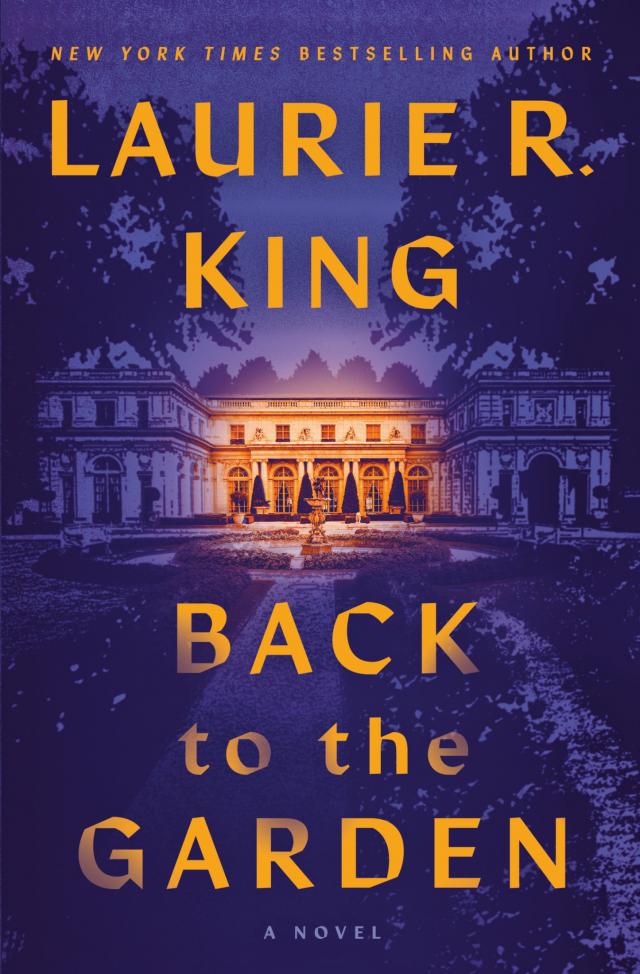
Cover image: Travelview/Getty
ep_prh_6.0_140822100_c0_r0
Contents
Cover
Title Page
Copyright
Epigraph
Prologue: Then
Chapter 1: Now
Chapter 2
Chapter 3
Chapter 4
Chapter 5: Then
Chapter 6
Chapter 7: Now
Chapter 8
Chapter 9
Chapter 10: Then
Chapter 11: Now
Chapter 12
Chapter 13
Chapter 14
Chapter 15
Chapter 16
Chapter 17
Chapter 18
Chapter 19
Chapter 20: Then
Chapter 21
Chapter 22: Now
Chapter 23: Then
Chapter 24
Chapter 25: Now
Chapter 26: Then
Chapter 27: Now
Chapter 28: Then
Chapter 29
Chapter 30
Chapter 31: Now
Chapter 32: Then
Chapter 33: Now
Chapter 34
Chapter 35: Then
Chapter 36: Now
Chapter 37: Then
Chapter 38: Now
Chapter 39
Chapter 40
Chapter 41
Chapter 42
Chapter 43
Chapter 44
Chapter 45: Then
Chapter 46: Now
Chapter 47
Chapter 48
Chapter 49
Chapter 50
Chapter 51
Chapter 52
Chapter 53
Chapter 54
Chapter 55: Then
Chapter 56
Chapter 57
Chapter 58
Chapter 59: Two Weeks Later
Dedication
Afterword / Thanks
By Laurie R. King
About the Author
So the Lord God cast Adam out from the garden of Eden, to cultivate the land he came from.
Why are you so angry? Why is your face resentful? If you do well, will you not be accepted? And if you do not, won’t sin crouch outside your door, filling you with longing?
—Genesis
PROLOGUE
Then
Southern Oregon
The man in the dripping Army poncho paused to shove back his hood and stand, head cocked, trying to make out the half-heard sound. A minute later, a car came into view, half a mile or so down the hill—a big white Pontiac, struggling to keep on the road. The man leaned on his shovel, judging the contest between the treacherous surface—the way up to the commune was unpaved, rutted, steep, and slick with the endless rain—and the determined car, which obviously had good tires.
The car slithered and flirted with disaster, but managed to avoid going off the edge or getting bogged down in the section where the culvert had washed out last month. When it came to the end of the clear section and vanished behind the trees, the man bent over to shake the rain from his long hair and beard, like a dog coming out of a river, then slopped the last shovelfuls of mud from the blocked ditch before walking down to see what the invader wanted.
The mud-spattered Pontiac eased into the farmyard, hesitating over the choice of targets: ancient woodshed or shiny new greenhouse? Psychedelic school bus up on blocks or geodesic dome layered in tarpaulins? In the end, the driver chose the aging farmhouse in the middle, pulling up close to the steps. The engine shut off, the music died—had to be a tape player, a radio would get nothing but static this far out. The person inside leaned over to roll up the passenger-side window, then sat, staring through the smeared windshield at the house as if expecting someone to come out.
The man in the poncho stayed where he was.
Eventually, the car door cracked open, emitting a figure who might have beamed in from another planet: a man in his early thirties with a carefully styled mop of red-blond hair, his mustache and sideburns trimmed just the safe side of emphatic. A large black umbrella poked into the air and opened, shelter for the wide lapels of his suit and the bright silk of his tie. The whole picture suggested a salesman who’d become disastrously lost—but when the salesman’s other hand came into view, holding a sleek attaché case, the bearded man recognized what this man had to be: a lawyer.
Junior partner, early thirties, who hadn’t really thought out the whole hippie-commune-in-Oregon thing. He made a noise of disgust as he noticed the muck swallowing the inch-high heels of his gleaming shoes. One foot came up, driving the other farther down, but as he looked desperately toward the farmhouse steps, his glance caught on the figure in the poncho.
“Afternoon,” he shouted, his good cheer sounding a bit forced. “I’m looking for Rob Gardener? Robert John Gardener?”
For long seconds, the only sounds in all the world were the hiss of rain and the tick of an overworked engine. Junior partner on one side of the lonely farmyard, large bearded man with a heavy implement on the other. Representative of The Establishment, the law, the benefits of right behavior on one side, and across from him…
The newcomer cleared his throat. “Your cousin David—David Kirkup? Gave me this address, and—”
The voice that interrupted was gravelly, deep, and so rough it might not have spoken in days. “So,” Rob said. “Has the Old Bastard finally died?”
1
Now
The day had been going so well, until the bones turned up.
It was a Monday, for one thing. Jen liked Mondays. The Gardener Estate was closed to the public, which always made it feel more like a family home than a place of work. The staff could park where they wanted, dress for comfort, and dive into their tasks without having to dodge the cameras and the clueless. Some of them even came in early, to work up an appetite for the morning break, and at noon they sat down together for an only slightly ironic communal lunch.
This Monday was also a perfect April morning on California’s Central Coast: warm sun, blue sky, the formal gardens a mosaic of glorious color, the Great Field a sweep of brilliant seasonal green, thanks to the series of winter storms. The kind of day that tempted Jen to spurn office work and spend the morning in old jeans, allowing the real gardeners to order her around.
Except that those winter storms had created a problem.
Yes, it was great not to worry about drought for a change, to see the trees leaf out so generously and the nearby reservoir fill. Not so great was how the long months of sodden ground had toppled over three of the Estate’s oldest trees, collapsed a stretch of century-old stone retaining wall, and—this being the matter that was keeping Jen from a day of nice, mindless weeding—lent a Pisa-like tilt to the biggest and most idiosyncratic of the Estate’s outdoor statues.
Rafi, the head groundsman, had noticed the tilt back in February. It wasn’t an immediate hazard, since the statue was outside the formal gardens and easy enough to fence off, but with good weather coming on, picnickers would soon arrive, and small children whose parents ignored the NO CLIMBING signs. Normally, a repair order would have gone through, a simple matter of choosing a contractor and having the Estate’s art conservator there to supervise. But for this statue?
Manager, groundsman, and conservator, along with the hard-hatted driver of the big crane idling behind them, stood to survey the job.
“I could just finish tipping it over, so it’s not a hazard,” the driver sug
gested.
“Let the blackberries grow over it,” Rafi agreed. “Call it environmental art or something.”
“It is the weirdest thing on the place,” Jen admitted. Jen Bachus had been the Estate’s manager since the Trust took over, and before that, a neighbor and regular trespasser. Jen had definite opinions on the weirdnesses of the Gardener Estate—and a sixteen-foot-high, tile-covered figure with long skirts, an odd torso, and a trio of conjoined heads was a thing most visitors found unforgettable. And that was before they got to the expression on its face.
But the conservator was shaking her head. “You can’t do that. It’s a Gaddo.” Although even her voice suggested a tiny bit of agreement: Midsummer Eves was kind of creepy.
Mrs. Dalhousie, the Estate’s archivist and conservator, was only here because of the Estate’s Gaddoes. She’d retired from New York’s MOMA, moved west, and come with a ladies’ group to visit the gardens—where she was astonished to find three (possibly four) sculptures by the artist known as Gaddo, a woman famous in the seventies, notorious in the eighties, and out of fashion by the end of the nineties, when her feminist outrage was superseded by Damian Hirst’s masculine irony of rotting cows and formaldehyde sharks. There were signs that she was now, twelve years after her death, about to be rediscovered as the gynocentric precursor of bad-boy shock art.
Mrs. Dalhousie had instantly volunteered—rather, she walked in and took over. And once she’d sorted out the Gaddoes (which might include the Minoan snake-goddess figure they’d found gathering dust in the attic), she moved on to transforming the archives from a room full of memorabilia into a properly cataloged, scanned, and referenced archive of the Gardener Estate’s century-long history. Mrs. Dalhousie approached every project, be it sculpture restoration or newspaper storage, with a computer’s tireless energy, a monk’s passionate dedication, and precisely nil sense of humor.
But not even Mrs. Dalhousie could claim that Midsummer Eves was the ideal ornament for a part of the Estate given over to picnicking families and long views over rolling hills. The Eves might have two other faces, but the massive laurel hedge made it impossible to tell. For decades, this face had loomed at the top of the Great Field like an avenging goddess, baring her sharpened teeth at passersby and frightening the more sensitive children.
Were it not for the inescapable fact that its creator later became famous enough to be known by a single name, the Eves might already have been allowed to quietly deteriorate, just one more piece of pretentious hippie junk from the Estate’s commune era.
“At least it’s an early Gaddo,” Jen commented. “From her ‘Menacing Feminist’ phase rather than full-on gross-out. Unless you think the grout contains pureed placentas or ground-up human bones.”
The two men looked alarmed. Mrs. Dalhousie looked thoughtful, but only corrected Jen’s terminology. “It’s known as her ‘Sisterhood’ phase, and the dates for this would place it early on, which makes it all the more important. As for the bones in that piece you’re referring to, they were from a monkey, not a human child. At any rate, I shall be quite interested to see the other faces. Gaddo’s sketches for the piece are surprisingly fragmentary.”
“Whatever we find, this thing’s costing us a fortune, even before we look at the renovation costs and security measures. Do you think…” Jen fixed her eyes on the statue and tried to sound as if this was something that was just occurring to her. “I don’t suppose we’d be allowed to sell it? Like, to a museum? I suppose a private collector would pay more, but I’d rather see it in public hands. And if a museum—like MOMA—oversaw the renovations, they’d be done right. Do you think the Trust might consider letting it go?”
She could feel Mrs. Dalhousie’s gaze, drilling into the side of her face.
Mrs. D claimed that the Gaddo would generate income from art historians and selfie-seekers—eventually. Jen wasn’t sure the Estate’s bank balance would hold out long enough to see a return on expenditures. However, if they could sell the Eves, there were any number of projects that had been pending for some time…
But in fact, the ultimate fate of Midsummer Eves was not up to Jen, or even Mrs. Dalhousie.
“According to the Trust agreement,” Mrs. Dalhousie pointed out, “anything beyond maintenance and repairs requires Mr. Gardener’s approval.”
That reminder took some of the shine out of the morning.
Jen’s gaze slid over to Rafi, who had worked for the Estate longer than she had. “Do you know when anyone last saw Rob?”
“Hmm. November?”
“Oh, right—when he took a shot at those hikers.”
Mrs. Dalhousie blinked, the crane driver looked uneasy, and Jen gave them both an apologetic smile. “Mr. Gardener’s private corner of the Estate is clearly posted against trespassing. Though it was only bird shot, and he wasn’t actually aiming at them.”
Still, the thought of setting off on a death-defying drive to speak with a famously irascible Gardener put a different shade across the job at hand.
“What about his cousin?” Mrs. Dalhousie suggested.
“David is still in Germany.”
An odd silence fell.
The crane driver waited. When no explanation came, he took off his hard hat to scratch his balding head. “Well, anyway. Your problem’s with the base. The thing is held together like crazy—forty years and not so much as a crack—but it doesn’t look like they stabilized the ground underneath it at all, just wove up a bunch of rebar, slapped some forms around it, and poured directly on the dirt. And that’s your problem. It’s so close to that hedge, nobody spotted the stream undermining the whole thing. Look, I’m going to have to pick it up base and all, anyway. If you like, I could just take it a little farther, to that flat place. It could sit there for months. You can even put up a scaffolding and do your repairs there.”
Jen nodded. “That’s probably for the best. In the meantime, Mrs. D, I’ll pencil in a discussion on selling it on next week’s Board agenda. Maybe when David gets back, he can go up and talk to Rob, see if he’s fond of the thing. We might even be able to fit in a preliminary vote on Tuesday, if Rob doesn’t mind…retiring it.”
She could no longer avoid Mrs. Dalhousie’s eyes.
The older woman’s expression was clear. I am the veteran of a thousand art-world negotiations. I am not deceived by your act of innocence. At the same time, she was experienced enough to choose private conversation over public argument, so she added her permission for the crane driver to get on with the task of shifting the sculpture, base and all.
But as he began pulling out a series of straps and hooks, she spoke, for Jen’s ears alone. “You’ve been thinking about this for a while, haven’t you?”
“What, selling it? Not very long.”
“Ms. Bachus, behind that wide-eyed manner of yours lies one of the most relentless forces I’ve ever worked with. Why are you so determined to be rid of the Eves?”
“I don’t want to get rid of her. Honestly, I’d be happy to have her stand here and glare at the picnickers forever. But I looked up what a Gaddo is worth. And I have a dim idea of what restoring her is going to cost. If selling this statue means we don’t have to sell off some of the Estate itself, that’s a decision I could live with.”
“Selling some land? Has it reached that point?”
“Our operating costs don’t change much, whether we’re open or not. After the past couple years, our cushion is nearly into the red. Something has to give. Unless you like the proposal David’s bringing back from Germany.”