Beatrice and croc harry, p.1
Beatrice and Croc Harry,
p.1


Dedication
For my beloved daughter
Beatrice Lucinda Freedman
Contents
Cover
Title Page
Dedication
Chapter 1: An Awful Lot of Places for Something to Go Wrong
Chapter 2: Self-Control
Chapter 3: Good for Any Constitution
Chapter 4: Horace Harrison Junior the Third
Chapter 5: Complete and Total Calamoflation
Chapter 6: So Can We Be Friends Now?
Chapter 7: The Weight of 333 Broad-Billed Hummingbirds
Chapter 8: The Noble Art of Decrockestation
Chapter 9: The Bee’s Knees
Chapter 10: Weighs on My Conscience
Chapter 11: Thanks for the Permission
Chapter 12: Croc’s Honour
Chapter 13: Straight Answers
Chapter 14: Aren’t You The Little Saint?
Chapter 15: Mundane Impediments Like Geography
Chapter 16: Six Out of Ten
Chapter 17: The Only Family She Had
Chapter 18: A Little Nap on Such a Soft Bed
Chapter 19: The Navel of the Universe
Chapter 20: Drama King
Chapter 21: Not Sharing You With Anyone Else
Chapter 22: Emotional Neglect
Chapter 23: Popping Socks
Chapter 24: One Hundred Percent Not Dead
Chapter 25: A Piece of Her Mind
Chapter 26: Life in a Cage
Chapter 27: Teleportation Now
Chapter 28: He Didn’t Know a Thing About Her
Chapter 29: Nothing Wrong With Her Skin
Chapter 30: One Last Grand Palaver
Chapter 31: Have You Been Living Among Animals?
Penultimate Word From Author to Reader
The St. Lawrence Dictionary of Only the Best Words, Real and Concocted
Acknowledgements
About the Author
Copyright
About the Publisher
Chapter 1
An Awful Lot of Places for Something to Go Wrong
Beatrice was not entirely sure if she was dead. She raised two fingers to her lips and felt her own warm breath. She appeared to be awakening from a deep, dark dream in which she had either died or come close to it. As she opened her eyes and studied her circumstances, the facts confirmed that she was alive. She didn’t know much, but she knew this: her name was indeed Beatrice. It had a certain flow. Three syllables and never just two, thank you very much.
Beatrice was lying in a single bed in a one-room, wooden cabin. She had never slept in that bed before or seen the cabin. She had no idea what awaited her outside, except an incessant woodpecker. Eight pecks in a row. Pause. Another eight pecks. And again. And again. There was nothing like a woodpecker to get her attention. It sounded like an electric hammer in the hands of a toddler. The message, being banged right into the grey matter of her brain, seemed to say, I am here and you are there and if you don’t get up this very second I am going to tap tap tap tap tap tap tap tap until you go completely mad.
Beatrice swung her legs off the bed. Straight ahead: three rows of shelves, stacked with books. To her left: a bedside table, and on it, two more books. On top was a manual with meticulous purple handwriting on the cover. It said: Survival Tips, Argilia Forest, 2090. Beatrice turned to the first page, which consisted of a simple message in purple ink: Outhouse is outside. Climb down the ladder and head to the river. Ladder? River? Outhouse? Was this some sort of joke?
The second book on the bedside table was filled with the same handwriting. Each letter was tiny and printed and looked like it had been smacked into place by a typewriter key. Typewriters? How did she even know about typewriters? Beatrice remembered nothing about herself or her past, except for her first name. But she knew about typewriters. Once, she had seen several of them in a museum and was quite sure that she had laughed as she pounded the keys and slammed the carriage return and rolled out a sheet of paper. For a girl who did not even know her own age or the name of her mother, if she had a mother, Beatrice found it unsettling that she could recall typewriters and the museum sign that said people had used them as recently as a century ago.
Perhaps the second book would explain who she was, or where she was, or where she had come from.
Nope.
No such luck.
It was a dictionary as thick as two bricks. So heavy she needed both hands to pick it up. It was entitled The St. Lawrence Dictionary of Only the Best Words, Real and Concocted.
Beatrice sighed. She was hungry and in no mood to be trifled with. Still, she was curious. She flipped open the dictionary and landed on the B page. Beatrice. That is your name. Well, thanks for the information. She read on. Bumfuzzled: To be utterly confused and somewhat dazzled.
That pretty well summed things up. She was bumfuzzled. Absolutely, totally, completely bumfuzzled.
What kind of dictionary knew her name and spoke to her? She flipped through the huge book and located a few more words, each one strange and faintly ridiculous. The dictionary seemed like a wound-up friend, talking at her between every breath. One could only take so much of that. Beatrice shut the book. She looked all around her.
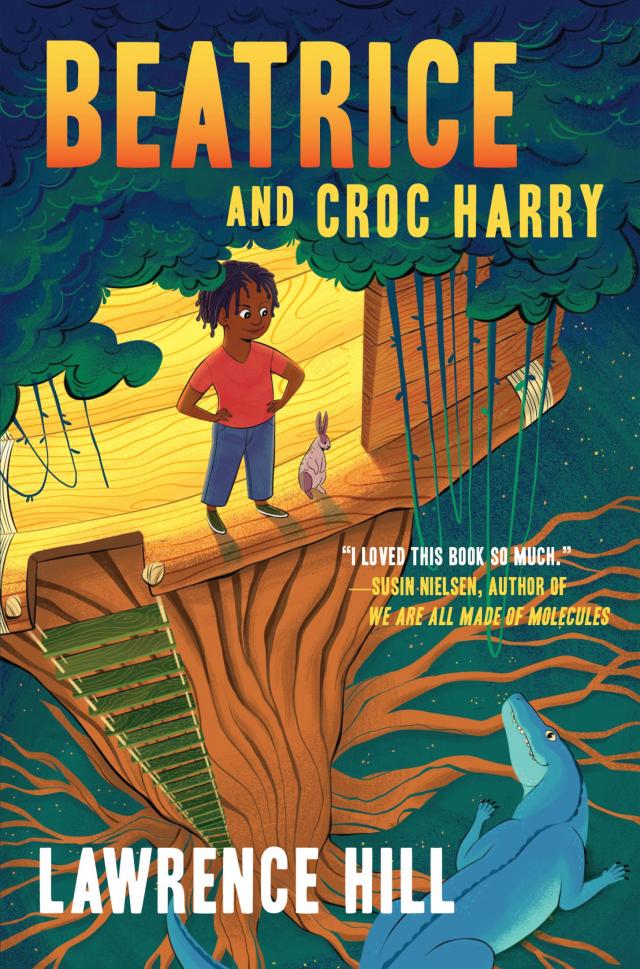
Pots and pans hung from hooks above a table. There was a hatchet. There was a sign: No cooking in the tree house. Beatrice stood up and examined herself in the mirror. She saw a girl. Not a toddler nor a teenager. Maybe eleven or twelve? In her opinion, she looked short for her age. She studied her own face. Brown skin. A litany of freckles. Tight black curls, which were in a state of complete bedhead. She’d have to comb out the kinks and do something with them.
How could a person see herself in the mirror and not even know her own last name?
Beatrice was wearing a set of onesie pyjamas decorated with zebras. Really? She was too old for that. Had someone selected the zebra pyjamas for her? If so, they had underestimated her. Beatrice did not care to be underestimated. She found a stack of clothing on a dresser. Socks. Underwear. Pants. Shirt. Sweater. Sturdy runners.
She dressed quickly. The whole cabin swayed. Was she on a ship? Was it an earthquake? Beatrice ran to a window opposite the door. She looked out and saw huge leaves as big as soccer balls and branches thicker than her own body.
A shiver ran down her spine. She was alone in the tree house, high above the ground. She had no clue where she came from or how she got there, but she had caught a memory, as if it were an autumn leaf twirling through the air. The memory was connected to the dream from which she had just awakened. There had been screaming. But it was not her screaming. She was too badly hurt to speak. The screaming came from other people: men, women and children. She heard the terror in their voices, rising and falling. The wailing went on and on. But that was all she remembered. No images. Just sound.
Enough of that.
Beatrice shook her head. She had to pee, and she was hungry. On a solid wooden table that looked just the right size for eating alone, reading and writing, Beatrice found an open knapsack. On the top was stitched the word Beasack. All right then. Beasack it was. It contained two small cooking pots, a bowl, a wooden stirring spoon, an eating spoon, cloth bags of dried oats, cinnamon, brown sugar, raisins, slices of dried apple, salt and a packet of butter. She poked around to see what else was in the Beasack: matches and a slingshot and a bag of perfectly round stones—presumably to be used with the slingshot. Beatrice grabbed the hatchet and stuffed it into the Beasack. She slung the pack over her shoulder. She opened the door and stepped out onto a giant branch that was wider than the span of her arms. She was fifteen feet off the ground. She was in the middle of a massive forest. No sign of people. Just birds. A veritable cacophony of birdsong. The birds sang out in a concert of tiny voices. She heard them. She could actually make out their tiny, individual voices: “Worms here. Airstream coming. Updraft. Downdraft. Mind my nest. Look out. Human approaching.”
Beatrice climbed down a rope ladder. It swung as she descended. She let the ladder rock her back and forth like a swing and hopped down onto a spongey forest floor. She stepped back. The tree that held the house looked like an elephant, seen from the side. The base of the tree spread out like a giant foot. She stood beside the tree and walked from one side of the trunk to the other: it took fifteen steps. The branch on which the tree house rested shot out in a straight line and looked like an endless trunk.
Near the base of the tree, Beatrice found three signs staked in the ground. One said biggest fig tree in Argilia. The second said outhouse and pointed to the left. The third said cookfire and pointed to the right. She tallied what she knew so far. She was in a massive forest named Argilia. She lived in a cabin perched on a huge branch of a giant fig tree. Apparently, there was a place to cook nearby.
Beatrice picked up a stick and scratched at the rich forest floor. She dug under some moss and saw tiny bugs running away. When she listened carefully, she could hear one of them complaining: “Hey. That hurts. Easy with that stick. I have feelings, too, you know.”
“Sorry,” Beatrice said. She dropped the stick and stood up. She left the tree and took a narrow, winding forest path. Paw prints marked the path, but there were no signs of humans. The trail wound past trees and bushes, and after a few minutes, led her to a big river. It was fast flowing and wider than a house. Wider than three streets, back-to-back. The current seemed to say, Try me. Just try me. See what happens. Beatrice tried to throw a stone across the river, but it landed with a plop in the midd
le of the water.
A handwritten sign near the riverbank said Potable water, which, according to The St. Lawrence Dictionary of Only the Best Words, Real and Concocted, meant drinkable. If the water was fit to drink, why not just write Drink here? Or Drinkable? Or Knock yourself out?
She scooped water into her oatmeal pot. She found the firepit, which was covered by an iron grate and had been dug into a clearing close to the river. It was a good place for a fire—no trees or bushes nearby, so she would see if anything or anyone was approaching her.
It was a clear, sunny day. Was she safe? Might there be lions or grizzly bears? She pulled out her slingshot, loaded a stone into it, pulled it back, aimed at a tree and let the stone fly. It travelled only a few feet and dropped onto the earth. She couldn’t harm a flea with that thing. Not unless she practised. That would have to come later.
With her hatchet, Beatrice chopped some dead branches into kindling and started a fire. She set the pot down on the grate. Beatrice had no idea if she had a mother, father, sister or brother, or why someone had left her in a tree house with instructions, but she knew how to make oatmeal. To the water, she added oats and all the additional ingredients.
As the pot heated up, Beatrice stirred in some butter. In the dictionary, she had seen a definition for the word ingreasements: The finest oatmeal additions mixed with two pats of melted butter. Beatrice stirred the oats and the ingreasements until they thickened and bubbled. Cooking comforted her. It gave her something to do. Beatrice prepared to pour her breakfast into the bowl. But the pot had no handle, so she had to return to the tree house for oven mitts.
She stuffed the slingshot in her pocket and left the Beasack and hatchet by the fire. She filled the spare pot with river water and carried it back toward the tree house. As she walked, she felt a mounting irritation about not knowing where she had come from. But whatever the country, city or village, Beatrice felt in her bones that something had gone wrong. She kept checking her arms and legs. No scratches. No broken bones. There were any number of vital organs in her body—for instance, heart, lungs, stomach, kidneys, liver and pancreas—so there were an awful lot of places for something to go wrong. The dream had suggested that some part of her body was broken or damaged. But everything seemed to be working. She was in no pain.
Still, it was frustrating not to be able to walk up to a person and ask for explanations. This put her in such an irritable mood that she put down her pot of water, retrieved the slingshot from her pocket, placed a marble-sized stone in the sling, pulled back hard and let it fly. The stone shot through the air and thwacked against something. From behind some bushes, she heard a low, angry voice.
“Watch it.” The bushes thrashed.
Beatrice clenched her slingshot.
The voice came at her again. “Some people have no clue. No broughtupcy. No manners at all. Throwing stones here, there and everywhere. Really!”
It was a deep-throated, irritated, expressive voice. Beatrice understood every word, but the voice did not seem human. She took a step back as the thrashing continued and the bushes parted.
There, before her, appeared an immense crocodile. She guessed that it was at least three times the length of her own body. Its scales were soaking wet. In the sunlight, they shimmered a deep, rich turquoise. Although the blue-green colour looked like it came from a beautiful jewel, the reptile terrified her. Its thick, powerful tail swished. It unhinged its jaws to reveal two rows of sharp teeth. Its breath smelled like rotting meat. It looked her up and down as she froze in her tracks.
The crocodile straightened its legs to lift the front of its body off the ground. It looked like it was doing a push-up. “Who in tarnation are you?” the crocodile asked. It thumped its tail twice. Beatrice felt the vibrations under her feet.
Beatrice stared at the beast. How many teeth did it have? She could only see the sharp ones perched outside of its mouth. Sharp teeth waiting and ready made her nervous.
“I am Beatrice,” she said.
“How astonishingly unhelpful,” it said. “Can you do any better?”
The crocodile stopped moving. Beatrice wondered if it was getting ready to lunge. Would a crouching crocodile be getting ready to lunge, like, say, a cat or a tiger?
“I am under no obligation to reveal my personal autobiography,” she said, holding one hand with the other, to keep them from shaking. “And just who are you?”
“I am a King Crocodile. Biggest kind going. You may call me Croc Harry. And I happen to have just emerged from my burrow. It was a perfect estivation, until you struck me, entirely unprovoked I must say, with that stone.”
“Estivation?” Beatrice muttered.
“Hot weather hibernation for crocodiles and certain other species, but never mind that. I’m annoyed. Frankly, I am quite piqued.” Croc Harry opened his mouth and bellowed.
Beatrice took one step back. The crocodile had teeth like knives. He was loud and unpleasant to behold, but he did not look like he was king of anything. She gripped her slingshot. She pulled another stone from her pocket and loaded it into the sling.
“Don’t even think about it,” Croc Harry said.
“You have teeth, so I have a slingshot,” Beatrice said. “Even-steven.”
Croc Harry bent his front legs and lowered the top half of his body back down on the ground.
“So you are a talking crocodile?” Beatrice asked. “And what are you doing here, anyways?”
“The word you intended to use is anyway, which has no need for the s. You said it entirely wrong.”
Beatrice felt her face grow hot. “Pardon me?”
“It’s anyway,” Croc Harry said, “not anyways. Were you educated in a barn?”
Beatrice said nothing. She could find no words to match her anger.
The crocodile nodded his head. Up and down. Like a human. “You are clearly a willy lump lump,” he said.
“Willy lump lump,” Beatrice repeated. “Is that an insult?”
“In the same ballpark as fool. Ignoramus.”
“I don’t appreciate being called a willy lump lump,” Beatrice said.
This monstrous turquoise reptile sure had a knack for getting under her skin. He knew how to get her blood boiling.
Beatrice took another step back. The slingshot shook in her hand. If he were to attack, how should she defend herself? His eyeballs were his only vulnerability: they sat curiously atop his head. It did not seem wise to get into a fight with a crocodile. What she had to do was stand up to him. Maybe all he needed was a verbal slap down.
“We are not in school,” Beatrice said, “and I have no need of grammar lessons from a beast whose centre of gravity is pitifully low.”
“What is that supposed to mean?”
“Your centre of gravity. It’s how low you sit to the ground. The lower your centre of gravity, the less likely you are to have a viable brain. As a matter of fact, your centre of gravity is lower than that of a pig. Infinitely lower!”
The crocodile snorted. Water shot from his mouth. “Pigs. I’ve eaten pigs.”
“I doubt that,” Beatrice said.
“Little ones. Piglets are most succulent!”
“You shouldn’t go killing animals. Why don’t you pick on someone your own size?”
Croc Harry snorted again. “You clearly know nothing about the laws of nature. Let me spell it out for you: if I don’t kill, I don’t eat. Also, in this world, if you’re big, you chase. If you’re small, you run. Picking on someone your own size won’t get you far. Not in this forest.”
At that moment, an armadillo and two of her pups raced across the forest path and disappeared into the woods.
“If I were you,” Croc Harry said, “I wouldn’t take on anything bigger than an armadillo.”
Beatrice knew a thing or two about armadillos. She must have read about them, before she wound up in this mysterious forest. “You shouldn’t go near armadillos. They can give you leprosy.”
The crocodile took two steps back. “Let’s de-escalate. You may go on your way, without fear of becoming my breakfast, if you apologize.”
Beatrice put her hand on her hip. “Breakfast? Apologize?”
The crocodile rolled his eyes. They looked like billiard balls spinning in the sun. “An apology is a statement that you’re sincerely sorry,” he said.