Dead horse gap, p.1
Dead Horse Gap,
p.1


Lee Christine is the author of six romantic suspense novels. Her first crime novel, Charlotte Pass, was published in 2020 and was a finalist for Favourite Romantic Suspense Novel in the 2020 Australian Romance Readers Awards. Her second crime novel, Crackenback, was published in 2021 and her third, Dead Horse Gap, in 2022.
Lee lives in Newcastle, NSW, with her husband and her Irish Wheaten Terrier, Honey. To read more about Lee Christine, visit http://leechristine.com.au.
Praise for Charlotte Pass
‘This intriguing, page-turning mystery will have you gripping the handle of your hot beverage of choice, if not spilling it entirely.’ TasWriters
‘Ice, snow, fog and darkness set the scene in Lee Christine’s chilling delve into the niche genre of romantic alpine crime.’ Newcastle Weekly
‘This is a murder mystery in the classic tradition, revealing a cast of characters from the past and slowly revealing secrets and connections. And this comes interwoven with a side serving of romance for the present day characters.’ NZ Booklovers
‘Not afraid to tug at your heart strings in one paragraph and have you gasping in shock at the next, this is a confident and assured book that will keep you guessing until you reach its nail-biting conclusion.’ The Manning Community News
Praise for Crackenback
‘A nail-biting cat and mouse game in play.’ Living Arts Canberra
‘I did enjoy this one; empathetic characters, wonderful settings and a gripping narrative.’ Reading, Writing and Riesling
‘Lee Christine is certainly making her mark in crime fiction with memorable characters involved in cracking good plots set in the stark beauty of the Snowy Mountains in the heart of winter—the perfect time to commit a seriously good crime.’ Blue Wolf Reviews
‘Lee Christine has produced a novel of great merit. Crackenback builds on the success of Charlotte Pass and in its place we have another absolutely thrilling read.’ Mrs B’s Book Reviews
‘Crackenback is a strong, multi-layered work of crime fiction with good lashings of Australiana, wit and enough tension to cause an emotional avalanche.’ The Manning Community News
This is a work of fiction. Names, characters, places and incidents are products of the author’s imagination or are used fictitiously. Any resemblance to actual events, locales or persons, living or dead, is entirely coincidental.
First published in 2022
Copyright © Lee Christine 2022
All rights reserved. No part of this book may be reproduced or transmitted in any form or by any means, electronic or mechanical, including photocopying, recording or by any information storage and retrieval system, without prior permission in writing from the publisher. The Australian Copyright Act 1968 (the Act) allows a maximum of one chapter or 10 per cent of this book, whichever is the greater, to be photocopied by any educational institution for its educational purposes provided that the educational institution (or body that administers it) has given a remuneration notice to the Copyright Agency (Australia) under the Act.
Allen & Unwin
83 Alexander Street
Crows Nest NSW 2065
Australia
Phone: (61 2) 8425 0100
Email: info@allenandunwin.com
Web:www.allenandunwin.com
ISBN 978 1 76106 607 8
eISBN 978 1 76106 359 6
Set by Midland Typesetters, Australia
Cover design: Nada Backovic
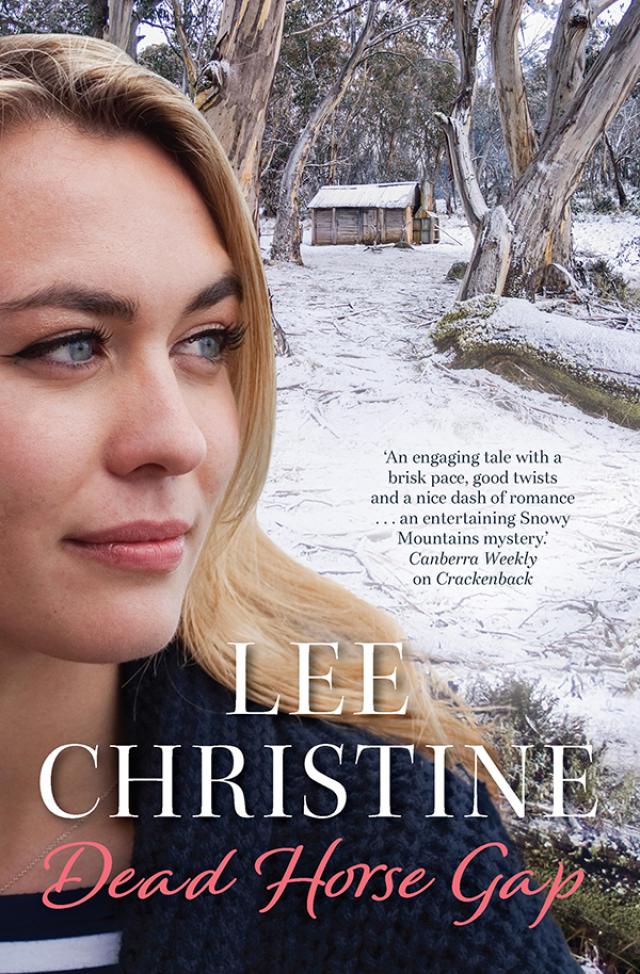
Cover photo: Mike Edmondson (Cascade Hut); Getty Images / Kathrin Ziegler (model)
For Honey, who never tires of hearing my story read aloud many times over, and who demands only treats and daily walks in return.
Contents
Prologue
One
Two
Three
Four
Five
Six
Seven
Eight
Nine
Ten
Eleven
Twelve
Thirteen
Fourteen
Fifteen
Sixteen
Seventeen
Eighteen
Nineteen
Twenty
Twenty-one
Twenty-two
Twenty-three
Twenty-four
Twenty-five
Twenty-six
Twenty-seven
Twenty-eight
Twenty-nine
Thirty
Thirty-one
Thirty-two
Thirty-three
Thirty-four
Thirty-five
Thirty-six
Thirty-seven
Thirty-eight
Thirty-nine
Forty
Forty-one
Forty-two
Forty-three
Forty-four
Forty-five
Forty-six
Forty-seven
Forty-eight
Forty-nine
Fifty
Fifty-one
Fifty-two
Fifty-three
Acknowledgements
Prologue
They didn’t call him cowboy for nothing.
Most pilots would have aborted the landing on the tiny airstrip, unwilling to descend over the mountainous terrain in the dark, but he knew the runway was there, and he was confident he could make it. He should have landed hours ago, but a blizzard had forced him to fly around the weather. Now, long after darkness and aviation last light, the pilot made a bumpy approach into Khancoban Airport in the Snowy Mountains. He was accustomed to night flying thanks to years of crop-dusting after dark, and he had confidence in his Cessna. He had checked it prior to departure, checked he had enough go-juice, checked that he himself was fit to fly.
Fierce gusts buffeted the light plane as he worked the throttle, controlling his descent. Focused on his instruments, his mind totally in the cockpit, he checked the plane was straight and level, checked his airspeed was good, checked his altitude and GPS track. He looked up, scanning the darkness for the visual cues he needed to put the light plane safely on the ground. The clouds parted, and in the momentary wash of moonlight he glimpsed the three-kilometre stretch of water he’d been searching for. He closed the throttle, raised the nose and extended the undercarriage, slowing the Cessna before it dropped into the bank of fog hovering over the Khancoban pondage. He switched on his landing lights. Two bright beams appeared on each wingtip.
Tension gathered at the top of his spine. In the reflection of his landing lights, he could see the strands of fog becoming thinner.
Now. Any moment now.
The pilot let out a triumphant whoop. He was over the water, flying at a slow 70 knots and one minute away from landing. He chose full flap before opening the throttle to maintain his approach as the flaps ran to position. The airstrip was short and devoid of runway lights, but it was there, waiting in the darkness, just on the other side of the concrete spillway.
Five seconds to landing, and the pilot glimpsed the turbulent water below, gushing from the spillway and flowing into the Swampy Plain River. Then he was touching down, applying the brakes as soon as the wheels struck solid ground.
Euphoria raced through his body but it was immediately replaced by horror at a looming shape blocking the runway. Unable to stop in time, he wrenched the plane to the left, hoping to ground loop whatever it was. Time slowed. The plane careered to the left, a tyre exploding like a bomb. Above the blood pounding in his ears, he heard the grating, tearing sound of metal as the right wing clipped the tractor and was torn from the plane. The engine hit the ground, flinging fuel across the airstrip and sending the control column slamming into the pilot’s chest. With the breath punched out of him, he groped for the Cessna’s door handle, sparks spraying like fireworks all around him.
One
Detective Constable Mitchell Flowers had never been a fan of light planes. As a passenger, he worried about the single engine failing, or the lone pilot suffering a medical emergency. But as he walked across the part-asphalt part-grass runway of Khancoban Airport, it was clear that neither of those things were responsible for this accident. The burnt-out tractor with a slasher on the back in the middle of the airstrip was quite obviously the culprit.
It was 6.45am and first light in the Snowy Mountains in New South Wales, two degrees above zero, minus six with the wind chill. Flowers had woken with a dull headache brought on by too many hours in front of a computer screen and too few hours’ sleep. Negotiating the snowy hairpin bends along the Alpine Way had intensified the headache into a painful throb on the left side of his skull. He reached into his coat pocket for a tab of anti-inflammatory tablets, popped out two and swallowed them dry.
As he neared the wreckage, a uniformed officer straightened up from where he’d been taking photographs of a landing wheel that had rolled some distance away. Bald and heavy-set, he had the kind of bushy moustache blokes his age had grown in the seventies and never shaved off.
‘Sergeant Walt Collins, Khancoban Police,’ the officer said, hitching up his pants by the belt.
Flowers held up his ID. ‘Detective Constable Mitchell Flowers, Sydney Homicide.’
‘Sydney?’
Here we go, thought Flowers, not missing the officer’s unimpressed expression at a wet-behind-the-ears detective with a full head of hair homing in on his turf.
‘That’s right.’
‘I asked for the Queanbeyan boys.’
‘I was in Queanbeyan for a court case,’ Flowers replied, careful not to sound defensi
ve.
It had just gone midnight last night when Inspector Gray had called his mobile and told him to get himself to Khancoban. A plane has crashed on the Snowy Hydro airstrip. Possible sabotage according to early reports. The pilot’s dead.
Sergeant Collins looked past Flowers to the gravel road where a small group of onlookers had gathered outside the locked gate. ‘So, you’re it?’ he asked.
Deal with it, Flowers wanted to say. Instead, he answered calmly, ‘My partner will be here soon.’ How soon that would be Flowers had no idea, so he took out his notepad and pen and asked, ‘So, what happened here?’
Sergeant Collins gave a heavy sigh and gazed at the two blackened vehicles roped off with police tape. ‘The plane came in late last night. The airport manager heard it and raced down here. He did his best but there was nothing he could do. Fire and Rescue put out the blaze.’
Flowers followed the sergeant’s gaze. A fire truck was parked on the other side of the airfield, its two crew members on watch.
‘What state is the body in?’
Sergeant Collins shook his head slowly, his eyes grave. ‘Burned to a crisp.’
Flowers jotted down shorthand in his notebook. Just his luck he was on his own at his first plane crash, and one where foul play was suspected. He shivered inside his heavy-duty police jacket and wondered what Detective Sergeant Ryder would do if he were here. No doubt his more experienced partner had attended multiple plane crashes in the past. He’d done everything else.
Flowers glanced back towards the burnt-out vehicles. ‘Why was the tractor on the runway?’
Collins spread his hands. ‘Nobody seems to know.’
‘Who had access to it?’
‘Only the bloke who does the mowing, apparently.’
Flowers nodded. ‘I’ll figure out what other resources we’ll need to bring in, and I’ll get in touch with the Coroner’s office.’ Beyond the wreckage, several large pieces of jagged metal and other general debris were scattered across the grass, torn from the aircraft before it had been engulfed in flames. ‘Do we know who the pilot is—was?’
‘We’re pretty sure it’s Art Lorrimer. The wreckage is consistent with a Cessna 210, which he flies. He was due to land here yesterday, but the weather turned bad.’
‘Is he local?’
‘Not to Khancoban,’ Collins said. ‘The family have a grazing property down Tooma way, White Winter Station.’
‘Have they been notified?’
‘Not as yet.’
Flowers looked at the growing number of people gathering at the gate. A sign bearing the Snowy Hydro logo warned: Khancoban Airport, No Entry, Authorised Personnel Only.
‘Was anyone waiting here for him to land last night?’
‘Not to my knowledge.’
‘How long does it take to walk into the town? Five minutes?’
‘If that.’
‘So, maybe he wasn’t getting picked up, maybe he intended on walking into town. I’ll make some enquiries, see if he booked a room anywhere.’ Flowers pocketed his notepad and pen, the acrid smell of burnt rubber and aviation fuel surrounding the wreckage turning his stomach. ‘I’d better take a look at the body,’ he said, glad he’d decided to skip breakfast.
With Sergeant Collins close behind, Flowers ducked under the police tape, the stench poisoning the otherwise pristine breeze blowing off the pondage on the other side of the spillway. As they moved carefully towards the burnt-out vehicles, it became clear from the angle of the plane that the pilot had attempted to turn away from the tractor. The right wing had detached from the fuselage while the undercarriage looked to have been ripped out, possibly from colliding with the tractor’s slasher. But that would be for the Australian Transport Safety Bureau to work out.
‘You have photographs of all this?’ Flowers asked, burnt grass crackling under his boots.
‘Yep.’
As they drew closer to the plane, Flowers held up a hand for Collins to stop. He could already make out the charred skull and torso from where they stood and, to his mind, there was no doubt how the pilot had died. ‘We need to leave this to forensics,’ he said, turning away from the grisly scene. ‘We touch any part of that and it could crumble to black ash.’
As they walked back towards a large, corrugated-iron shed, the lone building gracing the airport, Flowers phoned Harriet Ono in Canberra. She was Ryder’s most trusted forensic pathologist.
‘Boy Wonder!’ Harriet’s voice reverberated in his ear. ‘Why are you calling me?’
Flowers winced at the nickname she’d bestowed on him when he’d first been partnered with Ryder. ‘Shouldn’t you be in an autopsy or something? I was getting ready to leave a message.’
‘I couldn’t resist answering when I saw it was you. What’s up?’
Flowers gave her a rundown of the situation. ‘I need a team up here real fast. Can you do it?’ He watched as Sergeant Collins headed into the shed. Both roller doors were open and two men were sitting at a table inside, deep in conversation. ‘I think a rep from the Transport Safety Bureau could be here already.’
‘Probably, they’re based in Canberra as well. What’s the weather like?’
Flowers surveyed the sky. ‘Fine, partly cloudy with a light breeze coming from the south—’
‘Righto, smart-arse. Listen up, the local police or emergency services can cover the crash site if there’s strong wind or rain threatening. That’s it, until the body is removed. I don’t want anyone contaminating my crime scene.’
‘So I’ll take that as a yes?’
‘Of course it’s a yes,’ she said irritably. ‘Where’s Ryder? Is he okay?’
‘Fine. Busy juggling court appearances and a whole bunch of other stuff. I’ll tell him you were worried though. Thanks, Harriet, see you when you get here.’ He hung up before she could give an outraged reply. Hiding an amused smile, Flowers went to join the others, relieved that the crime scene would soon be in the hands of one of the best police pathologists in the business.
The shed was part office, part rec room and part hangar. A yellow plane, hardly bigger than a toy, was parked at the far end. Flowers sat down at the table and Sergeant Collins made the introductions. Zane Alam from the Transport Safety Bureau was slightly built with shiny black hair. By contrast, Benjamin Hoff, the airport manager, was blond and lanky and dressed in pilot’s white.
No chance of mixing these two up, thought Flowers, despite their identical aviator sunglasses. Taking out his notepad again, he spoke to Ben Hoff first.
‘Why was the tractor parked in the middle of the runway?’
‘I have no idea. When I left, it was parked beside the shed, like it always is.’ Hoff’s reddened eyes shifted to the blackened scar on the airstrip. ‘It’s never left on the runway—for obvious reasons.’
Flowers turned to Zane Alam. ‘Do you think the pilot made an emergency landing?’ Despite the tractor and slasher, it seemed an obvious question to ask.
‘That will all come out in our investigation,’ Alam said. ‘From initial reports, and these are purely anecdotal, Detective, the pilot may well have landed safely if it weren’t for the tractor. Several members of the community heard the plane come in, as did Ben. No one reported hearing engine failure.
Flowers noted this down, nodding for him to continue.
‘The pilot wouldn’t have seen the tractor until after he’d touched down,’ Alam went on. ‘This airstrip doesn’t have runway lights that can be switched on remotely from the plane. If it had, they might have given him a slightly better chance of seeing the tractor sooner and taking evasive action.’
Flowers frowned. ‘Pilots can turn on runway lights?’
Alam nodded. ‘Not all airports are big enough to have control towers, but some do have runway lights. The pilot tunes in to a particular radio frequency that allows him to switch them on. This pilot would have approached slowly because of the short runway and lack of lighting. When he touched down, he’d have lost too much speed to get the plane back in the air, but he’d still be travelling too fast to avoid a collision. Everything would have happened in seconds.’
Silence fell over the group. Flowers stared at the grey tabletop and tried to imagine the pilot’s panic when he realised the runway was blocked. ‘Where are the keys to the tractor kept?’ he asked after a while.