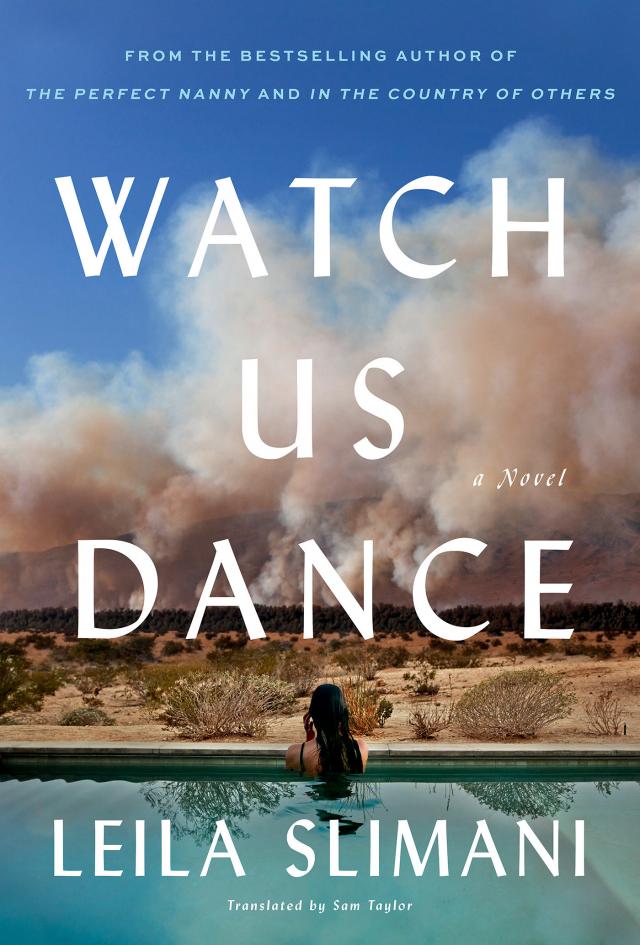
Watch us dance, p.27
Watch Us Dance,
p.27


Amine knows how this will end. Once the property deeds have been handed out, they will rise in unison and swarm like grasshoppers over the buffet of couscous and grilled meat. Having no desire to see this, he steps along the top of the wall like a tightrope walker before jumping off the other side. He passes the rows of mandarin trees and sees the bright-orange fruit shining in the cold winter sunlight. It promises to be a good harvest. He should be happy: tomorrow there will be even more money, more success, more power. Of course, anything can happen. Frost, a storm, parasites that take over the plants and reduce his work to nothing. The farmer is always in God’s hands. This is what he repeats to Mathilde, but she does not understand. She says he looks ill. That he should see a doctor. That his insomnia is taking a toll on his health. She has even insinuated that he is crazy, paranoid, as his brother Jalil used to be.
Outside the door of the farmhouse some peasant women are waiting, their heads and shoulders protected by large woolen blankets. Some of them are holding sugarloaves or young rabbits, which they will offer to Mathilde in exchange for her knowledge. In the courtyard the tablecloths have dried and it is easier to make out the colors in the dresses of the young Alsatian girls, the bright-yellow beaks of the geese. Amine goes over to the peasant women. Intimidated by the master’s presence, they pull the blankets a little lower over their faces, speak in quieter voices, pat their babies’ backs to stop them from whining. The women move away from the door to let him pass, but Amine does not go inside. No, he just stands there, motionless, frozen, his feet rooted to the ground as if he has no intention of ever leaving. The women look at one another but say nothing. What is wrong with him? Why is he acting like this? Is he sick too? His eyes are red from lack of sleep and his hands shake slightly. Amine presses his forehead to the glass door. He watches Mathilde, who is sitting on a chair, slowly bandaging a young man’s calf. She looks up at him and a smile illuminates her face. She jumps to her feet so quickly that the patient cries out in pain. Amine sees her coming toward him and he thinks she is capable, with that smile, with that boyish gait, of bringing him back to reason. And his lips articulate: “Home.” Mathilde comes out into the courtyard and a woman rushes over to offer her blanket, but Mathilde waves her away. “I’m not cold,” she says, taking her husband’s frozen hands in her own. “Mehdi called. Our granddaughter was born this morning.” Later the women in the douar will describe how they saw Amine draw his wife close to him, so close that the peasant women thought he was holding on to her to stop himself from falling. And there, under the high palm trees, they began swaying from foot to foot, despite the icy December wind, despite the whispers of the incredulous watching women. They danced, and some of the spectators claimed that they could see tears rolling down the master’s face and that they heard Mathilde say in Arabic: “You are happy, aren’t you?”
Acknowledgments
This book owes its existence to the precious testimonies of people who lived through this period of history in Morocco or who studied it. They were a great help to me. Thank you to Zakya Daoud for her generosity, her sense of humor, her frankness and open-mindedness. Thank you to Kenza Sefrioui for her precious advice, and to Driss el-Yazami for his unfailing humanity and integrity. All my gratitude goes to Tahar Ben Jelloun, who is forever teaching me about my history. I owe a great deal to Mohamed Tozy, who has been enlightening me for years, enabling me, through his colossal work, to better understand my country. Hamid Barrada, my eternal friend, was once again an exceptional source of aid, as was Perla Servan-Schreiber, who agreed to travel back into the past for me. And so too was Pierre Vermeren, my former teacher. Thank you to Dominic Rousseau, who has written about the hippies in Morocco and who very generously agreed to enlighten me on that surprising period in Essaouira. I must also thank Françoise Autin for her affection and for the methodical research she carried out on my behalf. Fatna El Bouih, for whom I feel great admiration, kindly agreed to answer my questions. Thank you to Souad Balafrej for her trust and friendship. I would like to thank my father’s friends who came forward while I was writing this book and who, with great modesty and tenderness, recounted their youthful years in his company. I would also like to pay tribute here to all those who had the courage to testify to the Equity and Reconciliation Commission about crimes committed during the Years of Lead in Morocco. The report that emerged from the commission was a priceless source for me, and those who helped compile it have all my admiration.
About the Author
Leila Slimani is the bestselling author of The Perfect Nanny, one of The New York Times Book Review’s 10 Best Books of 2018, for which she became the first Moroccan woman to win France’s most prestigious literary prize, the Goncourt. Her other books include Adèle, Sex and Lies, and the #1 international bestsellers In the Country of Others and Watch Us Dance, which are the first and second parts of a trilogy of novels based on her family’s roots in revolutionary Morocco. Slimani is French president Emmanuel Macron’s personal representative for the promotion of the French language and culture, and is the chair of the jury for the 2023 International Booker Prize. She was ranked #2 on Vanity Fair France’s annual list of the Fifty Most Influential French People in the World. Born in Rabat, Morocco, in 1981, she divides her time between France and Portugal.
Sam Taylor is the award-winning translator of more than sixty books from French, including all of Leila Slimani’s fiction.
What’s next on
your reading list?
Discover your next
great read!
Get personalized book picks and up-to-date news about this author.
Sign up now.
_143817171_
Leila Slimani, Watch Us Dance