The bright sword, p.1
The Bright Sword,
p.1


Also by Lev Grossman
Warp
Codex
The Magicians
The Magician King
The Magician’s Land
The Silver Arrow
The Golden Swift
VIKING
An imprint of Penguin Random House LLC
penguinrandomhouse.com
Copyright © 2024 by Cozy Horse Limited
Penguin Random House supports copyright. Copyright fuels creativity, encourages diverse voices, promotes free speech, and creates a vibrant culture. Thank you for buying an authorized edition of this book and for complying with copyright laws by not reproducing, scanning, or distributing any part of it in any form without permission. You are supporting writers and allowing Penguin Random House to continue to publish books for every reader.
Interior illustrations on this page, this page, this page, this page by Wesley Allsbrook
Library of Congress Cataloging-in-Publication Data
Names: Grossman, Lev, author.
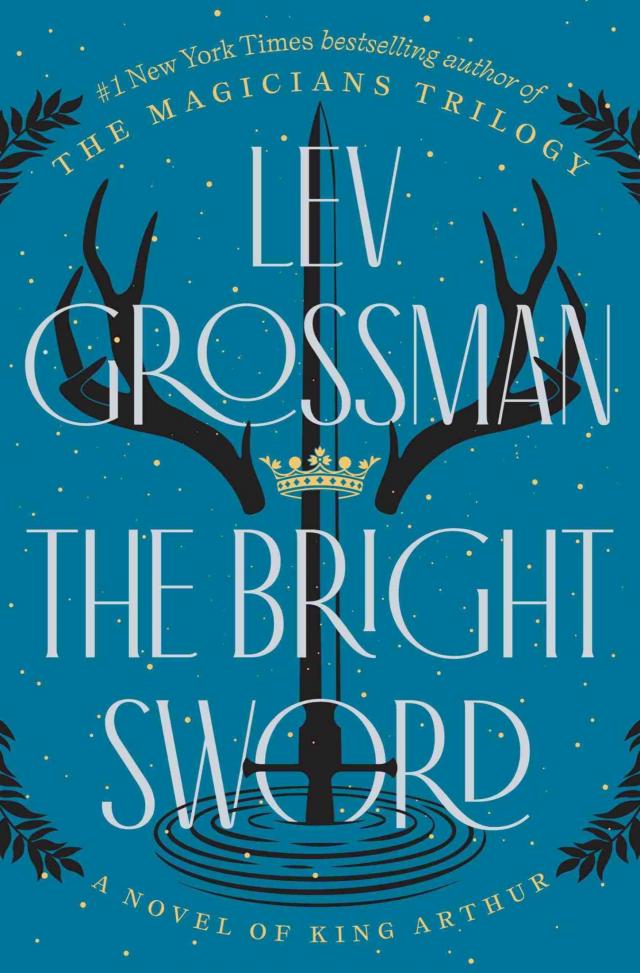
Title: The bright sword : a novel of King Arthur / Lev Grossman.
Description: [New York] : Viking, 2024.
Identifiers: LCCN 2023030353 (print) | LCCN 2023030354 (ebook) | ISBN 9780735224049 (hardcover) | ISBN 9780735224056 (ebook) | ISBN 9780593833568 (international edition)
Subjects: LCSH: Arthur, King—Fiction. | Knights and knighthood—Great Britain—Fiction. | Great Britain—History—To 1066—Fiction. | LCGFT: Historical fiction. | Novels.
Classification: LCC PS3557.R6725 B75 2024 (print) | LCC PS3557.R6725 (ebook) | DDC 813/.54—dc23/eng/20231016
LC record available at https://lccn.loc.gov/2023030353
LC ebook record available at https://lccn.loc.gov/2023030354
Ebook ISBN7 9780735224056
Cover design: Elizabeth Yaffe
Cover images: Shutterstock
Designed by Nerylsa Dijol, adapted for ebook by Cora Wigen
This is a work of fiction. Names, characters, places, and incidents either are the product of the author’s imagination or are used fictitiously, and any resemblance to actual persons, living or dead, businesses, companies, events, or locales is entirely coincidental.
pid_prh_7.0_147498684_c0_r0
Contents
Dedication
Epigraph
Book I: A War of Wonders
Chapter One: Azure, Three Scepters, a Chevron Or
Chapter Two: Roman Roads
Chapter Three: A Yong Knight
Chapter Four: Camelot
Chapter Five: The Tale of Sir Bedivere
Chapter Six: The Tale of Sir Bedivere, Part II
Chapter Seven: The Last Battle
Chapter Eight: The Tale of Sir Bedivere, Part III
Chapter Nine: The Green Knight
Chapter Ten: A New Sword
Chapter Eleven: The Tale of Sir Palomides
Book II: A God of Sand and Dust
Chapter Twelve: The Novice
Chapter Thirteen: The Tale of Sir Palomides, Part II
Chapter Fourteen: The Well of Ink
Chapter Fifteen: The Glass Castle
Chapter Sixteen: The Battle of Camelot
Chapter Seventeen: The Tale of Sir Dinadan
Chapter Eighteen: A Silver Shilling
Chapter Nineteen: The Lion in the Desert
Chapter Twenty: The Twisted Staff
Chapter Twenty-One: The Tale of Sir Dagonet and Sir Constantine; Or, the Quest for the Holy Grail; Or, the Very Last Adventure
Chapter Twenty-Two: The Tale of Sir Dagonet and Sir Constantine, Part II
Chapter Twenty-Three: The Tale of Sir Dagonet and Sir Constantine, Part III
Book III: The Blind Giant
Chapter Twenty-Four: The Indigo Knight
Chapter Twenty-Five: Miracles
Chapter Twenty-Six: The Waste Land
Chapter Twenty-Seven: The Barrow
Chapter Twenty-Eight: The Tale of Nimue
Chapter Twenty-Nine: The Wild Hunt
Chapter Thirty: The Spear
Chapter Thirty-One: The Tale of Sir Scipio
Book IV: The Saxon Shore
Chapter Thirty-Two: Galahad
Chapter Thirty-Three: The Queen
Chapter Thirty-Four: The King’s Dream
Chapter Thirty-Five: The Lady of the Lake
Chapter Thirty-Six: The Night Office
Chapter Thirty-Seven: Lancelot
Chapter Thirty-Eight: Three Witches
Chapter Thirty-Nine: Angle-Land
Chapter Forty: A Bright World
Historical Note
About the Author
_147498684_
For my family: Sophie, Ross, Hally, and Baz
anoeth bid bet y Arthur
a hidden thing is the grave of Arthur
—“The Stanzas of the Graves,” from The Black Book of Carmarthen
Book I
A War of Wonders
Strange women lying in ponds distributing swords is no basis for a system of government.
—Monty Python and the Holy Grail
One
Azure, Three Scepters, a Chevron Or
Collum punched the other knight in the face with the pommel of his sword gripped in his gauntleted fist, so hard the dark inlaid metal dimpled under his knuckles, but his opponent showed absolutely no sign of falling over or surrendering to him. He swore under his breath and followed it up with a kick to the ankle but missed and almost fell down, and the other knight spun gracefully and clouted him smartly in the head so his ears rang. He would’ve given a thousand pounds to be able to wipe the sweat out of his eyes, not that he had a thousand pounds. He had exactly three shillings and two silver pennies to his name.
The two men backed off and circled each other, big swords held up at stiff angles, shifting from guard to guard, heavy shards of bright sunlight glancing and glaring off the blades. They’d dropped their shields after the tilt to have both hands free. No mistakes now, Collum thought. Circles not lines, Marshal Aucassin whispered in his mind. Watch the body not the blade. He threw a diagonal cut that glanced harmlessly off the other knight’s shoulder. The inside of his helmet was a furnace, sharp smells of hay and sweat and raw leather. He’d come here to test himself against the flower of British chivalry, the greatest knights in the world, and by God he was getting what he came for. He was getting the stuffing beaten out of him.
They stepped lightly, testing, offering, up on the balls of their feet. Every tiny movement made their armor squeak and clank and jingle in the quiet of the meadow; even the tips of their swords made tiny whips in the stifling air. Why—why had he thought this was a good idea? Why hadn’t he stayed back on Mull? Heatstroke prickled at the back of Collum’s neck. They weren’t fighting to the death, but if he lost he’d lose his horse, and his armor, which he hadn’t gone through all the trouble of stealing it from Lord Alasdair just so he could hand it over to some nameless knight who probably had half a dozen spares waiting for him back at his cozy castle.
And without his horse and armor Collum was nobody and nothing. An orphan and a bastard, poor as a church mouse and very far from home. And he could never go back. He’d made damn sure of that, hadn’t he?
He didn’t even know who he was fighting; he’d stumbled on this man purely by chance, or possibly by God’s will—thanks a bunch, as always—sitting under a crooked ash in a meadow, head in his hands, as if the weight of the sunlight itself were too much for him. He’d looked up and shouted a challenge at Collum, and who did that anymore? It was like something out of the stories. Whoever this was, he was a knight of the old school.
His armor was old-fashioned, too, the breastplate black steel damascened with a pattern of fine silver whorls and a rose at the center. A rich man’s armor. A nobleman’s. His helmet had a pointy snout like a beak, and like Collum he bore the vergescu, the plain white shield of an unfledged knight. Collum bore it because he was not technically—as he’d tried to explain—a knight at all, not yet, he hadn’t sworn the vows, but there were other reasons to bear the vergescu, like to hide your identity if you were in disgrace. Or Sir Lancelot bore it sometimes because otherwise no one would fight him.
This man was no Lancelot, but he was pretty damn good. Thoroughly fledged. Collum was taller but the mystery knight was faster—he barely saw him move when bang! his wrist went numb and ping! a tiny fastening pin sprang off his gauntlet and disappeared forever into the grass. He stepped neatly inside Collum’s reach and grabbed for his wrist with his off hand, and Collum skipped back, panting like a bellows, but he stumbled and the man jammed his blade in the gap where his gardbrace didn’t fit right, shaving off a sharp curl of bright steel.
He pressed his advantage, whipping a backhand strike at Collum’s head that just missed—
There it was. The knight let his follow-through pull him round just a little too far. He was tired, or he’d overcommitted, either way he couldn’t quite stop the stroke and it left him off-balance. Collum’s blood broke out in a martial chorus and with the last of his strength he barged ahead behind his gauntleted fist MANG! to the side of the knight’s helm, and twice more, MANG! MANG! Just like that he was through and into that other place, th
e one where he felt like a solid shining steel godling and nothing could stand against him, certainly not this soft, staggering wretch he saw before him! Collum regripped and delivered a clean, high, two-handed horizontal cut and the knight’s head snapped round and he sat down backward on the grass.
Sir Vergescu tried to raise his blade but only dropped it again, as though fairies had cursed it so it weighed a thousand pounds. Collum let himself bend over panting, hands on hips. Sweat stung his eyes and gathered and dripped under his chin. Had he won? Really won? The man just sat there. He’d won.
He dropped to one knee and pressed the top of his helm against the cross of his sword. Thanks be to almighty God in Heaven! Thank you God for giving me—your unworthy servant—this magnificent fucking victory! He’d fought a British knight in a British hayfield and he had won. He could keep his precious armor, for now at least. In the darkness of his helmet un-knightly tears prickled in his eyes. Somewhere inside him there was strength, the strength he’d always longed for but never quite believed in. Not really. Not truly.
Or was there? Was there not something about this victory that was just a little bit too easy? Collum pushed that unappealing idea away, sniffed, and hauled himself to his feet again.
“Well fought, sir,” he said. “Do you yield?” Collum thought in Gaelic, the language of the north, but for the occasion he used the courtliest, most correct, most Roman Latin he could muster.
The man didn’t answer. That beaky bird-helmet just gazed up at him, expressionless. It looked quizzical and a bit funny.
In fact, now that Collum had a second to take it in, the man’s appearance was stranger than he’d realized. Armor hid his face but in other ways it spoke volumes. That pretty silver rose on his chest had been scratched and scribbled over; somebody had taken a nail or a sharp rock to it. On top of the knight’s helm, where a lady’s favor might have been, a knotted hank of dry grass was tied instead.
There were streaks of rust on his mail undercoat where the armor plates overlapped and trapped the wet. Sir Vergescu’s cozy castle was far away, if he even had one. He must’ve been out on the road a long time. Maybe not so different from Collum after all.
He shook off his gauntlets and fumbled with his bare fingers at the buckles and catches at the back of his head and tore his helmet off and dropped it on the grass. The bright world blasted in on him from all sides, loud and acid-green. He rubbed his face vigorously with both hands. The hot summer air felt marvelously cool. The rush of victory was fading now, and the heat and hunger and thirst were coming back. His knees felt weak. He hadn’t eaten in two days.
He hoped the man wasn’t hurt. He’d actually been looking forward to having a chat with him. Breaking down the combat, talking some shop. Maybe he knew how things stood at Camelot. Maybe he even knew Sir Bleoberys of the Round Table.
“Well fought, sir,” Collum said. “Do you yield to me now?”
“Fuck your mother.”
The man’s voice was hoarse and weary. Somewhere a woodlark sang: loo-loo-loo-loo-loo tlooeet tlooeet tlooeet.
“Beg pardon?”
“Your mother.” His Latin was surprisingly refined. A lot better than Collum’s. “Fuck. Her.”
Maybe they weren’t going to be having that chat after all.
“That is ill said of you, sir.” Collum cleared his throat. “I ask again: Do you yield to me now?”
“Well, that all depends,” the man replied, “on whether or not you’ve fucked your mother yet.”
He was angry, obviously. It was embarrassing, losing to an unfledged knightling. God knows he, Collum, wouldn’t have wanted to lose to himself. But it wasn’t his idea to fight, was it?
Maybe he was hurt after all. Maybe he was in pain. Collum put out his hand to help him up, and the mystery knight held out his own—but then quick as a lizard he grabbed Collum’s wrist instead, and with his other hand he whipped something thin and dark out of a sheath at his waist—a misericord, a long, thin knife made for slipping between armor plates—and thrust it up at Collum’s groin.
Purely on instinct Collum twisted his hips and took the blow smartly on his steel skirt. He caught the man’s knife hand and for a heartbeat they strained against each other, trembling. The knight kicked Collum’s ankles out and rolled on top of him with all his weight, and Collum lost the knife hand—God’s blood!—and panicked and scrabbled and caught it again just in time to keep his throat from getting laid open.
He threw his other arm around the man’s shoulders, heaved with his hips, and rolled them back over.
“God’s nails, stop!” His voice cracked hysterically. “Just yield!”
Collum fumbled for his own knife and forced it through the slit in the knight’s helm. The knight trembled like a rabbit in a snare and clawed at Collum’s face and thrust wildly with his pelvis. Then he coughed once and went still.
The sound of insects was loud, like dry seeds rattling in a dry pod. Silent pillars of golden country sunlight were slowly burning the green timothy grass into hay.
The knight lay flat on the ground as if he’d fallen there from a great height.
Jesus. Collum scrambled to his feet, breathing hard. Shitting Jesus. Thou recreant knight. He’d never killed a man before. God have mercy on us both.
The man kicked once and then stopped moving forever. The only part of him that was exposed was that one fish-pale hand, the one he’d bared to go for his misericord. There were brown speckles on the back of it, some ropy blue veins. Sir Misericord had not been in his first youth.
And now he was dead. And for what? Nothing. A game, played for no one, in an empty field.
And to think that they were barely a day’s ride from Camelot, the sun that bathed all of Britain in the golden light of chivalry.
“God have mercy,” Collum whispered. An hour ago he’d been no one, then he was a hero, and now he was a murderer. He stood there for a long time, he didn’t know how long. A cloud passed in front of the sun. The two horses, his and the dead knight’s, watched him with long-lashed disinterest.
Then Collum knelt and with a shudder drew his knife out of the man’s eye socket. He walked over to where the fallen knight’s shield lay face down on the matted grass and turned it over with his toe. You could still make out the arms under a hasty coat of white paint: Azure, Three Scepters, a Chevron Or.
Two
Roman Roads
It was late afternoon. Collum rode on through a cool June rain, sitting bolt upright in the saddle, staring straight ahead into the misty distance. The drops stepped down from leaf to leaf through the trees overhead and strained ticklingly through his armor. Why didn’t he just yield? Collum was a problem solver by nature, but his mind could get no traction on this one. Or on this: What was a knight that skilled, that well armored, doing fighting and dying in the middle of nowhere? Against a nobody like him? Just a big boy with a sword, from a nowhere island at the edge of the world, green as grass and fresh as dew.
The low sky was like a tent the pale creamy gray of unwashed linen. The water was cool on his face, which burned where the dying knight had scratched it.
Death itself didn’t shock Collum. People were guttering candles, always on the brink of going out, from measles or pox or childbirth or a cough. They starved or shat themselves to death or were eaten by bears or wolves. But nobody should die the way that man had. The doorway from life into death was a perilous one, fraught with misadventure, and he’d stumbled through it naked and unprotected, with no friends or family around him, no priest to absolve and anoint him. Only his murderer for company.
Before Collum rode on he had buried him—he could do that much, though the dirt was packed with roots and stones and he had to use the dead man’s own sword to dig with, a fine, slim blade with a pommel shaped like a wheel, thereby ruining its edge. Then he laid the knight to rest under his crooked ash tree and hung his white shield over him on a crooked branch. Unlucky tree, ash. Any crops its shadow fell on would wither. Collum couldn’t bring himself to take the man’s fancy armor, he wasn’t going to strip his corpse like a scavenger, but he did have a silver medal on a thong round his neck with a curious device on it: a twisted rod of knotty wood like a crooked walking stick. The metal had an old look about it. Collum added it to his St. Christopher and St. Lawrence. You could never have too many medals.